A beach boardwalk is a raised or hardened pedestrian walkway built along an oceanfront or across beach sand dunes. It gives people a clearer walking route, helps organize beach access, and can protect fragile sand, vegetation, and habitat from repeated foot traffic.
The term can describe several different things. In a resort town, a beach boardwalk may be a wide public promenade lined with shops, benches, railings, ramps, bicycle lanes, and beach entrances. In a protected coastal park, it may be a short dune walkover or an elevated nature path that carries visitors across sensitive sand, marsh, or interdune habitat.
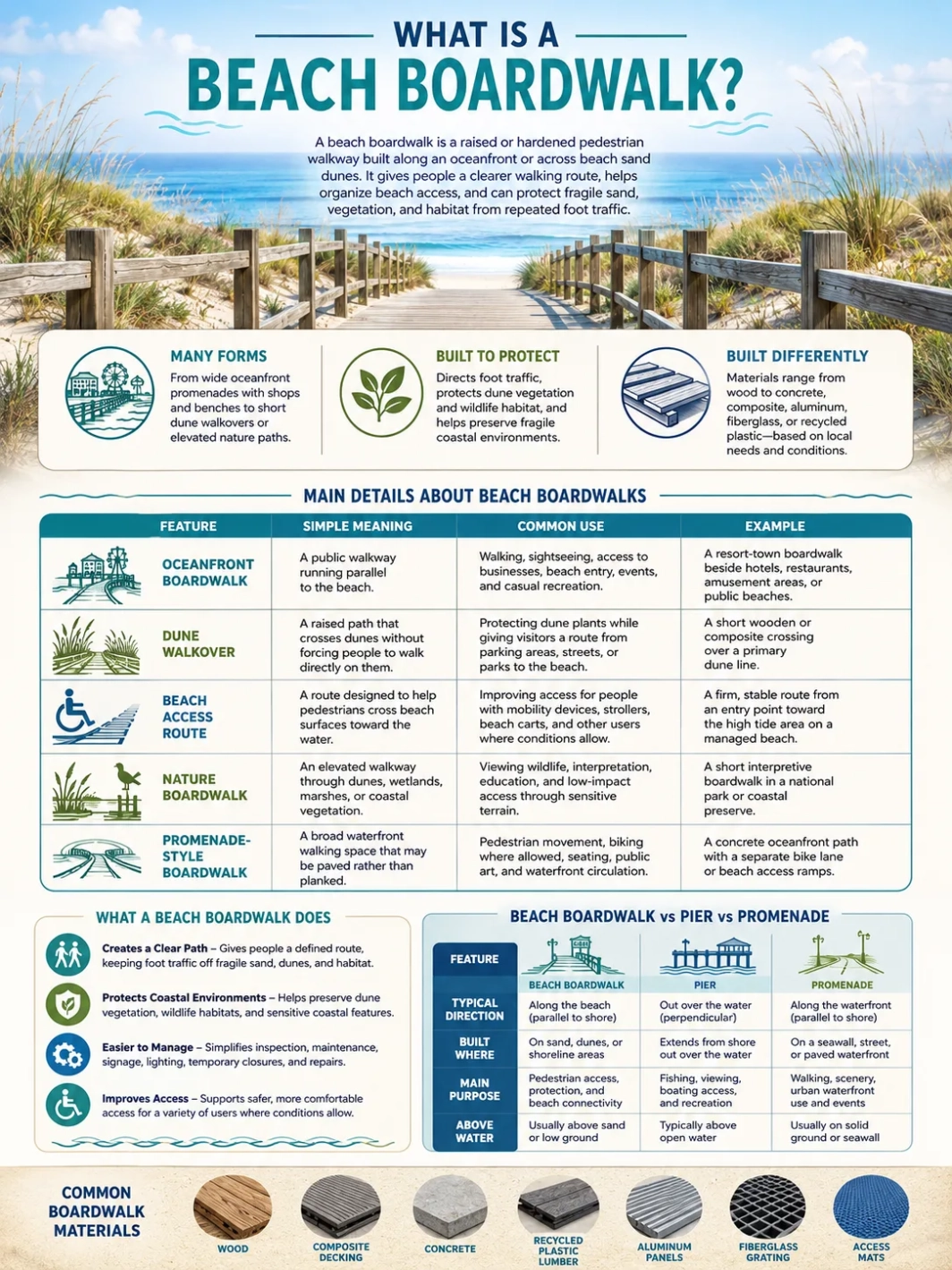
A beach boardwalk is not always made of wood. Older boardwalks often used timber planks, but modern coastal walkways may use concrete, composite decking, recycled plastic lumber, aluminum panels, fiberglass grating, or removable access mats. The right material depends on salt exposure, storms, maintenance capacity, accessibility goals, local rules, and the sensitivity of the beach environment.
Main Details About Beach Boardwalks
| Feature | Simple Meaning | Common Use | Example |
|---|---|---|---|
| Oceanfront Boardwalk | A public walkway running parallel to the beach. | Walking, sightseeing, access to businesses, beach entry, events, and casual recreation. | A resort-town boardwalk beside hotels, restaurants, amusement areas, or public beaches. |
| Dune Walkover | A raised path that crosses dunes without forcing people to walk directly on them. | Protecting dune plants while giving visitors a route from parking areas, streets, or parks to the beach. | A short wooden or composite crossing over a primary dune line. |
| Beach Access Route | A route designed to help pedestrians cross beach surfaces toward the water. | Improving access for people with mobility devices, strollers, beach carts, and other users where conditions allow. | A firm, stable route from an entry point toward the high tide area on a managed beach. |
| Nature Boardwalk | An elevated walkway through dunes, wetlands, marshes, or coastal vegetation. | Viewing wildlife, interpretation, education, and low-impact access through sensitive terrain. | A short interpretive boardwalk in a national park or coastal preserve. |
| Promenade-Style Boardwalk | A broad waterfront walking space that may be paved rather than planked. | Pedestrian movement, biking where allowed, seating, public art, and waterfront circulation. | A concrete oceanfront path with a separate bike lane or beach access ramps. |
What a Beach Boardwalk Does
A beach boardwalk solves a simple problem: beaches are beautiful places to visit, but sand, dunes, saltwater, wind, tides, vegetation, and heavy foot traffic make access difficult to manage. A boardwalk gives people a defined path instead of letting thousands of footsteps spread across the same fragile coastal surface.
On developed waterfronts, the boardwalk acts like a public street for pedestrians. It helps people move between hotels, restaurants, piers, lifeguard areas, restrooms, beach entrances, amusement zones, and transit stops without walking through soft sand. It can also separate walkers from bicycles or service vehicles when the design allows.
On protected beaches, the role is more environmental. Dunes are not just piles of sand; they are living coastal features shaped by wind and held together by vegetation. The National Park Service explains that dune vegetation helps trap windblown sand and stabilize dune complexes on barrier islands.[b] A boardwalk can direct visitors over or around those areas instead of through them.
Beach boardwalks also help land managers concentrate maintenance. A clear route is easier to inspect, repair, close temporarily, sign, light, and manage than informal paths that appear wherever people decide to walk. This is one reason boardwalks are common at beaches with dunes, marshes, nesting areas, storm exposure, or heavy seasonal crowds.
Beach Boardwalk vs Pier vs Promenade
Beach boardwalk, pier, and promenade are often used together in travel writing, but they are not the same structure. The differences matter because each one has a different relationship to the beach, the water, and public access.
| Feature | Beach Boardwalk | Pier | Promenade |
|---|---|---|---|
| Typical Direction | Usually runs along the beach or crosses dunes toward the beach. | Usually extends out over water. | Usually runs along a waterfront, beach, river, or urban edge. |
| Main Purpose | Beach access, walking, public circulation, dune protection, or recreation. | Fishing, sightseeing, docking, amusement, dining, or water access. | Walking, seating, civic space, waterfront movement, and public gathering. |
| Surface | Wood, composite, concrete, recycled plastic, metal, or other firm surfaces. | Wood, concrete, steel, or mixed structural materials. | Often concrete, stone, pavers, asphalt, or other paved surfaces. |
| Relationship to Sand | Often built on, above, beside, or across sand and dunes. | Usually begins at land and projects over water. | May be next to sand, but can also be fully urban or paved. |
| Best Use of the Term | Use when the walkway is directly connected to beach movement or coastal access. | Use when the structure projects into the ocean, bay, lake, or river. | Use when the space is a broad waterfront walking corridor, even if it has no wooden boards. |
Why Beach Boardwalks Became Common
Beach boardwalks became popular because they made sandy resort areas easier to use. The Atlantic City boardwalk is one of the best-known early examples in the United States. Atlantic County’s historical account says the first section opened along the New Jersey beach on June 26, 1870, and that the original temporary wooden walkway was intended to help keep sand out of railroad cars and hotels.[a]
That early purpose still explains many beach boardwalks today. Sand moves. Shoes carry it. Wind pushes it. Visitors need a firm route. Businesses and public buildings need cleaner access. Beach managers need predictable circulation. A boardwalk turns a shifting shoreline into a more usable public edge without removing the beach itself.
Over time, the beach boardwalk also became a social space. In many towns, it is where people stroll before sunset, reach the beach without using a car, sit on benches, watch the surf, visit seasonal businesses, or connect to nearby parks. In protected landscapes, the same basic idea becomes quieter: the boardwalk is a controlled path through a sensitive place.
Main Types of Beach Boardwalks
1. Resort and Oceanfront Boardwalks
These are the classic public boardwalks many people imagine first. They often run parallel to the beach and may connect hotels, restaurants, arcades, piers, shops, public restrooms, lifeguard stations, bike routes, and beach entrances. Some are wooden. Others are concrete promenades that still function like boardwalks because they serve the same waterfront role.
Resort boardwalks are usually designed for high foot traffic. Width, lighting, railings, access ramps, emergency access, cleaning, storm repairs, and seasonal crowd control all matter. Local rules often decide whether bicycles, scooters, pets, vendors, or special events are allowed.
2. Dune Walkovers
A dune walkover is a boardwalk-style path built over dunes or along designated beach crossings. Its main job is to keep people from cutting informal paths through dune vegetation. These structures may include stairs, ramps, handrails, landings, edge protection, and signs asking visitors to stay on the walkway.
Dune walkovers are common at beaches where dunes form a natural protective edge between the ocean and inland areas. Their height, width, foundation, and route can vary widely because dune shape, erosion patterns, storms, property boundaries, and environmental permits vary by location.
3. Beach Access Routes
A beach access route is a more specific accessibility term. The U.S. Access Board describes a beach access route as a continuous, unobstructed path that crosses the beach surface and gives pedestrians access to the water for beach, shoreline, or water-related activities.[d] Some are permanent; others are removable because storms, tides, erosion, or seasonal beach changes can damage fixed routes.
Not every beach boardwalk is a compliant beach access route. A scenic boardwalk might be wide and smooth but not reach the water. A dune walkover may protect vegetation but include stairs. A beach access route is judged by more specific technical criteria, and those criteria can vary depending on the managing agency and legal setting.
4. Nature and Interpretive Boardwalks
Nature boardwalks are often found in national parks, state parks, wildlife refuges, preserves, and coastal education areas. They may pass through dunes, marsh edges, mangroves, coastal forests, interdune flats, or wetlands. Their purpose is not only movement; it is also observation and learning.
Interpretive signs may explain plants, shorebirds, dune formation, tidal movement, habitat restoration, or local history. These boardwalks are often shorter than resort boardwalks, but they can be more sensitive to design because the walkway must reduce damage to the place it helps visitors see.
5. Storm-Replacement and Resilient Boardwalks
Coastal boardwalks are exposed to wind, salt, wave overwash, flooding, and storm debris. When damaged structures are rebuilt, managers may change materials, reduce footprints, strengthen foundations, or adjust routes. At Canaveral National Seashore, the National Park Service described beach boardwalks as critical for safe beach access while protecting the fragile dune system, and noted that replacement boardwalks were planned with sustainable materials and reduced maintenance needs after storm damage.[g]
Common Materials Used in Beach Boardwalks
There is no single best beach boardwalk material for every coast. A busy oceanfront promenade, a small dune crossing, and a remote nature preserve may need very different solutions. Salt air, moisture, sand abrasion, heat, flooding, fire rules, structural loads, maintenance budgets, and accessibility expectations all affect material choice.
| Material | Common Use | Strengths | Limits | Maintenance Level |
|---|---|---|---|---|
| Pressure-Treated Wood | Small beach crossings, older boardwalks, park paths, and traditional coastal walkways. | Familiar appearance, workable on site, widely understood by builders. | Can splinter, warp, rot, loosen, or require frequent inspection in coastal weather. | Often moderate to high, depending on exposure and traffic. |
| Hardwood | High-visibility boardwalks where a natural wood look is desired. | Dense, attractive, often long-wearing when specified correctly. | Cost, sourcing, fastening, heat, and sustainability questions must be considered carefully. | Moderate, with regular inspection and replacement of damaged boards. |
| Composite Decking | Public walkways, dune crossings, and replacement projects. | Can reduce some problems linked to rot and splinters. | Heat buildup, expansion, fastener systems, traction, and long-term field performance should be reviewed by project professionals. | Often lower than traditional wood, but not maintenance-free. |
| Recycled Plastic Lumber | Coastal access structures and public paths where rot resistance is useful. | Does not rot like wood and can support sustainability goals when properly specified. | Can flex, expand, heat up, or require special structural detailing. | Often lower, with regular inspection still needed. |
| Concrete | Urban oceanfront promenades, high-traffic boardwalks, ramps, and durable beach edges. | Durable, stable, familiar for accessibility and heavy public use. | Less traditional appearance, harder repairs in some settings, and site impacts during construction. | Often lower on the walking surface, but joints, settlement, drainage, and edges still need care. |
| Aluminum or Fiberglass Grating | Wetland, marsh, dune, or elevated access areas where drainage and light penetration may matter. | Allows water and sometimes light to pass through, can work in wet environments. | Texture, glare, heat, openings, traction, and comfort for canes, wheels, and pets must be evaluated. | Varies by product, corrosion exposure, and fastener system. |
Material choice should not be treated as a style decision alone. In coastal work, the walking surface is only one part of the system. Posts, piles, footings, connectors, fasteners, railings, edge protection, drainage, ramps, landings, and tie-ins to parking or street routes can affect how the boardwalk performs over time.
Accessibility Notes for Beach Boardwalks
A beach boardwalk can improve access, but “boardwalk” does not automatically mean “accessible.” Visitors may still encounter stairs, steep ramps, loose sand at the end of the route, narrow passing areas, raised plank edges, gaps between boards, missing handrails, soft parking surfaces, seasonal closures, or sand blown across the walkway.
For accessible trail design, the U.S. Forest Service accessibility guide explains that accessible trail clear tread is generally at least 36 inches wide, with exceptions where conditions prevent full compliance, and that passing spaces are needed when routes are narrower than 60 inches in certain settings.[e] Beach access routes can have different requirements, especially when the route crosses sand or dunes.
For visitors, the practical question is not only “Is there a boardwalk?” Better questions include: Is there step-free access from parking or the street? Is the surface firm and stable? Are there gaps or raised boards? Does the boardwalk reach the beach, the water, or only a viewpoint? Are beach wheelchairs available? Are there seasonal closures or storm repairs?
For designers and land managers, accessibility must be considered early. Local rules, federal or state ownership, coastal permits, dune protection, flood exposure, slope, drainage, and available space can all affect what is practical and legally required. This article gives general information, not engineering, legal, or code advice.
Safety Notes for Visitors
Beach boardwalks are usually easy to use, but coastal conditions change quickly. Rain can make walking surfaces slippery. Sand can cover low spots. Salt air can corrode hardware. Heat can make some surfaces uncomfortable. Storms can damage railings, stairs, ramps, and foundations. Visitors should follow posted signs and avoid closed sections.
The National Park Service advises visitors at Fire Island to stay on boardwalks because doing so helps protect native plants and animals, helps keep some vegetation-related hazards away from visitors, and protects the plants that hold fragile dunes together. The same page also warns that some boardwalks may be slippery after rain and recommends wearing shoes to avoid splinters and cuts from nails.[c]
- Stay on the marked route, especially near dunes, wetlands, nesting areas, or restoration zones.
- Respect temporary closures after storms, construction, flooding, or high surf.
- Watch for wet boards, sand patches, uneven planks, raised fasteners, and loose railing sections.
- Keep pets controlled where they are allowed, and check local beach rules before visiting.
- Use handrails on stairs and ramps, especially when the surface is wet or sandy.
- Do not climb over railings, cut across dunes, or walk under damaged elevated sections.
- Check the managing agency’s website for current hours, fees, beach rules, and seasonal restrictions.
Environmental Role of a Beach Boardwalk
A well-placed beach boardwalk can reduce the spread of informal trails. Informal trails are the narrow paths people create when they repeatedly walk through the same dune grass, marsh edge, or vegetated sand. Over time, those paths can widen, fragment habitat, and make erosion easier.
Boardwalks help concentrate foot traffic in a predictable corridor. That can protect dune vegetation, reduce trampling, guide visitors away from nesting or restoration areas, and keep people from wandering into places that are difficult to patrol or repair. In wetlands and marshes, raised boardwalks can also let visitors observe habitat without walking through standing water or soft organic soils.
A boardwalk can also create environmental problems if it is poorly planned. It may shade vegetation, interrupt natural sand movement, attract heavy crowds, require foundations in sensitive areas, or need repeated storm repairs. Good design looks at the full site: wind, water, sand movement, wildlife, plant communities, visitor demand, and long-term maintenance.
Design Features You May Notice
Beach boardwalks can look simple, but many small design choices affect how they feel and how well they work. A visitor may notice only the view, but the boardwalk’s width, surface, edges, railings, slope, and access points shape the entire experience.
| Design Feature | Why It Matters | Visitor Impact |
|---|---|---|
| Elevated Deck | Can cross dunes, marsh edges, uneven sand, or wet areas without placing the walking surface directly on the ground. | Creates a clearer route and may improve views, drainage, and habitat protection. |
| Firm Surface | Helps people walk, roll strollers, or use mobility devices more predictably than on soft sand. | Can make beach access easier, especially from parking or street edges. |
| Gaps Between Boards | Allow drainage and expansion, but large gaps can catch wheels, canes, crutch tips, or small objects. | A smoother surface is usually more comfortable and safer for more users. |
| Ramps and Landings | Provide step-free movement where grades can be managed. | Useful for wheelchairs, strollers, carts, older visitors, and anyone avoiding stairs. |
| Railings and Edge Protection | Help define the route and protect users near changes in height or sensitive areas. | Can improve comfort, especially for children, older visitors, and crowded conditions. |
| Shade and Seating | Coastal sun, wind, and heat can make even short routes tiring. | Benches, shade structures, and rest points improve comfort without changing the beach itself. |
| Interpretive Signs | Explain dunes, wildlife, history, safety rules, or restoration areas. | Turns a walking route into an educational stop. |
Real Examples of Beach and Coastal Boardwalks
Real boardwalks show how broad the term can be. Atlantic City represents the resort-boardwalk tradition: a public oceanfront walkway that became tied to tourism, hotels, rail access, and beach culture. Its early purpose was practical, but the boardwalk later became part of the city’s identity.
White Sands National Park shows a different use. The Interdune Boardwalk is a short elevated route through fragile dune terrain. The National Park Service describes it as a 0.4-mile round-trip boardwalk with interpretive panels, a shade structure, and accessibility information, while also warning visitors to stay on the trail to avoid damaging delicate biocrust.[f]
Canaveral National Seashore shows how coastal boardwalks may be rebuilt after storm damage. In that setting, the boardwalk is not mainly a commercial promenade. It is a beach access structure that must work with dunes, storms, maintenance needs, and sensitive habitat.
These examples explain why “beach boardwalk” is a flexible term. It can mean a lively public waterfront, a quiet dune crossing, an accessible beach route, or a nature trail. The shared idea is controlled pedestrian access in a coastal setting.
What Makes a Beach Boardwalk Good?
A good beach boardwalk is easy to understand. Visitors should quickly know where to enter, where the path goes, what rules apply, and whether the route fits their needs. Confusing access points, unclear closures, poor signs, and sudden surface changes make even a beautiful boardwalk harder to use.
A good beach boardwalk also fits its site. A wide concrete promenade may work well in a busy urban resort area. The same design could be too heavy or disruptive in a quiet dune preserve. A narrow elevated boardwalk may be perfect for a nature area but too limited for a high-traffic beach town.
- Clear purpose: The boardwalk should serve a defined need, such as beach access, public circulation, dune protection, interpretation, or all of these together.
- Readable route: Visitors should be able to follow the path without guessing or cutting across sensitive areas.
- Suitable surface: The surface should match expected users, weather, sand movement, and maintenance capacity.
- Access from the start: Parking, transit stops, sidewalks, ramps, and beach entries should connect logically.
- Environmental fit: The route should avoid unnecessary disturbance to dunes, wetlands, vegetation, and wildlife zones.
- Maintenance plan: Boards, fasteners, railings, ramps, lighting, drainage, and storm damage need regular inspection.
- Honest visitor information: Current closures, seasonal rules, fees, hours, and accessibility limitations should be posted by the managing agency.
Common Misunderstandings
A Boardwalk Does Not Have To Be Wooden
The word “boardwalk” comes from the idea of walking on boards, but many modern beach boardwalks use other surfaces. A concrete oceanfront promenade may still be called a boardwalk if it functions as the main public walkway along the beach.
A Boardwalk Is Not Always a Tourist Strip
Some beach boardwalks are busy commercial places. Others are quiet public access structures with no shops at all. A small dune crossing at a protected beach may be just as much a beach boardwalk as a famous resort walkway.
A Boardwalk Is Not Automatically Safe in All Conditions
Boardwalks are outdoor structures. Wet weather, storm damage, sand buildup, loose boards, heat, and heavy crowds can change conditions. Visitors should use posted information and follow the managing agency’s current guidance.
A Boardwalk Is Not the Same as Full Beach Accessibility
A boardwalk may be accessible for part of its route but still end at soft sand, stairs, or a viewpoint. Visitors who need step-free or mobility-device access should check official accessibility pages, parking information, route surfaces, and beach wheelchair availability before going.
Visitor Checklist Before Using a Beach Boardwalk
For a simple walk, a beach boardwalk usually needs little planning. For families, wheelchair users, older visitors, pet owners, or anyone visiting after storms or during high season, a few checks can prevent problems.
- Check the official park, city, or beach website for current closures, hours, parking changes, beach rules, and seasonal restrictions.
- Look for accessibility details, not just the word “boardwalk.” Confirm ramps, surface type, rest areas, beach wheelchair availability, and whether the route reaches the sand or water.
- Wear shoes or sandals with grip, especially on older wooden boardwalks or after rain.
- Bring water and sun protection. Shade can be limited, especially on dune walkovers and exposed oceanfront paths.
- Stay off dunes and restoration areas, even if they look stable.
- Use marked beach entrances instead of cutting across vegetation or fencing.
- Report broken boards, missing railings, raised fasteners, blocked ramps, or storm damage to the managing agency.
Frequently Asked Questions
What Is the Main Purpose of a Beach Boardwalk?
The main purpose is to provide a clear walking route along or across a beach area. Depending on the site, it may also protect dunes, improve accessibility, support tourism, guide visitors to beach entrances, or provide a public waterfront space.
Is a Beach Boardwalk Always Made of Wood?
No. Many older boardwalks used timber planks, but modern beach boardwalks may use concrete, composite decking, recycled plastic lumber, aluminum, fiberglass grating, or removable access surfaces.
What Is the Difference Between a Beach Boardwalk and a Pier?
A beach boardwalk usually runs along the beach or crosses dunes and sand. A pier usually extends out over the water. Some beach areas have both, but they serve different access and recreation purposes.
Are Beach Boardwalks Wheelchair Accessible?
Some are, but not all. Accessibility depends on surface firmness, width, slope, ramps, gaps, landings, railings, parking connections, and whether the route continues onto or across the sand. Always check the official managing agency’s current accessibility information.
Why Do Beaches Use Boardwalks Over Dunes?
Boardwalks over dunes help concentrate foot traffic in one controlled path. This can reduce trampling of dune vegetation, protect habitat, and limit the spread of informal trails through sensitive sand areas.
Can Beach Boardwalks Be Damaged by Storms?
Yes. Coastal boardwalks can be damaged by flooding, storm surge, wind, debris, erosion, and sand movement. After severe weather, visitors should follow closures and check official updates before using a boardwalk.
Resources Used
- [a] Atlantic County, New Jersey: Atlantic City’s First Boardwalk — June, 1870 — Used for the historical note about the early Atlantic City boardwalk and its original practical purpose. (County government page using historical material from the Library of Congress.)
- [b] National Park Service: Sand Dunes at Fire Island National Seashore — Used for dune vegetation, sand stabilization, and the environmental role of dunes. (Official U.S. National Park Service source.)
- [c] National Park Service: For Your Safety — Stay On Boardwalks — Used for visitor safety notes and the instruction to stay on boardwalks to protect dunes, native plants, and animals. (Official U.S. National Park Service visitor safety page.)
- [d] U.S. Access Board: Chapter 10 — Outdoor Developed Areas — Used for the definition and design context of beach access routes, including beach route surfaces and access concepts. (Official federal accessibility guidance.)
- [e] USDA Forest Service: Accessibility Guidebook for Outdoor Recreation and Trails — Clear Tread Width of Trails — Used for general accessible trail surface and clear tread width context. (Official USDA Forest Service technical publication.)
- [f] National Park Service: Hiking Interdune Boardwalk at White Sands National Park — Used as a real example of an accessible dune boardwalk with interpretive and visitor-use details. (Official U.S. National Park Service activity page.)
- [g] National Park Service: Canaveral National Seashore Boardwalk Replacement — Used for the example of storm-damaged beach boardwalks being replaced with more resilient designs while protecting dunes. (Official U.S. National Park Service release; archived page noted by NPS.)