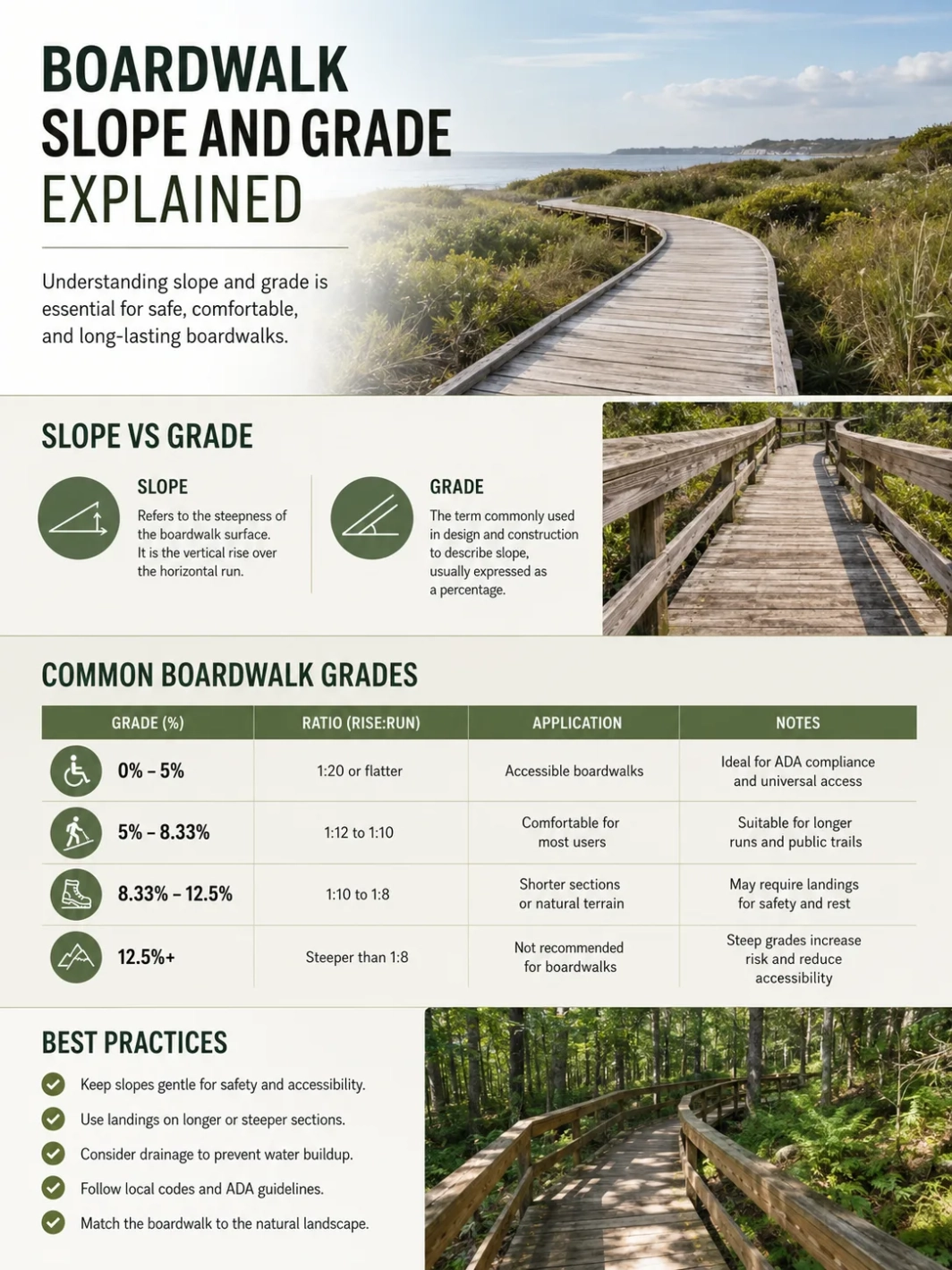
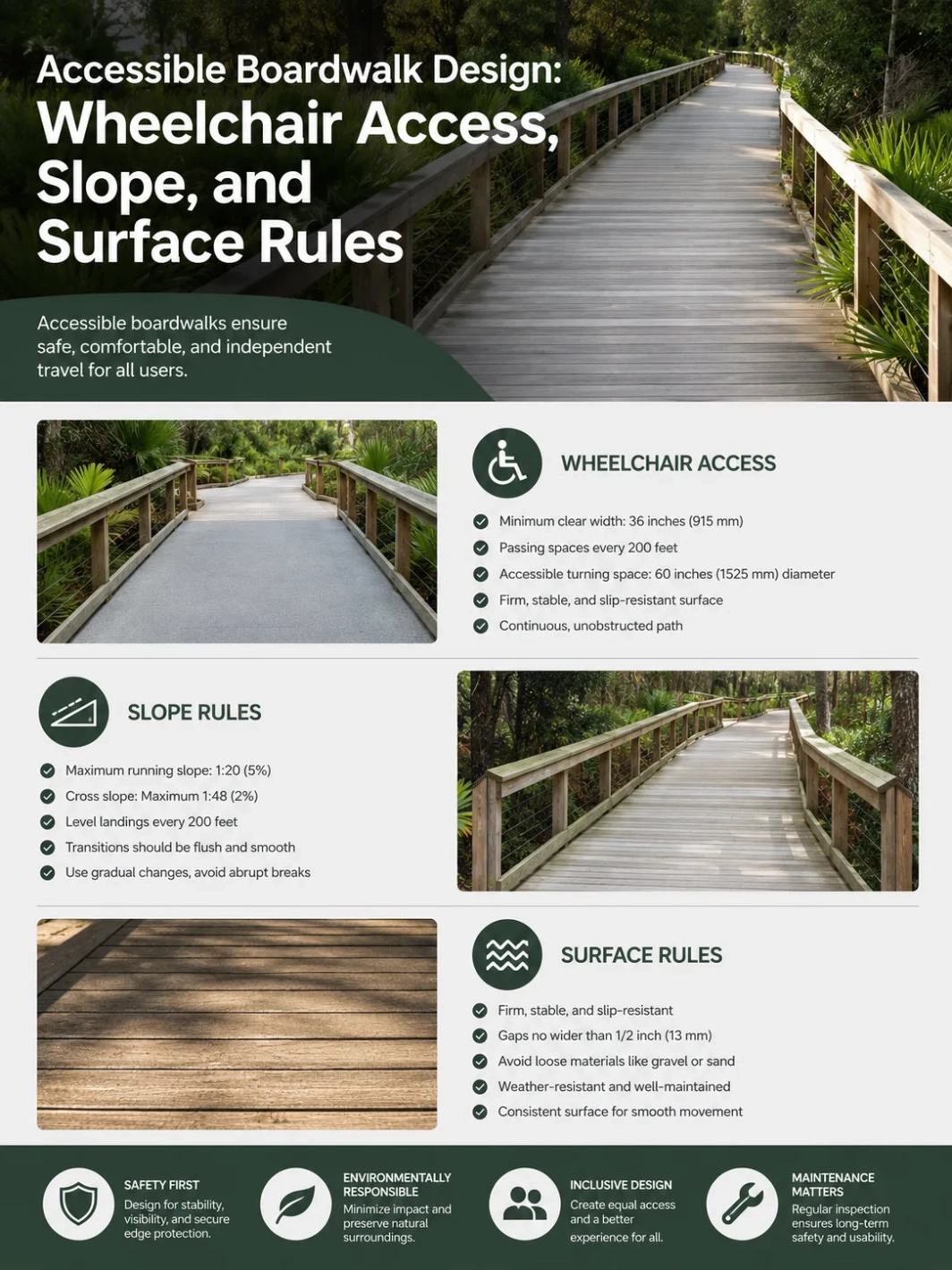
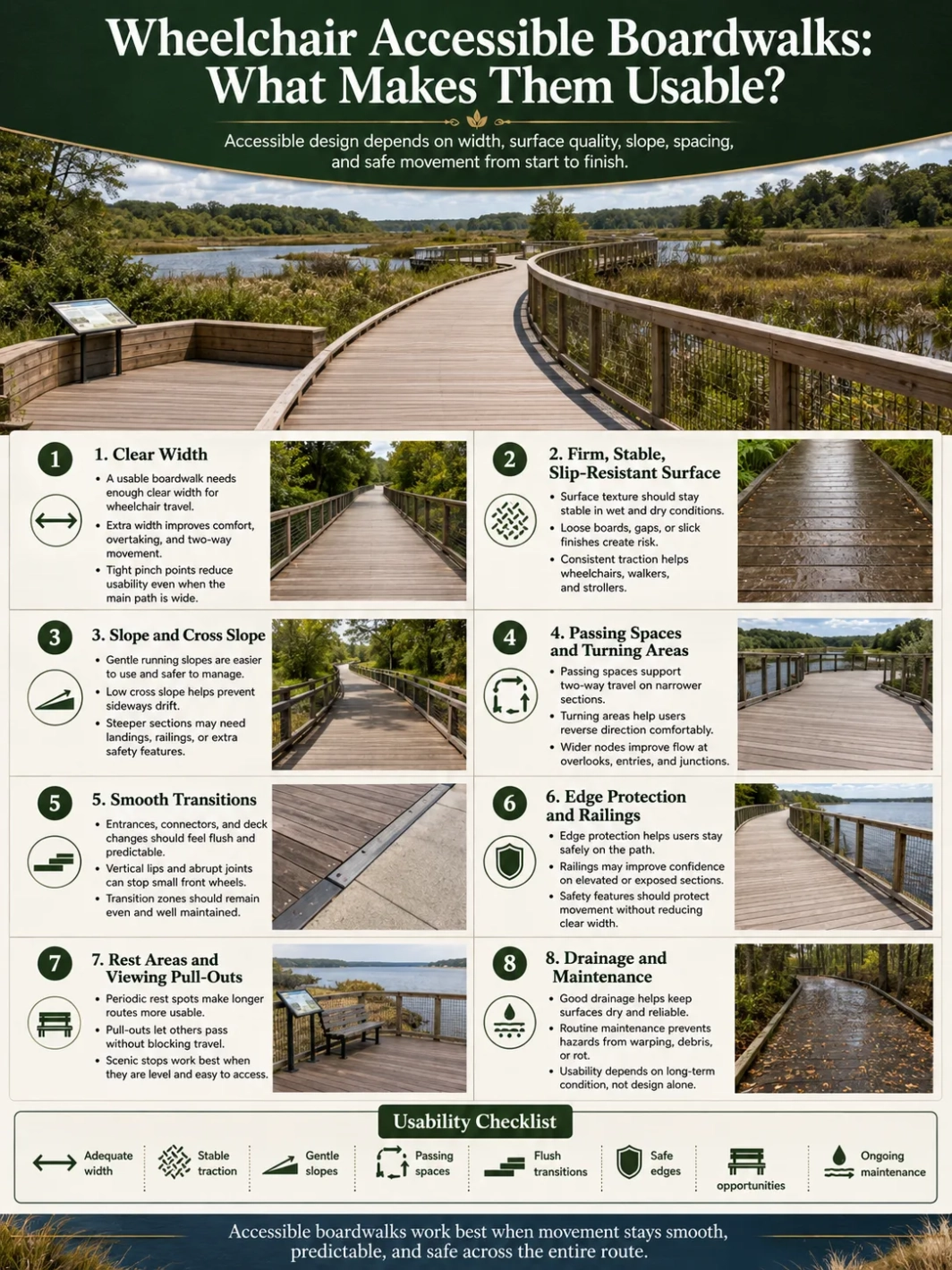
A wheelchair accessible boardwalk is usable when a visitor can enter it, move along it, pass or turn safely, rest when needed, and understand changing conditions before arriving. The most useful designs combine a firm surface, manageable slopes, enough clear width, safe plank gaps, edge awareness, and honest access information.
Main Details
| Design Feature | What Visitors Notice | Usability Value | Rule or Guidance Note |
|---|---|---|---|
| Firm, Stable Surface | Wheels do not sink, bounce, or stall on soft sections. | Allows more predictable movement for manual chairs, power chairs, walkers, and strollers. | Federal outdoor developed area guidance describes trail and access-route surfaces as firm and stable [a]. |
| Clear Travel Width | The usable path is not narrowed by rail posts, signs, benches, sand drift, or vegetation. | Reduces bottlenecks and allows steadier travel. | Federal trail guidance uses 36 inches as a minimum clear tread width, with wider spaces needed for passing. |
| Passing and Turning Space | Visitors can turn around or let another mobility device pass without backing long distances. | Especially useful on elevated wetland, dune, or overlook boardwalks. | Where trails are under 60 inches wide, passing spaces are part of federal trail guidance. |
| Small Plank Gaps | Front casters, cane tips, and crutch tips do not catch between boards. | Improves comfort and reduces abrupt stops. | Access Board guidance treats large board gaps as hazards and limits openings in relevant surfaces. |
| Rest Points | Benches, level landings, widened decks, or viewing platforms appear at useful intervals. | Supports visitors who fatigue quickly or need a pause away from traffic flow. | Resting intervals become more important where slope changes or routes are long. |
| Reliable Visitor Information | Access pages list length, width, slope, surface, restrooms, parking, and seasonal cautions. | Helps visitors decide before making the trip. | Official park pages with detailed access notes are more useful than a simple “accessible” label. |
Best Surface Signal: firm, stable decking with minimal height changes.
Best Width Signal: enough room to pass, turn, or wait without blocking the route.
Best Visitor Signal: official details list slope, length, surface, restrooms, and current alerts.
Weak Signal: a page only says “accessible” without route measurements or condition notes.
What Makes a Boardwalk Wheelchair Usable?
A boardwalk can be labeled accessible and still feel difficult if the route is narrow, tilted, slippery, crowded, poorly signed, or separated from accessible parking by an uneven approach. Usability is the practical test: can someone using a wheelchair, scooter, walker, cane, or stroller move through the route with a reasonable level of control?
For boardwalks, the details matter because the surface is often elevated above marsh, sand, water, dunes, or sensitive vegetation. A visitor cannot simply move off the path to avoid a rough board, pass another person, or turn around. This makes width, edge treatment, resting places, and condition updates more than small design choices.
Access note: “Wheelchair accessible” should not be read as a single universal promise. Outdoor routes can change after storms, flooding, frost, loose sand, vegetation growth, or repair work. The most helpful official pages explain the route conditions, not just the label.
Surface, Slope, and Width Standards That Matter
Public outdoor boardwalks may fall under different access rules depending on whether the route is a trail, an outdoor recreation access route, a beach access route, or part of another developed facility. Federal outdoor guidance is useful because it explains the physical features that affect real movement: surface firmness, width, passing space, openings, obstacles, running slope, cross slope, and rest intervals.
| Route Factor | Good Usability Signal | Problem Signal | Why It Matters |
|---|---|---|---|
| Approach from Parking | Accessible parking connects to the trailhead without a broken curb, loose gravel gap, or sand drift. | The boardwalk itself is usable, but the route to reach it is not. | The visitor experience starts before the first plank. |
| Decking | Boards are even, stable, and not warped upward at joints. | Raised boards, loose fasteners, soft decking, or bouncing sections. | Small height changes can stop front casters or make walkers unstable. |
| Openings | Plank gaps and drainage slots are narrow and placed with travel direction in mind. | Long gaps run parallel to the direction of travel. | Cane tips, crutch tips, and small wheels can catch in openings. |
| Cross Slope | The deck does not pull a wheelchair sideways. | A side tilt forces the visitor to steer constantly against gravity. | Manual wheelchair users may fatigue faster on tilted surfaces. |
| Passing Space | Wider areas, overlooks, junctions, or landings allow passing and turning. | A long narrow deck has no place to wait or reverse direction. | Elevated boardwalks leave little room for error during two-way movement. |
| Rest Areas | Benches, level landings, and widened decks appear where slopes or distances require pauses. | Visitors must stop in the main traffic path. | Rest areas support mobility, fatigue management, and visitor flow. |
Technical note: Accessibility standards vary by owner, jurisdiction, route type, project date, and site conditions. Public agencies, designers, and land managers should use the applicable code and professional review for construction decisions. Visitor pages should translate those details into plain route information.
Boardwalks with Notable Access Features
Real sites show the difference between an access claim and usable access information. The best examples do not only say “wheelchair accessible.” They describe length, width, surface, route character, restrooms, benches, landings, or visitor setting.
| Boardwalk | Location | Relevant Feature | Why It Matters | Visitor or Access Note | Official Source |
|---|---|---|---|---|---|
| Sterling Munro Boardwalk | North Cascades National Park Service Complex, Washington, USA | NPS lists the boardwalk as about 300 feet on its access page, with 6-foot width, 0% inclination, 0% cross slope, boardwalk surface, and no obstacles. | This is the kind of detailed route data visitors can use before arriving. | Located behind the North Cascades Visitor Center near Newhalem; benches and accessible restrooms are noted by NPS. | [b] |
| Anhinga Trail | Everglades National Park, Florida, USA | NPS describes a paved path and looping boardwalk through sawgrass marsh and freshwater slough. | The route combines wildlife viewing with a wheelchair accessible 0.8-mile round trip. | Official amenities include accessible restroom, parking, trailhead, seating, and wheelchair access. | [c] |
| Tahquamenon Falls Upper Falls Boardwalk | Tahquamenon Falls State Park, Michigan, USA | Michigan DNR notes a new 1,100-foot accessible boardwalk with five switchback landings, benches, and interpretive displays. | Landings and benches are not decoration; they help make a long approach more usable. | The state park page also notes accessible viewpoints and boardwalk access near the falls. | [d] |
| Arcadia Marsh Nature Preserve Boardwalk | Arcadia, Michigan, USA | The preserve gives access to a rare Great Lakes coastal marsh managed by Grand Traverse Regional Land Conservancy. | Wetland boardwalks can support public access while keeping visitors on a defined route. | Because marsh conditions and seasonal protection needs can change, official preserve updates should be checked before visiting. | [e] |
Access Features Visitors Should Look For
Clear Entry
Access: usable parking, curb ramps, a stable trailhead surface, and a smooth transition onto the deck.
Wide Enough to Breathe
Visitor impact: wider decks reduce tension when families, strollers, wheelchairs, and birders meet on the same route.
Rest Nodes
Best fit: benches, landings, and viewing platforms where visitors can pause without blocking the route.
Edge Awareness
Safety: curbs, rails, edge boards, or clear visual edges can help where the boardwalk is raised above water, marsh, sand, or slope.
Surface Maintenance
Maintenance: loose boards, algae, frost, sand, leaf buildup, and fastener movement can quickly change how usable the surface feels.
Useful Access Page
Source note: the strongest official pages list measurements, surface, restroom access, parking, and seasonal cautions.
Why Width and Passing Space Matter
Width is one of the easiest access features to overlook. A boardwalk can meet a narrow minimum and still become stressful when two mobility devices meet, when a family stops to view wildlife, or when a visitor needs to turn around after fatigue, weather, or a crowded overlook.
The Access Board explains that a trail tread under 60 inches does not allow two mobility devices to pass each other, so passing spaces become part of the access logic. On a boardwalk above water, marsh, dune vegetation, or a ravine, this matters more because the adjacent ground cannot be used as an informal pull-off.
Field note: an overlook platform, widened deck, T-shaped junction, switchback landing, or rest area may function like a visitor flow relief point even when an official page does not call it a “passing space.” Claims should follow the language used by the land manager.
Surface Details That Affect Wheelchairs, Walkers, and Canes
Boardwalk usability is often decided by small surface details. A deck may look level in a photo but still have raised fasteners, loose boards, uneven transitions, long plank gaps, algae on shaded sections, frost in the morning, or sand at the approach.
Good Access Signals and Warning Signals
| Look For | Why It Helps | Be Careful With |
|---|---|---|
| Tight, Even Decking | Reduces wheel chatter and caster catch points. | Warped boards, raised edges, loose screws, or cracked planks. |
| Non-Glare Visual Contrast | Helps visitors see edges, landings, and route changes. | Sun glare on pale decking or dark wet boards in shade. |
| Drainage Without Harsh Tilt | Keeps water from ponding without pulling mobility devices sideways. | Cross slope that makes steering tiring. |
| Clean Approach Zone | Keeps sand, mud, leaves, and gravel from turning the entry into the hardest part of the route. | Seasonal debris after storms, high water, or beach wind. |
Safety note: wet wood, composite decking, metal grates, shaded boardwalks, and frost-prone forest routes can feel different from dry midday conditions. Official cautions about wet or frosty boardwalks should be treated as useful planning information, not routine fine print.
Accessible Boardwalks in Wetlands, Dunes, and Shorelines
Boardwalks often appear in places where access and protection must work together. In marshes, the deck keeps visitors above wet soil and directs foot traffic away from plants and nesting habitat. In dunes, a raised crossing can reduce trampling and give visitors a defined route to the beach. Along shorelines, boardwalks may also keep travel predictable where sand, salt, flooding, and crowding change the ground surface.
For wheelchair users, these settings need more than a ramp at the beginning. The route must handle moisture, wildlife-viewing stops, edge exposure, soft approach surfaces, and seasonal maintenance. A wetland boardwalk with a firm deck but no current closure notice can still create problems if a protected-habitat closure affects the route.
Environmental note: accessible access and habitat protection are not opposites. A well-planned boardwalk can let visitors experience a marsh, dune, or slough while reducing informal paths through sensitive ground.
Visitor Fit
Most usable for: wheelchair users, visitors with walkers or canes, families with strollers, older visitors, people managing fatigue, wildlife watchers who need rest points, and visitors who need predictable surfaces.
Less usable when: the approach is sandy or steep, the deck is narrow for long distances, official pages omit route measurements, seasonal closures are unclear, or the surface is wet, icy, warped, or under repair.
Best planning habit: check the official park, preserve, city, or state page before visiting, especially after storms, floods, winter weather, construction notices, or habitat protection periods.
Maintenance Checks That Keep Access Usable
Accessible design can weaken over time if the boardwalk is not maintained. Wood expands, fasteners loosen, composite boards can shift, algae grows in shade, sand drifts across beach approaches, and winter conditions can change traction. A usable boardwalk needs routine inspection as much as good original design.
Practical Access Maintenance Checklist
- Check the approach from parking, transit stops, restrooms, and trailhead signs.
- Look for raised boards, loose fasteners, broken decking, and abrupt surface transitions.
- Clear sand, leaves, algae buildup, ice, or mud from the usable travel width.
- Confirm that benches, widened decks, and viewing platforms do not block the clear route.
- Keep access notices current during repairs, seasonal closures, storm damage, or wildlife protection periods.
- Inspect railings, edge boards, curbs, and visual edge cues on elevated sections.
- Update public route details when width, surface, slope, or access points change.
Frequently Asked Questions
Does “wheelchair accessible boardwalk” always mean the full route is easy?
No. It may mean the route is intended for wheelchair access, but ease depends on slope, width, surface condition, crowding, rest areas, weather, and the approach from parking or transit.
What is the most useful detail on an official access page?
Route measurements are especially useful: length, width, surface, slope, cross slope, obstacles, restrooms, parking connection, benches, and temporary closure alerts.
Are wooden boardwalks harder for wheelchairs than paved paths?
Not always. A well-maintained boardwalk can be very usable, but plank gaps, raised boards, wet surfaces, fastener movement, and frost can create access issues that paved routes may not have.
Why do passing spaces matter on boardwalks?
On an elevated or narrow boardwalk, visitors cannot easily move onto the surrounding ground. Passing spaces, widened decks, overlooks, and landings allow turning, waiting, and two-way travel.
Can a wetland boardwalk be accessible and still protect habitat?
Yes. A defined elevated route can reduce trampling, keep visitors above wet soil, manage wildlife viewing, and make access more predictable when the route is properly designed and maintained.
What should visitors check before using an accessible boardwalk?
Check the official land manager page for current closures, storm damage, surface cautions, seasonal restrictions, restroom access, parking conditions, and whether the accessible route starts directly from the parking area.
Resources Used
- [a] U.S. Access Board — Chapter 10: Outdoor Developed Areas — Used for federal outdoor trail and access-route guidance on firm surfaces, clear width, passing spaces, openings, slopes, and resting intervals. This is a federal accessibility authority.
- [b] National Park Service — Accessibility at Sterling Munro Trail — Used for official route measurements including length, width, surface, slope, obstacles, benches, and restroom access.
- [c] National Park Service — Anhinga Trail — Used for official information on the paved and boardwalk route, wheelchair access, length, amenities, and Everglades wetland setting.
- [d] Michigan Department of Natural Resources — Tahquamenon Falls State Park — Used for official information on the new 1,100-foot accessible boardwalk, switchback landings, benches, and accessible viewpoints.
- [e] Grand Traverse Regional Land Conservancy — Arcadia Marsh Nature Preserve — Used for official preserve context, Great Lakes coastal marsh setting, and land-manager information.