Accessible boardwalk design means a raised outdoor path can be used by wheelchair and mobility-device users without steep grades, unstable deck surfaces, unsafe side slopes, tight passing points, or unclear visitor information.
Main Details
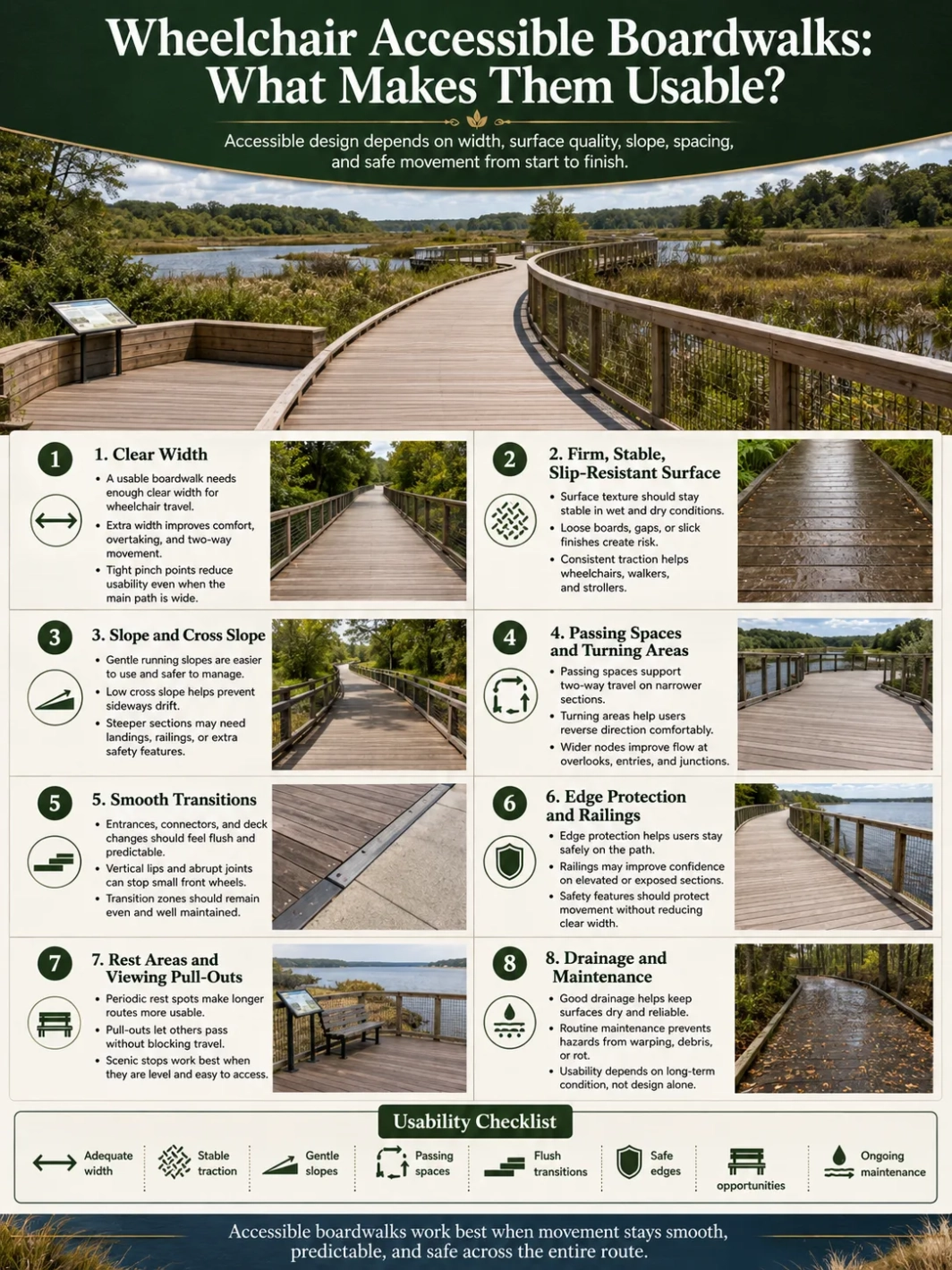
For boardwalks, access is shaped by four linked details: running slope, cross slope, surface stability, and clear width. A boardwalk may look simple, but a small change in board gap, grade, drainage angle, or turning space can decide whether the route feels usable or tiring.
| Design Feature | Practical Rule | Visitor Impact | Field Check |
|---|---|---|---|
| Running Slope | The lengthwise grade should stay gentle where possible. | Less effort for wheelchair users, walkers, and visitors with limited stamina. | Check whether uphill sections include level resting points. |
| Cross Slope | Side-to-side slope should stay low, especially on board surfaces. | Reduces sideways pull on manual wheelchairs and walkers. | Look for deck tilt, drainage pitch, and uneven transitions. |
| Surface | Decking should be firm, stable, even, and predictable. | Improves rolling comfort and reduces caster, cane, and crutch-tip problems. | Check board gaps, raised fasteners, frost, algae, and wet leaves. |
| Width and Passing | Narrow routes need planned wider points or turnouts. | Allows two-way movement, pausing, and safe passing without backing up. | Look for wider deck areas, overlooks, or T-shaped trail junctions. |
| Visitor Information | Access pages should describe length, grade, surface, obstacles, and parking. | Visitors can decide before arrival whether the route fits their equipment and comfort level. | Use official park or land-manager pages before visiting. |
Best Surface Signal: firm, stable decking with small openings and few abrupt lips.
Slope Signal: low running grade, low side slope, and level rest points after steeper sections.
Access Signal: official trail pages that list width, surface, grade, parking, restrooms, and obstacles.
Weather Signal: wet boards, frost, sand, leaf litter, and algae can change access conditions quickly.
Accessible Boardwalk Design Basics
An accessible boardwalk is not only a path with no stairs. It is a route where the walking surface, grade, width, edge conditions, rest areas, and connection to parking or trailheads work together. Federal outdoor developed-area guidance uses firm and stable surfaces as the baseline for trails, passing spaces, and resting intervals, and it treats board surfaces differently from loose or natural surfaces because boards can control slope and openings more precisely [a].
The practical difference usually appears at transitions: the point where asphalt meets the boardwalk, where a ramp lands on a deck, where a viewing platform widens, or where a wetland boardwalk connects to dirt trail. These spots can create short lips, drainage gaps, soft shoulders, or tight turns.
Access Note: “Accessible” does not always mean the same thing at every site. A national park, city waterfront, state preserve, beach access route, and private attraction may follow different rules. The most useful visitor pages give route length, surface, width, slope range, parking access, restroom access, and known obstacles.
Slope Rules That Shape Wheelchair Access
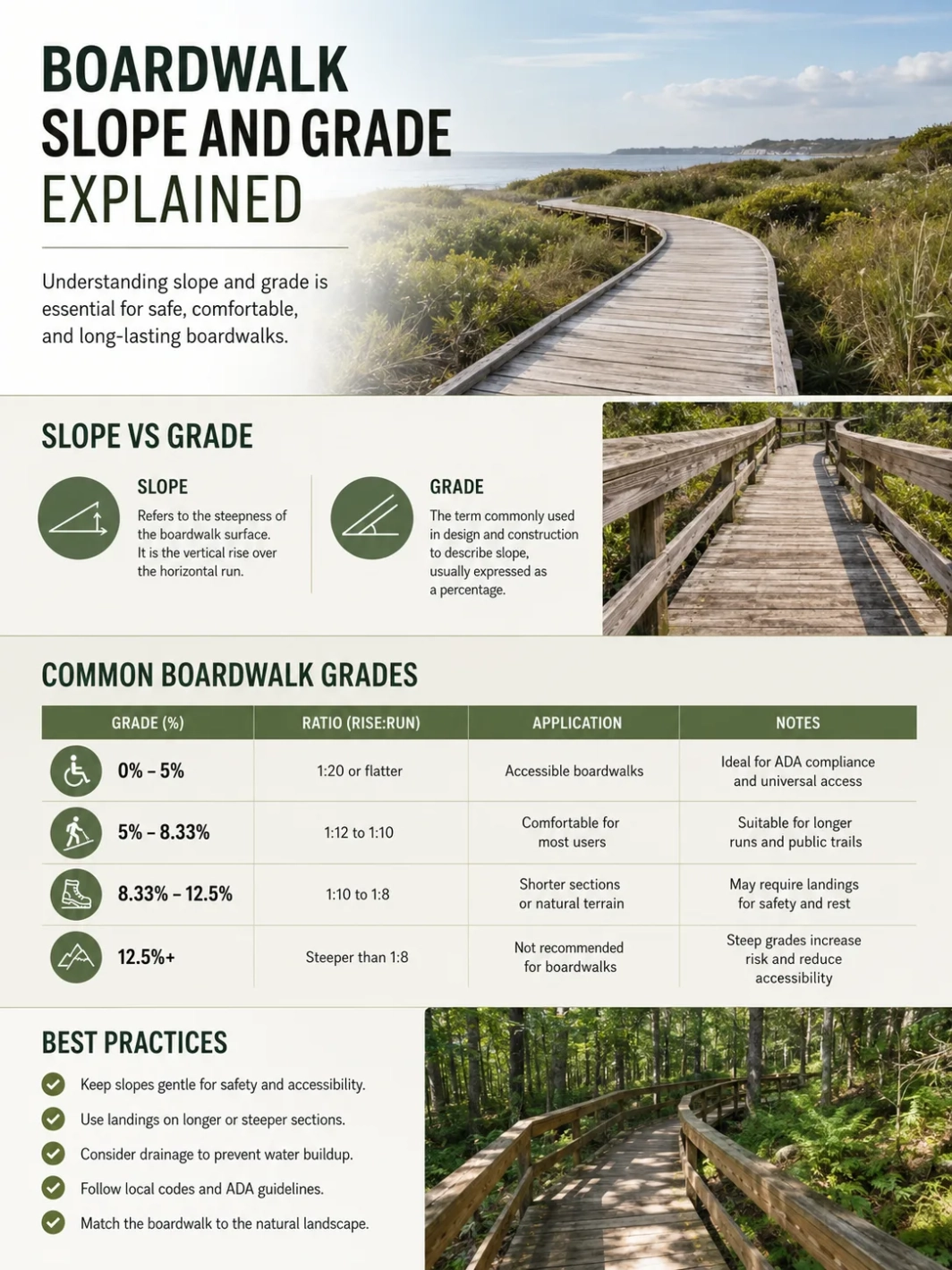
Running slope is the grade along the direction of travel. Cross slope is the side-to-side tilt across the boardwalk. Both matter, but they affect visitors differently. A steep running slope increases pushing effort. A steep cross slope pulls a wheelchair, walker, or stroller sideways.
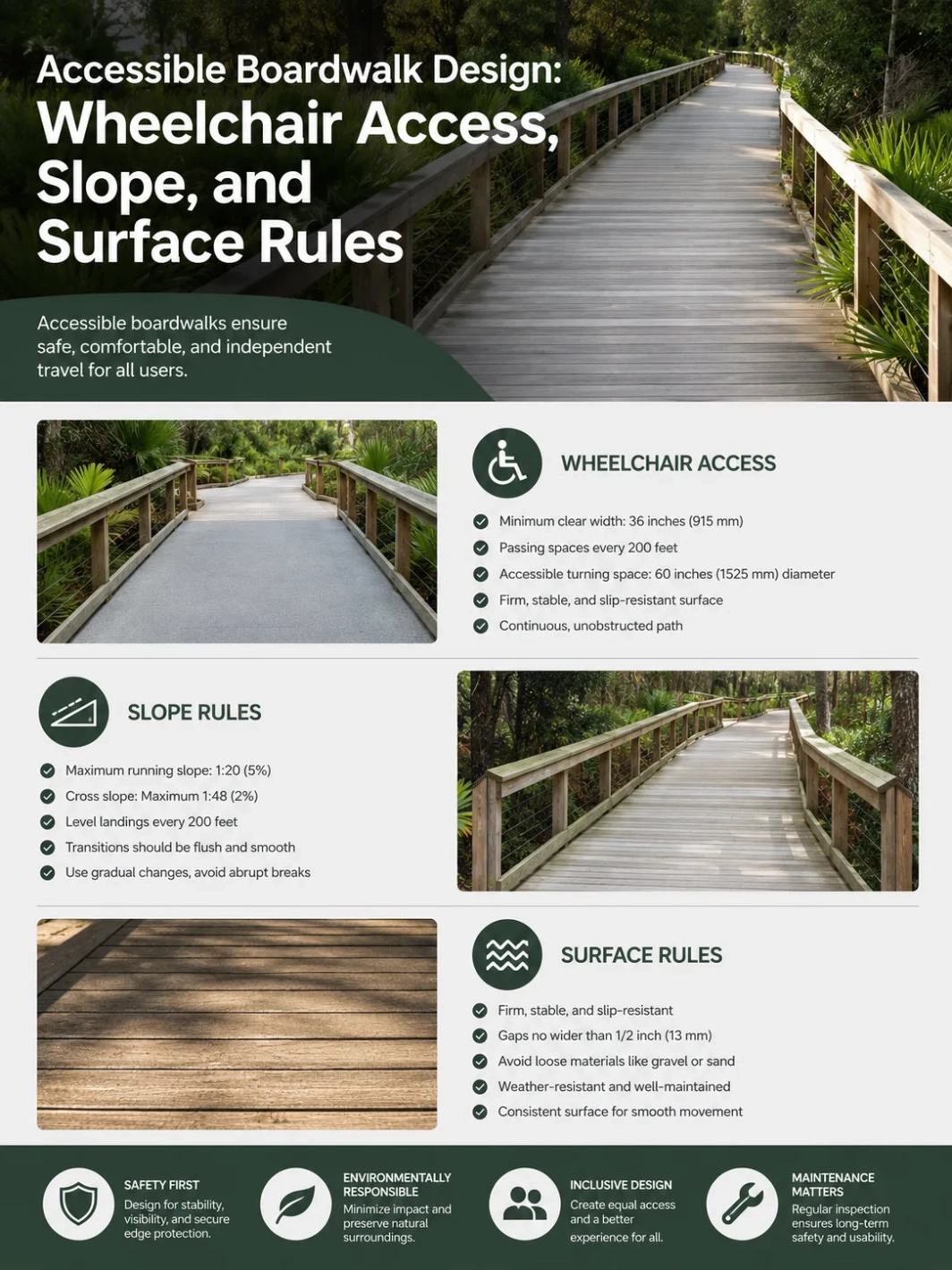
Federal outdoor trail guidance allows trail segments of any length up to a 1:20 running slope, which equals 5 percent. Steeper segments are handled with shorter maximum lengths and resting intervals. For board surfaces, cross slope is treated more tightly: the U.S. Forest Service outdoor accessibility guide says board-built or paved trail surfaces should not exceed a 1:48 cross slope, or 2 percent, while natural surfaces may need more drainage pitch [b].
| Slope Term | Simple Meaning | Why It Matters | Boardwalk Design Response |
|---|---|---|---|
| Running Slope | Uphill or downhill grade along the route. | Controls effort, braking, and fatigue. | Use gentle grades, switchbacks, landings, and rest intervals. |
| Cross Slope | Sideways tilt across the deck. | Creates lateral pull and uneven load on wheels or walkers. | Keep deck pitch low while still managing drainage. |
| Resting Interval | A level space after a steeper segment. | Lets visitors pause without blocking the route. | Place level landings at grade changes, overlooks, or wide deck areas. |
| Transition Slope | Small change where surfaces meet. | Can create a lip or sudden bump even when the main deck is smooth. | Keep thresholds flush and maintain settled approach surfaces. |
Technical Note: Slope design depends on land ownership, terrain, flood level, dune movement, wetland permits, and local code. The values here are general reference points from official outdoor accessibility sources, not a substitute for site design review.
Surface Rules: Firm, Stable, and Predictable
A boardwalk surface should resist deformation, stay stable under normal weather and use, and avoid openings that catch small wheels or mobility aids. On a wood or composite deck, the problem is rarely softness. It is more often board gaps, raised fasteners, warped planks, algae, sand, ice, or uneven replacement boards.
Openings deserve special attention because wheelchair casters, cane tips, and crutch tips are small. Official outdoor guidance describes gaps between planks and drainage slots as possible hazards when wheels or mobility aids can drop through or become trapped. Where possible, elongated openings should sit perpendicular to the main direction of travel rather than parallel to it.
Surface Scorecard for Accessible Boardwalks
| Surface Type | Typical Use Setting | Access Strength | Access Limit | Maintenance Demand |
|---|---|---|---|---|
| Wood Decking | Wetlands, dunes, shaded nature trails, historic-style parks. | Can provide a firm raised route over wet or sandy ground. | May warp, splinter, grow slick, or develop uneven gaps. | Medium to High |
| Composite Decking | Coastal routes, visitor-heavy parks, replacement projects. | More uniform boards and lower rot pressure than untreated wood. | Heat, expansion, fasteners, and texture still need review. | Medium |
| Fiberglass or Grated Panels | Wetlands, industrial waterfronts, flood-prone sites. | Can improve drainage and traction when selected carefully. | Openings, vibration, glare, or cane-tip feel may be concerns. | Medium |
| Concrete or Asphalt Approach | Trailheads, parking links, urban waterfront entries. | Usually easier to grade and maintain at the route connection. | Settlement can create lips at boardwalk transitions. | Low to Medium |
Safety Note: A boardwalk can meet a dry-day access goal and still become harder to use after rain, frost, leaf fall, sand drift, or algae growth. Visitor pages should mention seasonal surface changes when they are common.
Width, Passing Space, and Turnaround Areas
Width affects more than wheelchair clearance. It controls whether visitors can pass without backing up, whether someone can stop to rest without blocking the route, and whether a caregiver, child, or companion can travel beside a wheelchair user.
The Forest Service accessibility guide describes 36 inches as a baseline clear tread width for accessible trails and explains that 60 inches allows two wheelchairs to pass more comfortably. Where the clear tread width is less than 60 inches, passing spaces are expected at regular intervals unless a site condition prevents them [c].
Clear Travel Width
Why it matters: A route that is technically passable may still feel tight when railings, wheel rims, backpacks, or handrails reduce usable space.
Passing Areas
Access signal: wider deck areas, T-intersections, overlooks, and rest nodes can function like passing or turnout spaces when they are level and connected cleanly.
Turnaround Space
Visitor note: dead-end overlooks, bird blinds, and viewing decks need room to turn without forcing a long reverse movement.
Rest Nodes
Best fit: benches work better when paired with adjacent clear space so a wheelchair user can stop without sitting in the travel lane.
Real Boardwalk Access Examples
Real sites show why precise access details matter. The strongest official examples do not simply say “easy” or “accessible.” They list route length, width, surface, grade, railings, benches, obstacles, parking, and seasonal cautions.
| Example Site | Location | Relevant Feature | Visitor Impact | Source Note |
|---|---|---|---|---|
| Sterling Munro Trail | North Cascades National Park, Washington, USA | 300-foot boardwalk, 6-foot trail width, 0% inclination, 0% cross slope, benches, no listed obstacles. | Shows how a short boardwalk can publish precise access data rather than relying only on a difficulty label. | NPS trail accessibility page [d] |
| Sand Point Marsh Trail | Pictured Rocks National Lakeshore, Michigan, USA | Half-mile wheelchair-accessible boardwalk, about 4 feet wide, with railings and benches. | Shows a wetland boardwalk where width, railings, seating, and winter snow or ice are useful visitor details. | NPS accessibility page [e] |
| Rio Grande Village Nature Trail | Big Bend National Park, Texas, USA | First 100 yards are wheelchair accessible; mostly level boardwalk about 4 feet wide with recycled plastic boards, railings, platforms, and benches. | Shows how access can apply to one segment of a longer trail rather than the full route. | NPS activity page [f] |
| Salt Creek Boardwalk | Death Valley National Park, California, USA | Wheelchair-accessible replacement boardwalk rebuilt after flood damage, with flood-resistant design and deep footings. | Shows that accessible boardwalk design must also address flooding, environmental protection, and future maintenance pressure. | NPS repair and reopening notice [g] |
Short Boardwalks Still Need Full Access Data
Why it matters: Sterling Munro Trail is short, but the official listing gives width, slope, surface, obstacles, and restroom context. That is the kind of detail visitors need before arrival.
Partial Access Should Be Stated Clearly
Why it matters: Rio Grande Village Nature Trail has a wheelchair-accessible boardwalk segment, then the route changes to dirt, gravel, hill, and steps. Clear wording prevents visitors from assuming the whole trail has the same access condition.
Visitor and Maintenance Checks
Accessible boardwalks need both good design and steady inspection. A route that works after installation can lose access quality through board movement, fastener lift, surface slime, settlement at approach ramps, storm debris, or damage near railings and platforms.
Access Inspection Checklist
- Deck surface: check for warped boards, raised screws, loose panels, splinters, soft spots, and uneven replacements.
- Openings: review plank gaps, drainage slots, grate openings, and rail-side gaps that could catch casters or cane tips.
- Slope and drainage: confirm that water drains without creating a side tilt that pulls mobility devices sideways.
- Transitions: inspect where pavement, gravel, sand, soil, or ramp surfaces meet the boardwalk.
- Passing and rest areas: keep widened areas, benches, and clear companion spaces free of signs, cones, debris, or vegetation.
- Seasonal conditions: monitor algae, frost, snow, leaf litter, sand drift, and flood debris.
- Visitor information: update official pages when a segment closes, surface changes, or access conditions differ by season.
Repair Note: Access and Resilience Belong Together
Flood-prone, coastal, and wetland boardwalks need more than a smooth deck. Salt Creek Boardwalk in Death Valley is a useful example because the public access problem was tied to streambank protection, flood destruction, replacement facilities, deep footings, and a sensitive habitat. In exposed sites, accessible design and durable reconstruction are part of the same visitor-access problem.
Common Design Mistakes
| Mistake | Why It Creates a Barrier | Better Design Response |
|---|---|---|
| Calling a route accessible without measurements | Visitors cannot judge grade, width, surface, parking, or known obstacles. | Publish length, surface, width, slope range, obstacles, restrooms, and parking notes. |
| Using narrow decking without passing relief | Two-way movement becomes stressful, especially on long wetland or dune routes. | Add level wider sections, rest nodes, T-intersections, or overlook platforms where site conditions allow. |
| Ignoring board gaps and fastener lift | Small wheels, cane tips, and crutch tips can catch on surface interruptions. | Inspect plank spacing, vertical alignment, fasteners, and replacement board height. |
| Treating drainage as only a maintenance issue | Too much side pitch can make the route harder for manual wheelchair users. | Balance drainage with low cross slope and clean surface transitions. |
| Designing overlooks as dead ends | Visitors using mobility devices may have to reverse out of a crowded viewing area. | Provide usable turning space and avoid placing benches, rails, or signs inside the needed clear area. |
Field Note: The most helpful access descriptions are specific rather than promotional. “Boardwalk, 4 feet wide, benches, railings, winter ice possible” is more useful than “easy walk.”
Frequently Asked Questions
What makes a boardwalk wheelchair accessible?
A wheelchair-accessible boardwalk usually needs a firm and stable surface, manageable running slope, low cross slope, enough clear width, usable transitions, passing or turning areas, and clear information about obstacles, parking, and restrooms.
Is a wooden boardwalk automatically accessible?
No. Wood can create a firm raised route, but access still depends on slope, width, plank gaps, surface condition, transitions, rail placement, wet-weather traction, and maintenance.
Why does cross slope matter so much for wheelchair users?
Cross slope creates sideways pull. Even a route with a gentle uphill grade can become tiring or difficult if the deck tilts sideways for drainage or because boards have settled unevenly.
Can a boardwalk be accessible if only part of the trail is accessible?
Yes, but the official visitor information should say where access starts and ends. If a boardwalk segment later becomes dirt, gravel, stairs, or a steep trail, that change should be stated plainly.
Do accessible boardwalks need handrails?
Handrails may be needed depending on slope, height, edge condition, local rules, and site design. Railings can also support visitor safety near water, marsh, dunes, drop-offs, or wildlife-sensitive areas.
What should visitors check before using an accessible boardwalk?
Check the official land-manager page for closures, route length, surface type, width, slope, parking, restroom access, seasonal hazards, and whether mobility-device access applies to the full route or only one section.
Resources Used
- [a] U.S. Access Board: Chapter 10, Outdoor Developed Areas — Used for firm and stable surface guidance, outdoor trail slope concepts, board-surface cross slope, resting intervals, openings, and beach access route context. Official federal accessibility source.
- [b] U.S. Forest Service: Trail Slopes — Used for running slope, cross slope, board-surface drainage, and resting interval explanation. Official U.S. Forest Service accessibility guide.
- [c] U.S. Forest Service: Clear Tread Width of Trails — Used for clear tread width, 60-inch passing space logic, and passing-space interval guidance. Official U.S. Forest Service technical publication.
- [d] National Park Service: Accessibility at Sterling Munro Trail — Used as a real boardwalk example with trail length, width, surface, slope, cross slope, and obstacle information. Official NPS visitor-access page.
- [e] National Park Service: Pictured Rocks Accessibility — Used for Sand Point Marsh Trail access details, including half-mile wheelchair-accessible boardwalk, approximate width, railings, benches, and winter surface caution. Official NPS park accessibility page.
- [f] National Park Service: Rio Grande Village Nature Trail — Used for a partial-access boardwalk example with recycled plastic boards, railings, platforms, benches, and a route transition to non-boardwalk trail. Official NPS activity page.
- [g] National Park Service: Salt Creek Boardwalk Reopens — Used for a documented boardwalk repair and reconstruction example linking wheelchair access, flood resistance, deep footings, and habitat protection. Official NPS news release.