Boardwalks in nature reserves give visitors a defined, elevated route through wetlands, dunes, bogs, marshes, forests, and shoreline habitats without spreading foot traffic across sensitive ground. The best designs balance public access, wildlife viewing, drainage, accessibility, safety, and habitat protection.
Main Details
| Access Goal | Boardwalk Role | Habitat Benefit | Visitor Note |
|---|---|---|---|
| Keep people on one route | Creates a clear path through sensitive ground. | Reduces informal side trails, trampling, and soil disturbance. | Stay on the deck even when wildlife appears close to the edge. |
| Cross wet or soft ground | Raises visitors above mud, standing water, roots, and seasonal flooding. | Limits compaction in marsh, fen, bog, and swamp soils. | Surfaces can still be slippery after rain, frost, algae growth, or leaf fall. |
| Offer wildlife viewing | Uses hides, overlooks, benches, and widened viewing points. | Concentrates viewing activity where managers can control disturbance. | Quiet movement matters more than speed in birding and wetland areas. |
| Support more visitors | Provides a predictable route for families, school groups, strollers, and mobility devices where site conditions allow. | Protects the surrounding habitat from scattered access. | Accessibility claims should be checked with the reserve manager before visiting. |
Why Nature Reserves Use Boardwalks
A nature reserve boardwalk is not only a walking surface. It is a visitor-management tool. In places where the ground is wet, loose, shallow-rooted, eroding, or used by nesting and feeding wildlife, an ordinary dirt trail can widen over time as people step around puddles, mud, roots, or crowded sections.
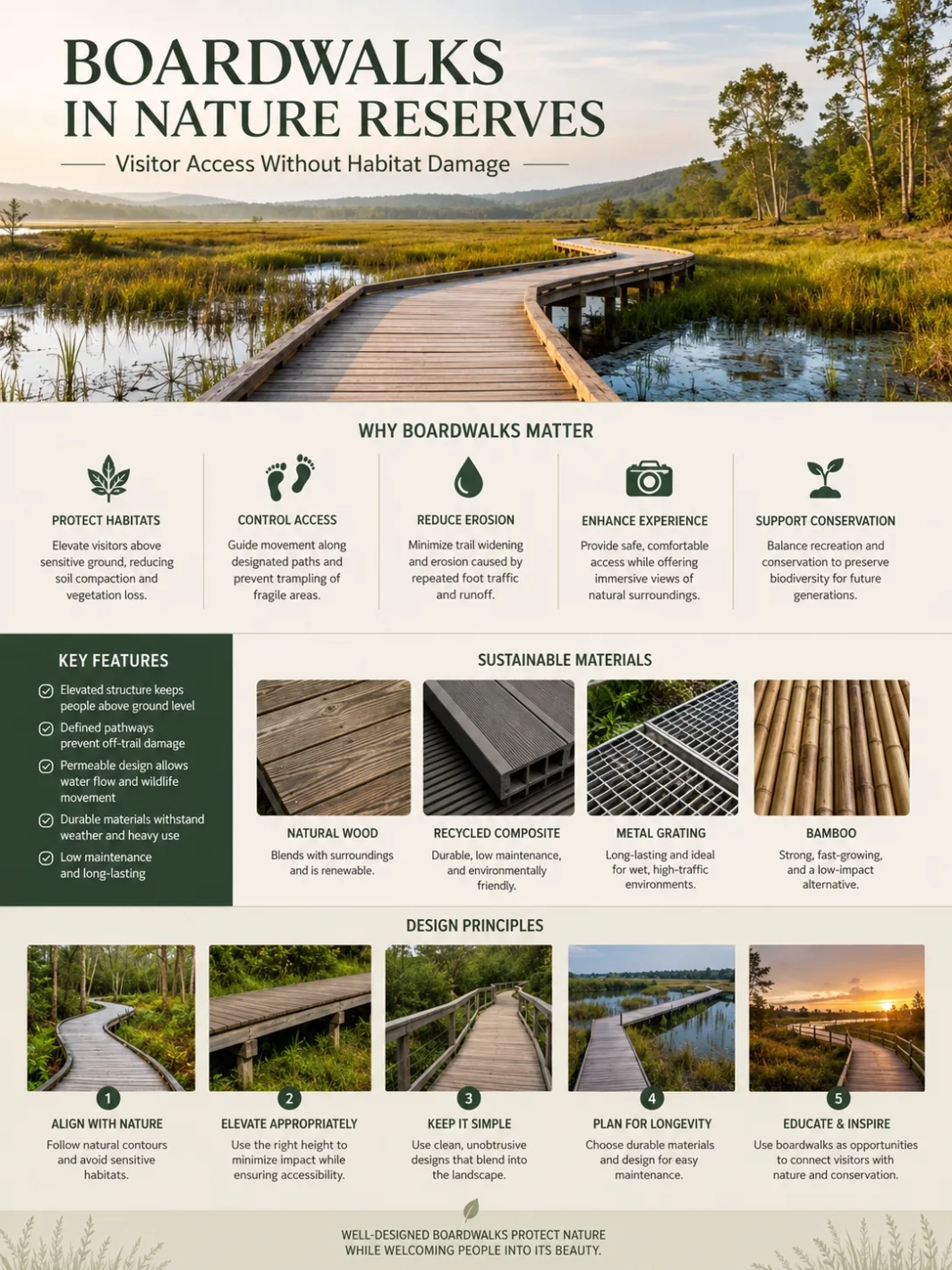
A raised boardwalk narrows that pressure into one managed line. It lets the reserve offer public access while keeping feet, stroller wheels, and mobility devices away from vegetation and soft soils. The same structure can also carry signs, benches, viewing decks, railings, edge protection, and small rest nodes without spreading infrastructure across the habitat.
Environmental note: a boardwalk does not remove all visitor impact. It changes where that impact happens. Good routing, seasonal closures, cleaning, repairs, dog rules, group-size control, and staff monitoring still matter.
How Boardwalks Reduce Habitat Damage
The practical value of a reserve boardwalk comes from several small design choices working together. The deck keeps visitors above wet ground, the route makes access easy to understand, and the edges signal where visitors should not walk. In a well-managed reserve, the boardwalk also guides people toward viewing points instead of letting them chase the closest photo angle.
Defined Route
Why it matters: visitors know where to walk, where to stop, and where not to enter.
Raised Surface
Surface role: the deck crosses waterlogged soil without forcing a wider gravel or dirt trail into the reserve.
Viewing Control
Visitor impact: hides, overlooks, and wider deck areas keep watching, photography, and group stops in planned places.
Soil Protection
Best fit: peat, fen, marsh, swamp edge, dune vegetation, wet woodland, and shallow-rooted plant zones.
| Design Feature | Visitor Function | Habitat Role | Common Reserve Setting |
|---|---|---|---|
| Elevated decking | Keeps feet above wet soil, roots, and standing water. | Reduces trampling and soil compaction beside the route. | Wetlands, bogs, swamps, reedbeds. |
| Low edge definition | Makes the walking line obvious without overbuilding the site. | Discourages shortcut paths and off-route viewing. | Marshes, dunes, fragile forest floors. |
| Overlook platform | Gives visitors a place to pause, pass, sketch, photograph, or use binoculars. | Concentrates stopping behavior away from nesting or feeding zones. | Birding reserves, lakeshores, open-water hides. |
| Rest node or bench | Supports slower walkers and school groups. | Prevents informal sitting areas from forming on vegetation. | Longer loop walks and reserve education trails. |
| Seasonal closure gate | Allows managers to close a section during flooding, repair, nesting, or unsafe conditions. | Protects habitat when conditions are too sensitive for public use. | Flood-prone wetlands and wildlife refuges. |
Wetland and Nature Reserve Examples
Real reserves show how the same idea changes by landscape. A cypress swamp boardwalk, a cattail marsh trail, a Welsh fen path, and an Australian wetland route all solve the same access problem in different ways: visitors need a clear path, while habitat needs space, water movement, and lower foot pressure.
| Wetland Boardwalk | Location | Managing Authority | Habitat Setting | Why the Boardwalk Is Used | Access Note |
|---|---|---|---|---|---|
| Corkscrew Swamp Sanctuary Boardwalk | Naples, Florida, USA | National Audubon Society | Western Everglades cypress, wet prairie, marsh, and forest habitats. | The official visitor page describes a 2.25-mile boardwalk through major sanctuary habitats and notes wheelchair access at the visitor center and boardwalk [a]. | Useful model for a reserve where nearly all visitor movement is organized through one long elevated route. |
| Wetland Trail | San Luis National Wildlife Refuge, California, USA | U.S. Fish & Wildlife Service | Semi-permanent marsh with cattail, tule, riparian woodland, shallow water, and grassland edges. | The refuge asks visitors to stay on trails and lists the Wetland Trail surface as compacted gravel and boardwalk [b]. | Shows how a short refuge trail can combine ground trail, boardwalk, benches, and close wetland viewing. |
| Llangloffan Fen Walk | Pembrokeshire, Wales, UK | Natural Resources Wales | Fen habitat with soft waterlogged ground and hidden flooded ditches. | The official page tells visitors to stay on the boardwalk and notes the route is suitable for wheelchair users and prams [g]. | Strong example of safety and habitat protection using the same access route. |
| Blawhorn National Nature Reserve Boardwalk | West Lothian, Scotland, UK | NatureScot | Raised and blanket bog habitat with peat layers and specialist plants. | NatureScot reported a 280-metre boardwalk extension with seating and interpretation panels [d]. | Shows how boardwalk expansion can add education space without inviting open access across bog ground. |
| Fowlmere Boardwalk Path | Cambridgeshire, England, UK | RSPB | Reedbed, fen, scrub, chalk stream, and former water-cress beds. | RSPB directs visitors along a boardwalk path through reedbeds to a hide for wildlife viewing [e]. | Useful example of a boardwalk that links habitat immersion with controlled viewing from a hide. |
| Sale Common Boardwalks | Sale, Victoria, Australia | Parks Victoria | Internationally listed wetlands, freshwater marsh, red gum woodland, reed beds, and deeper water zones. | Parks Victoria describes boardwalks winding through several wetland habitat types and a nearby bird hide [f]. | Shows how boardwalks can bring visitors close to water-level habitat while keeping travel on managed paths. |
Access Patterns That Work Best
Nature reserve boardwalks work best when the visitor route is simple to understand. A loop is often easier for steady movement, while an out-and-back route may be better where habitat is narrow, land ownership is limited, or a sensitive area should not be crossed twice. Spur routes can lead to hides or overlooks, but they should be clear enough that visitors do not create side paths.
Route Snapshot for Reserve Managers and Visitors
- Entrance clarity: the first decision point should show the route, rules, distance, and return option.
- Edge behavior: low rails, curbs, or visible deck edges help visitors understand where the route ends.
- Viewing rhythm: small stopping areas prevent crowding on narrow spans.
- Surface predictability: boards, mesh, grating, or compacted approaches should be checked for slip, gaps, lifted edges, and drainage.
- Exit control: the end of the boardwalk should reconnect clearly to a trail, car park, visitor center, or signed return route.
Field note: a narrow boardwalk can still work well in a quiet reserve if it has occasional wider deck areas, clear sightlines, and low visitor volume. In busier reserves, narrow sections become pressure points when birdwatchers, families, school groups, and mobility devices meet in the same place.
Accessibility Notes for Reserve Boardwalks
Accessibility in a nature reserve is site-specific. A boardwalk may be suitable for wheelchair users or strollers in one reserve and unsuitable in another because of slope, deck width, approach surface, turning space, rail height, gaps, resting intervals, parking access, or seasonal flooding.
For federal outdoor developed areas in the United States, the U.S. Access Board’s outdoor developed area guide explains trail requirements for surface, clear tread width, passing spaces, obstacles, openings, running slope, cross slope, resting intervals, protruding objects, and trailhead signs. It also notes that surfaces of trails, passing spaces, and resting intervals must be firm and stable where the standards apply [c].
Accessibility note: do not assume that every boardwalk is accessible. The word “boardwalk” describes the structure, not the whole visitor experience. Approach paths, gradients, parking, toilets, gates, bridge lips, and temporary closures can change whether a route is usable for a particular visitor.
Safety and Maintenance Concerns
Boardwalks in nature reserves live in damp, shaded, exposed, or flood-prone places. That is exactly why they are useful, and also why they need steady inspection. A deck that crosses marsh water, peat, or reedbed margins can face algae growth, board movement, damaged rails, washed approaches, lifted fasteners, vegetation overhang, and wildlife-related wear.
| Maintenance Concern | What to Check | Visitor Impact | Habitat Link |
|---|---|---|---|
| Slippery surface | Algae, wet leaves, mud, ice, smooth boards, worn traction strips. | Slower walking, fall risk, temporary closure after bad weather. | Visitors may step off the deck if the walking line feels unsafe. |
| Loose or lifted boards | Fasteners, board ends, warped planks, uneven joints. | Trip risk and wheelchair or stroller difficulty. | Damaged sections may push traffic toward habitat edges. |
| Rail or edge damage | Loose posts, broken curbs, missing edge protection, leaning sections. | Less confidence near water, mud, or steep drop-offs. | Clear edges help visitors stay on route. |
| Flooded approach | Entry paths, low transitions, drainage dips, seasonal standing water. | Route may become inaccessible before the boardwalk itself is damaged. | People often create side routes around wet entry points. |
| Vegetation encroachment | Branches, reed growth, thorny plants, low visibility at corners. | Reduced passage width and hidden wildlife encounters. | Trimming must avoid nesting seasons and protected species rules. |
Safety note: visitors should follow posted closures and diversions. Temporary closure may protect people, but it can also protect nesting birds, wet ground after floods, or repair crews working in narrow habitat corridors.
Visitor Behavior That Protects the Reserve
The structure can only do part of the work. Visitor behavior decides whether the boardwalk remains a protective route or becomes a starting point for off-route disturbance. The rules are usually simple: stay on the deck, keep noise low near wildlife, avoid feeding animals, do not climb rails, keep dogs only where permitted, and give space to other visitors on narrow sections.
Low-Impact Boardwalk Use
Do: pause at overlooks, hides, benches, and widened deck areas instead of stopping in narrow travel lanes.
Do: let faster walkers pass where the deck is wider, then return to quiet movement near wildlife.
Do Not: step into reeds, moss, mud, dunes, or shallow water for photographs.
Do Not: assume pets, bikes, drones, or night access are allowed. Reserve rules vary by land manager.
Visitor tip: in birding reserves, the best view often comes from standing still at a planned viewing point. Moving quietly along the boardwalk usually causes less disturbance than leaning over edges or trying to follow wildlife through vegetation.
When a Boardwalk Is Not the Right Answer
A boardwalk is useful, but it is not always the least-impact option. Some habitats may be too sensitive for public access, even on an elevated deck. Other sites may need a seasonal viewing platform, a hardened edge trail, a guided-access model, or no visitor route at all. The right choice depends on hydrology, protected species, flood levels, soil depth, fire risk, maintenance access, visitor volume, and legal protection status.
Technical note: boardwalk planning in a reserve can involve environmental permits, engineering review, accessibility rules, cultural heritage checks, flood behavior, and long-term maintenance budgets. Public information pages can explain the visitor experience, but site design should be reviewed by qualified professionals and the responsible land manager.
Frequently Asked Questions
Why do nature reserves build boardwalks instead of normal trails?
Boardwalks are used where a normal trail would become muddy, widen over time, compact soil, damage plants, or push visitors into sensitive habitat. They are especially useful in wetlands, bogs, reedbeds, dunes, swamps, and fragile shoreline areas.
Do boardwalks completely prevent habitat damage?
No. They reduce and concentrate visitor impact, but they still need careful routing, maintenance, signs, seasonal management, and visitor cooperation. Damage can still occur if people step off the route or ignore closures.
Are nature reserve boardwalks usually wheelchair accessible?
Some are, but not all. Accessibility depends on deck width, slope, surface condition, turning space, parking, approach paths, gates, rest areas, and current maintenance. The official reserve page is the safest source before visiting.
Why do signs often say to stay on the boardwalk?
Soft ground, hidden ditches, nesting areas, fragile vegetation, restoration zones, and wildlife disturbance are common reasons. Staying on the boardwalk protects the visitor and the habitat at the same time.
Can boardwalks be used in dry habitats?
Yes. Boardwalks can also protect dune plants, shallow roots, archaeological surfaces, alpine soils, or forest floors where repeated foot traffic would create erosion or informal paths.
What should visitors check before going to a reserve boardwalk?
Check the official page for closures, weather warnings, dog rules, parking, distance, accessibility, toilets, seasonal flooding, repair work, and route changes. Boardwalk conditions can change quickly after storms or long wet periods.
Resources Used
- [a] Visit Corkscrew Swamp Sanctuary — supports the 2.25-mile boardwalk, Naples address, wheelchair access note, wet-surface warning, and visitor rules. The source is the official National Audubon Society visitor page for the sanctuary.
- [b] Hiking at San Luis National Wildlife Refuge — supports the Wetland Trail length, compacted gravel and boardwalk surface, foot-traffic rule, and stay-on-trails guidance. The source is the official U.S. Fish & Wildlife Service refuge page.
- [c] Chapter 10: Outdoor Developed Areas — supports accessible trail surface, passing space, slope, obstacle, and trailhead sign concepts. The source is the official U.S. Access Board guide for ABA outdoor developed area standards.
- [d] New Boardwalk Extension Opens at Popular West Lothian Nature Reserve — supports the Blawhorn National Nature Reserve boardwalk extension, seating, interpretation, and raised bog context. The source is NatureScot, Scotland’s national nature agency.
- [e] Fowlmere Nature Reserve — supports the reedbed boardwalk path, hide, and habitat setting. The source is the official RSPB reserve visitor page.
- [f] Sale Common Nature Conservation Reserve — supports boardwalks through wetland habitat types and nearby bird-hide access. The source is the official Parks Victoria reserve page.
- [g] Llangloffan Fen National Nature Reserve — supports the accessible boardwalk route, stay-on-boardwalk safety note, soft ground warning, and maintenance-closure guidance. The source is the official Natural Resources Wales visitor page.