Marsh boardwalks protect fragile ground by lifting people above saturated soil, plant roots, shallow water, and soft organic layers. Instead of letting visitors create informal muddy paths, a boardwalk concentrates movement on a designed surface while the marsh continues to filter water, store floodwater, and support wildlife habitat below and around it [a].
Main Details
| Feature | What It Does | Ground Protection Benefit | Visitor Benefit |
|---|---|---|---|
| Elevated walking surface | Keeps feet, wheels, and maintenance traffic above wet soil. | Reduces trampling, rutting, compaction, and side trails. | Cleaner, more predictable walking route through wet terrain. |
| Defined route | Guides people along one planned line. | Limits wandering into sensitive vegetation, nesting areas, and muddy edges. | Easier navigation and clearer wayfinding. |
| Piers, bents, sleepers, or piles | Support the structure where ordinary trail tread would fail. | Moves load to designed support points instead of spreading damage across the marsh. | More stable walking surface in saturated ground. |
| Open space below deck | Allows water, small debris, and some wildlife movement under the route. | Helps avoid blocking natural wetland flow when designed correctly. | Better views of water, plants, and wildlife. |
| Curbs, rails, and edge cues | Make the walking line visible and safer. | Discourages stepping off into fragile soil. | Helps families, school groups, and mobility-device users stay oriented. |
| Inspection-friendly construction | Makes loose boards, fasteners, drainage problems, and flood debris easier to find. | Prevents small defects from becoming erosion or safety issues. | Reduces closures and improves visitor confidence. |
What a Marsh Boardwalk Is
A marsh boardwalk is a raised pedestrian route built through wetland ground where ordinary dirt, gravel, or paved trails would often sink, erode, or push visitors toward informal bypass paths. It may be a short viewing spur, a loop trail, a wildlife observation route, or part of a longer park walkway.
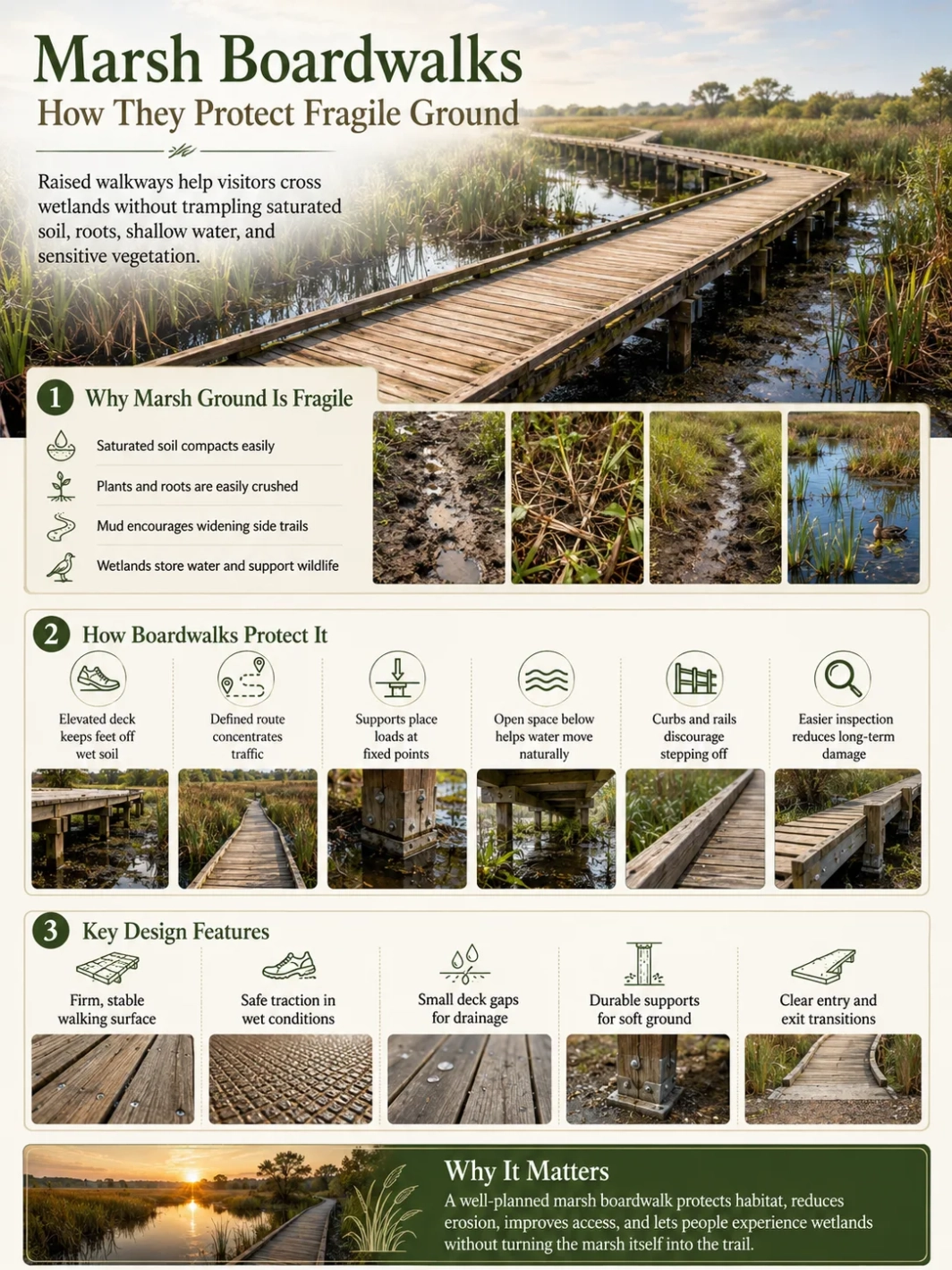
The word “marsh” matters. A marsh is not just “wet ground.” It is a wetland type shaped by water level, soil saturation, aquatic plants, emergent vegetation, seasonal flooding, and wildlife use. Many marshes are soft underfoot because their upper soil layer contains organic matter, roots, fine sediment, and water. A few steps off-route can leave ruts that stay visible long after the visitor is gone.
In trail design language, a boardwalk is not the same thing as a pier, bridge, promenade, or beachwalk. The USDA Forest Service describes a boardwalk as a structure with bents or piers supporting stringers and deck boards, often with curbs or rails, and notes that these structures are more complex than simple backcountry wetland crossings [b].
Why Marsh Ground Is So Easy to Damage
Marsh ground is fragile because it is doing several jobs at once. The soil holds water, supports rooted vegetation, stores organic material, and provides habitat for insects, amphibians, birds, reptiles, fish, and small mammals. When visitors step repeatedly on the same wet soil, the surface can compact, shear, or break apart.
Compaction is one of the quiet problems. A dry upland trail can often absorb moderate foot traffic because mineral soil drains and rebounds more easily. In a marsh, the water-filled pore spaces are part of the system. Repeated pressure can squeeze the surface, reduce plant growth, and create a muddy depression that collects more water.
Trampling also affects the living surface. Rushes, sedges, reeds, grasses, and other marsh plants hold soil together with roots and stems. When those plants are crushed, the trail edge can widen. Visitors then step farther to avoid mud, creating the familiar “braided trail” problem where one path becomes several damaged paths.
Water movement makes the issue more sensitive. Marshes may flood, dry down, receive tidal water, collect storm runoff, or hold shallow standing water after rain. A poorly placed path can interrupt flow, trap sediment, or act like a small dam. A well-planned boardwalk tries to give people access without treating the marsh like ordinary buildable ground.
How Marsh Boardwalks Protect Fragile Ground
They Keep Feet Off Saturated Soil
The simplest benefit is also the most visible: visitors walk on the deck, not on the marsh. That protects wet soil from direct foot pressure, stroller wheels, bicycle tires where allowed, and repeated maintenance access. Even a narrow boardwalk can prevent hundreds or thousands of small impacts from spreading across a marsh edge.
They Concentrate Use on a Planned Line
Marsh visitors often move toward open water, wildlife views, and better photo angles. Without a defined route, people may create shortcuts to viewing points or step around puddles. A boardwalk turns that desire for access into a controlled route. The best designs place viewing points where people naturally want to stop, reducing pressure on unprotected ground.
They Reduce Informal Trail Widening
On a muddy trail, the damaged area often grows from the edges. One person avoids a puddle, the next person steps slightly farther out, and soon the trail is twice as wide. A boardwalk with a firm deck, visible edges, and occasional passing or resting space can prevent that widening cycle.
They Let Water Move Under the Route
Marsh protection is not only about the walking surface. The space below the structure matters. A low crossing that blocks water can change plant patterns and create erosion. A raised boardwalk with suitable openings below the deck can allow shallow flow, floodwater, and floating organic debris to pass more naturally, though the details depend on hydrology, tides, flood height, and site-specific engineering review.
They Make Observation Less Disturbing
Many marsh boardwalks are built for birding, wildlife viewing, environmental education, and nature photography. By keeping people on a predictable route, they reduce random movement through habitat. This is especially useful near nesting areas, amphibian habitat, shallow pools, mudflats, and vegetated edges where animals feed or shelter.
Boardwalk Types Used in Marsh and Wetland Settings
| Type | Simple Meaning | Common Use | Limits |
|---|---|---|---|
| Puncheon | A short wooden walkway over wet or uneven ground. | Backcountry wet areas, boggy trail sections, short saturated crossings. | Often narrower and less suitable for high visitor volumes unless designed for that use. |
| Bog Bridge | A low, simple plank or short-span crossing close to the ground. | Light-use wetland trails where materials must be carried in. | May not meet accessibility needs and can be less comfortable for broad public use. |
| Elevated Boardwalk | A more substantial deck supported by bents, piers, piles, or similar foundations. | Visitor centers, marsh loops, interpretive trails, wildlife viewing routes. | More expensive and usually needs professional design input. |
| Viewing Platform | A wider deck area for stopping, viewing, or education groups. | Bird blinds, marsh overlooks, school programs, photography points. | Needs careful placement so people do not crowd sensitive habitat edges. |
| Floating Structure | A structure that rises and falls with water where traditional supports may not work. | Special cases with deep or changing water levels. | Not the default choice; wind, ice, currents, anchoring, and maintenance can be difficult. |
Design Features That Matter Most
Foundation Choice
Foundation choice is one of the biggest differences between a simple walkway and a lasting marsh boardwalk. Some sites use sleepers or sills near the surface. Others need piles, helical anchors, bents, or piers. Soft organic soil, buried roots, tidal movement, frost, floodwater, and sediment depth can all change the answer.
A good route study comes before construction. Designers often look for soil conditions, high-water evidence, plant communities, existing disturbed corridors, maintenance access, and places where a boardwalk can touch the ground as little as practical. Local wetland rules, permits, and land-manager requirements may control what can be built.
Deck Height and Water Clearance
A marsh boardwalk should not be placed at a height simply because it looks convenient. If it is too low, boards may stay wet, collect algae, trap debris, or be damaged by floodwater. If it is too high, it may need rails, stronger supports, more visible structure, and more maintenance. The best height is a site decision based on water levels, visitor safety, and environmental sensitivity.
Decking, Gaps, and Surface Safety
Deck boards need enough drainage to shed water, but openings cannot create hazards for wheels, canes, crutch tips, stroller wheels, or small feet. The U.S. Access Board guidance for outdoor developed areas says trail surfaces should be firm and stable, and openings in trail surfaces, including boardwalk plank gaps, must be small enough that a sphere more than one-half inch in diameter cannot pass through [c].
Surface texture also matters. Wet wood, algae, leaf litter, frost, and mud tracked from the approach trail can make a marsh boardwalk slippery. Designers and land managers may use textured decking, closer maintenance intervals, warning signs during icy periods, and drainage details that reduce standing water.
Edges, Curbs, and Railings
Edges are not only a safety feature. They also protect the marsh. A low curb or edge rail helps visitors sense the boundary of the walking surface. Taller railings may be needed where the deck is high, where groups gather, or where the route crosses water. In some flood-prone marshes, rails can catch debris, so the design has to balance visitor safety with water movement.
Transitions at the Entrance and Exit
The weakest point is often where the boardwalk meets the land trail. If the approach is muddy, visitors track mud onto the deck and step around the entry point. Good transitions use stable approaches, clear drainage, durable edge treatment, and enough space for visitors to pause without standing in wet soil.
Accessibility Notes for Marsh Boardwalks
A marsh boardwalk is not automatically accessible just because it is flat or wooden. Accessibility depends on width, slope, surface firmness, gaps, obstacles, turning spaces, resting intervals, rail design, approach routes, parking, restrooms, and current maintenance condition.
For public sites, accessibility planning should begin early. A boardwalk that is built too narrow may be difficult for wheelchairs, mobility scooters, strollers, and visitors walking side by side. A surface with raised fasteners, warped boards, or wide gaps can create barriers even on a short route.
Clear visitor information helps. Trail pages and signs should explain surface type, approximate length, grade, width when available, benches, railings, seasonal closures, pets rules, and whether the route is suitable for wheelchairs or strollers. If seasonal flooding, sand drift, ice, or construction affects access, the managing authority should be checked before visiting.
Environmental Considerations Before Building
Marsh boardwalks are often built to protect wetlands, but construction itself can cause damage if it is poorly planned. Crews may need temporary access mats, low-impact staging areas, hand-carried materials, work windows outside sensitive wildlife seasons, and erosion controls near disturbed soil.
Route selection should avoid the most sensitive ground when possible. A boardwalk may be better placed along an already disturbed edge, near an existing trailhead, or on a line that reaches a viewing area without crossing the wettest interior. In some protected marshes, the best design may be a short overlook rather than a long route through habitat.
Materials also deserve attention. Pressure-treated lumber, recycled plastic lumber, steel hardware, composite decking, and local timber each have tradeoffs in cost, weight, lifespan, traction, heat, maintenance, and environmental review. Fasteners and connectors need to match the material and wet conditions. In salt marshes, corrosion resistance becomes a larger issue.
Real Examples of Marsh Boardwalks
At Everglades National Park, the Anhinga Trail uses pavement and elevated boardwalk to move visitors through sawgrass marsh and freshwater slough. The National Park Service describes it as a flat, wheelchair- and stroller-accessible route beginning at the Royal Palm visitor area, with wildlife viewing for alligators, fish, turtles, anhingas, and other birds [d].
At Ankeny National Wildlife Refuge in Oregon, the Pintail and Egret Marsh Boardwalk begins from a parking area on Wintel Road, follows Bashaw Creek, and ends at an observation blind overlooking marsh habitat. The refuge also warns that the boardwalk can be slippery when wet or icy, a practical reminder that access structures still need seasonal caution [e].
These examples show why marsh boardwalks are not only construction features. They are visitor-management tools. They guide people to views, protect soft ground, reduce off-trail wandering, support interpretation, and make fragile wetland landscapes easier to experience without turning the habitat itself into the trail surface.
Maintenance Checks That Matter
- Look for loose, cupped, cracked, or lifted deck boards that can trip visitors or catch mobility devices.
- Check fasteners, connectors, stringers, curbs, rails, and transitions after heavy rain, flooding, freeze-thaw cycles, or high visitor use.
- Remove leaf litter, mud, algae buildup, and debris where they create slippery surfaces or trap moisture against wood.
- Inspect the entry and exit points for erosion, puddling, muddy bypasses, and widening around the boardwalk ends.
- Watch for flood debris caught on rails, posts, or supports because it can increase water pressure on the structure.
- Keep signs current when seasonal closures, wildlife restrictions, damaged sections, or access limitations change.
- Document recurring wet spots, leaning supports, settlement, or rot so repairs address the cause rather than only the visible symptom.
Common Mistakes in Marsh Boardwalk Planning
One common mistake is treating a marsh boardwalk as a simple deck project. Wetland structures have to deal with water movement, organic soil, vegetation, seasonal flooding, wildlife, and public access. A design that works in a dry park may fail quickly in saturated ground.
Another mistake is building the route too narrow for the expected use. A narrow backcountry plank may be acceptable in a low-use setting, but a visitor-center marsh trail may need more width, passing areas, railings, benches, and clear sightlines. The intended users should shape the structure.
A third mistake is ignoring the approach trail. If visitors reach the boardwalk through mud, standing water, or an eroding slope, the boardwalk will not solve the access problem. The full route from parking, trailhead, or visitor center to the marsh view needs to function as one system.
The final mistake is promising more certainty than the site allows. Marsh conditions change with season, stormwater, tides, drought, sediment, plant growth, and maintenance budgets. Public information should be clear, but it should also direct visitors to the managing authority for current closures, hours, parking rules, and access updates.
Frequently Asked Questions
What Is a Marsh Boardwalk?
A marsh boardwalk is a raised walking route built over wetland ground so visitors can cross or view a marsh without walking directly on saturated soil, roots, shallow water, and fragile vegetation.
How Does a Boardwalk Protect Marsh Soil?
It keeps foot traffic on a designed deck, reduces trampling, limits muddy side trails, and can allow water to move below the route when the structure is planned for local hydrology.
Are Marsh Boardwalks Always Wheelchair Accessible?
No. A boardwalk may be accessible if its width, slope, surface, gaps, turning areas, approaches, and maintenance condition support mobility-device use. Visitors should check the managing authority’s current access information before going.
What Materials Are Commonly Used for Marsh Boardwalks?
Common materials include treated wood, naturally durable lumber, recycled plastic lumber, composite decking, galvanized or corrosion-resistant hardware, and sometimes steel or helical supports. The best choice depends on moisture, salinity, load, access, budget, and environmental rules.
Why Not Build a Gravel Trail Through a Marsh?
Gravel may sink, spread, block water, or require repeated filling in saturated soils. In some places, a hardened trail with geotextile may work, but in very wet marsh ground a raised boardwalk can protect the surface better.
Should Visitors Stay on a Marsh Boardwalk?
Yes. Staying on the boardwalk protects soft soil, plants, wildlife habitat, and visitor safety. Marsh edges can be slippery, uneven, deeper than they look, or seasonally restricted for habitat protection.
Resources Used
- [a] Why are Wetlands Important? — Explains wetland functions such as water quality protection, wildlife habitat, floodwater storage, and recreation value. This is a U.S. Environmental Protection Agency page, making it a high-reliability official government source.
- [b] Wetland Trail Design and Construction: 2007 Edition — Defines boardwalk structure, foundations, stringers, wetland trail techniques, and design cautions. This is a USDA Forest Service Technology and Development publication, making it directly relevant for wetland trail construction.
- [c] Chapter 10: Outdoor Developed Areas — Provides outdoor recreation access guidance on trail surfaces, tread width, openings, slopes, and resting intervals. This is an official U.S. Access Board guide tied to federal accessibility standards.
- [d] Walk the Anhinga Trail — Describes a paved and elevated boardwalk route through sawgrass marsh and freshwater slough in Everglades National Park. This is a National Park Service page from the managing agency.
- [e] Ankeny National Wildlife Refuge: Visit Us – Trails — Gives official trail details for the Pintail and Egret Marsh Boardwalk, including access point, habitat notes, and wet or icy surface caution. This is a U.S. Fish and Wildlife Service refuge page from the land manager.