A swamp boardwalk is an elevated walking route built over wet, flood-prone, or saturated ground so visitors can move through swamp habitat without trampling vegetation, stepping into standing water, or disturbing sensitive wildlife areas.
| Use Case | What It Means | Visitor Impact | Design Pressure |
|---|---|---|---|
| Wet Ground Access | Creates a defined route above mud, standing water, roots, and soft organic soils. | Visitors can experience swamp habitat with cleaner, more predictable footing. | Posts, decking, transitions, drainage, and flood movement must be planned for local conditions. |
| Habitat Protection | Keeps foot traffic on one route instead of allowing informal paths through wetland plants. | Wildlife viewing improves while off-route disturbance is reduced. | Alignment should avoid rare plants, nesting areas, unstable trees, and hydrologic pinch points. |
| Accessible Outdoor Route | Many swamp boardwalks aim for firm, stable, step-free movement where terrain allows. | Wheelchair users, stroller users, older adults, and families get safer access. | Width, slope, resting areas, transitions, openings, edges, and protruding objects need careful review. |
| Flood and Storm Exposure | Swamp routes may sit in water, receive debris, or face treefall and storm surge. | Closures can occur after floods, fires, hurricanes, or structural inspections. | Materials, elevation, inspection cycles, and replacement planning matter as much as the first build. |
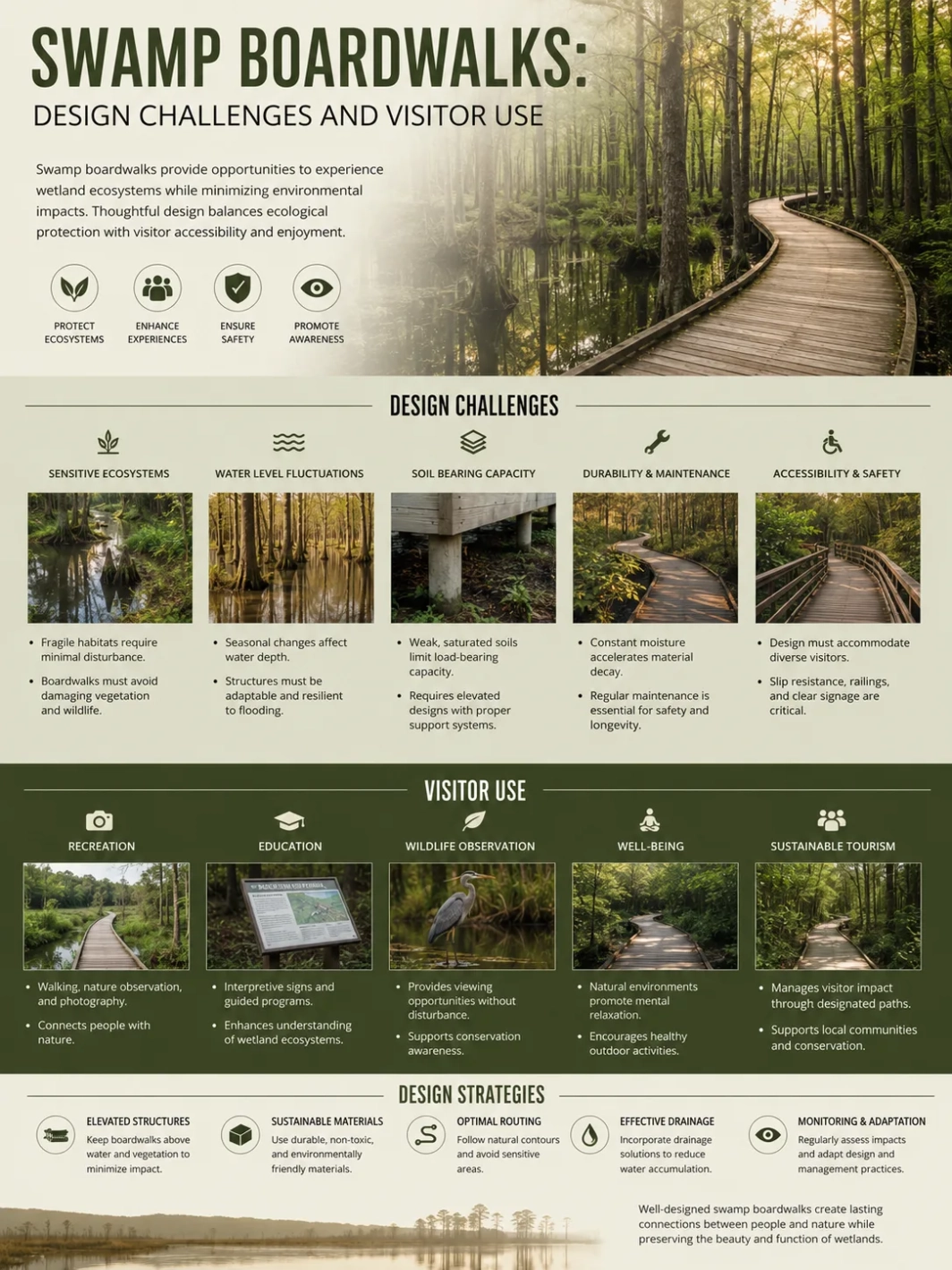
Setting: cypress swamp, bottomland forest, marsh edge, mangrove wetland, slough, or floodplain.
Visitor Role: access, wildlife viewing, education, photography, short walks, and low-impact nature routes.
Main Risk: water, rot, algae, shade, debris, insects, alligators in some regions, and damaged transitions.
What a Swamp Boardwalk Has to Solve
A swamp boardwalk looks simple from the deck, but it is solving several site problems at once. It separates visitor movement from saturated ground, protects plants from trampling, gives land managers a controlled route for education, and reduces the number of informal paths that can widen into damaged wetland corridors.
The hardest part is that swamp conditions are rarely still. Water depth changes by season, organic soils compress, roots grow near the surface, shade keeps decking damp, and storms can drop limbs or whole trees across the structure. A route that feels dry in winter may sit above standing water in another season.
Environmental note: A boardwalk does not make a swamp less sensitive. It concentrates visitor movement onto a managed line. That line still needs careful placement, inspection, and closure rules when flooding, nesting wildlife, or repair work changes site conditions.
Design Challenges in Swamp Conditions
The practical difference between a dry park walkway and a swamp boardwalk usually appears in the support system, deck surface, edge condition, and inspection routine. Swamp routes may need to stay usable during normal wet periods while also yielding to closures after floods, fire, hurricane damage, or treefall.
Soft Ground
Design pressure: peat, muck, and organic soils can shift under load. Supports often need site-specific review instead of a generic footing detail.
Standing Water
Visitor note: elevated routes help keep visitors dry, but high water can still close nearby trails, parking, or lower boardwalk segments.
Shade and Algae
Surface: damp shade can make decking feel slick, especially where leaves collect. Cleaning cycles and surface texture matter.
Wildlife Proximity
Access: boardwalks bring visitors close to birds, reptiles, fish, and wetland mammals. Railings, signs, and no-pet rules may be needed by site.
Technical note: In federal outdoor developed areas, U.S. Access Board guidance discusses firm and stable trail surfaces, resting intervals, slope limits, protruding objects, and openings in trail surfaces. These rules are technical access references, not a substitute for local code review, engineering design, environmental permits, or land-manager standards for a specific swamp site. [a]
Design Features That Matter Most
Swamp boardwalk design is less about one perfect material and more about matching the route to water, shade, visitor volume, maintenance access, and habitat limits. A short interpretive loop near a visitor center can be built and maintained differently from a remote route through a cypress strand.
| Design Feature | Why It Matters | Visitor Impact | Maintenance Concern |
|---|---|---|---|
| Raised Deck | Keeps the route above wet soil, shallow water, roots, and seasonal pooling. | Cleaner footing and easier movement during normal wet periods. | Posts, beams, and connections face long moisture exposure. |
| Firm Surface | Reduces wheel sink, tripping, and unstable movement. | Better for wheelchairs, strollers, canes, and slow walkers. | Loose boards, cupping, gaps, and lifted transitions need inspection. |
| Edge Protection | Helps visitors stay on the route where the ground beside it is lower or wet. | Reduces missteps and discourages off-route movement. | Rails and curbs can catch debris and may need repair after storms. |
| Rest Nodes | Short pauses matter on hot, humid, exposed, or wildlife-viewing routes. | Visitors can step aside, rest, take photos, or let others pass. | Benches and widened deck areas need enough room without blocking travel. |
| Wildlife Viewing Points | Overlooks can concentrate viewing in safer, more durable locations. | Less crowding on narrow deck sections. | Platforms may need stronger edge details and more frequent cleaning. |
| Clear Transitions | Trailhead joins, ramps, and changes from pavement to plank are common failure points. | Less jarring movement for wheelchairs, strollers, and carts used by staff. | Settling soil can create lips, gaps, or uneven boards. |
Visitor Use: What Changes on a Swamp Boardwalk
For visitors, the useful question is access, not terminology. A swamp boardwalk may feel like a short nature trail, a wildlife-viewing deck, an accessible route, or a fragile wetland crossing depending on its setting. The same boardwalk can serve families in the morning, birders in the afternoon, school groups during programs, and photographers during high wildlife activity.
Best Visitor Fit
Families: Short loops with railings, benches, restrooms near the trailhead, and clear return routes are usually the easiest fit.
Birders: Slow movement, quiet overlooks, early hours, and seasonal water levels often matter more than trail distance.
Wheelchair and Stroller Users: Step-free transitions, firm decking, width, slope, resting spaces, and current closure notices should be checked before travel.
School Groups: Defined routes, interpretive stops, and durable gathering points help keep groups together without widening informal trails.
Safety note: Swamp boardwalks may pass through areas with alligators, snakes, insects, standing water, and unstable ground beside the deck. Stay on the route, follow pet rules, avoid leaning over railings, and check official alerts after heavy rain, fire, wind, or flooding.
Wetland Boardwalk Examples
Real sites show why swamp boardwalk design is not one single recipe. Some routes focus on accessible visitor access near a visitor center. Others carry people into deeper cypress habitat, across floodplain forest, or above marsh and slough edges where water level changes shape the visitor experience.
| Wetland Boardwalk | Location | Managing Authority | Habitat Setting | Why the Boardwalk Is Used | Access Note | Official Source |
|---|---|---|---|---|---|---|
| Kirby Storter Boardwalk | Ochopee, Florida, USA | National Park Service, Big Cypress National Preserve | Cypress strand, grassland, pond, and gator-hole habitat | Gives visitors a defined route from roadside facilities into swamp habitat without walking through saturated ground. | NPS describes the one-mile boardwalk walk as immersive and accessible, with picnic and restroom facilities at the site. | [b] |
| Corkscrew Swamp Sanctuary Boardwalk | Near Naples, Florida, USA | National Audubon Society | Old-growth bald cypress, wet prairie, marsh, and Western Everglades habitat | The 2.25-mile boardwalk organizes visitor movement through a protected swamp sanctuary and supports wildlife viewing. | Audubon lists the boardwalk and Blair Visitor Center as wheelchair accessible, with wheelchairs available for free use. | [d] |
| Chesser Island Boardwalk and Cane Pole Trail | Okefenokee National Wildlife Refuge, Georgia, USA | U.S. Fish and Wildlife Service | Swamp edge, prairie lookout, canal corridor, and refuge trail network | Boardwalk and plank sections create controlled access across wet ground and to viewing areas. | FWS notes paved and wood-planked ground without lips or steps between transitions on the Cane Pole Trail and Chesser Island Boardwalk, plus bench stops. | [e] |
| Congaree Boardwalk Trail | Hopkins, South Carolina, USA | National Park Service, Congaree National Park | Old-growth bottomland hardwood forest, bald cypress, tupelo, sloughs, and floodplain | Provides a visitor-center route into floodplain forest where many nearby trails can be affected by flooding. | NPS lists the route as 2.6 miles round trip, with benches and wheelchair and stroller access. | [f] |
| Anhinga Trail | Everglades National Park, Florida, USA | National Park Service | Sawgrass marsh and freshwater slough | Combines pavement and boardwalk so visitors can move through and over wetland habitat while viewing wildlife. | NPS lists it as a 0.8-mile round trip and wheelchair accessible. | [g] |
Boardwalk Repair and Maintenance Notes
Swamp boardwalk maintenance is different from ordinary sidewalk maintenance because the structure is exposed from above and below. Deck boards receive sun, shade, algae, leaf litter, and visitor wear. Supports and connections face moisture, flooding, shifting ground, storm debris, and wildlife activity. Treefall and fire can also change access overnight.
Documented Repair and Maintenance Examples
| Boardwalk or Trail | Location | Documented Issue | Repair or Maintenance Action | Visitor Impact | Official Source |
|---|---|---|---|---|---|
| Kirby Storter Boardwalk | Big Cypress National Preserve, Florida | A fire was reported on October 14, 2024; NPS stated that most of the raised walkway was consumed. | NPS said damage assessment, environmental cleanup, and reconstruction would follow the investigation. | The boardwalk and adjacent parking area were closed at the time of the release. | [c] |
| Corkscrew Swamp Sanctuary Boardwalk | Near Naples, Florida | Audubon reported that Hurricane Irma caused tree damage, boardwalk breaches, and a 560-foot knocked-out section. | Repairs later used replacement materials, including FiberForce lumber made with post-consumer recycled products. | One damaged section stayed closed for more than two years before replacement work was completed. | [d] |
| Congaree Boardwalk Trail | Congaree National Park, South Carolina | NPS states the floodplain sees about 10 flood events per year and that low sections have become uneven, unstable, and repair-heavy over time. | A construction project is replacing and elevating parts of the Boardwalk Trail, with rolling closures and detours during work. | Current access can change by section, so visitors should check alerts before going. | [f] |
Field note: A repair record is useful only when it is tied to a named boardwalk and managing authority. Avoid assuming that another swamp route has the same closure, material, fire exposure, or storm history unless the land manager documents it.
Access, Width, Resting Areas, and Visitor Flow
Swamp boardwalks often serve mixed users in a narrow corridor: people stopping for wildlife, visitors using mobility devices, families with strollers, photographers with tripods, and rangers leading programs. A route may meet basic access needs but still feel crowded if every wildlife sighting creates a bottleneck.
Wider deck areas, rest nodes, benches, viewing platforms, and turnout-style spaces can reduce pressure on the main travel lane. When a source does not call a space a “passing space,” it is better to describe it plainly as a widened deck area, overlook platform, rest node, or visitor flow relief point.
Transitions: Check where pavement, gravel, ramp, and board decking meet.
Resting: Benches are helpful, but they should not narrow the usable travel line.
Viewing: Overlooks keep wildlife stops from blocking the route.
Closures: Swamp routes can close after floods, fires, storms, or repair work.
Accessibility note: “Wheelchair accessible” on an official page is useful, but visitors should still check current alerts, seasonal flooding, restroom access, parking distance, and whether any detour changes the route. Temporary detours may not match the normal boardwalk surface.
Material and Surface Tradeoffs
Swamp boardwalk materials need to handle moisture, heat, shade, biological growth, and repeated maintenance. Wood can feel natural and comfortable underfoot, but it may decay, cup, splinter, or burn. Composite and recycled materials can reduce some decay issues, but texture, heat, wet traction, fire behavior, and structural use still need site review.
General Material Scorecard for Swamp Boardwalk Settings
| Material Type | Maintenance Demand | Slip Concern | Moisture Exposure | Typical Use Setting |
|---|---|---|---|---|
| Untreated or Naturally Durable Wood | Medium to high, depending on species and exposure | Medium where shade and algae build up | High in standing-water and humid sites | Interpretive trails where natural texture is desired and inspection is frequent |
| Pressure-Treated Wood | Medium | Medium | Medium to high | Park routes where local rules and environmental review allow its use |
| Composite or Recycled Plastic Lumber | Low to medium | Varies by surface texture and wet conditions | High tolerance for decay, but not always ideal for heat or traction | Replacement decking, short access routes, and test sections where approved |
| Fiberglass-Reinforced Decking | Low to medium | Often selected for textured and drainage-friendly surfaces | High tolerance when specified correctly | Storm-exposed, flood-prone, or high-maintenance wetland routes |
Material choice should never be separated from support spacing, fastening system, fire exposure, shaded wetness, expected visitors, and the land manager’s ability to inspect the route. A low-maintenance material on paper can still fail if transitions, fasteners, or support details are wrong for the site.
Visitor Rules That Protect the Boardwalk and the Swamp
Visitor rules on swamp boardwalks are not just etiquette. They protect the structure, wildlife, and the people using a narrow elevated route. Some sites restrict bicycles, pets, or off-route movement because the deck is narrow, the surface can be damaged, wildlife may be close, or the ground beside the route is unsafe.
Do and Avoid on Swamp Boardwalks
| Visitor Action | Do | Avoid | Why It Matters |
|---|---|---|---|
| Wildlife Viewing | Pause at overlooks, benches, or widened areas when available. | Blocking the main travel lane for long photo stops. | Maintains flow for wheelchairs, strollers, groups, and staff. |
| Walking Surface | Step carefully after rain, leaf fall, or morning humidity. | Running on damp decking or leaning over rails. | Wet shade and algae can change traction quickly. |
| Route Boundaries | Stay on the boardwalk and signed paths. | Stepping into mud, plants, water, or informal side paths. | Protects vegetation and avoids unstable ground. |
| Pets | Follow the posted pet rule for the specific site. | Assuming leashed pets are allowed on every swamp boardwalk. | Some refuges restrict pets on boardwalks due to alligator presence or resource concerns. |
| Closures | Check official alerts before visiting after storms, fires, floods, or repair notices. | Crossing barriers or using closed segments. | Damage may not be visible from the trailhead. |
Frequently Asked Questions
Why Are Boardwalks Used in Swamps?
They give visitors a defined route above wet soil, standing water, roots, and sensitive vegetation. They also help land managers protect habitat by reducing off-route trampling.
Are Swamp Boardwalks Usually Wheelchair Accessible?
Some are, especially routes near visitor centers, but access varies by site. Check the official land manager’s page for surface, distance, slope, closures, restrooms, and any temporary detours.
What Makes a Swamp Boardwalk Hard to Maintain?
Moisture, shade, algae, flood debris, soft soils, treefall, insects, fire exposure, and storm damage can all shorten service life or require closures for inspection and repair.
What Materials Work Best for Swamp Boardwalks?
There is no single best material. Wood, treated lumber, composite decking, recycled plastic lumber, and fiberglass-reinforced systems can all be used when matched to moisture, traction, structure, visitor use, fire risk, and local rules.
Can Swamp Boardwalks Close Temporarily?
Yes. Flooding, fire, hurricanes, fallen trees, wildlife management, inspections, and replacement projects can close sections or entire routes. Current alerts from the park, refuge, sanctuary, or city are the best source before travel.
Why Do Some Swamp Boardwalks Ban Pets?
Pet rules depend on the site. Some swamp boardwalks pass close to alligators or sensitive habitat, and the managing agency may restrict pets while allowing service animals under applicable rules.
Resources Used
- [a] U.S. Access Board: Chapter 10, Outdoor Developed Areas — Used for outdoor route, trail surface, resting interval, slope, protruding object, and access design references. Official federal accessibility source.
- [b] National Park Service: Kirby Storter Roadside Park — Used for Kirby Storter Boardwalk location, one-mile boardwalk walk, accessibility, amenities, and cypress swamp visitor context. Official land-manager source.
- [c] National Park Service: Fire Destroys Kirby Storter Boardwalk in Big Cypress National Preserve — Used for the documented October 2024 fire, closure, damage assessment, cleanup, and reconstruction context. Official NPS news release.
- [d] Audubon: Visit Corkscrew Swamp Sanctuary — Used for the 2.25-mile boardwalk, Ramsar wetland context, old-growth bald cypress setting, visitor access, and wheelchair availability. Managing organization source.
- [e] U.S. Fish and Wildlife Service: Hiking at Okefenokee National Wildlife Refuge — Used for Chesser Island Boardwalk, Cane Pole Trail, step-free transitions, bench stops, wheelchair loan note, and pet restrictions related to alligators. Official refuge source.
- [f] National Park Service: Congaree National Park Trail Information — Used for Boardwalk Trail distance, floodplain setting, benches, and wheelchair and stroller access. Official park source.
- [g] National Park Service: Anhinga Trail — Used for Everglades sawgrass marsh and freshwater slough context, 0.8-mile round-trip distance, and wheelchair access note. Official park source.