A good birdwatching boardwalk gives visitors a stable route through wetlands, marshes, dunes, forests, or shorelines while keeping people on a defined path. The best examples combine quiet access, open sightlines, viewing platforms, habitat protection, and clear visitor rules.
| Use Case | What Matters Most | Visitor Impact | Design Signal |
|---|---|---|---|
| Wetland Birding | Raised access over water, mud, reeds, or soft soil | Birders can watch waterfowl, rails, herons, and shorebirds without stepping into habitat | Boardwalks, blinds, overlooks, and no-pet rules |
| Migration Stops | Slow visitor flow and enough space for binoculars or scopes | Less crowding during spring or fall bird movement | Wider viewing nodes, benches, and clear route markers |
| Accessible Birding | Firm, stable surface and predictable grades | Wheelchair users, seniors, and families with strollers can use the route more easily | Level decking, handrails, resting intervals, and accessible parking nearby |
| Habitat Protection | Keeping visitors on one managed line through sensitive ground | Less trampling, fewer informal paths, and more predictable wildlife viewing | Railings, board edges, signs, and set-back observation areas |
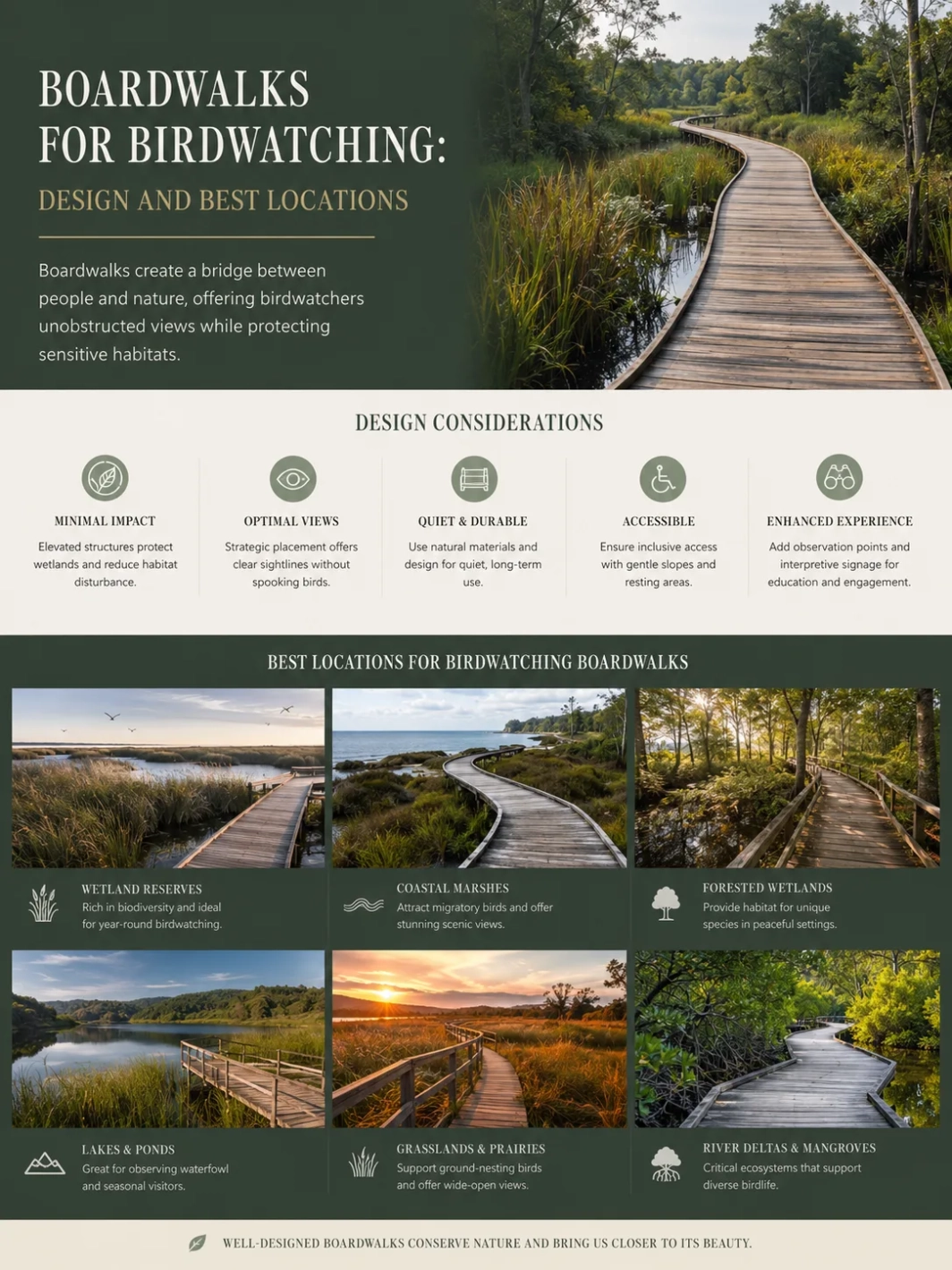
Best Feature: a quiet overlook where visitors can pause without blocking the route.
Watch Point: check official sources for closures, seasonal restrictions, pets, tides, insects, and hunting dates.
What Makes a Boardwalk Good for Birdwatching?
A birdwatching boardwalk is not just a walkway with a nice view. It works when the route lets people move slowly, stop safely, look outward, and stay away from nesting, feeding, or resting habitat. The practical difference usually appears in the surface, sightline, and how people are guided through the site.
The best birding routes often pass along habitat edges: open water beside reeds, wet meadow beside woodland, mudflat beside upland, or dune scrub beside beach. These edges give birds food and cover while giving visitors a clear viewing angle. A boardwalk also keeps feet off wet soil, marsh vegetation, dune plants, and fragile shoreline ground.
Accessibility note: Federal outdoor developed area guidance describes trail surfaces, passing spaces, and resting intervals as needing firm and stable surfaces, with surface openings limited so wheels, canes, and feet are not caught in gaps. Birding boardwalks benefit from the same logic because visitors often stop, turn, and look through binoculars rather than simply pass through. [a]
Design Features That Improve Birdwatching
| Design Feature | Why It Matters | Visitor Impact | Best Use |
|---|---|---|---|
| Viewing Platforms | Give people a place to stop without blocking the main line of travel | Binoculars, scopes, and photography are easier to manage | Open marsh, pond edge, salt marsh, and migration viewpoints |
| Quiet Decking | Loose boards, sharp echoes, and rattling railings can disturb the experience | Visitors move more calmly and can hear calls, wingbeats, and water movement | Forested wetlands and close-range birding routes |
| Railings or Edge Definition | Keep visitors on the route and discourage informal side paths | Habitat pressure is reduced and visitor movement becomes predictable | Wetlands, dunes, nesting areas, and soft soil sites |
| Rest Nodes | Allow longer observation without crowding narrow sections | Seniors, families, photographers, and slow walkers can pause comfortably | Long loops, accessible trails, and busy migration sites |
| Interpreted Sightlines | Signs can point out habitat zones instead of only naming species | Visitors understand why birds gather in certain places | Refuges, preserves, school group routes, and nature centers |
Design note: exact width, railing height, deck material, slope, and resting interval decisions depend on site conditions, local rules, water levels, environmental permits, and maintenance capacity. A public birding boardwalk should be reviewed by the land manager and qualified design professionals before construction or alteration.
Best Boardwalk Locations for Birdwatching
The strongest birdwatching boardwalks share a pattern: they are placed where birds already concentrate, and they manage visitor movement rather than pushing people directly into habitat. The locations below are supported by official park, refuge, conservation, or wildlife-agency sources.
| Boardwalk | Location | Main Setting | Best For | Access / Map Note | Official Source |
|---|---|---|---|---|---|
| Anhinga Trail | Everglades National Park, Florida, USA | Sawgrass marsh and freshwater slough | Close-range views of anhingas, herons, egrets, gallinules, turtles, and alligators | Royal Palm area; paved path and looping boardwalk; Open in Google Maps | [c] |
| Corkscrew Swamp Sanctuary Boardwalk | Naples area, Florida, USA | Western Everglades swamp, cypress forest, marsh, and wet prairie | Wading birds, songbirds, raptors, winter Painted Bunting, and shaded wetland walking | 375 Sanctuary Road West; 2.25-mile boardwalk; Open in Google Maps | [d] |
| Great Salt Lake Shorelands Preserve Boardwalk | Layton, Utah, USA | Freshwater marsh, mud flats, salt marsh, upland edge | American avocets, snowy plovers, black-necked stilts, ibis, and waterfowl | Visitor center near 3200 West; mile-long boardwalk and observation tower; Open in Google Maps | [e] |
| Potter Marsh Boardwalk | Anchorage, Alaska, USA | Freshwater marsh at Anchorage Coastal Wildlife Refuge | Waterfowl, yellowlegs, phalaropes, grebes, northern harriers, eagles, and seasonal salmon viewing | Potter Marsh parking area along Seward Highway; 1,550-foot wooden boardwalk; Open in Google Maps | [f] |
| Cape May National Wildlife Refuge Boardwalk Trails | Cape May Peninsula, New Jersey, USA | Salt marsh, maritime forest, dunes, grassland, and beach-edge habitat | Migration birding, wading birds, clapper rail habitat, and observation platforms | Two Mile Beach Unit and refuge trail system; accessible boardwalk segments and platforms; Open in Google Maps | [g] |
Location Notes From Real Birding Boardwalks
Anhinga Trail: Close-Range Wetland Viewing
Why it matters: this route shows how a short boardwalk can be highly useful when it crosses active water and marsh habitat. The National Park Service describes it as a pavement-and-boardwalk trail over sawgrass marsh and freshwater slough, with winter wildlife concentration along the route.
Access note: the route is listed by NPS as wheelchair accessible and 0.8 miles round trip. Because wildlife can be close to the path, visitors should stay on the route and avoid crowding animals.
Corkscrew Swamp: Long Loop Through Multiple Habitats
Why it matters: Corkscrew shows the value of a longer boardwalk that moves through several habitats without forcing visitors onto wet ground. Its 2.25-mile route gives birders time to scan cypress forest, marsh, and open wetland edges.
Visitor note: Audubon notes that the boardwalk is wheelchair accessible, but also warns that parts may be slippery when wet. This is a useful reminder that accessible design and day-of surface conditions are not the same thing.
Great Salt Lake Shorelands: Boardwalk Plus Tower
Why it matters: the preserve pairs a mile-long boardwalk with a 30-foot observation tower. That combination helps visitors watch open wetland birds from both low and elevated viewpoints while staying on a managed route.
Habitat note: pets are not permitted at the preserve. For birding sites, this rule is not just a visitor preference; it helps reduce pressure on nesting and migrating birds.
Potter Marsh: Short Boardwalk, High Wildlife Density
Why it matters: Potter Marsh shows that a birding boardwalk does not need to be long to be productive. The Alaska Department of Fish and Game describes a 1,550-foot wooden boardwalk crossing marsh openings and sedges used by waterfowl and other birds.
Safety note: visitors are advised not to disturb nesting waterfowl or migrating salmon. Birding boardwalks often share space with fish, mammals, and other wildlife, so route behavior matters beyond bird observation.
Accessibility and Visitor Flow for Birdwatching
Birdwatchers move differently from ordinary trail users. They pause, turn sideways, lift optics, point out birds, compare field marks, and sometimes stand in one place for several minutes. A narrow boardwalk can still work, but only if it includes wider places where people can step aside without leaving the route.
Wheelchairs: firm decking, manageable grades, and turning space matter more than scenic claims.
Scopes: wider overlooks reduce blockage when visitors set up tripods or spotting scopes.
Strollers: smooth transitions, railings, and rest nodes make family birding more practical.
Groups: school walks and guided birding need pull-off areas where a leader can stop safely.
Field note: if a source calls a route accessible, still check the official site before visiting. Storms, wet boards, construction, wildlife closures, beach restrictions, snow, hunting seasons, and insect conditions can change the actual visitor experience.
Habitat Protection and Birding Ethics
A boardwalk protects habitat only when visitors use it as intended. The route should make the correct behavior easy: stay on the path, pause at overlooks, avoid flushing birds, keep distance from nests, and follow posted restrictions. This is especially important at salt marshes, shorebird areas, rookeries, migration stopovers, and wetland edges.
Bird welfare note: the American Birding Association Code of Birding Ethics advises birders to avoid stressing birds, use restraint around nests and feeding sites, and limit recordings or other attraction methods, especially in heavily birded areas or around rare, threatened, or endangered species. [b]
Better Birdwatching Behavior on Boardwalks
| Do | Avoid | Why It Matters |
|---|---|---|
| Step into overlooks or wider deck areas before stopping for long views | Blocking the center of a narrow boardwalk | Other visitors can pass without pressure or noise |
| Use binoculars or a scope from the route | Leaning over rails or stepping off the deck | Marsh plants, dune vegetation, and nesting zones stay protected |
| Keep voices low near feeding or nesting birds | Calling loudly to move birds or get a photo | Bird behavior remains more natural |
| Check pet rules before arriving | Assuming dogs are allowed on wetland boardwalks | Many preserves restrict pets to reduce wildlife disturbance |
How to Choose a Birdwatching Boardwalk
For New Birders
Best fit: short loops with signs, benches, open water, and easy parking. Anhinga Trail and Cape May boardwalk segments are good models because birds can be visible without long hikes.
For Mobility Access
Best fit: boardwalks that publish accessible route notes, not just scenic descriptions. Look for firm surface language, accessible parking, railings, benches, and rest areas.
For Migration Trips
Best fit: locations on known flyways with marsh, forest edge, beach, or mudflat habitat. Arrive early, expect crowds, and use overlooks rather than stopping in narrow travel lanes.
For Photography
Best fit: wider platforms, railings that allow stable positioning, and clear sightlines. Avoid using the boardwalk edge as a place to crowd birds or block other visitors.
Visitor Checklist Before You Go
- Check the managing authority’s page for current access, closures, hunting dates, storm damage, construction, or beach restrictions.
- Bring binoculars before bringing a long camera setup; many birding boardwalks are narrow or busy.
- Wear shoes with traction because shaded wood, algae, rain, frost, or salt spray can make decking slick.
- Use insect protection at marshes and wetlands, especially in warm months.
- Respect no-pet rules, service animal policies, nesting closures, and signs asking visitors to stay on the boardwalk.
- Visit early morning for songbirds and quieter conditions; use official local guidance for seasonal bird movement.
Safety note: birding boardwalks can pass near water, wildlife, mud, exposed sun, wind, insects, or uneven transitions. Do not assume a short route is risk-free. Follow posted rules, keep children close, and give wildlife space.
Frequently Asked Questions
What is the best type of boardwalk for birdwatching?
The best type usually has a firm surface, open sightlines, quiet stopping areas, and viewing platforms near productive habitat. Wetlands, marshes, ponds, dunes, and coastal refuges often offer the strongest birding value.
Are birdwatching boardwalks usually wheelchair accessible?
Some are, but not all. Look for official wording about wheelchair access, firm surfaces, grades, accessible parking, and rest areas. A boardwalk can be flat in one section and still have slippery boards, narrow turns, or seasonal closures.
Why do many birding boardwalks restrict pets?
Pets can disturb feeding, nesting, resting, or migrating birds, even when leashed. Wetland preserves and refuges may restrict dogs to protect wildlife and keep bird behavior more natural near the route.
Is a longer boardwalk always better for birding?
No. A short boardwalk can be excellent if it crosses active habitat and gives clear viewing angles. Potter Marsh and Anhinga Trail show how compact routes can work well when birds use the habitat close to the path.
What should birders avoid on a boardwalk?
Avoid blocking narrow sections, stepping off the deck, crowding nests, using loud playback, feeding wildlife, or leaning over rails to get closer views. Use overlooks and wider spaces when stopping for longer observation.
When is the best time to visit a birdwatching boardwalk?
Early morning is often better for birds and quieter visitor conditions. Season matters more than time alone: spring and fall migration, winter waterbird concentration, nesting restrictions, and local tides can change what visitors see.
Resources Used
- [a] U.S. Access Board — Outdoor Developed Areas Guide — Used for firm and stable surface, passing space, resting interval, and outdoor route accessibility context. This is a federal accessibility source.
- [b] American Birding Association Code of Birding Ethics — Used for bird welfare, nest-distance, recording, and disturbance guidance. Hosted by Cornell’s bird conservation resources.
- [c] National Park Service — Anhinga Trail — Used for route length, setting, wheelchair-accessible note, and birding value at Everglades National Park. This is the official federal park source.
- [d] Audubon — Visit Corkscrew Swamp Sanctuary — Used for boardwalk length, address, accessibility, habitat, birding, and visitor condition notes. Audubon manages the sanctuary.
- [e] The Nature Conservancy — Great Salt Lake Shorelands Preserve — Used for preserve location, boardwalk length, observation tower, habitat, bird species examples, and pet restrictions. TNC manages the preserve.
- [f] Alaska Department of Fish and Game — Potter Marsh Wildlife Viewing — Used for boardwalk length, marsh habitat, bird species examples, wildlife notes, and safety guidance. This is the state wildlife agency source.
- [g] U.S. Fish & Wildlife Service — Cape May National Wildlife Refuge Trails — Used for trail, boardwalk, observation platform, salt marsh, and seasonal access details. This is the official federal refuge source.