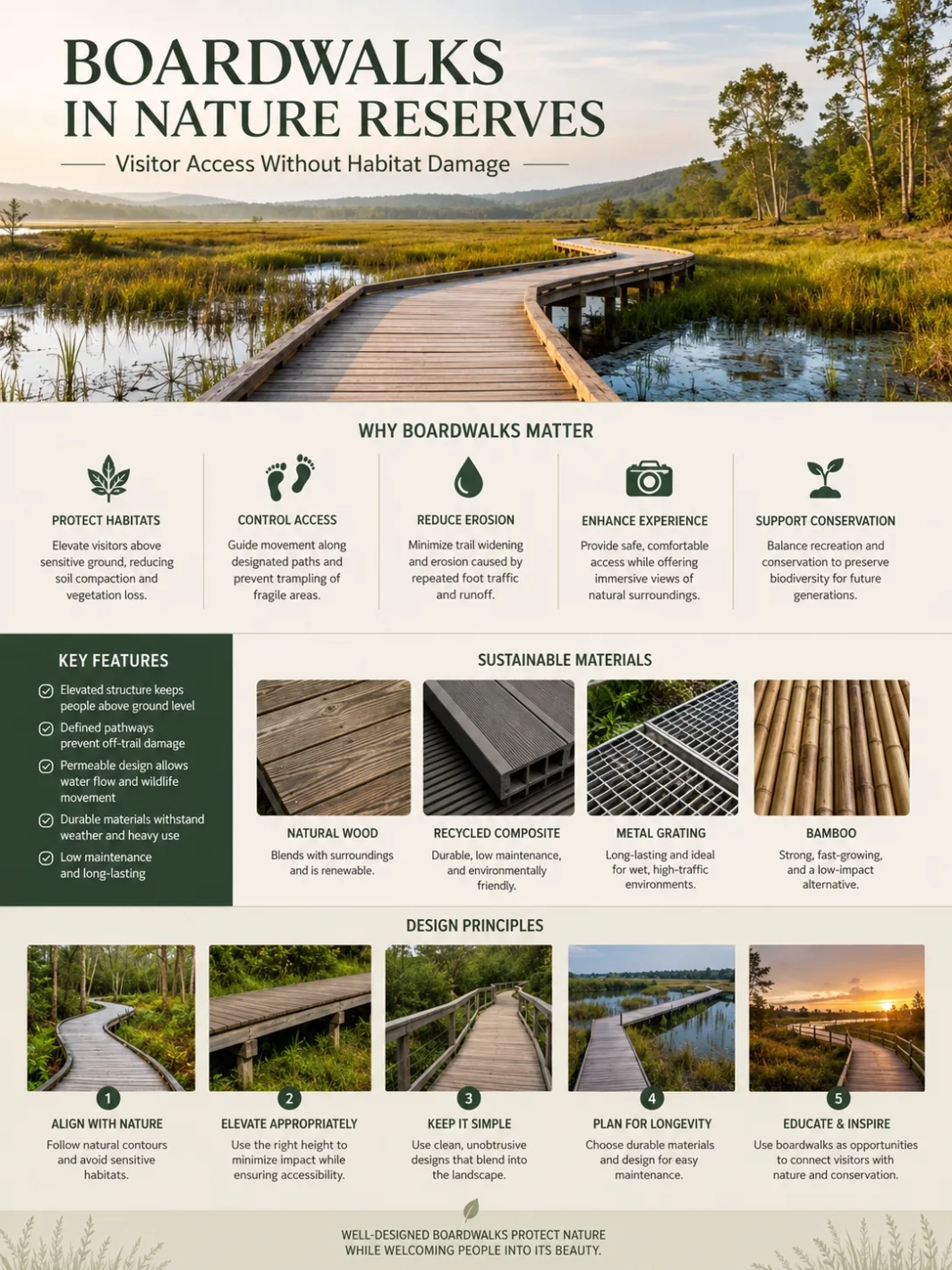
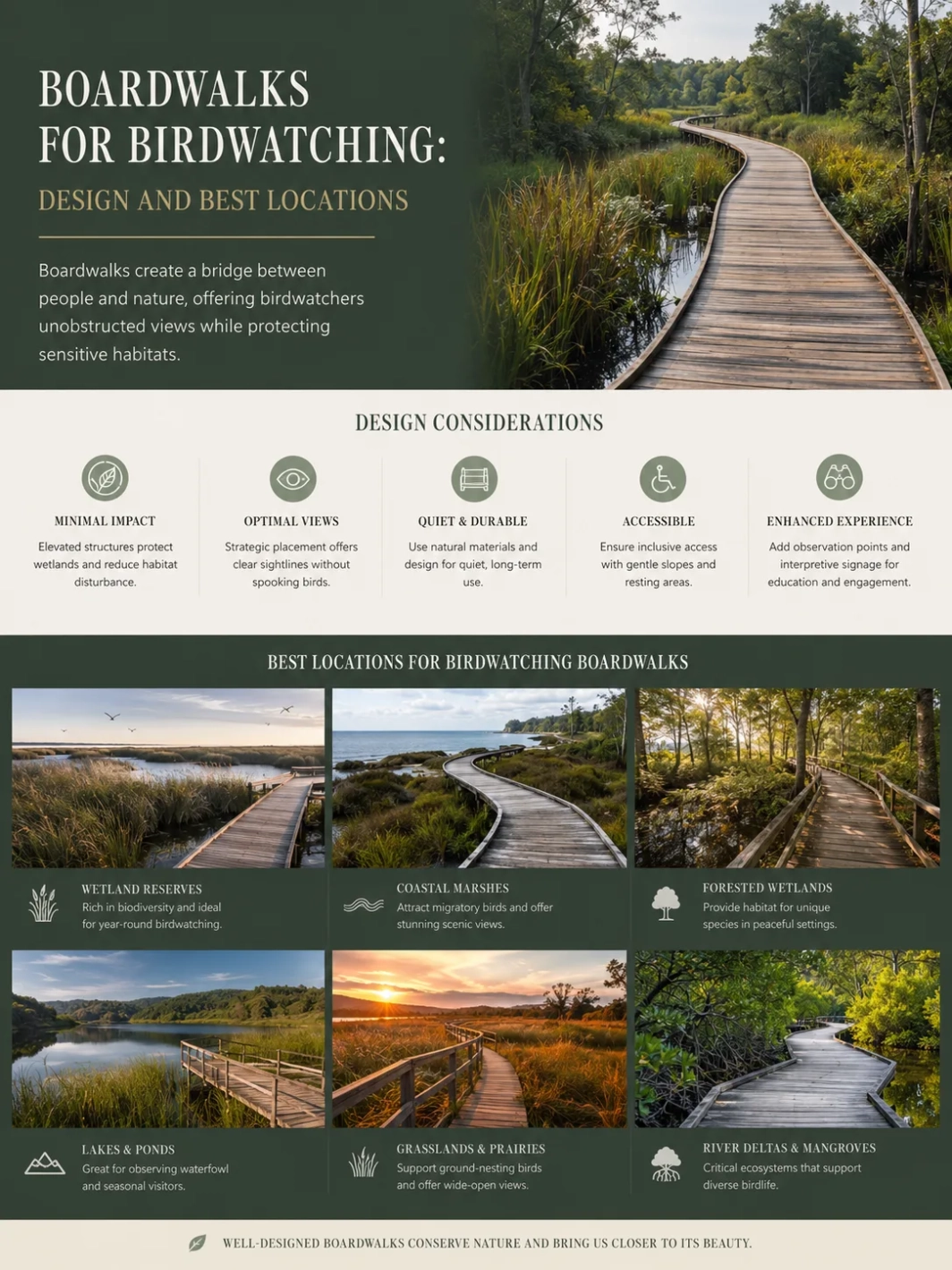
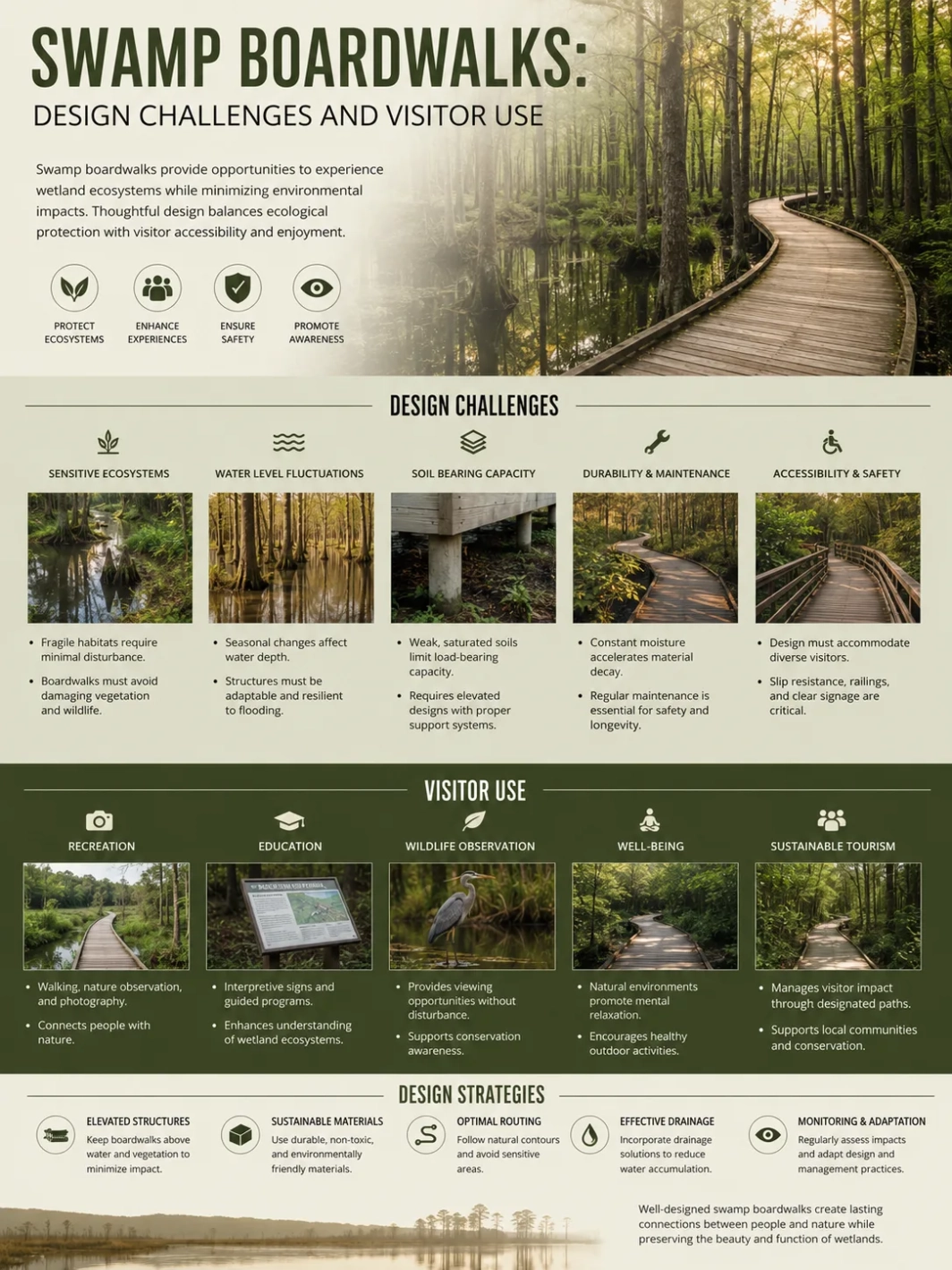
A wetland boardwalk is an elevated walking route built to guide visitors across saturated ground while reducing trampling, soil disturbance, and informal trail widening. Good design balances public access, wetland protection, accessibility, safe footing, drainage, durable materials, and site-specific permitting.
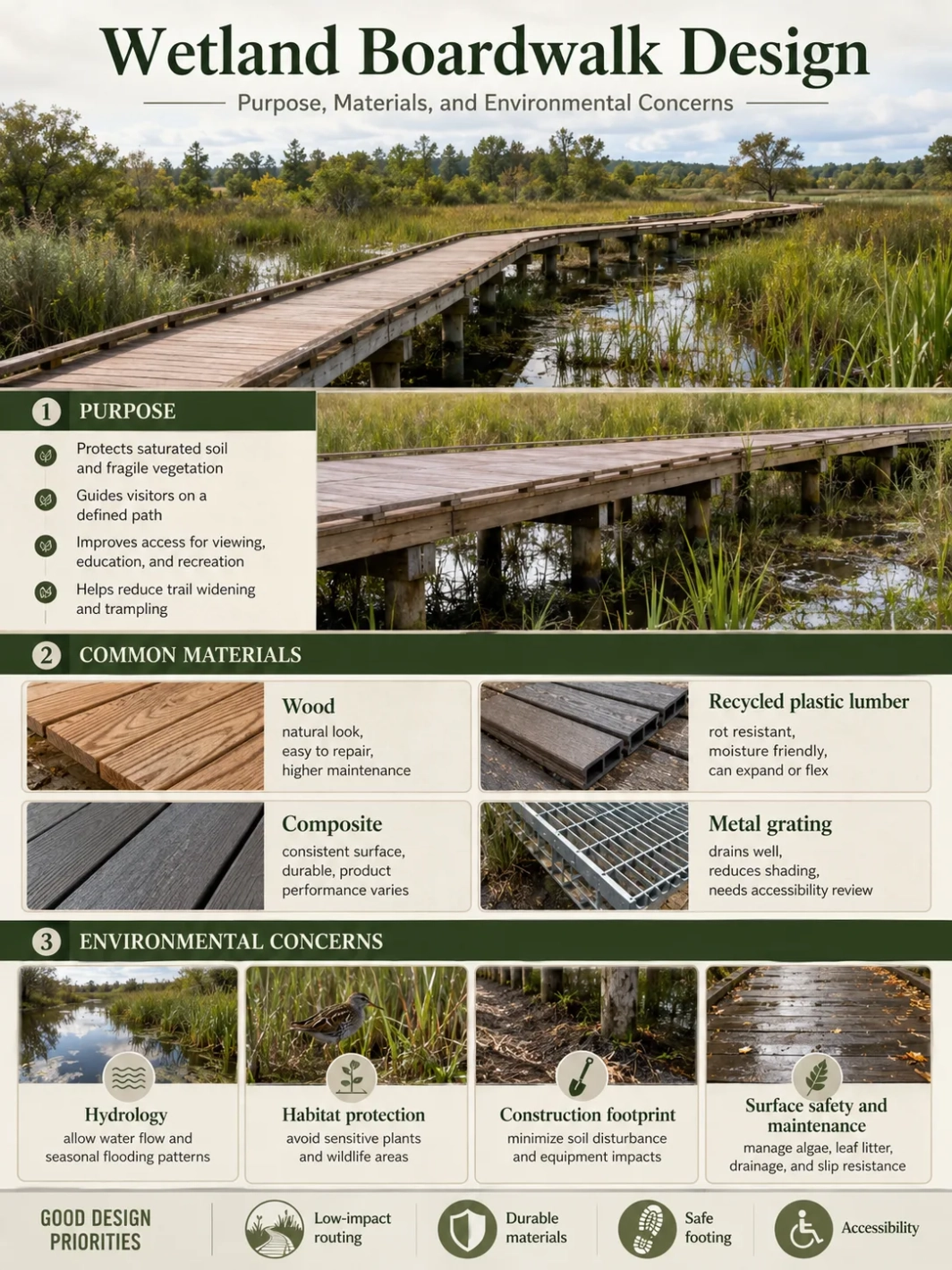
Wetlands are not ordinary trail settings. Water levels rise and fall, soils can be soft or organic, vegetation may be sensitive, and wildlife use can change by season. A boardwalk responds to those conditions by lifting people above the wet surface instead of forcing a compacted path through it. The best wetland boardwalks feel simple to the visitor, but they are carefully planned around hydrology, habitat, maintenance access, and visitor behavior.
The design goal is not just to “keep feet dry.” A wetland boardwalk can protect water quality, prevent shortcut trails, support birding and interpretation, and make a marsh, swamp, bog, fen, wet meadow, or bottomland forest easier to experience without treating the wetland as open ground. Wetlands provide water-quality improvement, flood storage, habitat, shoreline protection, recreation, and other public benefits, which is why access structures in these places should be modest, durable, and carefully routed [a].
Main Details for Wetland Boardwalk Design
| Design Area | What It Means | Why It Matters | Common Concern |
|---|---|---|---|
| Purpose | Creates a defined walking route above wet or sensitive ground. | Reduces trampling, informal paths, and direct contact with saturated soils. | A boardwalk should solve an access problem, not simply add a feature. |
| Route Alignment | Follows a path that avoids the most sensitive habitat where possible. | Helps limit vegetation removal, wildlife disturbance, and construction impacts. | The shortest route is not always the least damaging route. |
| Foundation Type | Uses piles, helical supports, sleepers, floating segments, or other systems depending on site conditions. | Supports the deck while responding to soft soils, water movement, and maintenance needs. | Local wetland rules and soil conditions can strongly affect what is allowed. |
| Decking Material | May use wood, recycled plastic lumber, composite decking, metal grating, or concrete in limited developed settings. | Affects slip resistance, heat, texture, maintenance, durability, and environmental footprint. | No single material is best for every wetland. |
| Accessibility | Considers width, surface firmness, slope, resting points, edge protection, and openings between boards. | Makes the route more usable for visitors with mobility devices, strollers, canes, or limited stamina. | Accessible design requires more than a flat-looking surface. |
| Environmental Review | Considers wetland permits, disturbance limits, construction access, erosion control, and mitigation. | Helps avoid damage to waters, vegetation, soils, and habitat. | Permitting can vary by jurisdiction and wetland type. |
What a Wetland Boardwalk Is Designed to Do
A wetland boardwalk is a controlled access structure. It keeps most visitor movement on a narrow, durable surface instead of letting foot traffic spread across saturated soils and plant communities. In busy parks, that single design choice can prevent a “braided” trail pattern where visitors step around muddy spots and slowly widen the disturbance area.
The boardwalk also creates predictable access for maintenance staff, educators, birders, photographers, school groups, and visitors who need a firmer walking surface. In a marsh or wet meadow, it can bring people close enough to see water, sedges, cattails, amphibians, dragonflies, and wetland birds without encouraging them to enter the habitat.
For land managers, the purpose should be stated before design begins. A wildlife-viewing boardwalk may need quiet overlooks and screened platforms. An educational boardwalk may need wider nodes for groups and interpretive signs. A short accessible loop near a visitor center may need benches, turning areas, and a surface that stays usable after rain. A maintenance route may need different load assumptions and access controls.
How Wetland Conditions Shape the Design
Wetland boardwalk design starts with the site, not the product catalog. The same deck board can perform well in one preserve and poorly in another because water depth, soil strength, sunlight, shade, leaf litter, freeze-thaw cycles, salt exposure, visitor volume, and wildlife use all change the way the structure ages.
Hydrology and Seasonal Water Levels
Hydrology is the first constraint. Some wetlands are wet year-round; others are seasonally saturated, flooded after storms, or dry enough to confuse casual visitors during part of the year. Boardwalk height should account for ordinary high water, seasonal flooding, drainage patterns, and the need to let water move under or around the structure.
A boardwalk that is too low can become submerged, slippery, or blocked by debris. A boardwalk that is much higher than needed can increase visual impact, require more railing, cast more shade, and feel less connected to the wetland. In sensitive sites, designers often aim for the lowest practical elevation that keeps the route functional and protects the resource.
Soils, Roots, and Support Systems
Wetland soils may be soft, organic, deep, or easily compacted. That affects whether a boardwalk uses driven piles, helical piles, shallow supports, floating sections, or a hybrid system. The right choice depends on geotechnical conditions, wetland rules, construction access, expected loads, and long-term maintenance needs.
In forested wetlands, route alignment should also account for tree roots and future growth. Cutting major roots can harm trees, but weaving too tightly around trunks can create narrow turns and maintenance problems. In open marshes, the concern may be different: shade, wildlife nesting areas, invasive plant spread, and disturbance from construction equipment.
Permits and Construction Footprint
Many wetland boardwalk projects require review before construction because work in, over, under, or near waters and wetlands may trigger federal, state, tribal, or local requirements. Under the Clean Water Act Section 404 program, discharging dredged or fill material into waters of the United States, including wetlands, can require a permit; the permit logic emphasizes avoiding impacts first, then minimizing them, then compensating for unavoidable impacts [b].
This does not mean every small boardwalk follows the same process. A city park, national wildlife refuge, private conservation area, coastal marsh, and forested freshwater wetland may face different requirements. The safe approach is to check the land manager and the relevant permitting agencies early, before assuming that a “light” boardwalk has no regulatory footprint.
Common Wetland Boardwalk Materials
Material choice affects more than appearance. It influences weight, maintenance intervals, traction, expansion gaps, heat in full sun, fastener performance, replacement difficulty, and how the boardwalk reads within the landscape. In wet settings, durability and serviceability matter as much as the initial cost.
| Material | Common Use | Strengths | Limits | Maintenance Level |
|---|---|---|---|---|
| Wood Decking | Nature trails, marsh loops, forested wetlands, interpretive routes. | Natural look, familiar walking feel, relatively easy to repair in sections. | Can weather, check, become slippery with algae, and vary by species and treatment. | Medium to high, depending on exposure and detailing. |
| Recycled Plastic Lumber | Wet, shaded, or high-moisture boardwalks where rot resistance is a priority. | Does not rot like untreated wood and can work well in damp settings. | Can expand, flex, retain heat, and require careful structural detailing. | Medium, with attention to fasteners and movement. |
| Composite Decking | Visitor boardwalks where a consistent manufactured surface is desired. | Consistent boards, potential durability, and reduced splinter concerns. | Product performance varies; some surfaces can still be slick when wet. | Medium, based on product and site exposure. |
| Metal Grating | Specialized sections where drainage, visibility, or reduced shading is desired. | Allows water and some light through, drains quickly, and can provide grip. | May feel uncomfortable for some users, can be noisy, and needs accessibility review. | Low to medium, depending on corrosion exposure. |
| Concrete or Paved Approaches | Trailheads, short approaches, overlooks, and transitions near parking or visitor facilities. | Firm surface, durable in developed settings, useful for access transitions. | Less suitable deep inside sensitive wetlands and may increase impervious surface. | Low to medium. |
Wood remains common because it fits visually into natural settings and is easy to work with, but it must be selected and detailed for moisture. USDA Forest Service research materials on wood as an engineering material discuss wood properties, moisture behavior, decay, preservatives, fastenings, and exterior use; those topics are directly relevant when timber is considered for damp outdoor structures [c].
Good detailing often matters as much as the material itself. Deck boards need drainage, fasteners must resist corrosion, transitions should not create trip edges, and replacement sections should be practical. In shaded wetlands, leaf litter and biofilm can make even durable materials slippery if maintenance is ignored.
Boardwalk, Trail Bridge, Puncheon, and Promenade: How They Differ
These terms overlap in casual use, but the distinctions help when planning a wetland route. A boardwalk is usually a raised walking surface that continues through wet, sandy, or sensitive ground. A trail bridge usually crosses a defined stream, ditch, ravine, or channel. A puncheon is a short raised trail structure often used over muddy or seasonally wet spots. A promenade is usually wider, more urban, and designed for social strolling along a waterfront or public edge.
| Feature | Wetland Boardwalk | Trail Bridge | Puncheon | Promenade |
|---|---|---|---|---|
| Main Purpose | Crosses saturated or sensitive ground over a longer route. | Crosses a specific gap, watercourse, or low area. | Carries a trail over a short muddy or wet section. | Supports wide public walking in a developed setting. |
| Typical Setting | Marsh, swamp, bog, fen, wet meadow, dune wetland, bottomland forest. | Creek, ravine, drainage channel, tidal inlet, or small stream. | Forest trail, wet meadow edge, seasonal seep, low trail segment. | Urban waterfront, beach edge, public park, commercial district. |
| Visitor Experience | Nature viewing, interpretation, birding, accessible outdoor access. | Short crossing point with a clear destination. | Functional dry-foot crossing, often minimal. | Social walking, seating, views, events, and civic access. |
| Design Emphasis | Habitat protection, route control, wetland hydrology, accessibility. | Span, structural safety, water flow, approach grades. | Low impact, simple construction, trail continuity. | Capacity, comfort, lighting, public realm, durability. |
Accessibility and Visitor Use
Accessible boardwalk design is not only about wheelchair users. A firm, predictable surface also helps people using canes, walkers, strollers, braces, or crutches. It helps older visitors, families with young children, and people who need resting points. In wetlands, accessibility also reduces the temptation to step off the route to avoid mud, puddles, or uneven ground.
The U.S. Access Board’s guidance for outdoor developed areas addresses trails, outdoor recreation access routes, boardwalk openings, running slopes, cross slopes, passing spaces, resting intervals, and protruding objects. For example, it states that openings in trail surfaces, including spaces between boardwalk planks, must be small enough that a sphere more than one-half inch in diameter cannot pass through, and it gives slope and resting-interval requirements for accessible routes [d].
For wetland boardwalks, the most visitor-facing accessibility elements are usually clear width, stable surface, gentle transitions, board gaps, passing spaces, edge protection, benches, overlooks, and clear trailhead information. If only part of a route is accessible, signs and web pages should say so plainly. Visitors should not discover a stair, narrow dirt segment, or steep grade only after they have already entered the boardwalk.
Surface Firmness and Stability
The surface should not shift, compress, or deform under typical use. The Forest Service accessibility guidebook explains firm and stable trail surfaces and notes that surfaces must be evaluated under the weather and use conditions expected during the managed season [e]. In a wetland, that means testing design assumptions against rain, shade, organic debris, frost, flooding, and visitor volume.
Edges, Railings, and Viewing Areas
Not every low boardwalk needs a full railing, but edge conditions should be deliberate. A raised curb may help keep mobility devices on the deck. Railings may be needed where the fall risk is greater, where the boardwalk crosses deeper water, or where visitor crowding is expected. Viewing platforms should allow people of different heights and mobility levels to see the wetland, not just the top rail.
Environmental Concerns in Wetland Boardwalk Design
A boardwalk can reduce visitor impact, but it is still a built structure in a sensitive environment. The main environmental concerns are vegetation removal, soil disturbance, shade, hydrologic change, wildlife disturbance, erosion, construction access, material leaching, litter, and long-term maintenance disturbance.
Route Choice and Habitat Avoidance
The route should avoid the most sensitive areas whenever practical. That may mean moving away from nesting habitat, rare plant communities, unstable soils, deep peat, or areas where construction access would cause more damage than the finished boardwalk prevents. In some wetlands, an edge route with selected overlooks may be better than a route through the center.
Shading and Vegetation Change
Boardwalks cast shade. In a forested wetland, this may be less noticeable. In an open marsh, bog, or fen, a long shaded strip can affect low vegetation below the deck. Wider decks, solid decking, and high railings can increase shade. Designers may consider narrower alignments, grated sections, or careful spacing where light-sensitive vegetation is a concern, subject to accessibility and safety review.
Construction Access and Soil Disturbance
The construction phase can cause more damage than the finished boardwalk if access is poorly planned. Temporary mats, hand-carried materials, low-ground-pressure equipment, seasonal timing, erosion controls, and staging outside the wetland can all reduce disturbance. The best method depends on site rules, soil strength, water depth, and the scale of the project.
Visitor Behavior and Informal Trails
A boardwalk should make the desired path obvious. Clear starts, comfortable widths, well-placed overlooks, and interpretive signs reduce the urge to step off the deck. If visitors want a view, a photo spot, or a resting place and the design does not provide it, they may create informal side paths that damage vegetation.
Safety and Maintenance Checklist
Wetland boardwalk maintenance should be planned before the first board is installed. Moisture, shade, algae, leaf litter, corrosion, flooding, and freeze-thaw movement can change the surface over time. A simple inspection routine helps managers find small problems before they become closures.
- Check deck boards for loose fasteners, popped screws, rot, cracking, warping, flexing, or uneven joints.
- Look for slippery areas caused by algae, wet leaves, mud, pollen, or shaded biofilm.
- Inspect railings, curbs, kick rails, transitions, benches, viewing platforms, and interpretive signs.
- Confirm that drainage gaps are open and not packed with debris.
- Watch for settlement, tilted supports, floating debris, erosion around approaches, or scouring near water flow paths.
- Trim vegetation only where needed for clearance, visibility, safety, and resource management.
- Review trailhead notices after storms, seasonal flooding, snow, ice, or wildlife management closures.
- Document recurring wet spots or damage patterns so repairs address the cause, not only the symptom.
Seasonal conditions should be described honestly on official trail pages and signs. If a boardwalk can be icy in winter, slick after rain, flooded after storms, or partly inaccessible during vegetation growth, that information helps visitors choose safely and protects the site from avoidable damage.
Real Wetland Boardwalk Examples
Real examples show how design choices respond to different places. At Sand Point Marsh Trail in Pictured Rocks National Lakeshore, the National Park Service describes a half-mile wheelchair-accessible flat interpretive loop where most of the trail is a wooden boardwalk crossing wetland habitats and old dune ridges, with a paved portion completing the loop [f]. This is a good example of a wetland boardwalk used for interpretation, birding, and controlled access.
At Rio Grande Village Nature Trail in Big Bend National Park, the first 100 yards are described by the National Park Service as wheelchair accessible and crossing a spring-fed wetland on a mostly level boardwalk about four feet wide, with recycled plastic boards, metal railings, open platforms, and benches [g]. That example shows how material choice, benches, platforms, and a limited accessible segment can support wildlife viewing in a water-rich area within an otherwise arid park.
These examples are not universal templates. They show that wetland boardwalks can be short, interpretive, accessible, wildlife-focused, seasonal, or connected to a larger trail. Each site still needs its own review of soils, water, habitat, visitor demand, maintenance capacity, and managing authority requirements.
Design Questions Before Building or Replacing a Wetland Boardwalk
- What visitor problem is the boardwalk solving: wet trail, habitat protection, accessible access, education, safety, or route control?
- Which agency, park, refuge, preserve, municipality, or landowner manages the wetland?
- Are there federal, state, tribal, or local wetland permits or environmental reviews required?
- What are the normal, seasonal, and storm-related water levels?
- Can the route avoid the most sensitive vegetation, wildlife areas, and unstable soils?
- How will materials and equipment reach the work area without widening the disturbance zone?
- What surface width, passing space, resting point, edge protection, and slope are needed for the intended visitors?
- Which material can be repaired locally and maintained within the manager’s budget?
- How will the structure be inspected after floods, storms, ice, or heavy visitor use?
- What information should visitors see before they arrive, including closures, seasonal access, pets, bikes, or wheelchair notes?
Frequently Asked Questions
What Is the Main Purpose of a Wetland Boardwalk?
The main purpose is to provide a defined walking route across wet or sensitive ground while reducing trampling, mud widening, soil compaction, and disturbance to vegetation and wildlife habitat.
What Is the Best Material for a Wetland Boardwalk?
There is no single best material. Wood, recycled plastic lumber, composite decking, metal grating, and paved approaches can all work in the right setting. The best choice depends on water exposure, shade, visitor use, maintenance capacity, accessibility needs, and local environmental rules.
Do Wetland Boardwalks Need Permits?
Many projects do, especially when work affects wetlands, waters, soil, fill, vegetation, or construction access. Requirements vary by location, wetland type, land ownership, and project method, so the managing authority and relevant agencies should be checked before design is finalized.
Can a Wetland Boardwalk Be Wheelchair Accessible?
Yes, many wetland boardwalks are designed for wheelchair access. Usability depends on clear width, firm and stable surface, slope, cross slope, board openings, passing spaces, resting areas, transitions, and accurate visitor information.
Are Boardwalks Bad for Wetlands?
A poorly routed or poorly built boardwalk can harm wetlands, especially during construction. A carefully planned boardwalk can reduce visitor trampling, protect sensitive soils, guide access, and support education while keeping most people on a controlled path.
Why Do Some Wetland Boardwalks Become Slippery?
Wet shade, algae, leaf litter, pollen, mud, ice, and worn deck texture can make surfaces slippery. Regular inspection, cleaning, drainage, material selection, and seasonal visitor warnings help reduce the problem.
Resources Used
- [a] Why are Wetlands Important? | US EPA — Used for wetland functions such as water quality, flood storage, habitat, shoreline protection, recreation, and ecological value. This is reliable because it is an official U.S. Environmental Protection Agency resource.
- [b] Permit Program under CWA Section 404 | US EPA — Used for the general explanation of dredged or fill material, wetlands, avoidance, minimization, and compensation in Section 404 permitting. This is reliable because it is an official EPA regulatory information page.
- [c] Wood Handbook: Wood as an Engineering Material | US Forest Service Research and Development — Used for background on wood properties, moisture, decay, preservatives, fastenings, and exterior-use considerations. This is reliable because it is published by the USDA Forest Service Forest Products Laboratory.
- [d] Chapter 10: Outdoor Developed Areas | U.S. Access Board — Used for boardwalk openings, accessible trail design, slope, cross slope, passing spaces, and resting interval concepts. This is reliable because the U.S. Access Board is the federal agency responsible for accessibility guidelines.
- [e] Accessibility Guidebook for Outdoor Recreation and Trails | USDA Forest Service — Used for firm and stable trail surface logic, tread obstacles, openings, and outdoor accessibility considerations. This is reliable because it is a USDA Forest Service technical guidebook.
- [f] Sand Point Marsh Trail | U.S. National Park Service — Used as a real wetland boardwalk example with a wheelchair-accessible interpretive loop, wooden boardwalk, paved section, and wetland habitat context. This is reliable because it is an official National Park Service place page.
- [g] Birdwatch at Rio Grande Village Nature Trail | U.S. National Park Service — Used as a real example of a spring-fed wetland boardwalk with recycled plastic boards, railings, open platforms, benches, and a partially accessible route. This is reliable because it is an official National Park Service activity page.