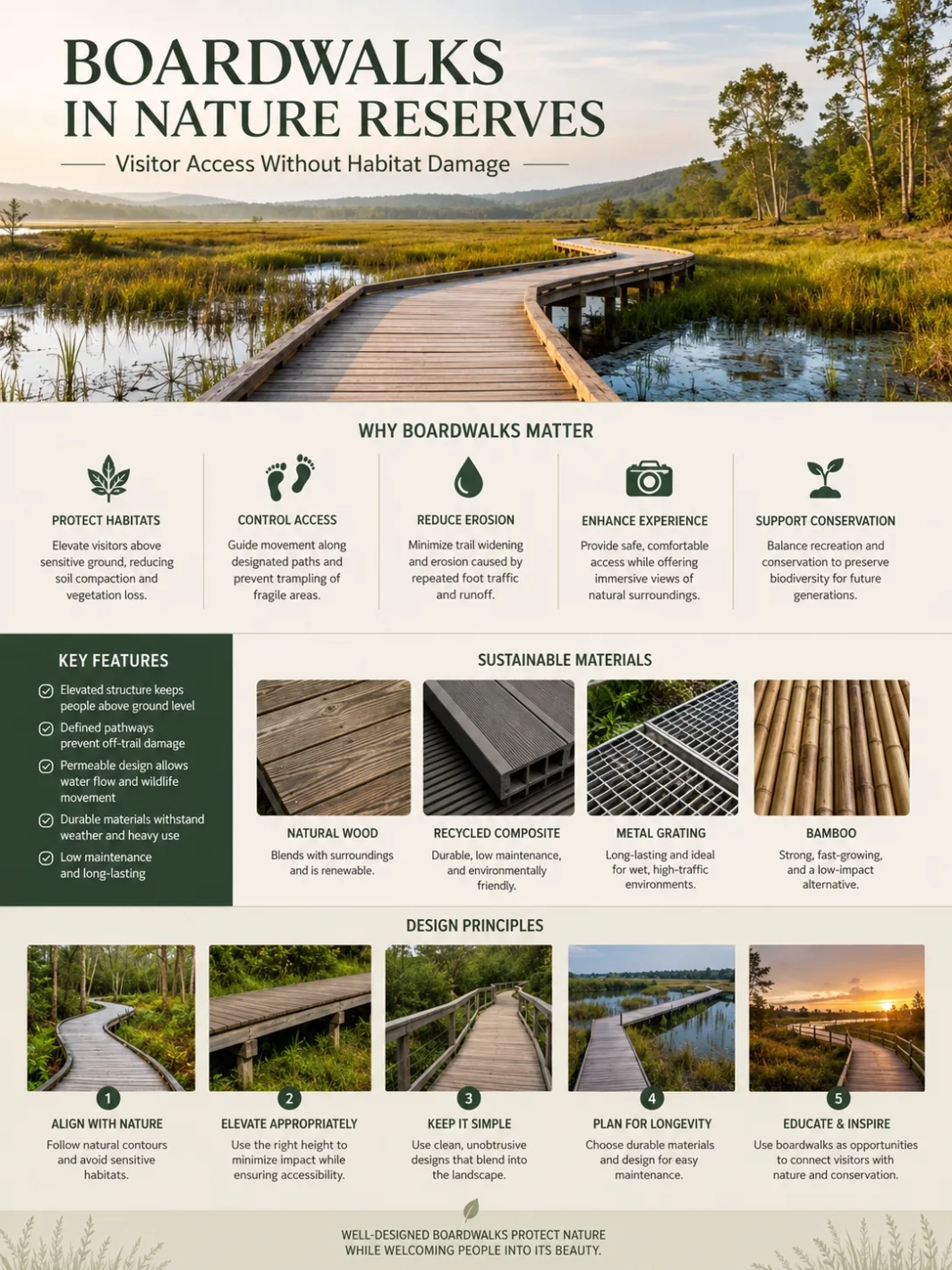
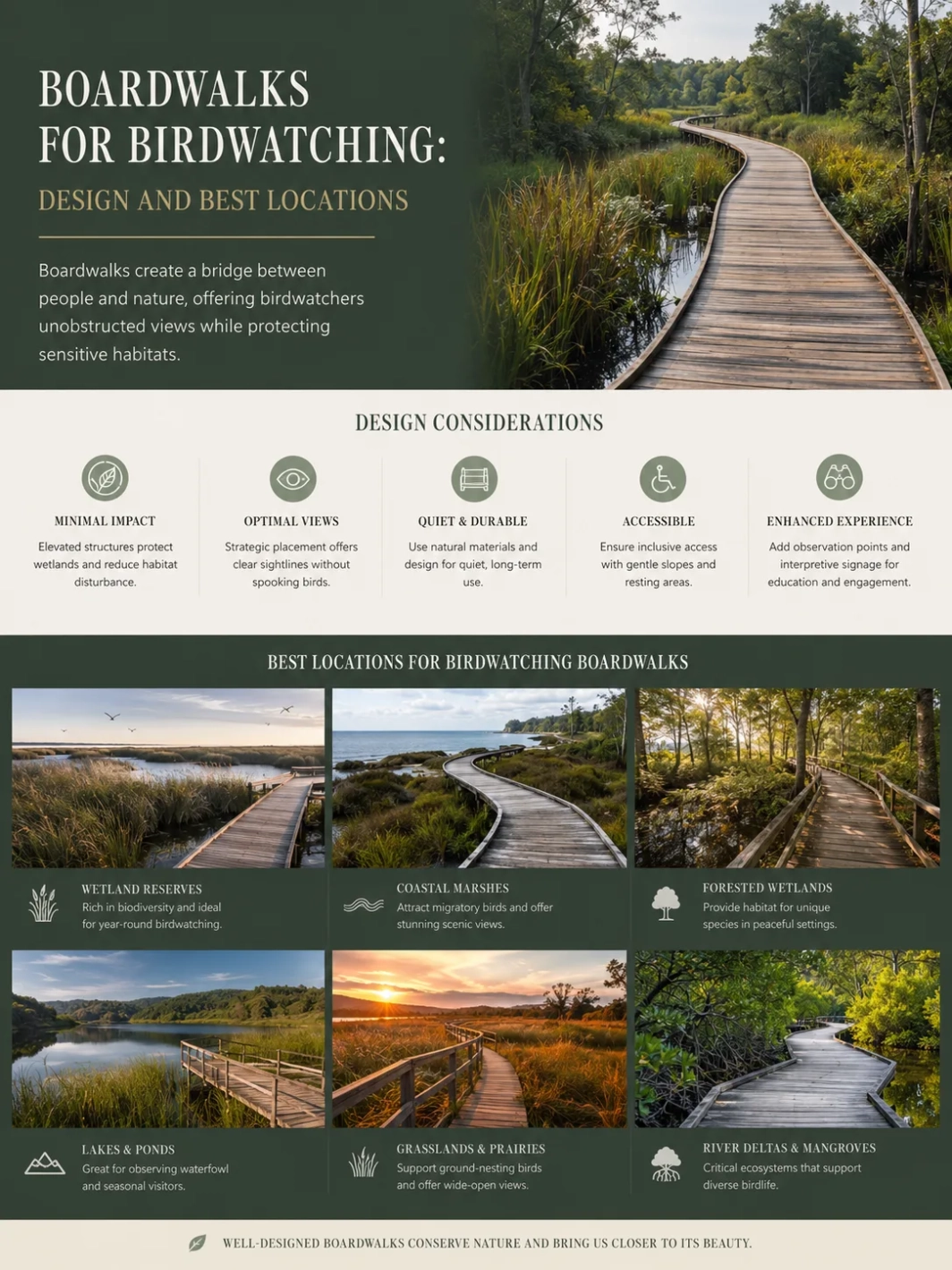
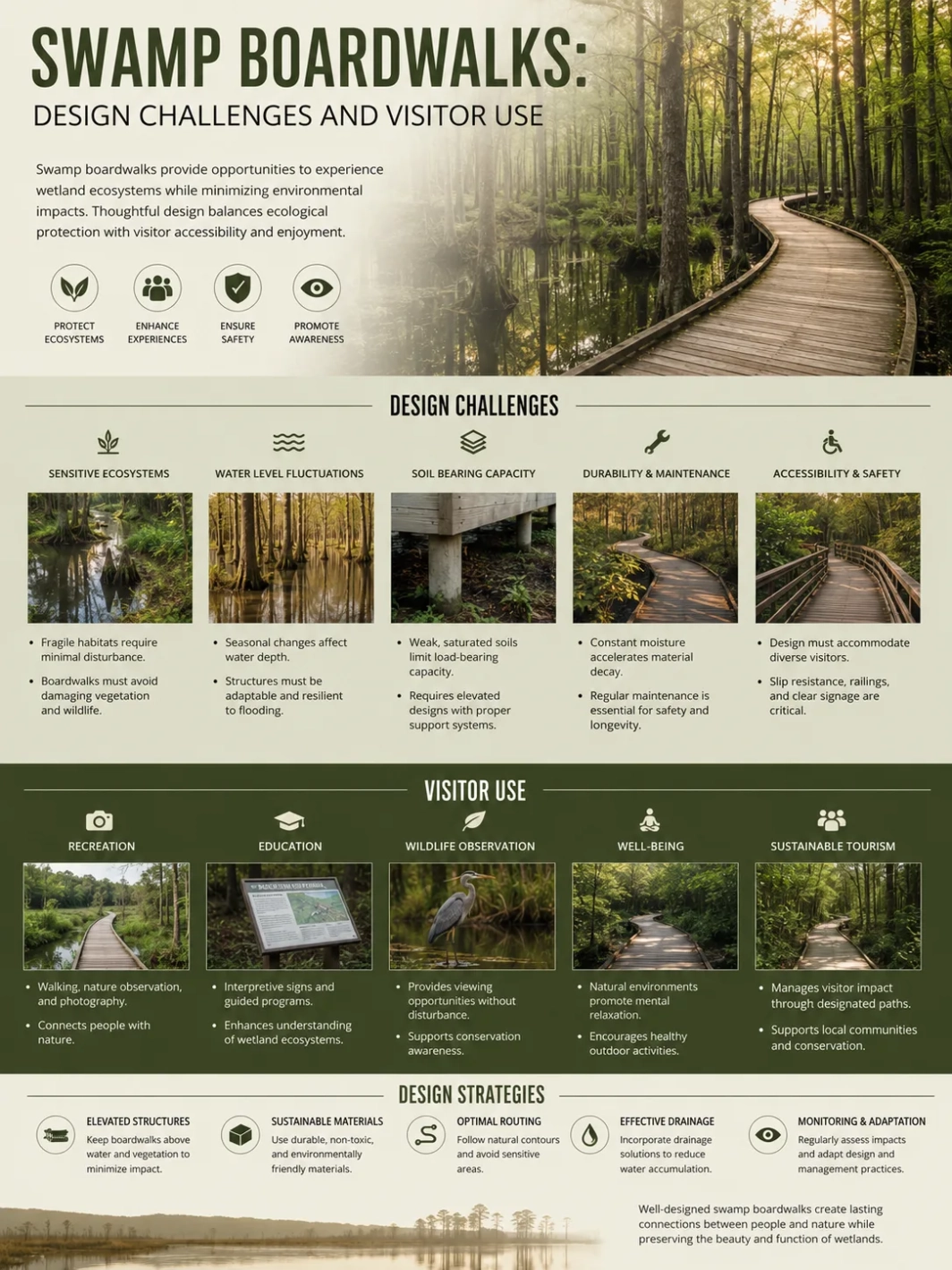
Wetland boardwalks are used because they let people cross marshes, swamps, bogs, sloughs, and other wet ground without trampling fragile soils, damaging plants, or forcing visitors through mud and standing water. A good wetland boardwalk protects the site while giving visitors a safer, clearer, and more accessible route.
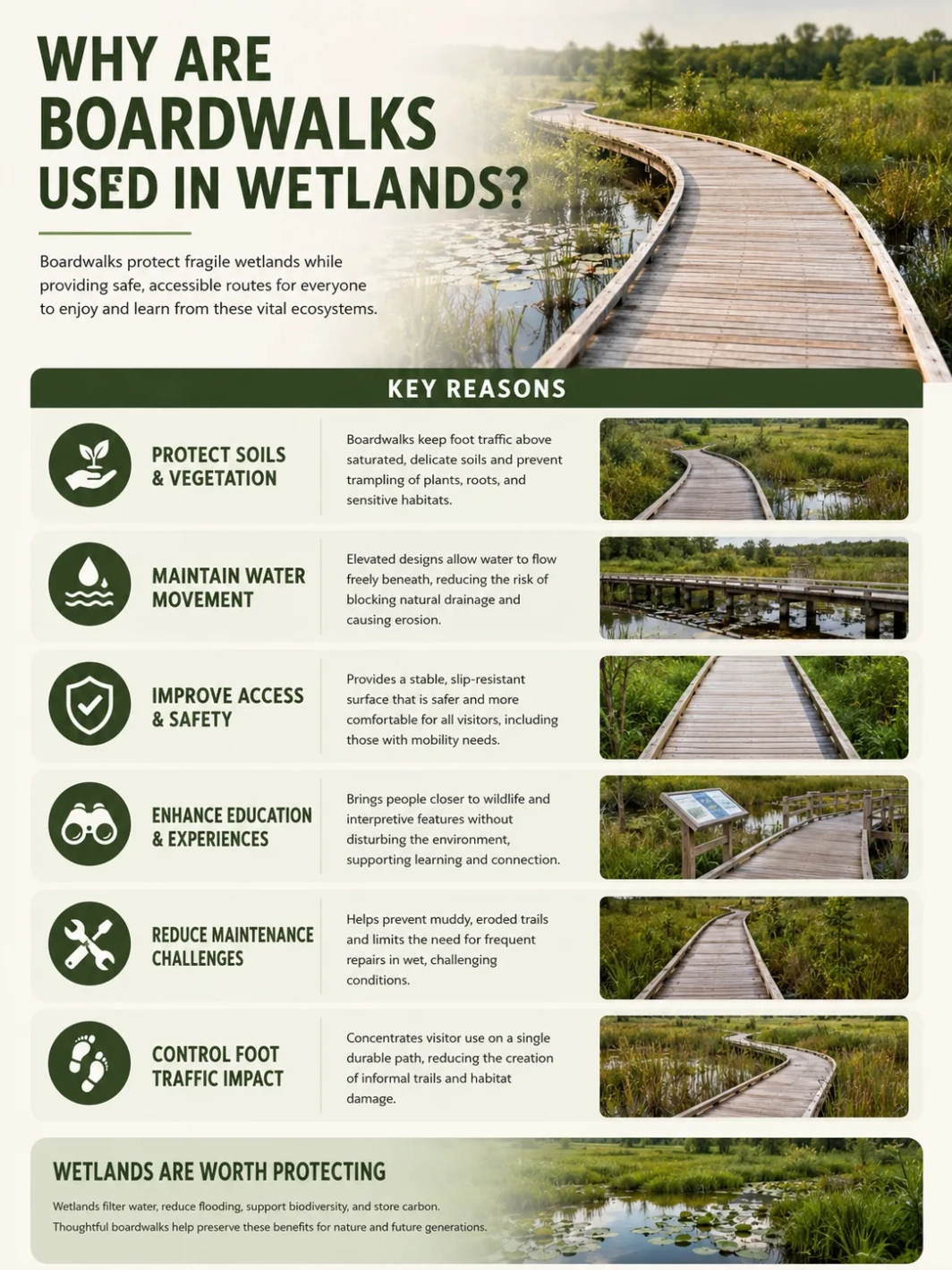
That simple answer explains most wetland boardwalks, but it does not explain all of them. In many parks, refuges, preserves, and coastal areas, a boardwalk is also an interpretation tool, a wildlife-viewing platform, a drainage solution, an accessibility feature, and a way for land managers to keep foot traffic in one narrow corridor instead of letting it spread across sensitive habitat.
Main Details
| Purpose | What It Means | Wetland Benefit | Visitor Benefit |
|---|---|---|---|
| Protect Soft Soils | Raises foot traffic above saturated ground. | Reduces rutting, compaction, and informal side paths. | Keeps the route drier and easier to follow. |
| Protect Plants | Channels visitors onto one built surface. | Limits trampling of sedges, reeds, mosses, cypress knees, marsh grasses, and dune vegetation. | Allows close views without stepping into habitat. |
| Maintain Water Movement | Uses elevated spans, gaps, piles, or piers instead of a continuous fill path. | Can reduce blockage of shallow water flow when designed properly. | Lets people cross wet areas that would otherwise be muddy or flooded. |
| Improve Access | Creates a more predictable walking surface. | Concentrates use on a managed route. | May support wheelchair, stroller, cane, and low-mobility access when built to applicable standards. |
| Support Education | Places visitors close to wetland zones, wildlife, and interpretive signs. | Builds public understanding of wetland value. | Makes birding, photography, and nature learning easier. |
| Reduce Maintenance Problems | Separates the trail surface from mud, roots, and seasonal wetness. | Helps prevent trail widening and repeated muddy repairs. | Creates a clearer route during wet seasons. |
Why Wetlands Need a Different Kind of Trail
Wetlands are not simply “wet land.” They are living transition zones shaped by water, soil, plants, and wildlife. The U.S. Environmental Protection Agency describes wetlands as landscapes that help protect and improve water quality, provide wildlife habitat, store floodwaters, and maintain surface water flow during dry periods [a].
Those same traits make ordinary trails difficult. A dirt path that works well in an upland forest may fail in a marsh or swamp. Saturated soils can deform under repeated foot traffic. Roots may be exposed. Water may move across the route after rain, tides, snowmelt, or seasonal flooding. Visitors often walk around puddles, and those small detours can slowly widen a trail into a disturbed strip of mud and trampled vegetation.
A boardwalk solves the problem by moving the walking surface above the wetland rather than forcing the wetland to behave like dry land. Instead of draining, filling, or hardening a larger area, land managers can often use a narrower constructed route that crosses the wettest sections with less direct contact between visitors and the soil.
How Boardwalks Protect Wetland Soil and Vegetation
The main environmental reason for using a boardwalk is traffic control. Wetland soils are often soft, organic, loose, or saturated. Once repeated steps break the surface, the damage can hold water, attract more detours, and make recovery slow. A raised deck keeps shoes, strollers, and mobility devices on a durable surface instead of on fragile ground.
Vegetation protection is just as important. In a marsh, visitors may step on sedges, rushes, cattails, reeds, or young wetland plants without realizing how much pressure they are adding. In a bog, sphagnum moss and floating mats can be extremely sensitive. In a cypress swamp, roots and knees may sit close to the walking route. In a coastal wetland, boardwalks can help keep people off marsh grass and dune vegetation that stabilizes sand and habitat edges.
A boardwalk does not make a wetland impact-free. Its posts, shade, construction access, and visitor use still need planning. The value is that it concentrates disturbance in a known, managed corridor instead of allowing thousands of small, uncontrolled impacts across a wider area.
Why Elevation Matters in Wet Areas
Elevation is the feature that separates many wetland boardwalks from ordinary paths. The USDA Forest Service describes several wetland trail structures, including turnpikes, puncheon, bog bridges, and boardwalks. In that manual, a boardwalk is treated as a more developed structure with spaced bents or piers, stringers, decking, and often curbs or handrails [b].
Raising the walking surface can help in four practical ways. It keeps visitors above mud and shallow water. It reduces the temptation to create side trails. It can allow water and small wildlife to pass under or around the route when designed with the site hydrology in mind. It also gives visitors a better line of sight across reeds, water channels, open marsh, or swamp forest.
The right height depends on the wetland. A low bog bridge may be enough for a backcountry route across a wet meadow. A heavily visited interpretive wetland near a visitor center may need a wider boardwalk with railings, stronger foundations, and more formal accessibility planning. A tidal marsh or floodplain may need careful review of water levels, debris movement, scour, and seasonal closures.
Boardwalks, Puncheon, Bog Bridges, and Turnpikes
People often call every wooden wetland walkway a boardwalk, but trail builders use more precise terms. The names can vary by region, yet the basic differences help explain why one wetland trail may look like a narrow plank path while another looks like a full visitor boardwalk.
| Structure | Simple Meaning | Common Use | Main Limitation |
|---|---|---|---|
| Boardwalk | A raised walking structure supported by piers, bents, piles, or similar foundations. | Visitor centers, interpretive wetland trails, high-use marshes, swamp loops, and accessible nature routes. | Can be costly, exposed to flood debris, and dependent on careful structural design. |
| Puncheon | A simple wooden walkway over wet ground, often lower and more rustic than a formal boardwalk. | Bogs, muskeg, muddy forest sections, and wet trail segments where drainage is difficult. | May be narrow and may not meet accessibility expectations without added design work. |
| Bog Bridge | A low plank or short-span bridge system close to the ground. | Backcountry wet areas, mossy ground, and short wet crossings. | Can feel narrow and may not suit heavy visitor traffic. |
| Turnpike | An elevated fill trail with drainage, often built above the surrounding water table. | Seasonally wet ground where drainage and stable fill are practical. | Not suitable for every wetland, especially where grading or drainage would harm the site. |
| Causeway | A hardened raised route, sometimes similar to a turnpike but without the same drainage approach. | Wet areas where a durable tread is needed and groundwater saturation is less severe. | May interrupt water movement if poorly planned. |
The best choice is site-specific. Soil depth, water movement, visitor volume, equipment access, flood risk, protected species, and the managing authority’s goals all matter. For public sites, construction may also require environmental review, permits, and professional design input.
Accessibility Benefits of Wetland Boardwalks
Wetlands can be hard to access without a constructed route. Mud, exposed roots, narrow tread, standing water, soft shoulders, and uneven surfaces can exclude visitors who use wheelchairs, walkers, canes, strollers, or who simply need a steadier place to walk.
The U.S. Access Board’s outdoor developed areas guidance says trail surfaces, passing spaces, and resting intervals must be firm and stable where the applicable standards apply. It also recognizes that outdoor settings can have terrain, environmental, legal, and construction constraints that affect what is practicable [c].
Boardwalks can help meet that need because the walking surface can be built flat, continuous, and predictable. They can include edge protection, passing areas, overlooks, benches, railings, interpretive panels, and connections to accessible parking or visitor facilities. The details matter. A boardwalk with large gaps, abrupt changes in level, slick decking, or missing passing spaces may still be difficult for many users.
The Forest Service accessibility guidebook notes that openings in trail surfaces, including spaces between planks on a boardwalk, can become hazards when wheels, cane tips, crutch tips, or shoe heels can drop through; it allows openings up to 1/2 inch in trail surfaces under that guidance [d].
Safety Reasons for Using Boardwalks in Wetlands
Wetlands are beautiful, but they can be hard to read from the ground. A shallow-looking muddy edge may be deeper than expected. A vegetated mat may not be solid. Roots, algae, wet leaves, ice, and shaded planks can create slipping risks. A boardwalk gives visitors a defined route and makes the expected walking line obvious.
Safety design is not only about railings. It also includes deck texture, drainage gaps, turning space, sightlines, edge curbs, transitions from land to deck, warning signs, seasonal closure systems, and maintenance access. In wildlife areas, a boardwalk also helps maintain distance from water edges, nesting zones, reptiles, or other animals without turning the experience into a fenced-off exhibit.
Visitors still need to use care. Wet boards can be slippery. Railings should not be climbed. Children should stay close to adults. In many wetlands, pets may be limited or prohibited to protect wildlife and prevent disturbance. If a park posts seasonal rules, closures, or wildlife warnings, those notices should be treated as part of the boardwalk experience, not as optional advice.
Real Examples of Wetland Boardwalk Use
One of the clearest examples is the Anhinga Trail in Everglades National Park. The National Park Service describes it as a self-guided pavement and boardwalk trail through sawgrass marsh and freshwater slough, with views of alligators, fish, turtles, anhingas, and other birds. The route is listed as 0.8 miles round trip and begins at the Royal Palm visitor area [e].
Another useful example is Sand Point Marsh Trail at Pictured Rocks National Lakeshore. The National Park Service describes it as a half-mile, wheelchair-accessible, flat interpretive loop where most of the route is a wooden boardwalk crossing wetland habitats and old dune ridges. This shows how a boardwalk can combine access, habitat protection, birding, and interpretation in one short route [f].
National wildlife refuges use the same logic. At Pocosin Lakes National Wildlife Refuge, the U.S. Fish & Wildlife Service describes the Scuppernong River Interpretive Boardwalk as an accessible loop through a cypress swamp, with interpretive signs that help visitors look, listen, and learn about the habitat [g].
Design Features That Matter Most
A wetland boardwalk is not just a row of boards. Good design starts with the wetland itself. The route should avoid the most sensitive plants and wildlife areas where possible. It should respect natural water movement. It should connect logically to trailheads, parking areas, overlooks, visitor centers, or other access points without creating confusing shortcuts.
- Surface: Decking should provide a firm, stable walking surface suited to expected weather and use.
- Elevation: The structure should sit high enough for wet conditions, but not higher than necessary without a clear reason.
- Foundations: Sleepers, piles, piers, or helical supports may be used depending on soil, water, span, and load.
- Drainage and Flow: The design should avoid blocking water, trapping debris, or forcing water into new erosion paths.
- Edges: Curbs, railings, or edge protection may be needed where there is height, water, visitor volume, or accessibility concern.
- Viewing Areas: Small widened overlooks can reduce crowding and keep people from stopping in the main walking lane.
- Maintenance Access: Crews need a way to inspect decking, fasteners, rails, vegetation, and flood damage safely.
Materials vary. Wood is common because it is familiar, workable, and visually compatible with natural settings. Recycled plastic lumber, composite decking, steel framing, fiberglass grating, and concrete elements may appear in some projects. Each material has tradeoffs in cost, slip behavior, heat, lifespan, repairs, weight, environmental setting, and local rules.
Maintenance Issues Wetland Boardwalks Face
Wetland boardwalks usually need regular inspection because they sit in damp, shaded, flood-prone, or biologically active places. Moisture can speed decay in wood. Floodwater can move debris against posts and railings. Shade can encourage algae or leaf buildup. Freeze-thaw cycles can shift transitions. Fasteners may corrode faster in coastal or treated-wood environments.
Maintenance is also a visitor-management issue. A missing board, loose rail, tilted transition, or slippery section can quickly affect access. Land managers may close sections temporarily after flooding, storms, high water, or construction. For any specific wetland trail, current hours, parking rules, closures, and fees should be checked on the official managing agency’s page because those details can change by season and site condition.
Simple Visitor Etiquette on Wetland Boardwalks
- Stay on the boardwalk, even when the ground beside it looks dry.
- Do not pick plants, disturb nesting areas, or move signs and barriers.
- Keep noise low when watching birds, reptiles, amphibians, and mammals.
- Use railings for balance, not as seating or climbing areas.
- Let faster walkers pass at wider areas or overlooks.
- Check official alerts before visiting after storms, floods, hurricanes, heavy rain, or winter weather.
- Follow posted pet rules; many wetland boardwalks limit pets to protect wildlife.
Frequently Asked Questions
Why not just build a normal dirt trail through a wetland?
A normal dirt trail can become muddy, compacted, widened, and unstable in saturated soils. A boardwalk keeps visitors on a defined route and can reduce direct trampling of wetland plants and soil.
Do boardwalks harm wetlands?
They can if poorly planned, but a carefully designed boardwalk often reduces broader visitor impact by concentrating foot traffic. Route choice, foundations, shade, water flow, construction methods, and long-term maintenance all affect the result.
Are wetland boardwalks always wheelchair accessible?
No. Some are fully accessible, some are partly accessible, and some rustic wetland walkways are narrow or uneven. Accessibility depends on surface firmness, width, slope, gaps, transitions, passing space, and the standards used by the managing authority.
Why are some wetland boardwalks closed after storms?
Storms and floods can move debris, loosen boards, shift approaches, damage railings, or leave slippery material on the deck. Temporary closures allow managers to inspect and repair the route before reopening it.
What materials are best for wetland boardwalks?
There is no single best material. Wood, composite, recycled plastic lumber, steel, fiberglass, and concrete can all be used in different settings. The right choice depends on water level, soil, visitor volume, climate, budget, maintenance capacity, and local environmental requirements.
Why do some boardwalks have railings and others do not?
Railings depend on height, visitor use, risk near water, accessibility goals, local rules, and the character of the site. A low backcountry bog bridge may have no railing, while a high-use visitor boardwalk may need curbs, rails, overlooks, or edge protection.
Resources Used
- [a] Why Are Wetlands Important? | US EPA — Used for wetland functions, including water quality, habitat, floodwater storage, and dry-period surface flow. (Reliable because it is an official U.S. Environmental Protection Agency wetland resource.)
- [b] Wetland Trail Design and Construction: 2007 Edition | USDA Forest Service — Used for boardwalk structure terminology, foundations, stringers, flood debris, and design context. (Reliable because it is a USDA Forest Service Technology and Development publication.)
- [c] Chapter 10: Outdoor Developed Areas | U.S. Access Board — Used for outdoor trail accessibility context, firm and stable surfaces, and constraints in outdoor settings. (Reliable because the U.S. Access Board develops federal accessibility guidance.)
- [d] Accessibility Guidebook for Outdoor Recreation and Trails | USDA Forest Service — Used for trail surface openings, boardwalk plank gaps, and pedestrian-route hazards. (Reliable because it is a USDA Forest Service accessibility guidebook.)
- [e] Walk the Anhinga Trail | U.S. National Park Service — Used as a real wetland boardwalk example in sawgrass marsh and freshwater slough. (Reliable because it is the official National Park Service page for the trail.)
- [f] Sand Point Marsh Trail | U.S. National Park Service — Used as a real example of a wetland boardwalk with accessible interpretive trail information. (Reliable because it is an official National Park Service place page.)
- [g] Pocosin Lakes National Wildlife Refuge Trails | U.S. Fish & Wildlife Service — Used as a refuge example of an accessible interpretive boardwalk through cypress swamp habitat. (Reliable because it is an official U.S. Fish & Wildlife Service refuge page.)