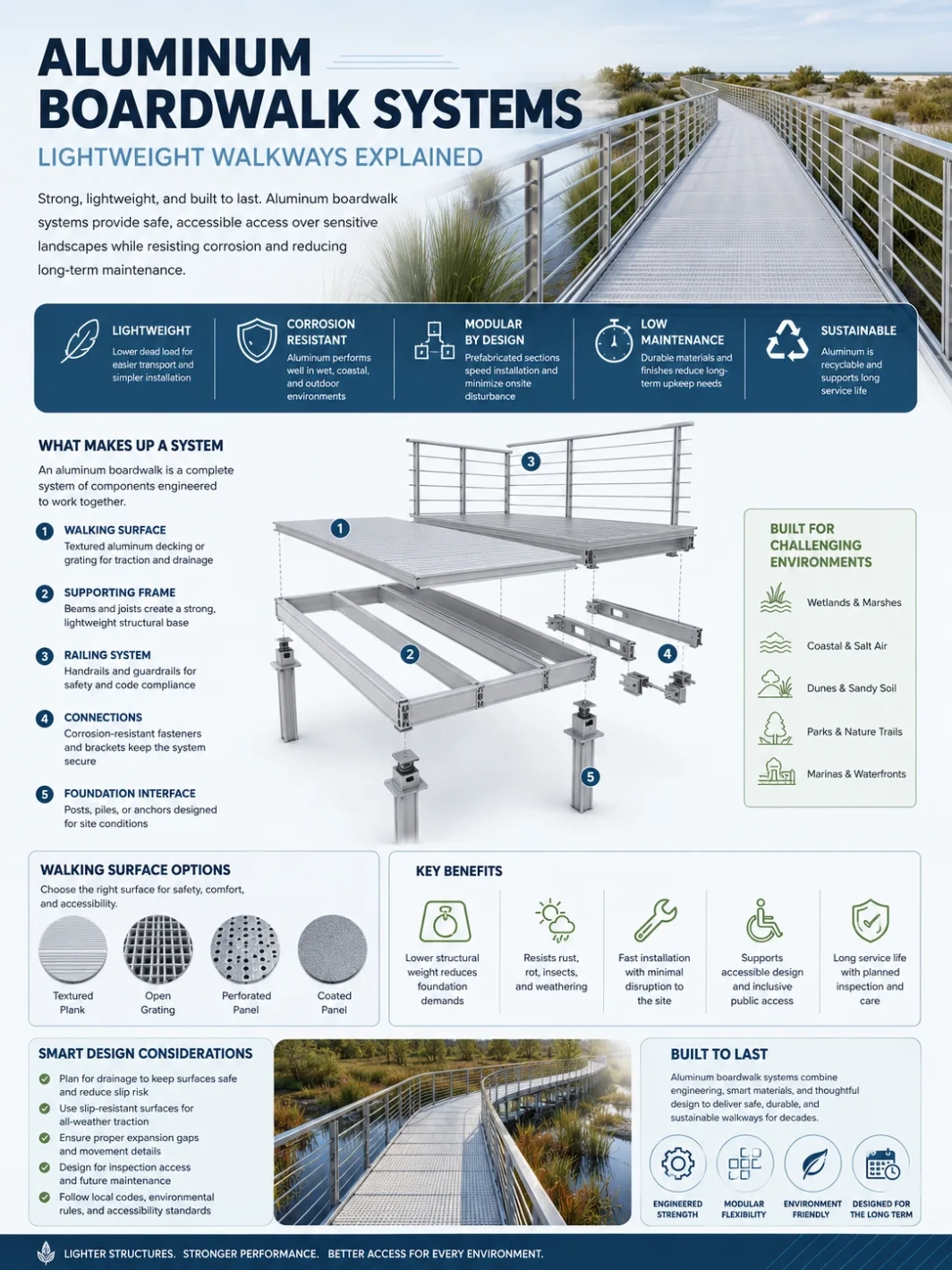
An aluminum boardwalk system is a lightweight, modular walkway built with aluminum framing, decking panels, rails, connectors, and site-specific foundations. It is used where parks, beaches, wetlands, dunes, marinas, or public trails need a durable elevated path without the weight of concrete or heavy timber.
Aluminum is not the right answer for every boardwalk. It makes the most sense where reduced weight, corrosion resistance, clean prefabrication, fast installation, and lower long-term surface upkeep matter. It still needs careful design, compatible fasteners, drainage planning, slip-resistant walking surfaces, and review against local codes, environmental rules, and accessibility requirements.
Main Details About Aluminum Boardwalk Systems
| Feature | What It Means | Why It Matters | Common Site Example |
|---|---|---|---|
| Primary Material | Structural aluminum members, planks, panels, rails, or framing | Reduces dead load and allows modular sections to be moved more easily | Wetland trail, marina walkway, dune crossing, park overlook |
| Main Use | Raised pedestrian access over sensitive, wet, sandy, or uneven ground | Helps protect habitat while giving visitors a defined walking route | Marsh boardwalk, coastal access route, nature preserve path |
| Walking Surface | Textured aluminum decking, grating, coated panels, or hybrid deck systems | Affects traction, drainage, wheel comfort, cane tips, and stroller movement | Beach access boardwalk, fishing platform approach, accessible trail segment |
| Accessibility Focus | Clear width, firm and stable surface, slope, openings, passing spaces, and edge protection | Determines how usable the boardwalk is for wheelchairs, mobility scooters, strollers, and visitors with low vision | Outdoor recreation access route or viewing platform |
| Maintenance Focus | Fasteners, connections, surface wear, drainage, corrosion points, railing stability, debris buildup | Aluminum reduces some upkeep, but it does not remove the need for inspection | Salt-air promenade, wetland boardwalk, park walkway |
What an Aluminum Boardwalk System Includes
An aluminum boardwalk is usually a system, not just a row of metal planks. The walking surface, supporting beams, posts, handrails, guardrails, edge protection, fasteners, and foundation interface must work together. A well-designed system also considers how visitors enter the walkway, how water drains away, how sections are inspected, and how repairs can be made without disturbing the site more than necessary.
The word “system” matters because aluminum components are often prefabricated. Sections can be fabricated off-site, delivered in manageable modules, and installed with less field cutting than a custom-built timber structure. That can be useful in wetlands, dunes, preserves, and narrow access corridors where heavy equipment may be restricted.
For structural use, aluminum should still be treated as an engineered material. The Aluminum Association’s Aluminum Design Manual is a structural reference used for aluminum component strength, member behavior, welded and unwelded conditions, alloy and temper information, and standard practice topics [b]. A public boardwalk project should not rely on material reputation alone; loads, spans, railings, connections, and local design rules all need project-specific review.
Why Aluminum Is Used for Boardwalks
The main reason aluminum is attractive for boardwalk systems is its combination of low weight and durability. A lighter superstructure can reduce handling difficulty during installation and may reduce the demand placed on foundations, especially where the ground is weak, wet, sandy, or difficult to access.
Federal Highway Administration bridge guidance describes aluminum as having an excellent strength-to-weight ratio and useful corrosion resistance, while also warning that contact with materials such as concrete can create corrosion concerns unless proper isolation is used [a]. That same logic applies to many boardwalk details. Aluminum can be a practical outdoor material, but connections and interfaces must be handled carefully.
Aluminum is also popular because it can be extruded into repeatable shapes. Manufacturers can form planks, channels, tubes, curbs, railing parts, and frame members with consistent profiles. This helps create modular boardwalk sections with predictable fit, which can be valuable for public agencies managing long routes, repeated repairs, or phased replacement work.
Where Aluminum Boardwalks Work Best
Aluminum boardwalk systems are most useful where the site asks for light handling, corrosion resistance, precise fabrication, and a defined public walking surface. Common settings include coastal walkways, marina approaches, dune walkovers, wetland viewing paths, pedestrian bridges, fishing access routes, park platforms, and accessible outdoor routes near visitor centers.
- Wetlands and marshes: Aluminum can reduce the weight carried by piles, helical anchors, or other foundations while keeping visitors above saturated ground.
- Coastal and marine areas: Aluminum can perform well in salt-air settings, but fastener selection and galvanic isolation become especially important.
- Dune crossings: Modular sections may help create defined access routes across shifting sand, but the design still needs to respect dune protection rules.
- Urban waterfronts: Aluminum can suit promenades, viewing decks, and connector walkways where a clean, low-profile structure is desired.
- Remote parks: Lightweight sections can be easier to transport than concrete or heavy timber, although remote installation still depends on terrain, permits, and crew access.
Aluminum may be less attractive where the desired character is rustic, where vandal resistance is the top concern, where local agencies prefer timber for visual reasons, or where the project budget cannot support fabricated metal systems. It can also be a poor fit if the walking surface becomes noisy, hot, slippery, or uncomfortable for the intended visitor group.
Common Aluminum Boardwalk Components
Decking Panels
The decking is the part visitors feel first. Aluminum decking may use solid planks, ribbed planks, perforated panels, open grating, or coated walking surfaces. Each option changes the experience. Solid or closely spaced planks can feel smoother under wheels. Open grating may drain well but can be uncomfortable for some shoes, small wheels, cane tips, or pets if not designed for public pedestrian use.
Support Framing
The frame carries the deck and transfers loads to the supports. Aluminum framing may include stringers, cross members, beams, brackets, and prefabricated side frames. The frame must account for pedestrian loading, maintenance access, lateral movement, rail loads, thermal movement, and the local exposure environment.
Rails, Curbs, and Edge Protection
Not every boardwalk needs a full guardrail, but many elevated walkways, overlooks, bridges, and dune crossings do. Edge protection can help mobility devices stay on the walking surface. Rails may also be needed where there is a drop, water edge, steep side slope, or visitor crowding. Local codes and the managing authority should control final railing decisions.
Foundations and Supports
Aluminum boardwalks are light, but they still need stable support. Foundations may include piles, helical piles, concrete footings, precast supports, spread footings, or specialized low-disturbance systems. The USDA Forest Service describes wetland trail construction as a field where drainage, water levels, piles, boardwalks, puncheon, and site conditions shape the structure used [d].
Aluminum vs Wood, Composite, and Concrete Boardwalks
| Material | Common Use | Strengths | Limits | Maintenance Level |
|---|---|---|---|---|
| Aluminum | Modular public walkways, coastal paths, wetland crossings, platforms | Lightweight, corrosion resistant, prefabrication-friendly, recyclable | Can be noisy, may need coatings or textured surfaces, requires careful fastener isolation | Low to moderate, depending on exposure and connections |
| Wood | Nature trails, rustic parks, traditional beach boardwalks | Natural appearance, familiar construction, comfortable walking feel | Can rot, splinter, warp, burn, or require frequent replacement in wet sites | Moderate to high in harsh environments |
| Composite | Visitor boardwalks, small platforms, park walkways | Resists rot better than untreated wood, often visually warmer than metal | Can expand, fade, sag if undersupported, or become slick depending on texture | Low to moderate |
| Concrete | Urban promenades, high-use waterfronts, permanent access routes | Heavy, stable, durable, familiar to code officials | Difficult to install in sensitive or saturated areas; high dead load | Low, but repairs can be more disruptive |
Accessibility Notes for Aluminum Boardwalks
Accessibility is not only about adding a ramp. For boardwalks, it includes clear width, slope, cross slope, openings in the deck, passing areas, firm and stable surfaces, edge protection, resting intervals, and the way the route connects to parking, trailheads, visitor centers, toilets, overlooks, and other site features.
The U.S. Access Board’s outdoor developed area guidance states that trail surfaces should be firm and stable, trail clear tread width should generally be at least 36 inches, openings in boardwalk or bridge surfaces should not allow passage of a sphere more than one-half inch in diameter, and board surfaces have specific cross-slope limits for accessibility [c]. These values are not a substitute for project design, but they give planners a clear starting point.
Aluminum decking can support accessibility when the surface is stable, gaps are controlled, joints are smooth, slopes are managed, and transitions do not create abrupt lips. Problems appear when grating openings are too large, decking flexes noticeably, wet surfaces become slick, or the boardwalk narrows at rails, gates, benches, interpretive signs, or scenic pullouts.
Surface Safety and Visitor Comfort
A boardwalk surface should guide visitors without drawing attention to itself. Aluminum can be made with ribs, grooves, punched textures, applied coatings, abrasive strips, or aggregate finishes. The best choice depends on expected weather, sand, mud, leaf litter, salt spray, bare feet, bicycle restrictions, mobility devices, and maintenance capacity.
- Traction: Wet metal can feel slick if the finish is too smooth. A pedestrian-grade textured surface is usually preferable.
- Drainage: Water should leave the walking surface without creating wheel-trapping gaps or hidden slick areas.
- Heat: Exposed metal can become hot in strong sun, especially on beaches and open waterfronts.
- Noise: Hollow or ribbed aluminum decking may sound louder than wood when walked on, especially in quiet nature areas.
- Glare: Bright finishes can reflect light. Matte, coated, or weathered finishes may be easier on visitors’ eyes.
- Transitions: The change from asphalt, sand, gravel, soil, or concrete onto the aluminum deck should be smooth and visible.
Foundations, Wet Areas, and Low-Disturbance Installation
The foundation is often the hardest part of a boardwalk project. Aluminum can reduce the weight of the superstructure, but the ground still controls the design. Saturated soils, peat, mud, sand, tidal movement, frost, scour, tree roots, buried utilities, and protected habitat can all influence how supports are selected.
The Forest Service has documented foundation methods for boardwalks and viewing platforms, including helical anchors, piles, and precast concrete approaches for difficult sites with standing water or limited access [e]. For aluminum systems, the foundation detail also needs to prevent harmful metal contact, trapped water, and connection movement that could loosen the structure over time.
In sensitive wetlands or dunes, the lightness of aluminum can help reduce construction disturbance, but it does not cancel environmental review. A managing authority may need to consider permitting, seasonal work windows, protected plants, wildlife movement, storm surge, flood elevation, archaeological resources, and long-term maintenance access.
Environmental Considerations
A boardwalk is often built to reduce trampling, not to dominate the landscape. By keeping visitors on a defined route, a raised walkway can protect vegetation, reduce informal trails, limit soil compaction, and keep people away from fragile wetland edges or dune faces. The material choice should support that purpose.
Aluminum has the advantage of being recyclable and durable, but environmental fit depends on the full project. A long-life system may reduce replacement cycles, yet fabrication, transportation, foundations, coatings, and eventual removal all matter. On natural sites, a slightly heavier but visually quieter material may sometimes be preferred by the land manager.
Good environmental design also includes boardwalk height, spacing, shade effects, water movement, animal passage, construction access, and how visitors are encouraged to stay on the path. In marshes and dunes, a poorly placed boardwalk can still change drainage, shade plants, or draw people into sensitive areas.
Maintenance Checklist for Aluminum Boardwalks
Aluminum boardwalks are often promoted as low-maintenance, but low-maintenance does not mean inspection-free. A simple inspection routine helps catch small issues before they become closures, trip hazards, loose rails, or damaged access points.
- Check deck panels for looseness, uplift, sharp edges, surface wear, coating loss, or damaged textures.
- Inspect bolts, screws, brackets, welds, and connectors for movement, corrosion staining, missing parts, or incompatible metal contact.
- Look for trapped debris, sand, salt residue, mud, leaves, and algae that can reduce traction or block drainage.
- Confirm that openings, joints, and transitions remain safe for wheels, canes, crutches, strollers, and shoes.
- Inspect railings, curbs, edge protection, benches, viewing platforms, and interpretive signs for stability.
- Watch foundation areas for settlement, scour, leaning posts, exposed supports, erosion, or undermining after storms.
- Review user behavior: crowding, fishing use, bicycles, pets, maintenance carts, or unauthorized vehicles can change loading and wear.
Common Design Mistakes
Many boardwalk problems begin with small assumptions. A lightweight material can still fail to serve visitors if the surface is uncomfortable, the route is too narrow, the foundation shifts, or the design does not match the surrounding environment.
- Choosing aluminum only for low weight: Weight matters, but surface comfort, exposure, cost, railing loads, and maintenance access matter too.
- Ignoring galvanic corrosion: Aluminum in contact with incompatible metals or wet concrete details can create avoidable corrosion points.
- Using open grating without visitor testing: Large openings can create problems for cane tips, small wheels, footwear, and visitors with limited balance.
- Forgetting thermal movement: Long metal runs can expand and contract, so joints and connections need room to perform.
- Underplanning transitions: Many trip hazards happen where the boardwalk meets soil, sand, asphalt, concrete, or another trail surface.
- Designing for dry weather only: A good boardwalk should be reviewed for rain, flooding, wind-blown sand, salt spray, ice where applicable, and storm cleanup.
Real Boardwalk Context: Why Raised Walkways Matter
Aluminum systems are one material answer to a larger boardwalk problem: how to give people access without forcing them through fragile, wet, sandy, or uneven terrain. National park boardwalks show this purpose clearly. Everglades National Park’s Anhinga Trail uses pavement and boardwalk through sawgrass marsh and freshwater slough, with accessibility notes describing a flat route suitable for wheelchairs and strollers [f].
Congaree National Park’s Boardwalk Loop gives another example of a raised walkway used as an accessible introduction to a wet forest environment, with a 2.6-mile boardwalk route from the visitor center area [g]. These examples are not presented as aluminum projects; they show the visitor-access role that any boardwalk material must serve.
For an aluminum system to be successful, it has to meet that same visitor-access test. It should protect the setting, feel safe underfoot, support different users, tolerate the exposure, and remain maintainable for the agency, park, preserve, resort, marina, or community that owns it.
When Aluminum Is a Good Fit
Aluminum is often a strong candidate when a project needs prefabricated sections, moderate spans, corrosion resistance, clean installation, or reduced weight over weak ground. It is also useful where the managing authority wants a long-life system and has the budget for engineered components rather than repeated small repairs.
It may not be the best fit when the visual character must be rustic, when the site is extremely remote and metal transport is difficult, when the surface would be uncomfortable in hot sun, or when local maintenance crews are more experienced with timber. Material choice should follow the site, not a trend.
Frequently Asked Questions
Are Aluminum Boardwalks Better Than Wood Boardwalks?
Aluminum can be better where low weight, corrosion resistance, prefabrication, and reduced rot risk matter. Wood may be better where natural appearance, quiet walking feel, lower initial cost, or historic character matters more. The best choice depends on exposure, budget, visitor use, and maintenance capacity.
Do Aluminum Boardwalks Rust?
Aluminum does not rust like iron or steel, but it can corrode in the wrong conditions. Salt exposure, trapped moisture, incompatible metals, wet concrete contact, and poor drainage can create problems. Proper detailing, fastener selection, coatings, and isolation materials help reduce risk.
Are Aluminum Boardwalks Slippery?
They can be slippery if the surface is smooth, worn, wet, sandy, icy, or covered with algae. Public pedestrian boardwalks usually need a textured, coated, ribbed, or otherwise slip-resistant walking surface matched to the site’s climate and maintenance routine.
Can Aluminum Boardwalks Be Wheelchair Accessible?
Yes, if the route is designed with proper width, stable surface, controlled openings, manageable slopes, smooth transitions, passing areas where needed, and safe edge details. Accessibility depends on the whole route, not only the deck material.
Are Aluminum Boardwalks Good for Wetlands?
They can be suitable for wetlands because lightweight modular sections may reduce handling difficulty and support elevated access. The final design still depends on soil, water level, permits, habitat sensitivity, foundations, drainage, and the managing authority’s environmental requirements.
How Long Do Aluminum Boardwalks Last?
Service life varies by alloy, finish, fasteners, exposure, loading, drainage, installation quality, and inspection routine. A well-detailed aluminum system can be long-lasting, but exact lifespan should come from the manufacturer, engineer, and site manager rather than a generic estimate.
Resources Used
- [a] Engineering Design, Fabrication, and Erection of Prefabricated Bridge Elements and Systems — Used for aluminum structural context, including strength-to-weight ratio, corrosion resistance, and material isolation concerns. (Federal Highway Administration; official U.S. Department of Transportation technical source.)
- [b] Aluminum Design Manual 2020 — Used for the role of recognized aluminum structural design references. (The Aluminum Association; long-standing industry standards and technical reference organization.)
- [c] Chapter 10: Outdoor Developed Areas — Used for outdoor trail and boardwalk accessibility concepts, including width, firm and stable surfaces, slopes, and openings. (U.S. Access Board; official federal accessibility standards and guidance source.)
- [d] Wetland Trail Design and Construction: 2007 Edition — Used for wetland trail and boardwalk construction context, including materials, drainage, piles, and trail techniques. (USDA Forest Service Technology and Development Program; official public land management technical source.)
- [e] Innovative Foundations for Boardwalks and Viewing Platforms — Used for foundation options such as helical anchors, piles, and precast support methods in difficult boardwalk settings. (USDA Forest Service; official technical report for recreation infrastructure.)
- [f] Walk the Anhinga Trail — Used as a real example of a boardwalk and paved trail through a wetland setting with visitor accessibility notes. (National Park Service; official park visitor information.)
- [g] Boardwalk Loop — Used as a real example of an accessible boardwalk route in a national park wetland forest setting. (National Park Service; official park route information.)