Composite boardwalks are often better than wood for wet, high-use, or hard-to-maintain walking surfaces, but they are not automatically better for every boardwalk. Wood can still be the better choice where low initial cost, easy repair, natural appearance, or structural framing flexibility matter most.
The most accurate answer is this: composite decking can reduce rot, splintering, warping, and routine surface maintenance, while wood remains familiar, repairable, visually natural, and often less expensive at the start. For public trails, wetlands, beach access routes, parks, and waterfront promenades, the better material depends on the site environment, expected foot traffic, accessibility goals, maintenance capacity, and whether the boards are only a walking surface or part of a load-bearing structure.
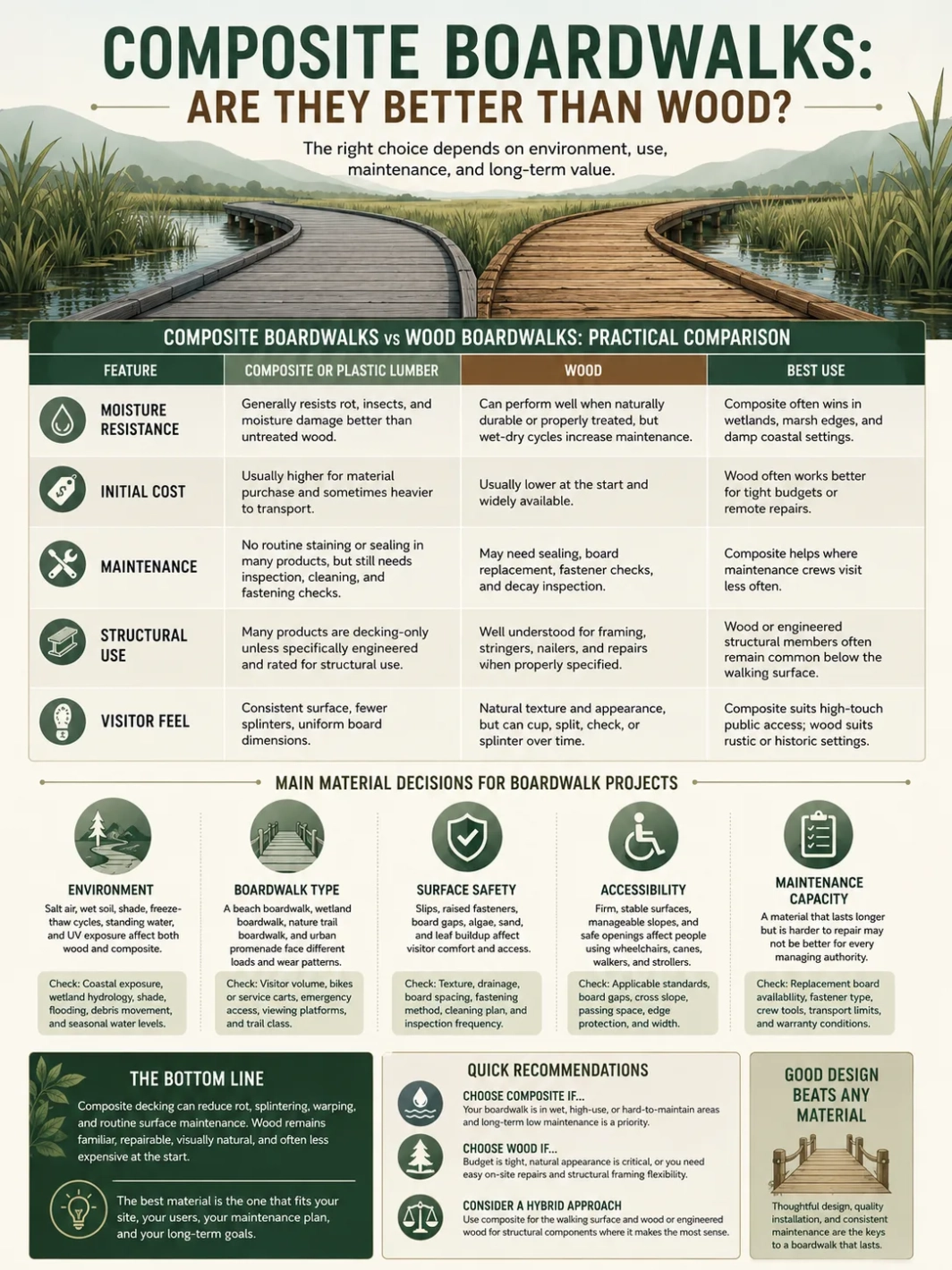
| Feature | Composite or Plastic Lumber | Wood | Best Use |
|---|---|---|---|
| Moisture Resistance | Generally resists rot, insects, and moisture damage better than untreated wood. | Can perform well when naturally durable or properly treated, but wet-dry cycles increase maintenance. | Composite often wins in wetlands, marsh edges, and damp coastal settings. |
| Initial Cost | Usually higher for material purchase and sometimes heavier to transport. | Usually lower at the start and widely available. | Wood often works better for tight budgets or remote repairs. |
| Maintenance | No routine staining or sealing in many products, but still needs inspection, cleaning, and fastening checks. | May need sealing, board replacement, fastener checks, and decay inspection. | Composite helps where maintenance crews visit less often. |
| Structural Use | Many products are decking-only unless specifically engineered and rated for structural use. | Well understood for framing, stringers, nailers, and repairs when properly specified. | Wood or engineered structural members often remain common below the walking surface. |
| Visitor Feel | Consistent surface, fewer splinters, uniform board dimensions. | Natural texture and appearance, but can cup, split, check, or splinter over time. | Composite suits high-touch public access; wood suits rustic or historic settings. |
What a Composite Boardwalk Actually Means
A composite boardwalk is a raised or ground-level walkway that uses composite decking, recycled plastic lumber, fiberglass-reinforced plastic lumber, or wood-plastic composite boards for at least part of its walking surface. In a classic raised boardwalk, the deck is supported by stringers, bents, piers, ledgers, nailers, or other structural parts. The U.S. Forest Service describes boardwalks as structures with foundations and stringers that support a deck, often with curbs or handrails along the edges. [a]
The material question is not only “composite or wood.” It is also “which part of the boardwalk?” A deck board used as the walking surface has a different job from a pile, joist, stringer, railing post, curb, or helical foundation. Many composite products are excellent for decking but should not be treated as structural framing unless the manufacturer, designer, and local authority allow that exact use.
Main Details Before Choosing a Material
| Decision Point | Why It Matters | What to Check |
|---|---|---|
| Environment | Salt air, wet soil, shade, freeze-thaw cycles, standing water, and UV exposure affect both wood and composite. | Coastal exposure, wetland hydrology, shade, flooding, debris movement, and seasonal water levels. |
| Boardwalk Type | A beach boardwalk, wetland boardwalk, nature trail boardwalk, and urban promenade face different loads and wear patterns. | Visitor volume, bikes or service carts, emergency access, viewing platforms, and trail class. |
| Surface Safety | Slips, raised fasteners, board gaps, algae, sand, and leaf buildup affect visitor comfort and access. | Texture, drainage, board spacing, fastening method, cleaning plan, and inspection frequency. |
| Accessibility | Firm, stable surfaces, manageable slopes, and safe openings affect people using wheelchairs, canes, walkers, and strollers. | Applicable accessibility standards, board gaps, cross slope, passing space, edge protection, and route width. |
| Maintenance Capacity | A material that lasts longer but is harder to repair may not be better for every managing authority. | Replacement board availability, fastener type, crew tools, transport limits, and warranty conditions. |
Where Composite Boardwalks Usually Perform Better
Composite and plastic lumber products tend to perform best where the walking surface is exposed to frequent moisture, heavy pedestrian use, and limited maintenance windows. Forest Service trail guidance notes that wood-plastic composites, vinyl, and other plastics can reduce maintenance and damage from insects, rot, and moisture, and they do not twist, cup, or warp in the same way wood decking commonly can. The same source also warns that higher initial cost, closer support spacing, cracking risk in some products, and plastic sawdust management must be considered. [b]
For wetland boardwalks, composite decking can be useful because surface boards are often the part visitors touch, step on, and complain about first. A smooth but textured composite walking surface can reduce splinters and create a more consistent tread. That is helpful for families with children, older visitors, and users of mobility devices.
For beach boardwalks and dune walkovers, composite can also help where salt air, sand, and foot traffic make surface boards age quickly. It does not remove the need for inspections. Sand can abrade surfaces, storms can shift foundations, and fasteners can still loosen. But in many coastal access settings, composite may reduce the cycle of replacing weathered or splintered decking.
For urban waterfront promenades, composite can provide a cleaner, more uniform appearance. The surface may be easier for a city, park district, or waterfront authority to standardize across long public walkways, overlooks, fishing access areas, and scenic viewing platforms.
Where Wood Can Still Be Better
Wood is not outdated. It remains common because it is familiar, workable, and often easier to repair in the field. A trail crew can cut, drill, replace, plane, or fasten wood with standard tools. In a remote nature preserve or backcountry wetland, that can matter more than long product life on paper.
Wood also fits historic, rustic, and natural landscapes more easily. A boardwalk near a visitor center can look appropriate with composite planks, but a quiet forest bog bridge, an older park walkway, or a heritage waterfront may need the warmer texture of timber. Appearance is not just decoration. It shapes how the boardwalk fits the surrounding environment.
Cost is another reason wood remains competitive. Composite boards may reduce long-term maintenance, but initial purchase price, shipping weight, support spacing, and installation details can push the project cost higher. For a small park walkway, a short viewing platform, or a simple nature trail repair, wood may be the practical choice.
Wood is also better understood structurally. Pressure-treated wood, decay-resistant species, and engineered timber systems have long histories in boardwalk framing. Composite products vary widely by manufacturer, formulation, reinforcement, and rating. Forest Service guidance on alternatives to treated wood lists composite advantages such as less need for sealing or staining and reduced splitting or chipping, but also notes disadvantages such as expense, unnatural appearance, mildew or staining potential, color fading, and the fact that many products are not generally rated for structural use. [d]
Accessibility: The Surface Matters More Than the Label
For accessible outdoor pathways, the important question is not whether the board is wood or composite. It is whether the route is firm, stable, reasonably even, and suitable for the setting. The U.S. Access Board’s outdoor developed area guidance discusses firm and stable surfaces, beach access routes, boardwalk plank openings, route width, obstacles, and slope conditions. It notes that gaps in boardwalk planks can become hazards if wheels, canes, or crutch tips can drop through or become trapped. [c]
Composite decking can help accessibility when it stays flatter over time, resists splinters, and maintains a consistent board profile. Wood can also meet access goals when the boards are properly installed, maintained, and replaced before cupping, raised fasteners, gaps, or decay create barriers.
Accessible design depends on the full route. A good board surface cannot fix a route with steep approaches, missing edge protection, poor drainage, unsafe transitions, or narrow pinch points. For public projects, land managers should check current federal, state, local, and site-specific rules before selecting materials or dimensions.
Safety and Visitor Comfort
Composite boards can reduce splinters, exposed grain, and uneven weathering, but they still need a slip-aware maintenance plan. Algae, leaf litter, mud, salt spray, frost, and wet sand can make any boardwalk surface less comfortable. A material that looks clean in a brochure can still become slick in a shaded marsh or coastal dune crossing if the surface is not cleaned and inspected.
Wood boardwalks have their own safety patterns. Raised nails or screws, soft spots, checking, loose planks, broken railings, rot at contact points, and water trapped around fasteners are common inspection items. Wood can be easy to repair, but that advantage only matters if the managing authority has the staff, budget, and inspection schedule to catch problems early.
Heat can also affect comfort. Some composite and plastic boards may feel warmer under direct sun, especially in open beach or urban waterfront settings. Color, texture, ventilation below the deck, and local climate all matter. A shaded wetland trail has different surface demands than an exposed pier-like promenade.
Maintenance Differences in Real Use
- Composite decking: inspect fasteners, board movement, surface wear, stains, algae, cracking, edge damage, and manufacturer-specific spacing requirements.
- Wood decking: inspect decay, splinters, raised grain, loose boards, fastener corrosion, cupping, checking, surface coatings, and rot around cut ends or holes.
- Both materials: check transitions, ramps, railings, curbs, drainage, debris buildup, settlement, flood damage, and trip points.
- Wetland settings: avoid letting sawdust, shavings, cutoffs, treated wood debris, or plastic fragments enter sensitive soils or water.
- Coastal settings: inspect after storms, high tides, dune movement, erosion, and wind-blown sand buildup.
One practical difference is debris handling during construction and repair. Wood shavings decompose, though treated wood debris still needs proper handling. Plastic and composite shavings do not decompose in the same way, so cutting and drilling should be controlled. On sensitive sites, good practice is to cut away from water when possible, capture shavings, and remove them from the project area.
Environmental Considerations
Composite boardwalks are often promoted as environmentally friendly because some products use recycled plastic, recovered wood fiber, or fiberglass-reinforced recycled material. That can be a real benefit, but it is not the whole evaluation. A longer-lasting board surface can reduce replacement cycles, yet the product may be heavier, harder to recycle locally, or less suitable for field cutting in sensitive habitats.
The U.S. Environmental Protection Agency includes plastic lumber landscaping timbers and posts in its recovered-content procurement guidance. EPA describes plastic or composite lumber as a way to give new life to recovered wood and plastic materials such as milk jugs and plastic bags, while also noting that plastic lumber needs product-specific testing because it is not homogeneous in the same way as virgin plastic. [e]
Wood has environmental tradeoffs too. Locally appropriate, certified, decay-resistant, or properly treated wood may be a sensible choice, especially when repairability and natural appearance matter. Poorly chosen wood, however, can lead to frequent replacement, more disturbance, and more maintenance traffic in fragile areas.
Real Public-Land Examples
At Cape Cod National Seashore, the National Park Service reported that the Atlantic White Cedar Swamp Trail boardwalk had been resurfaced mostly with plastic lumber in the early 2000s and that a later repair replaced a remaining wooden section. The same NPS release said sawdust was captured and removed to keep it out of the wetlands, showing how material choice and construction practice work together in a sensitive swamp setting. [f]
At Lassen Volcanic National Park, NPS described a Bumpass Hell boardwalk reconstruction using recycled plastic lumber reinforced with fiberglass rods. The park selected the material to better withstand acidic gases and caustic elements in an active hydrothermal area, which is a good reminder that “better” can depend on unusual site chemistry, not just normal rain and foot traffic. [g]
When Composite Is the Better Choice
- The boardwalk is in a wetland, marsh, beach, or humid environment where rot is a recurring problem.
- The managing authority wants a more consistent walking surface with fewer splinters.
- Maintenance access is difficult, seasonal, or expensive.
- The project is a public-facing trail, promenade, visitor center loop, beach access route, or nature preserve walkway with high use.
- The product is properly specified for the span, support spacing, fasteners, UV exposure, load, and climate.
- The project team has a plan for cutting, drilling, shavings control, and future replacement boards.
When Wood Is the Better Choice
- The setting needs a rustic or historic appearance.
- The project has a limited initial budget.
- Local crews need easy field repair with common tools and readily available boards.
- The material will be used in structural framing where wood is already well understood and properly specified.
- The boardwalk is short, lightly used, or easy to inspect and repair.
- The land manager prefers a natural material and has a maintenance plan that matches local moisture and decay conditions.
Practical Selection Checklist
- Identify the boardwalk type: beach boardwalk, wetland boardwalk, nature trail boardwalk, dune walkover, promenade, or park access route.
- Separate the walking surface decision from the structural framing decision.
- Check whether the product is rated for decking only or for structural use.
- Review support spacing, fastener requirements, board expansion, drainage, and ventilation.
- Match the surface to accessibility goals, including firmness, stability, transitions, openings, and slope.
- Plan for cleaning, inspection, replacement boards, and post-storm checks.
- Confirm local codes, environmental permits, land manager rules, and professional design needs.
Frequently Asked Questions
Are Composite Boardwalks Slippery?
They can be slippery if algae, mud, frost, wet leaves, or sand build up on the surface. Texture helps, but cleaning and inspection matter for both composite and wood boardwalks.
Do Composite Boardwalks Last Longer Than Wood?
Often they last longer as walking surfaces in wet or high-use areas, but product quality, UV exposure, support spacing, fastening, and maintenance all affect service life.
Can Composite Boards Be Used for Structural Supports?
Only if the specific product is engineered and approved for that structural use. Many composite products are intended mainly for decking, while wood, metal, concrete, or engineered systems may support the load below.
Are Composite Boardwalks Better for Wetlands?
They can be a strong choice for wetland walking surfaces because they resist rot and reduce splintering, but the full design must also protect hydrology, soils, vegetation, and visitor access.
Is Wood Still a Good Boardwalk Material?
Yes. Wood is still useful for rustic settings, lower initial budgets, structural framing, and sites where easy repair is more important than a low-maintenance surface.
What Is the Main Downside of Composite Boardwalks?
The main downside is not one single issue. Higher initial cost, product-specific engineering limits, heat, color fading, cracking in some products, and plastic shavings during construction all need review.
Resources Used
- [a] Wetland Trail Design and Construction: 2007 Edition — Structures Requiring Foundations Continued — Used for the basic boardwalk structure definition, including foundations, stringers, deck boards, and professional design considerations. (Reliable because it is a USDA Forest Service technical trail construction publication.)
- [b] Floating Trail Bridges and Docks — Materials — Used for practical advantages and limitations of wood-plastic composites, vinyl, plastic decking, and wood in wet outdoor structures. (Reliable because it is a USDA Forest Service Technology and Development resource.)
- [c] Chapter 10: Outdoor Developed Areas — Used for outdoor access route concepts, firm and stable surfaces, boardwalk openings, beach access routes, and slope/accessibility considerations. (Reliable because it is published by the U.S. Access Board, the federal accessibility authority.)
- [d] Preservative-Treated Wood and Alternative Products in the Forest Service — Alternatives to Treated Wood — Used for strengths and limits of composite woods, plastic woods, vinyl, HDPE, and decay-resistant wood alternatives. (Reliable because it is a USDA Forest Service technical publication comparing material options.)
- [e] Comprehensive Procurement Guidelines for Landscaping Products — Used for recovered-content plastic lumber information and the note that plastic lumber requires product-specific testing. (Reliable because it is an official U.S. EPA Sustainable Materials Management resource.)
- [f] Repairs Complete on Atlantic White Cedar Swamp Trail; Major Funding from Friends of the Cape Cod National Seashore — Used as a real public-land example of plastic lumber used on a swamp boardwalk and shavings control in wetlands. (Reliable because it is an official National Park Service news release.)
- [g] Bumpass Hell Trail and Boardwalk Rehabilitation (2018 – 2023) — Used as a real example of recycled plastic lumber reinforced with fiberglass rods in a hydrothermal boardwalk setting. (Reliable because it is an official National Park Service project page.)