Concrete boardwalks work best where a walking route needs a firm, stable, long-wearing surface in a hard-use setting: coastal promenades, urban waterfronts, beach access routes, flood-prone parks, high-traffic lakefront paths, and short wetland crossings with engineered foundations. They are less suitable where a light-touch, removable, low-impact trail surface is the main goal.
A concrete boardwalk is not simply a sidewalk beside the water. It is a pedestrian structure or path system that uses concrete as the walking surface, structural deck, support element, or nearby access route. In the right place, it can solve problems that wood, plastic lumber, asphalt, or gravel may struggle with: heavy foot traffic, salt exposure, storm damage, wheelchairs, maintenance access, and long public-use seasons.
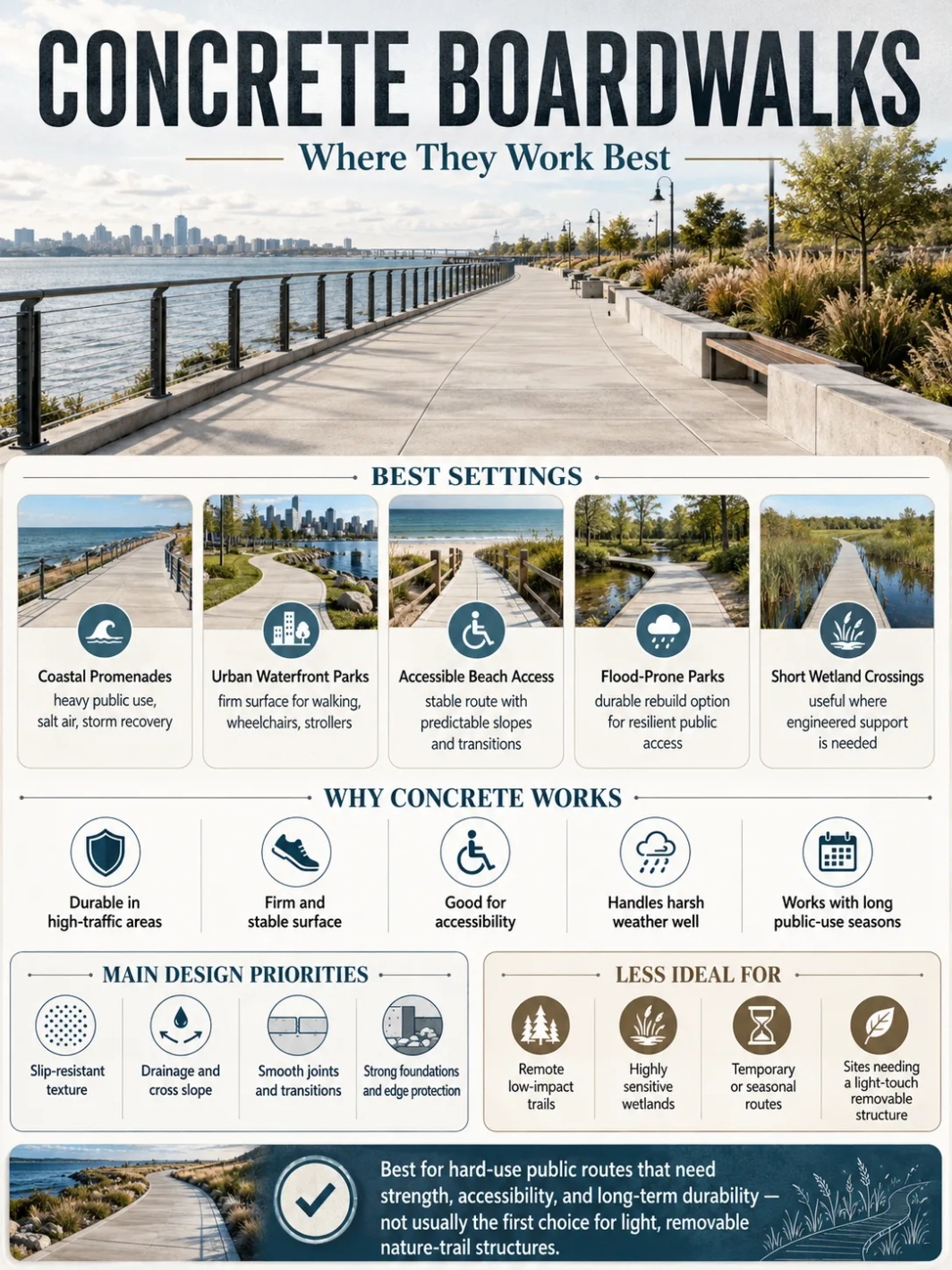
Main Details for Concrete Boardwalk Use
| Setting | Why Concrete Fits | Best Use Case | Main Caution |
|---|---|---|---|
| Coastal Promenade | Handles heavy public use, bikes, carts, salt air, and storm recovery better than many light deck systems. | Beachfront walking routes, oceanfront public paths, and busy resort corridors. | Drainage, expansion joints, and coastal corrosion protection need careful design. |
| Urban Waterfront Park | Creates a firm, predictable surface for walking, wheelchairs, strollers, maintenance vehicles, and events. | Riverwalks, lakefront promenades, harbor edges, and civic park walkways. | Concrete can feel hard and hot if shade, seating, and surface texture are ignored. |
| Accessible Outdoor Route | Concrete can provide a firm and stable surface with controlled openings, slopes, and transitions. | Beach access routes, trailhead connections, viewing platforms, and park access paths. | Accessibility depends on the full route, not just the surface material. |
| Engineered Wetland Crossing | Precast concrete elements can be useful where a strong deck or foundation is needed above wet soil. | Short wetland crossings, fishing platforms, and raised viewing areas. | Heavy construction can disturb sensitive habitat if access, permits, and staging are poorly planned. |
| Flood-Resilient Rebuild | Concrete can be paired with piles, elevated decks, retaining elements, dunes, and structured access points. | Storm-damaged coastal boardwalks rebuilt for long-term public use. | Design must match local flood data, shoreline movement, and land-manager requirements. |
| Small Natural Trail | Concrete is usually not the first choice unless the site needs a firm access route or durable short crossing. | Trailhead links, accessible spurs, and small viewing platforms. | Wood, fiberglass grating, or modular systems may be lighter and less disruptive. |
What a Concrete Boardwalk Means
The term can describe several different designs. Some concrete boardwalks are elevated decks made from precast concrete planks on piles. Others are wide waterfront promenades poured or paved on grade. In parks, concrete may also appear as ramps, landings, pile caps, retaining walls, beach access routes, or viewing platforms connected to a boardwalk system.
The most useful way to understand the material is by function. Concrete is chosen when the managing authority needs a hard, stable, durable public surface that can tolerate repeated use and predictable maintenance. It is not chosen because it looks like a traditional timber boardwalk. It is chosen because the site demands strength, accessibility, drainage control, or resilience.
Public outdoor routes also have accessibility requirements when they fall under applicable federal, state, local, or project-specific rules. The U.S. Access Board describes outdoor developed area requirements for trails, outdoor recreation access routes, beach access routes, surfaces, openings, slopes, passing spaces, and related route features.[a]
Where Concrete Boardwalks Work Best
Busy Beachfront Boardwalks and Promenades
Concrete is a strong candidate for beachfront boardwalks with year-round traffic, bicycles, service carts, beach maintenance equipment, emergency access needs, and frequent sand movement. A timber surface can feel warmer and more traditional, but it may require more frequent plank replacement, fastener checks, and surface repairs in a salty, sandy environment.
Concrete also allows designers to create broad pedestrian promenades with separated movement zones, ramps, benches, lighting, and utilities. In this setting, the boardwalk acts less like a narrow nature-trail crossing and more like public waterfront infrastructure.
Urban Waterfronts With Heavy Daily Use
Urban waterfronts are often used by commuters, joggers, visitors, cyclists, families, maintenance crews, and event staff on the same day. A concrete walking surface can support that mixed use better than many lightweight deck systems, especially where the route needs to connect to sidewalks, plazas, seawalls, piers, ferry terminals, parking areas, or public transit stops.
The tradeoff is comfort. Concrete needs thoughtful detailing: slip-resistant texture, glare control, shade, seating, expansion joints, drainage slopes, and smooth transitions at ramps. Without those details, a durable surface can still feel harsh for visitors.
Accessible Routes to Beaches, Views, and Facilities
Concrete can help create accessible routes because it can be formed into a firm, stable, even surface with controlled joints and predictable slopes. U.S. Access Board technical rules for outdoor recreation access routes include surface firmness and stability, minimum clear width, passing spaces, limits on obstacles, limits on openings, slope rules, and resting intervals.[b]
This does not mean every concrete boardwalk is automatically accessible. The full route matters: parking connection, trailhead transition, ramp grade, cross slope, landings, resting areas, handrails where required, edge protection, surface openings, and the condition of the route after storms or seasonal maintenance.
Storm-Prone Coastal Rebuilds
Concrete boardwalks are often considered after a storm, especially where the previous surface was damaged by surge, uplift, floating debris, or repeated coastal exposure. In these projects, concrete is only one part of the solution. The elevation, pile system, dune design, retaining elements, drainage, beach access points, and emergency repair strategy all matter.
Rockaway Beach in Queens is a useful public example. NYC Parks flood-resiliency materials describe a post-Hurricane Sandy rebuild that replaced the former wood boardwalk with more durable concrete planks, raised the boardwalk, used larger steel pipe piles, and paired the route with dune and sand-retaining features.[g]
Short Wetland Crossings With Engineered Support
Concrete is not usually the quietest or lightest choice for sensitive wetlands, but it can work where a boardwalk needs a very strong deck, a high-elevation span, or a stable viewing platform. USDA Forest Service trail documents describe wetland trail structures, geotextiles, foundations, and boardwalk-related construction choices, with special attention to wet soil, support methods, and drainage behavior.[c]
In wetland settings, the best design is often the one that limits disturbance while keeping visitors on a defined route. Concrete may be useful for specific structural parts, but the land manager must weigh soil conditions, hydrology, equipment access, habitat sensitivity, permitting, and long-term maintenance.
Where Concrete Is Usually a Poor Fit
- Remote trails with limited construction access: concrete is heavy, equipment-dependent, and harder to install than wood or modular trail structures.
- Highly sensitive wetlands: construction staging may disturb soil, vegetation, water flow, or wildlife habitat unless carefully managed.
- Temporary or seasonal routes: removable mats, modular panels, or timber structures may be more practical.
- Historic boardwalk districts: a full concrete surface may conflict with the intended character unless the design is handled carefully.
- Sites with poor drainage and freeze-thaw exposure: concrete can deteriorate if water, joints, deicers, and substructure details are not properly addressed.
Concrete Boardwalk Types
| Type | Simple Meaning | Common Use | Main Maintenance Focus |
|---|---|---|---|
| Precast Concrete Plank Boardwalk | Factory-made concrete deck sections placed on structural supports. | Coastal boardwalks, raised promenades, and durable public decks. | Joints, anchors, surface wear, drainage, and support connections. |
| Cast-in-Place Concrete Walkway | Concrete poured on site over a prepared base or structure. | Urban park paths, ramps, plazas, and waterfront promenades. | Cracking, settlement, drainage, surface texture, and control joints. |
| Concrete Paver Promenade | Individual concrete pavers set over a base layer. | Decorative waterfront paths, plazas, and repair-friendly walkways. | Uneven pavers, joint material, base movement, and edge restraint. |
| Pervious Concrete Access Route | Concrete designed with voids that allow water to pass through. | Low-impact drainage areas, trailhead paths, and light-use paved routes. | Clogging, vacuum maintenance, winter care, and drainage layer performance. |
| Concrete-Supported Boardwalk | Boardwalk with concrete pile caps, footings, abutments, or supports, even if the deck is another material. | Wetland crossings, fishing platforms, bridges, and viewing decks. | Foundation movement, corrosion at connections, and undermining. |
Design Features That Matter
Surface Texture
A concrete boardwalk needs enough texture for wet shoes, sand, mist, and occasional algae, but not so much texture that it becomes uncomfortable for wheelchairs, walkers, strollers, or bare feet near beach access points. Broom finishes, light exposed aggregate, saw-cut patterns, and precast surface treatments can all work when chosen for the setting.
Drainage and Cross Slope
Concrete does not forgive standing water. A good boardwalk route moves water away from the walking surface, rail bases, expansion joints, stair landings, and building entrances. In some projects, permeable pavement systems may help reduce runoff by allowing water to pass through the surface into underlying soil or gravel layers, but they need a suitable drainage design and maintenance plan.[e]
Joints and Transitions
Joints are not just construction details. They affect wheel comfort, trip risk, drainage, repair access, and long-term appearance. A concrete boardwalk should avoid sharp vertical changes at panel edges, ramps, bridge transitions, utility covers, and connections to sidewalks or sand paths.
Foundations and Substructure
Concrete surfaces can sit on compacted base layers, pile-supported structures, pile caps, abutments, retaining walls, or elevated frames. USDA Forest Service materials on boardwalk foundations include examples of precast concrete paired with steel pipe posts for a high-elevation boardwalk over a seasonally wet meadow, showing how concrete may be part of an engineered support strategy rather than only the walking surface.[d]
Edges, Railings, and Drop-Offs
Railings, curbs, wheel guides, edge protection, and warning strips depend on the site. A low promenade beside a lawn does not need the same edge treatment as a raised wetland boardwalk, dune crossing, or fishing platform. Land managers should evaluate fall exposure, user groups, maintenance access, and applicable codes before choosing an edge detail.
Accessibility Notes for Concrete Boardwalks
Concrete can support accessible design, but it does not replace proper route planning. A visitor using a wheelchair or mobility device experiences the whole sequence: arrival, parking or transit stop, entry path, surface, slope, resting space, shade, restrooms, viewing areas, beach access, and return route.
| Design Feature | Why It Matters | Visitor Impact | Rule or Source Note |
|---|---|---|---|
| Firm and Stable Surface | Reduces rolling resistance and helps visitors move without sinking or slipping. | Better for wheelchairs, walkers, strollers, and people with balance concerns. | Outdoor recreation access routes require firm and stable surfaces under Access Board rules. |
| Controlled Openings | Large gaps can catch wheels, canes, or shoe heels. | Safer travel across joints, grates, and boardwalk-style deck openings. | Access Board rules limit openings in outdoor recreation access route surfaces. |
| Reasonable Slope | Steep grades increase effort and can reduce independent access. | More comfortable movement, especially on long ramps or dune crossings. | Route type, terrain, and local standards affect exact slope requirements. |
| Passing and Resting Areas | Narrow routes can be difficult when two mobility devices, strollers, or groups meet. | Allows resting, turning, viewing, and two-way movement. | Passing and resting requirements depend on the route classification and width. |
| Smooth Transitions | Small lips at concrete panels, ramps, mats, or pavers can become obstacles. | Reduces tripping and improves comfort for wheeled movement. | Maintenance should include joint and settlement checks. |
Safety and Comfort Considerations
A concrete boardwalk should feel simple to use. Visitors should understand where to walk, where to cycle if cycling is allowed, where to stop for views, and where beach or trail access begins. Clear wayfinding matters as much as the material.
- Slip resistance: wet sand, algae, salt spray, and rain can change surface behavior.
- Heat: exposed concrete may become uncomfortable in hot sun, especially in beach settings.
- Glare: pale concrete can reflect bright light near water.
- Joints: raised or broken joints can create trip points.
- Edges: raised boardwalks need appropriate edge protection, rails, or visual cues.
- Shared use: bikes, scooters, runners, and pedestrians may need separated zones or clear signs.
- Night use: lighting should support visibility without creating glare or harming sensitive habitat.
Maintenance Factors for Concrete Boardwalks
Concrete is often chosen to reduce frequent deck replacement, but it is not maintenance-free. Coastal salts, freeze-thaw cycles, deicers, ponding water, reinforcement corrosion, joint failure, settlement, and edge undermining can all affect performance. FHWA materials on concrete pavement distress describe how freezing, thawing, deicing chemicals, and moisture exposure can contribute to deterioration mechanisms in concrete surfaces.[f]
Practical Maintenance Checklist
- Inspect joints, panel edges, ramps, stairs, and transitions after storm events.
- Check for ponding water, blocked drains, sand buildup, and erosion under edges.
- Look for cracks that widen, spall, hold water, or expose reinforcement.
- Monitor rail bases, bolts, anchors, and embedded metal for corrosion.
- Remove algae, sediment, and debris before the surface becomes slippery.
- Review accessibility routes after settlement, utility work, or winter damage.
- Use deicers and cleaning methods that match local maintenance policy and concrete specifications.
- Keep official visitor information updated when repairs, closures, or detours affect access.
Concrete Compared With Other Boardwalk Materials
| Material | Strengths | Limits | Best Setting |
|---|---|---|---|
| Concrete | Durable, firm, stable, good for heavy use, accessible routes, and storm-resilient public infrastructure. | Heavy, harder to remove, can crack, can feel hot, and needs careful drainage and joints. | Urban waterfronts, beach promenades, rebuilt coastal boardwalks, and access routes. |
| Wood | Traditional look, warm underfoot, easier to work with in many trail settings. | Can rot, splinter, loosen, or require frequent plank and fastener maintenance. | Nature trails, dunes, small park boardwalks, and scenic wetland crossings. |
| Composite or Plastic Lumber | Rot-resistant and often useful where wood decay is a concern. | Can expand, flex, fade, heat up, or need closer support spacing depending on product. | Beach access decks, low boardwalks, and selective replacement projects. |
| Fiberglass Grating | Lightweight, drainage-friendly, and useful where water or sunlight must pass through. | May feel less natural, may need edge treatment, and can be uncomfortable for some users. | Wetlands, industrial waterfronts, and sensitive drainage areas. |
| Asphalt | Smooth, familiar, and relatively easy to place on suitable bases. | Can soften in heat, crack, rut, or look less suitable for natural settings. | Multi-use paths, park roads, and trailhead connections. |
Environmental Considerations
Concrete boardwalks can protect habitat when they keep visitors on a defined route and prevent informal trampling through dunes, marshes, or lake-edge vegetation. They can also create impacts during construction if heavy equipment, staging areas, pile driving, runoff, or grading are not handled carefully.
The best projects treat the boardwalk as part of a site system. That system may include dune restoration, native planting, drainage layers, erosion control, wildlife-sensitive lighting, narrowed access points, interpretive signs, and seasonal closures. In wetland or coastal areas, the managing authority may need environmental review, permits, and professional design input before construction begins.
Common Mistakes When Choosing Concrete
- Choosing concrete only for appearance: it should solve a site problem, not just imitate a promenade style.
- Ignoring drainage: ponding water can affect comfort, safety, and long-term durability.
- Forgetting heat and shade: a hard surface without shade or seating can be tiring in coastal sun.
- Assuming low maintenance means no maintenance: joints, cracks, drains, rail bases, and transitions still need inspection.
- Using one detail everywhere: a dune crossing, wetland span, urban plaza, and fishing platform may need different structures.
- Overlooking accessibility from the start: retrofitting ramps, resting intervals, or transitions is usually harder than designing them early.
How to Decide If Concrete Is the Right Choice
A concrete boardwalk is usually worth considering when the route has heavy public use, a long service expectation, a need for a firm accessible surface, repeated storm exposure, or maintenance access requirements. It is less convincing when the route is remote, temporary, lightly used, historically timber-based, or located in a sensitive area where heavy installation would cause more harm than the surface solves.
For a real project, the decision should be made with site data: soil, water level, flood elevation, drainage, vegetation, expected users, route width, maintenance capacity, nearby landmarks, emergency access, and the rules of the managing authority. Local codes, accessibility rules, coastal regulations, and environmental permits may change the final design.
Frequently Asked Questions
Are Concrete Boardwalks Better Than Wood Boardwalks?
Concrete is better for heavy-use, accessible, coastal, or storm-prone routes where durability and a firm surface are priorities. Wood is often better for smaller natural trails, traditional boardwalk character, and lighter construction access.
Do Concrete Boardwalks Still Need Maintenance?
Yes. Concrete boardwalks need inspection for cracks, joint movement, drainage problems, surface wear, corrosion at metal connections, settlement, and storm damage. They may need less frequent deck replacement than wood, but they are not maintenance-free.
Are Concrete Boardwalks Good for Wetlands?
They can work for short engineered crossings, viewing platforms, or durable supports, but they are not always the best choice for sensitive wetlands. Site access, soil conditions, water movement, habitat protection, and permitting should guide the design.
Can a Concrete Boardwalk Be Wheelchair Accessible?
Yes, concrete can support a firm and stable accessible route, but the full design must address width, slope, openings, obstacles, resting intervals, transitions, and connections to parking, streets, trailheads, restrooms, or beach access points.
Why Do Some Coastal Boardwalks Use Concrete Instead of Timber?
Coastal managers may choose concrete because it can handle heavy visitor use, storms, salt air, maintenance vehicles, and long-term public infrastructure needs. The best coastal designs also consider dunes, drainage, access ramps, and flood resilience.
Is Pervious Concrete Useful for Boardwalk Areas?
Pervious concrete may be useful for nearby access paths, plazas, or low-impact paved areas where stormwater management is part of the design. It needs the right base layers, drainage conditions, and maintenance to avoid clogging.
Resources Used
- [a] U.S. Access Board — Chapter 10: Outdoor Developed Areas — Used for trail, outdoor route, beach access route, surface, slope, and route-planning context. This is reliable because it is published by the federal agency responsible for accessibility guidelines.
- [b] U.S. Access Board — ABA Standards, Chapter 10: Recreation Facilities — Used for outdoor recreation access route details such as firm and stable surfaces, width, obstacles, openings, slopes, and resting intervals. This is reliable because it is an official standards page.
- [c] USDA Forest Service — Wetland Trail Design and Construction — Used for wetland trail structure context, boardwalk foundations, and trail construction considerations in wet areas. This is reliable because it is a federal land-management technical publication.
- [d] USDA Forest Service — Innovative Foundations for Boardwalks and Viewing Platforms — Used for examples of boardwalk foundation systems, including precast concrete and steel support applications. This is reliable because it comes from the USDA Forest Service Technology and Development program.
- [e] U.S. EPA — Soak Up the Rain: Permeable Pavement — Used for pervious concrete and permeable pavement drainage context. This is reliable because it is an official U.S. Environmental Protection Agency stormwater resource.
- [f] Federal Highway Administration — Distress Mechanisms in Concrete Pavements — Used for freeze-thaw, deicer, moisture, and concrete deterioration context. This is reliable because it is a federal transportation research publication.
- [g] NYC Parks — Design and Planning for Flood Resiliency — Used for the Rockaway Beach and Boardwalk case study involving concrete planks, elevated design, steel pipe piles, and dune-related resilience features. This is reliable because it is an official NYC Parks planning document.