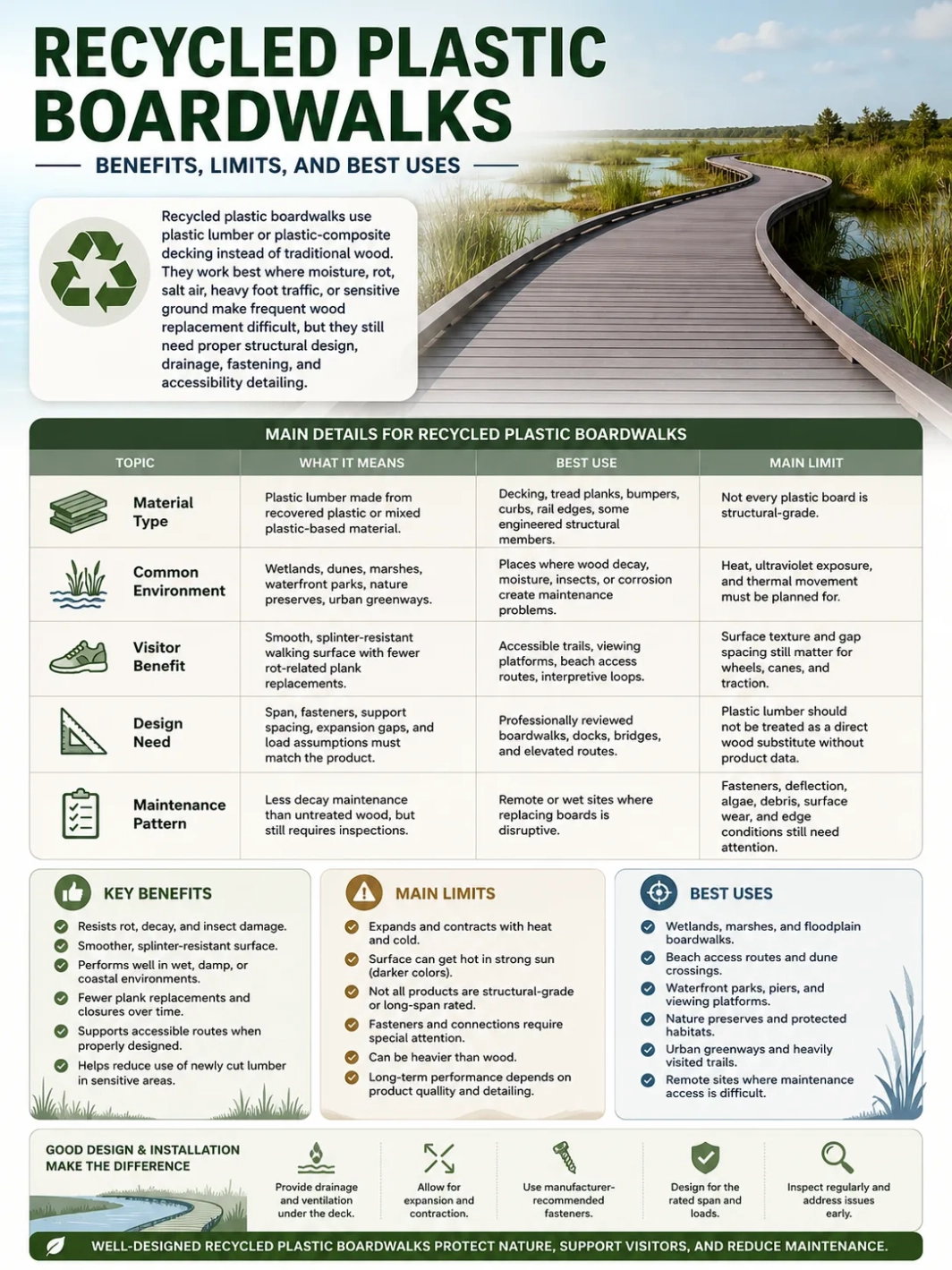
Recycled plastic boardwalks use plastic lumber or plastic-composite decking instead of traditional wood. They work best where moisture, rot, salt air, heavy foot traffic, or sensitive ground make frequent wood replacement difficult, but they still need proper structural design, drainage, fastening, and accessibility detailing.
| Topic | What It Means | Best Use | Main Limit |
|---|---|---|---|
| Material Type | Plastic lumber made from recovered plastic or mixed plastic-based material. | Decking, tread planks, bumpers, curbs, rail edges, some engineered structural members. | Not every plastic board is structural-grade. |
| Common Environment | Wetlands, dunes, marshes, waterfront parks, nature preserves, urban greenways. | Places where wood decay, moisture, insects, or corrosion create maintenance problems. | Heat, ultraviolet exposure, and thermal movement must be planned for. |
| Visitor Benefit | Smooth, splinter-resistant walking surface with fewer rot-related plank replacements. | Accessible trails, viewing platforms, beach access routes, interpretive loops. | Surface texture and gap spacing still matter for wheels, canes, and traction. |
| Design Need | Span, fasteners, support spacing, expansion gaps, and load assumptions must match the product. | Professionally reviewed boardwalks, docks, bridges, and elevated routes. | Plastic lumber should not be treated as a direct wood substitute without product data. |
| Maintenance Pattern | Less decay maintenance than untreated wood, but still requires inspections. | Remote or wet sites where replacing boards is disruptive. | Fasteners, deflection, algae, debris, surface wear, and edge conditions still need attention. |
What Recycled Plastic Boardwalks Are
A recycled plastic boardwalk is a raised or at-grade walking route built with plastic lumber, plastic-composite boards, or structural-grade plastic lumber. The material is made to resemble lumber, but it behaves differently from wood under load, heat, sunlight, and long-term use.
The USDA Forest Service describes recycled plastic lumber as a wood-like product made from recovered plastic, or recovered plastic mixed with other materials, and notes that it can be used as a substitute decking material on boardwalks [a]. That does not mean every recycled plastic board is suitable for every boardwalk. Product type, reinforcement, span rating, site conditions, and managing authority requirements all matter.
For visitors, the material choice is often invisible at first. The walking surface may look like a standard plank boardwalk. The difference becomes more important to park managers, trail builders, accessibility reviewers, and maintenance crews because recycled plastic can resist rot and moisture while introducing different issues, especially expansion, weight, fastening, and long-term deflection.
Why Recycled Plastic Is Used for Boardwalks
Boardwalks usually appear where a normal trail surface would fail, damage the landscape, or block visitor access. Wet soils, tidal areas, dunes, marshes, spring-fed wetlands, and fragile vegetation often need an elevated or hardened walkway. In those locations, conventional wood can decay, split, loosen, or require repeated replacement.
Recycled plastic lumber is attractive because it is decay resistant, does not absorb water like wood, and can reduce the need for cutting new lumber. In a public park or preserve, fewer plank replacements may also mean fewer closures, less disturbance to sensitive ground, and less repeated transport of materials into hard-to-reach locations.
The EPA’s recovered-materials purchasing guidance lists plastic lumber landscaping timbers and posts as products that can contain recovered materials such as HDPE, mixed plastics, sawdust blends, and fiberglass-reinforced mixes [c]. For public agencies, this can support recycled-content procurement goals when the material also meets project performance requirements.
Visitor Benefits
- A smoother surface than rough, weathered wood in many installations.
- Lower risk of splinters on hand-contact areas and plank edges.
- Good performance in damp settings where untreated wood would decay quickly.
- Potentially longer service intervals in remote wetlands, dunes, and waterfront parks.
- Useful for accessible routes when the surface is firm, stable, well-drained, and properly detailed.
Management Benefits
- Reduced rot-related plank replacement compared with many wood surfaces.
- Less pressure to use preservative-treated wood in sensitive wet areas.
- Possible alignment with recycled-content purchasing policies.
- More predictable board dimensions than rough natural logs in developed settings.
- Useful in heavily visited parks where temporary closures are costly or disruptive.
Best Uses for Recycled Plastic Boardwalks
Recycled plastic boardwalks are most useful when moisture, visitor volume, or access needs make traditional surfaces difficult to maintain. They are not only for beach towns. They can appear in national parks, municipal wetlands, wildlife refuges, botanical gardens, nature centers, urban waterfronts, and school outdoor-learning trails.
| Setting | Why Plastic Lumber Helps | Design Watch Point |
|---|---|---|
| Wetland Boardwalks | Resists rot where planks stay damp or shaded for long periods. | Foundation, pile choice, drainage, and environmental permits are still site-specific. |
| Beach Access Routes | Can provide a firmer route over sand or dunes when designed as a permanent or removable beach access surface. | Gaps, cross slope, edge protection, and seasonal storm exposure need review. |
| Nature Trail Loops | Works well for short interpretive boardwalks through marsh, forest, or spring-fed areas. | Surface texture and resting areas matter for visitors using mobility devices. |
| Urban Waterfronts | Can reduce decay problems in humid, splash-prone, or salt-air locations. | Heat buildup, color choice, railings, and crowd loads need attention. |
| Remote Park Walkways | Longer replacement intervals can reduce repeated hauling into sensitive or hard-to-access sites. | Plastic lumber can be heavier than wood, so installation logistics may be harder. |
| Caustic or Corrosive Sites | Selected reinforced products may perform better than ordinary materials in unusual chemical exposure. | Use must be based on manufacturer data and professional review, not assumption. |
A good example is the Bumpass Hell boardwalk work at Lassen Volcanic National Park, where the National Park Service described using recycled plastic lumber reinforced with fiberglass rods to withstand acidic gases and other caustic elements in a hydrothermal basin [f]. That example is useful because it shows the material being selected for a specific environment, not simply because it is recycled.
Common Types of Recycled Plastic Lumber
The phrase “recycled plastic boardwalk” can refer to several product families. They may look similar on a finished walkway, but their strength, stiffness, expansion behavior, texture, recyclability, and maintenance profile can differ.
| Material Type | Common Use | Strengths | Limits | Maintenance Level |
|---|---|---|---|---|
| HDPE or LDPE Plastic Lumber | Deck boards, curbs, bumpers, light-duty planks, some engineered members. | Moisture resistant, decay resistant, often made from common recovered plastics. | May have lower stiffness than wood and can move with temperature changes. | Low to moderate. |
| Wood-Plastic Composite | Decking in developed parks, promenades, viewing decks, and urban walkways. | Wood fiber can improve stiffness and reduce thermal movement. | Cut edges and exposed fibers may need attention; product formulas vary. | Moderate. |
| Fiberglass-Reinforced Plastic Lumber | Stronger boardwalk decking, framing members, specialty sites, wet or harsh environments. | Better structural potential when engineered for the application. | Usually higher cost; detailing depends heavily on product specifications. | Low to moderate. |
| Structural-Grade Plastic Lumber | Joists, beams, columns, posts, platforms, docks, and elevated boardwalk structures. | Made for structural applications when tested and specified correctly. | Requires engineering review and product-specific design data. | Moderate. |
| PVC-Based or Mixed-Resin Products | Some decking, trim, or specialty exterior profiles. | Can resist moisture and decay in certain applications. | Environmental profile, heat behavior, and recyclability depend on the formulation. | Moderate. |
Benefits of Recycled Plastic Boardwalks
Decay Resistance in Wet Places
Moisture is one of the main reasons boardwalks exist. In marshes, cedar swamps, mangrove edges, dune crossings, and shaded forest wetlands, wood can stay damp for long periods. Recycled plastic does not rot like untreated wood, so it can be a practical tread material where plank decay is the main maintenance issue.
Reduced Splintering and Surface Wear
Traditional wood boardwalks can develop splinters, raised grain, cracked edges, and loose fastener heads as they age. A well-selected plastic lumber surface can reduce some of those problems. This can help on trails used by children, older visitors, strollers, mobility devices, and people walking barefoot near beach access areas.
Useful for Sensitive Landscapes
In wetlands and dunes, the goal is often to keep visitors on a defined route while allowing water, sand movement, plant growth, and wildlife habitat to remain as undisturbed as possible. A durable boardwalk surface can reduce repeated repair work that would otherwise bring tools, debris, sawdust, vehicles, or crews back into the same sensitive area.
Recycled-Content Value
Recycled plastic lumber can turn recovered plastic into a long-use outdoor product. That benefit is strongest when the product has verified recycled content, the boardwalk is correctly designed, and the material can perform for many years without premature replacement.
Limits and Design Cautions
The main mistake is assuming recycled plastic lumber behaves like wood because it is sold in lumber-like shapes. It does not. Plastic lumber can expand and contract differently, deflect differently, and require different support spacing. Some products are excellent for decking but not appropriate for beams, joists, or other load-bearing parts.
The USDA Forest Service’s wetland trail construction guidance warns that some recycled plastic can be much heavier than wood, that 100-percent recycled plastic has limited strength by itself, and that thermal movement and ultraviolet degradation can create problems if the product is not properly selected [d]. These are not reasons to avoid the material. They are reasons to specify it carefully.
Structural Capacity Is Product-Specific
Some recycled plastic boards are decking only. Others are structural-grade profiles intended for framing or platform work. Elevated boardwalks, bridges, railings, overlooks, retaining edges, and long spans should be reviewed by qualified professionals using manufacturer data, local codes, site loads, and the managing authority’s requirements.
Thermal Expansion Needs Room
Plastic expands and contracts as temperature changes. A boardwalk exposed to full sun, freezing nights, hot sand, or seasonal temperature swings may need specific spacing, fastener slots, end gaps, and installation temperatures. Ignoring movement can lead to buckling, fastener stress, uneven joints, or noisy planks.
Heat and Color Matter
Darker boards can become uncomfortable under strong sun, especially near beaches, open wetlands, and waterfront promenades. Lighter colors may reduce heat but can show staining or weathering differently. Color should be considered along with surrounding habitat, visual impact, visitor comfort, and maintenance expectations.
Field Cutting Creates Non-Biodegradable Debris
Plastic shavings and dust do not break down like ordinary wood sawdust. Cutting, drilling, or trimming should be managed so debris is captured and removed, especially in wetlands, dunes, waterways, and habitat restoration areas.
Accessibility and Surface Details
A recycled plastic boardwalk is not automatically accessible. Accessibility depends on the full route: surface firmness, stability, width, slope, cross slope, openings between boards, edge conditions, transitions, resting intervals, parking connections, signage, and maintenance.
The U.S. Access Board’s outdoor developed areas guidance says trail and outdoor recreation access route surfaces must be firm and stable, and boardwalk openings should be small enough that a sphere more than one-half inch in diameter cannot pass through [b]. For boardwalks, that detail matters because wheel casters, cane tips, crutch tips, stroller wheels, and small bicycle tires can catch in poorly oriented gaps.
| Design Feature | Why It Matters | Visitor Impact | Source or Rule Note |
|---|---|---|---|
| Firm and Stable Surface | The boardwalk should not deform or shift under expected visitor use. | Supports wheelchairs, walkers, strollers, and steady walking. | Outdoor accessibility guidance emphasizes firm and stable surfaces. |
| Board Gaps | Large or lengthwise gaps can trap wheels, canes, or crutch tips. | Improves comfort and reduces trip or catch points. | Openings should be limited and oriented carefully. |
| Cross Slope | Side slope helps drainage but can make travel harder if too steep. | Improves independent use for visitors using mobility devices. | Board surfaces have stricter cross-slope expectations than many natural surfaces. |
| Transitions | Changes from soil, concrete, asphalt, sand, or gravel to boardwalk can create lips. | Reduces tripping and wheel impact at entry points. | Inspect after storms, frost movement, and settlement. |
| Resting Areas | Long routes, slopes, and open sunny boardwalks can tire visitors. | Benches and level pauses make the route more usable. | Especially useful on wetland loops, dune crossings, and overlooks. |
Safety and Maintenance Checklist
Recycled plastic boardwalks are often described as low maintenance, but low maintenance does not mean no maintenance. The surface, fasteners, substructure, railings, transitions, and drainage still need scheduled inspection.
- Check for loose or raised fasteners along the walking path.
- Look for plank deflection, sagging, rocking, or unusual movement under foot traffic.
- Inspect end gaps and expansion space after hot and cold seasons.
- Remove leaf litter, sand, mud, algae, and organic buildup that can reduce traction.
- Confirm that board openings have not widened or shifted out of alignment.
- Inspect transitions at access points, ramps, bridges, parking connections, and viewing platforms.
- Check curbs, rails, bumpers, edge protection, and toe boards where the boardwalk is elevated.
- Review drainage after storms so water does not pond on the walking surface.
- Capture and remove plastic drilling or cutting debris during repairs.
- Compare product condition against manufacturer guidance for UV exposure, fasteners, and replacement timing.
How Recycled Plastic Compares With Wood
Wood still has a place in boardwalk construction. It can be locally available, easier to work with, visually warmer, and familiar to builders. Recycled plastic becomes more attractive when decay, chemical treatment concerns, repeated replacement, or wet-site maintenance makes wood less practical.
| Feature | Recycled Plastic | Wood | Best Use |
|---|---|---|---|
| Moisture Resistance | Very good against rot and water absorption. | Depends on species, treatment, drainage, and exposure. | Plastic suits wetlands, splash zones, and damp shaded routes. |
| Structural Behavior | Must be checked by product type; may need closer supports or reinforcement. | Well-understood when graded and specified correctly. | Wood may be simpler for conventional framing; plastic needs product data. |
| Visitor Surface | Can be smooth and splinter-resistant; texture varies by product. | Can feel natural but may splinter, crack, or cup over time. | Plastic is useful for high-contact visitor routes. |
| Thermal Movement | Expansion and contraction need careful spacing. | Moves mostly with moisture changes and grain behavior. | Plastic needs careful detailing in sunny or high-temperature locations. |
| Appearance | Can look uniform, modern, or less rustic. | Often blends well in traditional park settings. | Wood may suit historic or rustic landscapes better. |
| Environmental Tradeoff | Uses recovered plastic but may be difficult to recycle if mixed with fibers or additives. | Renewable when responsibly sourced, but treatment and decay can be concerns. | Choice depends on site ecology, sourcing, expected life, and disposal plan. |
Specification Questions Before Choosing the Material
Good recycled plastic boardwalk projects start with product data, not just a material label. ASTM’s standard specification for polyolefin-based plastic lumber decking boards covers performance areas such as flexural properties, creep adjustment, thermal expansion, weatherability, fire properties, slip resistance, and support-joist span procedures [e]. Those categories are a useful checklist even when a project uses a different product family.
- Is the product decking-grade, structural-grade, or decorative?
- What recycled content is verified by the manufacturer?
- What support spacing is allowed for the expected live load and span?
- How does the product handle long-term creep under sustained load?
- What expansion gap is required for the local temperature range?
- What fasteners are approved, and are slots or oversized holes required?
- What surface texture or slip-resistance data is available?
- How does the product perform under UV exposure, salt air, freeze-thaw, or high heat?
- Can cutoffs, damaged boards, or future replacements be recycled locally?
- Does the managing authority require specific accessibility, environmental, or visual standards?
Environmental Considerations
Recycled plastic boardwalks can be a smart environmental choice, but the best answer depends on the full life cycle. A long-lasting recycled-content boardwalk that prevents repeated wetland disturbance can be a better fit than a short-lived surface that fails early or cannot be repaired cleanly.
Material selection should account for manufacturing source, verified recycled content, local availability, shipping distance, replacement interval, field debris, end-of-life recycling, and whether the product contains wood fiber, fiberglass, PVC, or other additives. A board that performs for decades in one site may not be the best choice in another.
For wetland and dune projects, the environmental impact is not only the board material. Foundations, helical piles, posts, geotextiles, rails, equipment access, sawdust or plastic shavings, erosion control, and visitor flow all affect the surrounding landscape.
Real-World Examples
Hydrothermal Boardwalks
In harsh hydrothermal settings, material selection may need to account for acidic gases, heat, moisture, mineral exposure, visitor safety, and visual impact. Reinforced recycled plastic lumber can be considered where ordinary wood or metal would face difficult exposure, but the final choice should be based on testing and professional design.
Wetland Interpretive Trails
Wetland boardwalks are one of the clearest uses for recycled plastic decking. They keep visitors above sensitive soils, reduce trail widening, and can provide viewing access to plants, birds, amphibians, tidal marshes, swamp forests, or spring-fed ponds. The walking surface must still handle drainage, algae, leaf litter, and changing water levels.
Large Park Systems
Yellowstone National Park has described replacing some aging wood walkways with boards made of recycled plastic to reduce pollutants and the amount of new wood products used in its boardwalk system [g]. Large park systems often make these decisions gradually because each boardwalk section has different visitor traffic, exposure, and maintenance needs.
When Recycled Plastic May Not Be the Best Choice
Recycled plastic is not automatically the best material for every boardwalk. A historic promenade, a rustic backcountry trail, a shaded forest route with local timber traditions, or a low-budget temporary path may call for a different surface. In some places, locally sourced wood, aluminum, grating, concrete, or removable mats may be more practical.
It may also be a poor fit when the product has no reliable span data, the supplier cannot verify recycled content, the site has extreme heat without shade, the boardwalk requires a rustic natural appearance, or the project team cannot manage expansion details and field-cutting debris.
Frequently Asked Questions
Are Recycled Plastic Boardwalks Better Than Wood?
They can be better in wet, salty, humid, or high-maintenance locations because they resist rot and reduce splintering. Wood may still be better for rustic appearance, conventional framing, lower upfront cost, or sites where local timber is preferred.
Can Recycled Plastic Lumber Be Used for Structural Boardwalk Framing?
Only if the product is intended and rated for structural use. Decking boards should not be assumed to work as joists, beams, posts, or rail supports. Elevated boardwalk structures should be reviewed using product data, code requirements, and site conditions.
Do Recycled Plastic Boardwalks Get Slippery?
They can become slippery if algae, mud, leaves, frost, sand, or worn surface texture reduces traction. A textured product, good drainage, regular cleaning, and shaded-area inspections are more important than the material name alone.
Are Recycled Plastic Boardwalks Accessible?
They can support accessible routes when properly designed. The route must be firm, stable, wide enough, not too steep, and detailed with safe board gaps, smooth transitions, resting spaces, and maintained surfaces.
How Long Do Recycled Plastic Boardwalks Last?
Service life depends on product formulation, UV exposure, structural design, fasteners, visitor traffic, climate, and maintenance. Some products are marketed for long service lives, but local conditions and installation quality determine actual performance.
Are Recycled Plastic Boardwalks Environmentally Friendly?
They can be, especially when they use verified recovered material and reduce repeated replacement in sensitive sites. The environmental value is strongest when the project also manages field debris, shipping, durability, habitat protection, and end-of-life options.
Resources Used
- [a] Plastic Wood and Alternative Materials for Trail Structures — Used for recycled plastic lumber definitions, boardwalk applications, material families, and structural cautions. This is a USDA Forest Service technical publication, making it directly relevant to trail and boardwalk material selection.
- [b] Chapter 10: Outdoor Developed Areas — Used for accessible outdoor route, trail surface, boardwalk opening, slope, and beach access route details. This is an official U.S. Access Board accessibility guide.
- [c] Comprehensive Procurement Guidelines for Landscaping Products — Used for recovered-material content context and plastic lumber procurement categories. This is an official U.S. EPA Sustainable Materials Management resource.
- [d] Wetland Trail Design and Construction: 2007 Edition — Used for recycled plastic material behavior, weight, strength, thermal movement, UV concerns, and field-cutting debris guidance. This is a USDA Forest Service trail construction publication focused on wetland environments.
- [e] ASTM D6662-22: Standard Specification for Polyolefin-Based Plastic Lumber Decking Boards — Used for decking performance categories such as flexural behavior, creep adjustment, thermal expansion, weatherability, fire properties, slip resistance, and support spacing. ASTM is a recognized standards organization.
- [f] Bumpass Hell Trail and Boardwalk Rehabilitation — Used as a real National Park Service example of reinforced recycled plastic lumber in a hydrothermal boardwalk setting. This is an official National Park Service project page.
- [g] Conservation Measures — Used for a large-park example of replacing some aging wood walkways with recycled plastic boards. This is an official Yellowstone National Park page from the National Park Service.