Wood boardwalks are outdoor walking structures built with wood decking, framing, or both. They look natural, feel warm underfoot, and fit well in parks, wetlands, beaches, and nature trails, but their lifespan depends heavily on moisture control, wood selection, fasteners, inspection, and routine maintenance.
| Topic | Practical Answer | Why It Matters |
|---|---|---|
| Best use | Parks, wetland overlooks, beach access routes, nature trails, dune crossings, garden walks, and low-impact visitor paths. | Wood blends visually with natural settings and can be easier to repair in sections than many poured or prefabricated surfaces. |
| Main advantage | Natural appearance, flexible construction, good visitor experience, and straightforward board-by-board repair. | A damaged deck plank can often be replaced without rebuilding the whole walkway. |
| Main drawback | Moisture, shade, soil contact, salt air, insects, cupping, checking, loose fasteners, and slippery organic buildup can shorten service life. | Most wood boardwalk problems begin when water cannot drain or the structure cannot dry. |
| Lifespan | Untreated plank decking in exposed outdoor trail use may have a short expected life; treated, naturally durable, or modified wood can last much longer when well designed and maintained. | There is no single lifespan for every site. Wetlands, coastal salt exposure, heavy traffic, and poor ventilation change the result. |
| Maintenance level | Moderate to high compared with concrete, stone, or some composite systems. | Wood needs inspections, cleaning, board replacement, fastener checks, vegetation control, and finish renewal where finishes are used. |
What Counts as a Wood Boardwalk?
A wood boardwalk is a constructed walking surface where wood forms the decking, the support frame, or both. Some are simple low walkways over damp ground. Others are elevated structures carried by posts, piles, piers, beams, stringers, or helical pile foundations. In trail work, related structures include puncheon, bog bridges, timber culverts, corduroy paths, and pile-supported boardwalks.
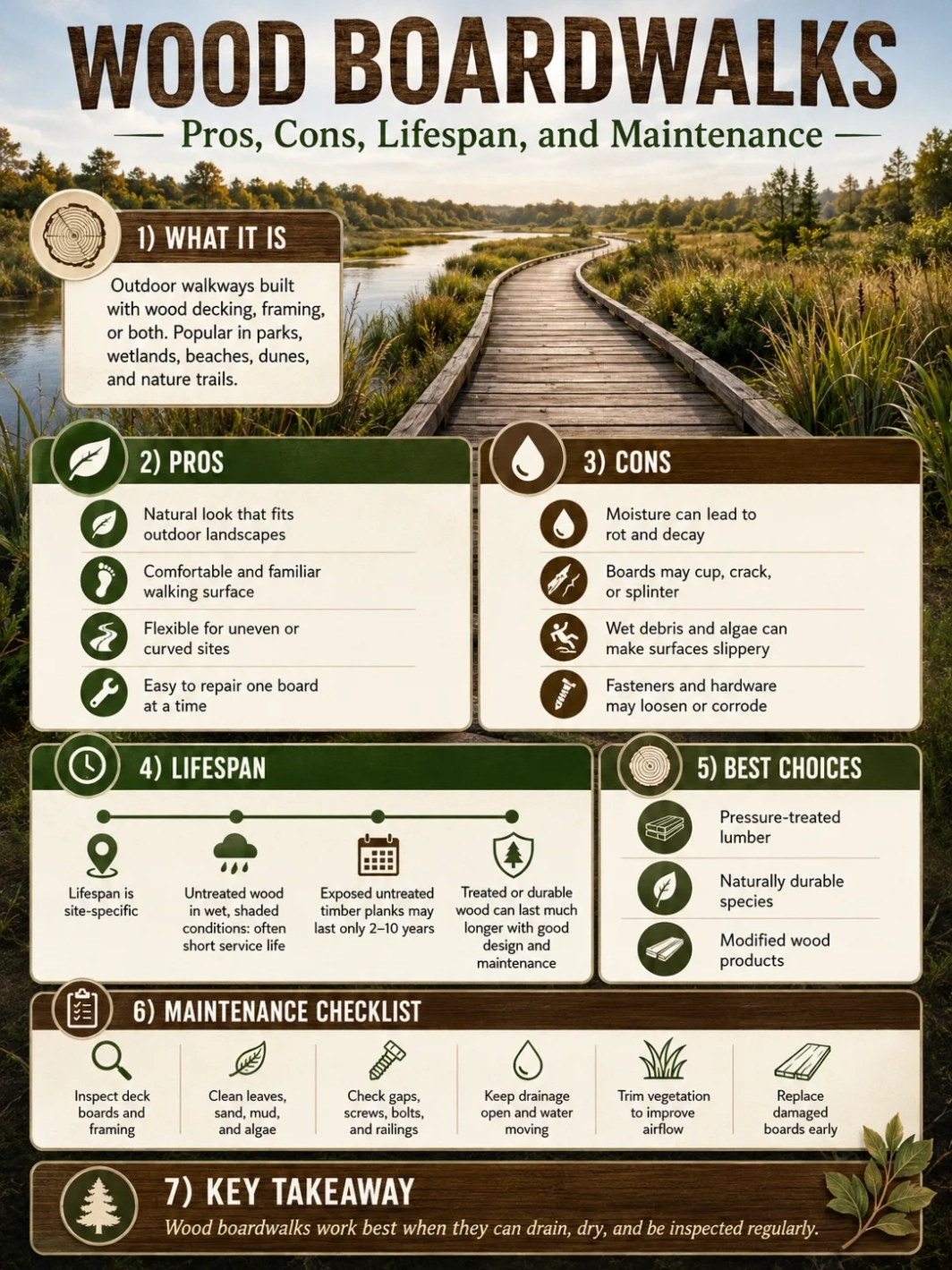
The exact design depends on the surrounding environment. A beach boardwalk must handle sand, sun, wind, and salt. A wetland boardwalk must avoid blocking water flow and damaging sensitive soils. A forest nature trail boardwalk may need to stay usable through shade, leaf litter, roots, seasonal flooding, and freeze-thaw movement.
USDA Forest Service wetland trail guidance describes several wet-area trail structures and notes that bog bridges and boardwalks are often supported on pile foundations, including end-bearing, friction, or helical piles depending on the site [a]. That is why a wood boardwalk should not be thought of as only “deck boards on the ground.” The foundation, drainage, and connection details usually matter as much as the surface.
Pros of Wood Boardwalks
Natural Appearance in Parks and Sensitive Landscapes
Wood is often chosen because it looks appropriate in wetlands, coastal dunes, forest preserves, campgrounds, wildlife refuges, and botanical areas. It has a softer visual presence than concrete and a warmer character than steel or fiberglass. For visitor-facing park walkways, that appearance can be part of the experience.
Flexible Construction for Uneven Sites
Wood components can be cut, fitted, repaired, and adjusted in the field. That flexibility helps where a boardwalk follows a curved trail, crosses hummocky ground, connects to an overlook, or must avoid trees, roots, water channels, or habitat features.
Repairable in Small Sections
One of wood’s biggest practical strengths is selective repair. A loose deck board, damaged curb, worn railing member, or failing section of tread can often be replaced without removing the entire boardwalk. For park managers, this can make maintenance more predictable when inspections are done regularly.
Comfortable Walking Surface
Wood is firm, familiar, and relatively quiet underfoot. It can work well for short interpretive loops, viewing platforms, fishing access, beach approaches, and nature trail segments where visitors expect a stable path but still want a setting that feels close to the landscape.
Cons of Wood Boardwalks
Moisture Is the Main Enemy
Wood used outdoors is exposed to rain, humidity, snow, standing water, wet soil, salt spray, and shaded drying conditions. Once moisture stays trapped in decking, joists, end grain, joints, or board cups, decay risk rises. Pressure treatment and durable species help, but they do not make poor drainage disappear.
Surface Movement Can Affect Comfort and Access
Wood can shrink, swell, cup, check, splinter, and weather. Small changes may only affect appearance. Larger movement can create trip points, uneven board edges, wide gaps, rough spots, or loose fasteners. These issues matter more on visitor paths used by strollers, wheelchairs, walkers, canes, and people with limited vision.
Slippery Conditions Need Attention
Wood boardwalks can become slippery when shaded, wet, frosty, or covered with algae, leaves, pine needles, sand, mud, or coastal film. This does not make wood unsuitable, but it does mean cleaning, surface texture, drainage, and seasonal inspection should be part of the maintenance plan.
Fasteners and Connections Can Wear Before the Boards
A boardwalk is not only lumber. Screws, bolts, washers, brackets, rail posts, ledgers, pile connections, and curb attachments all carry loads and resist movement. Corrosion, loosened screws, hidden rot around connections, or hardware pulled into soft wood can create problems even when most deck boards still look usable.
How Long Do Wood Boardwalks Last?
The honest answer is that wood boardwalk lifespan is site-specific. A dry, ventilated, well-built boardwalk with appropriate treated or naturally decay-resistant wood can remain useful far longer than an untreated walkway sitting low in wet shade. Decking may need replacement before structural members, and high-traffic sections may wear faster than quiet overlooks.
USDA Forest Service bridge information gives a useful caution: untreated sawn timber planks used for trail bridge decking have an expected life of only 2 to 10 years, while untreated log decks are listed with a short expected life as well [b]. That does not mean all wood boardwalks fail quickly. It means untreated wood in exposed trail conditions should not be treated as a long-life material.
| Condition | Likely Effect on Lifespan | Maintenance Response |
|---|---|---|
| Untreated wood in wet or shaded trail conditions | Usually short service life, especially when boards stay damp or touch soil. | Avoid for long-term public boardwalks unless the use is temporary and carefully managed. |
| Pressure-treated wood selected for the correct exposure | Can last much longer than untreated wood when treatment, detailing, drainage, and fasteners are appropriate. | Use the correct treatment category, protect cut ends as required, inspect connections, and keep the structure clean. |
| Naturally durable hardwood or decay-resistant species | Can perform well above ground, but performance varies by species, grade, sourcing, climate, and installation. | Confirm suitability for the site and avoid trapping water against the surface or substructure. |
| Wood near saltwater or brackish wetlands | May face salt, corrosion, wave action, high humidity, marine exposure, and more aggressive hardware deterioration. | Use appropriate fasteners, review preservative choices, and check official local requirements for aquatic environments. |
| Good airflow below and between boards | Usually improves drying and reduces decay pressure. | Control vegetation, maintain drainage openings, and avoid debris buildup beneath the deck. |
| Standing water, cupped boards, blocked gaps, or buried framing | Often shortens useful life. | Correct drainage problems early rather than only replacing boards after they fail. |
Best Wood Choices for Boardwalks
Pressure-Treated Lumber
Pressure-treated lumber is common for outdoor boardwalks because it is designed to resist biological deterioration better than untreated lumber. The USDA Forest Products Laboratory explains that wood used outdoors or exposed to moisture may be vulnerable to fungal decay and insects, and that pressure treatment with preservatives is a common way to protect wood from biological deterioration [c].
The important detail is selection. Wood treatment is not a single universal category. A boardwalk designer or land manager should match the wood to the exposure: above-ground decking, ground contact, freshwater contact, coastal setting, or structural member. Local codes, park standards, environmental permits, and product labeling can also affect what is allowed.
Naturally Decay-Resistant Wood
Cedar, redwood, black locust, tropical hardwoods, and other durable woods are sometimes used where appearance, texture, or chemical-treatment concerns influence the choice. These materials can be attractive, but they still need drainage, correct fasteners, and realistic inspection. “Naturally durable” does not mean immune to weathering or surface wear.
Modified Wood and Engineered Timber
Thermally modified wood, acetylated wood, glulam components, and other engineered or modified wood products may be used in some modern boardwalk projects. They can improve dimensional stability or durability, but performance depends on the product, detailing, exposure rating, and warranty conditions. For public access structures, manufacturer claims should be reviewed alongside local requirements and professional design input.
Design Details That Extend Lifespan
Keep Wood Away from Trapped Moisture
The most useful design habit is simple: let the boardwalk dry. Water should drain off the deck, out from between boards, and away from the substructure. Joists and beams should not sit in pockets of wet leaves, mud, sand, or dense vegetation. End grain, notches, bolt holes, and cuts deserve attention because they can absorb water faster than board faces.
Use Gaps Carefully
Gaps between boards help drainage and ventilation, but they also affect accessibility and safety. U.S. Access Board guidance for outdoor developed areas explains that gaps between planks on a bridge or boardwalk can trap wheels, canes, or crutch tips if they are too large; for covered trail surfaces, openings must be small enough that a sphere more than one-half inch in diameter cannot pass through [d].
Choose Fasteners for the Environment
Fasteners should match the wood treatment and exposure. Coastal boardwalks, treated lumber, and wetland settings can be hard on metal. Stainless steel, hot-dip galvanized hardware, or other approved corrosion-resistant connectors may be needed depending on the material and local specifications. Loose screws, proud bolt heads, and failing washers should be corrected before they become visitor hazards.
Control Vegetation Without Damaging the Site
Vegetation can shade a boardwalk, hold moisture against framing, drop organic debris into gaps, and hide early damage. Maintenance crews should keep sightlines and drying space open where allowed, while following the rules of the park, preserve, dune system, wetland, or conservation area. Sensitive sites may limit trimming, herbicide use, soil disturbance, or equipment access.
Wood Boardwalk Maintenance Checklist
A good maintenance program is not only a yearly stain job. It is a cycle of observation, cleaning, small repairs, documentation, and planned replacement. Public boardwalks should be inspected more often after storms, flooding, freeze-thaw periods, heavy visitor use, or nearby tree damage.
| Area to Check | What to Look For | Why It Matters |
|---|---|---|
| Deck boards | Loose boards, cupping, splinters, raised edges, checking, soft spots, broken ends, or excessive bounce. | The walking surface is the first safety and accessibility concern for visitors. |
| Board gaps | Gaps widened by shrinkage, blocked by debris, or uneven due to movement. | Gaps affect drainage, wheelchair casters, canes, crutch tips, and trip risk. |
| Fasteners | Corrosion, missing screws, lifted screw heads, loose bolts, washers pulled into wood, or stained wood around metal. | Connection problems can spread from one plank to a larger structural issue. |
| Framing | Soft joists, cracked beams, rot at bearing points, hidden moisture pockets, or sagging spans. | Deck boards are easy to see; framing problems are often missed until movement appears above. |
| Railings and curbs | Loose posts, cracked rails, protruding hardware, missing edge protection, or unstable curb boards. | Edges, overlooks, elevated walks, and dune crossings may need more protection than ground-level paths. |
| Drainage | Standing water, sediment, clogged culverts, blocked flow paths, sand accumulation, or washed-out approaches. | Drainage controls both wood decay and the condition of the land around the structure. |
| Surface buildup | Algae, leaves, pine needles, mud, salt film, sand, bird droppings, or organic mats. | Buildup can make the surface slippery and trap moisture against the wood. |
| Approaches | Soil erosion, gaps at transitions, settlement, steps at the boardwalk entrance, or washed-out trail edges. | A boardwalk can be sound while its approach becomes difficult or unsafe to use. |
Cleaning and Surface Care
Routine cleaning should remove debris without damaging the wood or the surrounding resource. Sweeping, brushing, low-pressure washing, and targeted cleaning are usually safer starting points than aggressive blasting. In wetlands, dunes, and park preserves, cleaning products may be restricted because runoff can enter sensitive habitat.
Exterior stains can help protect wood surfaces from sunlight and moisture. The Forest Products Laboratory notes that exterior stains are formulated to penetrate wood and are less prone to cracking or peeling than film-forming finishes such as paint [e]. For boardwalks, penetrating stains are often easier to maintain than coatings that form a slick or peeling film, but the right choice depends on product labeling, traction needs, and local rules.
Paint is usually a poor default choice for a walking surface because it can peel, trap moisture, hide decay, and become slippery when wet. Some boardwalks use textured finishes or anti-slip strips in selected areas, but these should be chosen carefully. Raised strips, sharp edges, or poorly attached mats can become their own trip hazards.
Accessibility and Visitor Safety Notes
Accessibility is not only about width. A useful boardwalk surface should be firm, stable, reasonably even, and maintained between planned inspections. USDA outdoor recreation accessibility guidance notes that cross slopes on board-built outdoor recreation access routes must not be steeper than 1:48, or 2 percent, and explains that cross slope affects the effort required by people using mobility devices [f].
- Keep walking surfaces even, with no sudden board movement under normal visitor loads.
- Repair raised fasteners, splintered boards, broken edges, and abrupt transitions quickly.
- Keep board gaps narrow enough for accessibility and oriented safely where possible.
- Maintain drainage without creating slots, holes, or surface changes that catch small wheels or walking aids.
- Use railings, curbs, edge protection, or warnings where elevation, water, slopes, or adjacent hazards require them.
- Trim constructed protrusions and poorly placed signs so they do not intrude into the clear path.
Boardwalk managers should also think about visitor use cases. A short wetland loop used by school groups, wheelchairs, and strollers has different needs than a remote hiking puncheon. A beach access route carrying barefoot visitors and beach carts has different wear patterns than a shaded forest observation platform.
Environmental Considerations for Wood Boardwalks
Boardwalks are often built because the surrounding environment needs protection. A raised walk can keep visitors off fragile dunes, wetland vegetation, muddy soils, wildlife habitat, or restored areas. But the boardwalk itself must be planned carefully so it does not block water movement, concentrate erosion, shade sensitive vegetation unnecessarily, or require repeated disturbance for repairs.
Treated wood choices deserve careful review near water, wetlands, and public contact areas. EPA information on chromated arsenicals explains that CCA-treated wood was used before 2004 in residential structures such as decks and playsets, that manufacturers voluntarily discontinued CCA-treated wood products for homeowner uses in December 2003, and that older existing structures do not automatically have to be removed [g]. For new boardwalk projects, current preservative labels, environmental permits, and land manager requirements should guide the material decision.
Disposal also matters. Old treated wood should not be burned, reused as mulch, or handled casually. Local waste rules may vary, especially for public agencies, commercial projects, or older treated materials. When a boardwalk is in a park, preserve, or coastal zone, disposal planning should be part of the maintenance budget rather than an afterthought.
When Wood Is the Right Choice
Wood is a strong candidate when the site needs a warm natural appearance, flexible field construction, repairable parts, and a structure that fits visually into a park or trail setting. It can work well for short interpretive loops, scenic overlooks, wetland crossings, garden walks, dune approaches, and boardwalks where regular inspection is realistic.
Wood may be less suitable where maintenance access is poor, the structure will be constantly wet, heavy crowds are expected every day, fire risk is a concern, vandalism is common, or local policy favors longer-life materials such as concrete, steel, aluminum, fiberglass, or recycled plastic. The best material is not the one that looks good on opening day. It is the one the manager can inspect, clean, repair, fund, and keep safe through the full service period.
Common Mistakes to Avoid
- Using untreated boards in a wet, shaded, or public-access setting and expecting long service life.
- Letting vegetation grow tightly against joists, beams, railings, or the underside of decking.
- Allowing sand, leaves, needles, or mud to stay packed between boards.
- Choosing fasteners that are not compatible with treated wood or coastal exposure.
- Ignoring approaches, where erosion and settlement can create sudden steps onto the boardwalk.
- Applying a surface coating that traps moisture or creates a slippery walking surface.
- Replacing deck boards repeatedly while ignoring failing framing underneath.
- Making plank gaps large enough to affect canes, crutches, wheelchair casters, stroller wheels, or small children’s feet.
Frequently Asked Questions
How long does a wood boardwalk last?
A wood boardwalk can last from only a few years to several decades depending on wood type, treatment, drainage, airflow, fasteners, climate, traffic, and maintenance. Untreated wood in wet outdoor trail conditions has a much shorter expected life than properly treated or naturally durable wood.
Are wood boardwalks high maintenance?
They are usually moderate to high maintenance compared with concrete or some composite systems. Maintenance normally includes cleaning, vegetation control, board replacement, fastener checks, inspection after storms, and finish renewal where stains or water repellents are used.
Do wood boardwalks get slippery?
Yes, they can. Wet shade, algae, leaves, pine needles, sand, mud, frost, and salt film can reduce traction. Good drainage, routine cleaning, surface texture, and timely repairs help keep the walking surface safer.
Is pressure-treated wood good for boardwalks?
Pressure-treated wood can be a practical boardwalk material when it is selected for the correct exposure and installed with compatible hardware. The exact treatment, use category, environmental setting, and local rules should be checked before use, especially near wetlands or water.
Should a wood boardwalk be stained or sealed?
Many wood boardwalks benefit from a penetrating exterior stain or water-repellent treatment, but the product must suit a walking surface and the surrounding environment. Film-forming coatings that peel, trap moisture, or become slick are usually a poor choice for public boardwalk decking.
What causes wood boardwalks to fail early?
Early failure is often caused by trapped moisture, poor drainage, untreated or mismatched wood, hidden decay at connections, incompatible fasteners, blocked board gaps, heavy organic buildup, poor airflow, and delayed replacement of damaged boards or framing.
Resources Used
- [a] Wetland Trail Design and Construction: 2007 Edition — Used for wetland trail structure types, pile-supported boardwalk context, drainage, corduroy cautions, and sustainable trail construction logic. This is reliable because it is a USDA Forest Service technical publication from an official .gov source.
- [b] Trail Bridge Catalog, Decks, Timber — Used for expected life cautions on untreated timber decking and trail bridge plank information. This is reliable because it is an official USDA Forest Service engineering resource.
- [c] Guidelines for the Selection and Use of Pressure-Treated Wood — Used for moisture, fungal decay, insect damage, pressure treatment, service-life, and environmental consideration context. This is reliable because it is a USDA Forest Products Laboratory General Technical Report.
- [d] Chapter 10: Outdoor Developed Areas — Used for boardwalk plank opening, accessible outdoor trail, and hazard guidance. This is reliable because the U.S. Access Board is the federal agency responsible for accessibility guidelines and standards.
- [e] Selection and Application of Exterior Stains for Wood — Used for exterior stain behavior, moisture, sunlight, and finish-maintenance discussion. This is reliable because it is a USDA Forest Products Laboratory technical report.
- [f] Accessibility Guidebook for Outdoor Recreation and Trails — Used for running slope, cross slope, resting interval, and board-built outdoor recreation access route guidance. This is reliable because it is an official USDA Forest Service accessibility guidebook.
- [g] Chromated Arsenicals (CCA) — Used for treated-wood background, older CCA-treated structures, alternatives, and disposal caution. This is reliable because it is an official U.S. Environmental Protection Agency resource.