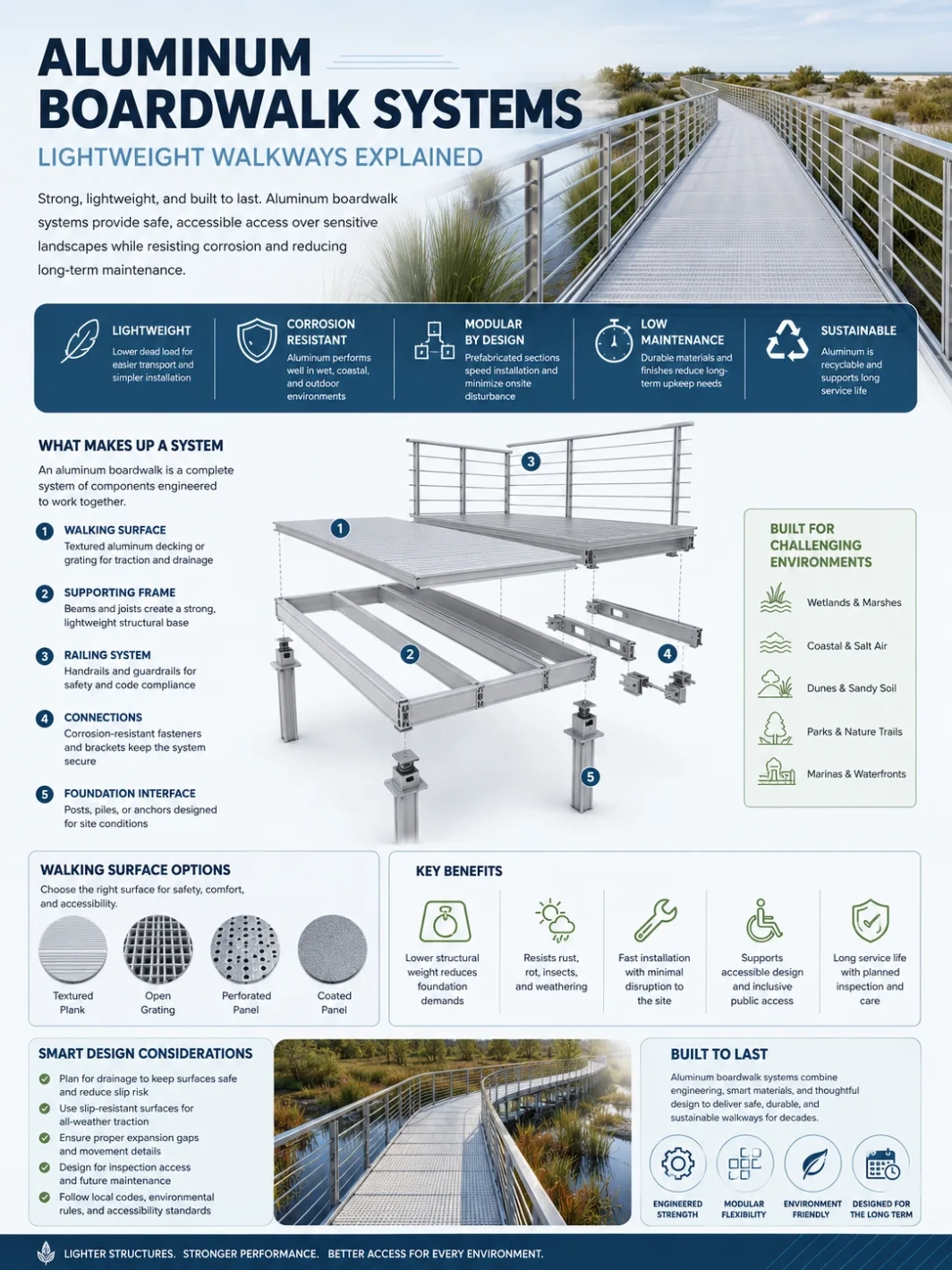
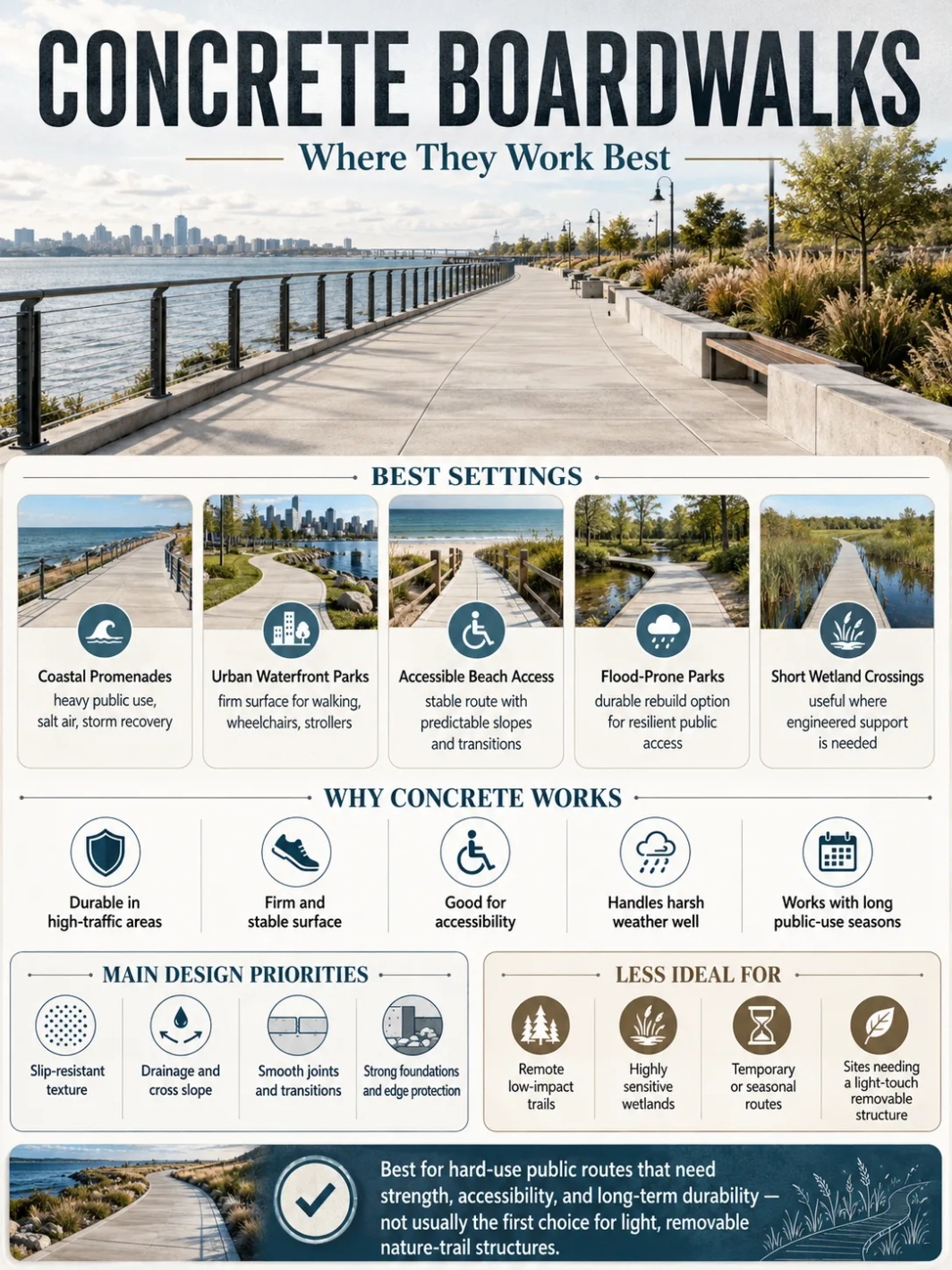
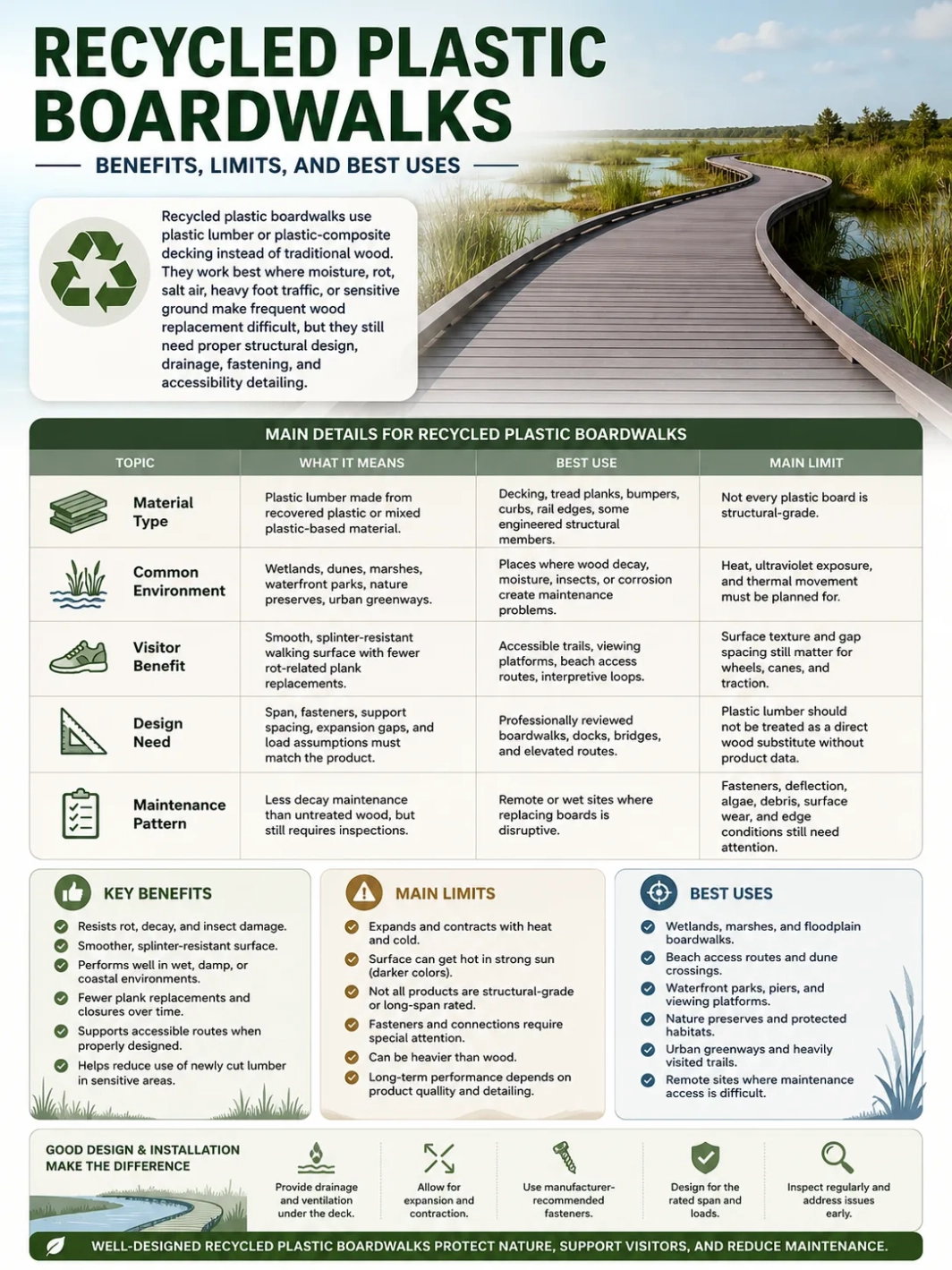
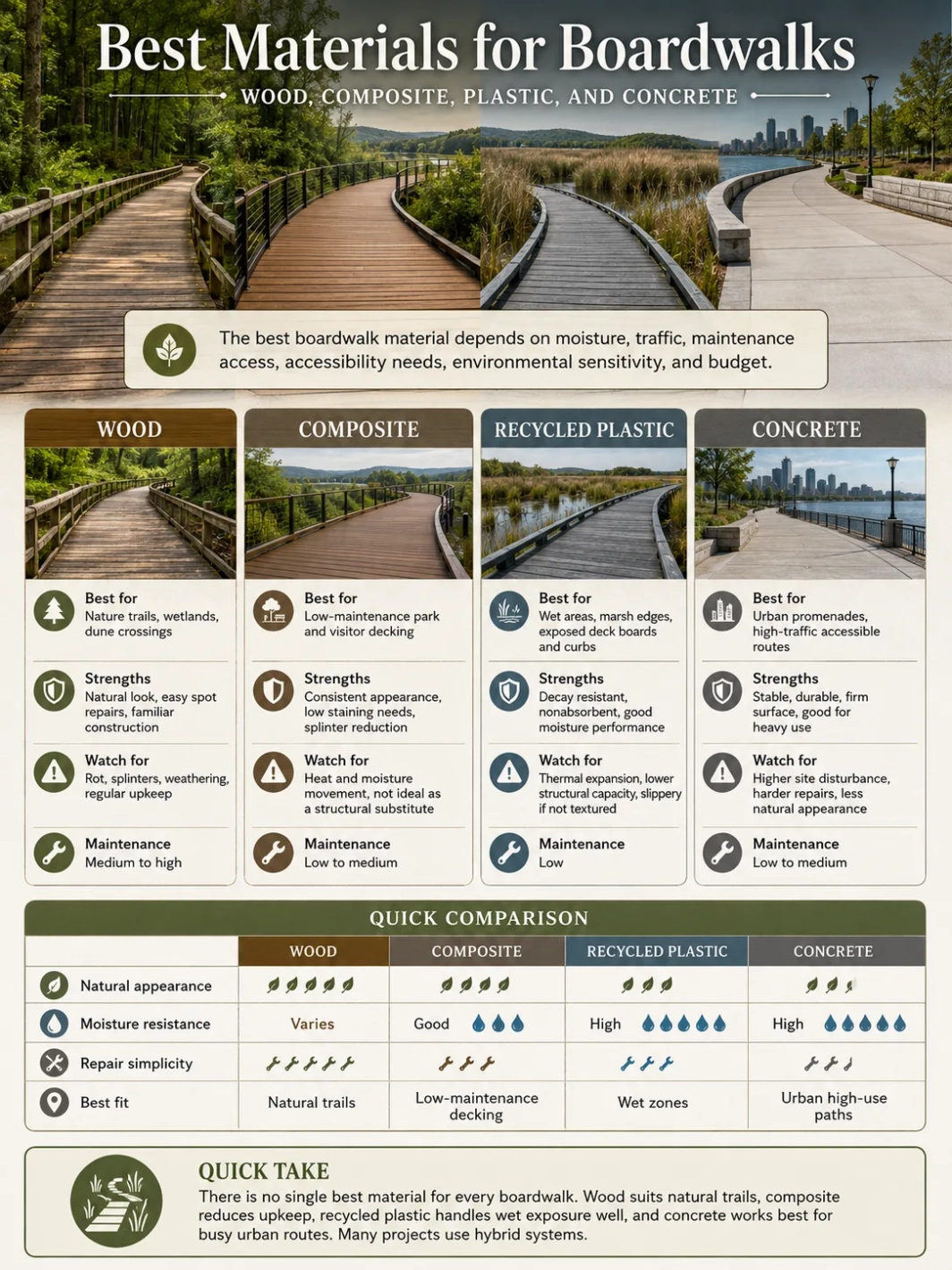
The best boardwalk material depends on moisture, visitor traffic, maintenance access, environmental sensitivity, accessibility needs, and budget. Wood feels natural and repairs easily; composite and plastic resist decay; concrete works well for durable urban or high-use paths.
A boardwalk is not just a walking surface. It is a raised or hardened outdoor route that protects wet soil, dunes, marsh plants, fragile roots, or visitor movement through difficult ground. The material choice affects how the structure drains, how it feels underfoot, how often it needs inspection, and how well it serves strollers, wheelchairs, maintenance crews, and daily visitors.
For most public boardwalk projects, the material decision is not a simple “wood versus plastic” choice. The walking deck, joists, beams, piles, curbs, railings, fasteners, and foundations may use different materials. Local codes, flood exposure, salt air, freeze-thaw cycles, protected habitat rules, and professional design review can all change the right answer.
Main Boardwalk Material Options
| Material | Common Use | Strengths | Limits | Maintenance Level |
|---|---|---|---|---|
| Wood | Nature trails, wetland walks, dune crossings, park paths | Natural look, familiar construction, easy spot repairs | Can rot, splinter, cup, weather, or need preservative treatment | Medium to high |
| Wood-Plastic Composite | Visitor boardwalk decking, overlooks, low-maintenance park routes | Consistent appearance, good surface texture, low staining needs | Can move with heat and moisture; not a direct substitute for structural wood | Low to medium |
| Recycled Plastic Lumber | Deck boards, curbs, bumpers, wet areas, some nonstructural parts | Decay resistant, nonabsorbent, useful in wet settings | May be slippery unless textured; thermal movement and load limits matter | Low |
| Concrete | Urban promenades, waterfront walks, heavy-use access routes | Stable, durable, firm surface, strong for high traffic | Higher site disturbance, harder repairs, less natural appearance | Low to medium |
How to Choose the Right Boardwalk Material
A good boardwalk material matches the site before it matches a product brochure. A shaded wetland trail with standing water has different needs from a sunny beachfront promenade. A narrow interpretive trail through a preserve may prioritize low visual impact, while a downtown coastal walkway may need high load capacity, predictable accessibility, and frequent cleaning.
The USDA Forest Service notes that trail structures and boardwalks have historically used local wood, but many agencies now consider recycled plastic lumber, fiberglass-reinforced polymers, aluminum, rubber lumber, tropical hardwoods, and newer preservative options when replacing deteriorated structures [a].
The first filter is environment. Wetlands, marshes, swamps, bogs, and coastal dunes usually need materials that tolerate moisture and limit repeated disturbance. The second filter is use. A quiet birding boardwalk, a beach access route, a fishing pier approach, and a busy waterfront promenade do not receive the same loads, turning movements, or maintenance pressure.
The third filter is access. Outdoor routes that are intended to be accessible should have a firm and stable surface, controlled openings, manageable slopes, and low obstacles. The U.S. Access Board treats board surfaces, concrete, asphalt, openings, running slope, and cross slope as practical access issues, not just construction details [b].
Wood Boardwalks
Wood remains one of the most common boardwalk materials because it is familiar, workable, and visually comfortable in natural settings. It suits wetland boardwalks, forest trails, dune walkovers, lakeshore paths, and park walkways where the structure should feel quiet and low-profile.
Wood’s biggest advantage is repairability. A damaged deck board, curb, or rail element can often be replaced without rebuilding the whole structure. Crews usually understand wood framing, and many parks can keep replacement boards, fasteners, and basic tools on hand.
The main weakness is exposure. Moisture, shade, insects, fungal decay, salt air, and trapped leaf litter can shorten wood’s life. In wet areas, the details matter: air movement below the deck, drainage, board spacing, fastener choice, and avoiding constant soil contact can be just as important as the species itself.
Decay-resistant species such as cedar, redwood heartwood, black locust, and some tropical hardwoods may perform better than ordinary untreated softwood in exposed conditions, but availability, cost, sourcing, and environmental policy vary by region. Treated wood can extend service life, but the preservative type should be checked carefully for the intended setting.
EPA information on wood preservatives explains that older chromated arsenical treatments are restricted and that newer preservative systems are used for many residential and outdoor wood applications. For public boardwalks, preservative choice should follow current labeling, local rules, environmental permits, and agency guidance [c].
Best Uses for Wood
- Low to moderate traffic nature boardwalks.
- Wetland trails where a natural appearance is desired.
- Dune walkovers and park routes with regular inspection access.
- Sites where small repairs must be simple and affordable.
- Historic or rustic settings where concrete or plastic would feel visually out of place.
Composite Boardwalks
Composite boardwalk decking usually refers to wood-plastic composite boards made from plastic and wood fiber. They are popular where managers want a wood-like appearance with less staining, painting, and surface maintenance than ordinary wood.
Composite can be a practical walking surface for parks, overlooks, urban nature trails, and waterfront paths. It often has a consistent profile, predictable color range, and textured surface. That texture can help with traction, although real slip resistance depends on product design, algae growth, cleaning cycles, and wet-weather conditions.
The Forest Service’s alternative materials guide explains that wood-plastic composites often contain wood flour and plastic, and that the wood component can stiffen the plastic and reduce temperature-related expansion. It also warns that composite lumber should not be treated as a direct structural replacement for wood where load-bearing strength and stiffness are required [d].
This distinction matters. A composite deck board may be suitable as a surface layer, while beams, stringers, piles, or long-span elements may need engineered wood, steel, concrete, fiberglass-reinforced products, or another approved structural system. The final choice should come from project specifications, not from appearance alone.
Best Uses for Composite
- Public boardwalk decking where a clean, consistent appearance is desired.
- Wet or humid parks where staining and repainting would be difficult.
- Short-span deck surfaces with properly designed support spacing.
- Visitor routes where splinter reduction is a priority.
- Sites where lifecycle maintenance is more important than the lowest first cost.
Recycled Plastic Lumber Boardwalks
Recycled plastic lumber is often used for boardwalk deck boards, curbs, bumpers, and other exposed components. It is valued because it does not rot like wood, absorbs little water, and can perform well in wet environments when properly detailed.
Plastic lumber can be especially useful in marshes, wetland trails, lake edges, and locations where crews want to reduce repeated replacement of decayed boards. It can also be useful for edge protection, kick rails, and wheel guides because it resists moisture and can be shaped into consistent profiles.
The material still has limits. Plastic expands and contracts more than wood, steel, or concrete. Some products can creep under long-term loads. Some surfaces can become slick when wet, shaded, sandy, or algae-covered unless the board has a suitable texture and is cleaned as needed.
Forest Service guidance states that recycled plastic lumber can be used as a substitute for several decking materials on boardwalks, but also notes that HDPE plastic lumber does not have the same load-bearing capacity as wood and should not simply replace wooden load-bearing components [e].
For this reason, plastic lumber is often strongest as a decking or edge material, not as an all-purpose structural answer. Structural-grade plastic, fiberglass-reinforced polymer, or hybrid systems may be appropriate in some projects, but those decisions belong in engineered plans.
Best Uses for Recycled Plastic Lumber
- Wetland boardwalk deck boards exposed to constant moisture.
- Edge bumpers, curbs, and guide rails on accessible outdoor routes.
- Replacement decking where wood decay has been a repeated problem.
- Low-maintenance visitor routes with manageable structural spans.
- Sites where recycling goals are part of the project brief.
Concrete Boardwalks and Promenade Surfaces
Concrete is most common where a boardwalk functions more like a promenade, accessible waterfront route, park walkway, or high-use public path. It creates a firm, stable, durable surface and can handle heavy pedestrian traffic, maintenance carts, and frequent cleaning better than many deck-board systems.
Concrete works best when the site can support the needed foundation and drainage design. It is not always the right material for sensitive wetlands, soft marshes, moving dunes, or locations where future removal must be light-touch. In those settings, elevated structures with smaller foundations may reduce ground disturbance.
Concrete also changes the visitor experience. It feels more urban and permanent than wood or composite. That can be ideal for a city waterfront, beach promenade, or busy park entrance, but less fitting for a quiet birding trail through a marsh.
Accessibility is one reason concrete remains useful. The Access Board identifies concrete, asphalt, and board surfaces in slope, opening, and obstacle requirements for outdoor recreation access routes and beach access routes. A well-finished concrete surface can help provide a predictable route, but joints, settlement, drainage, and surface texture still require attention.
Best Uses for Concrete
- Urban waterfront promenades and heavily visited park walks.
- Beachfront access zones where a firm, stable route is needed.
- Areas with frequent maintenance vehicles or cleaning equipment.
- Short boardwalk-like connections in plazas, overlooks, or visitor centers.
- Sites where long-term durability is more important than a natural deck appearance.
Material Choice by Environment
| Environment | Material Often Considered | Reason | Watch For |
|---|---|---|---|
| Wetland or Marsh | Wood, recycled plastic, composite, fiberglass-reinforced systems | Elevated structures can reduce damage to saturated soils and vegetation | Permits, foundations, floating sections, decay, algae, and seasonal water level |
| Coastal Dune | Wood, composite, recycled plastic | Decked walkovers can guide visitors over fragile dune vegetation | Salt air, wind-blown sand, storms, anchoring, and seasonal access changes |
| Urban Waterfront | Concrete, composite, treated wood, steel-supported decking | High traffic and maintenance access often matter more than rustic appearance | Drainage, railings, expansion joints, lighting, and slip resistance |
| Forest Nature Trail | Wood, composite, recycled plastic decking | Natural appearance and repairability are often valued | Leaf litter, shade, moss, rot, uneven settlement, and board spacing |
| Accessible Park Route | Concrete, board decking, composite, textured plastic | Surface firmness, stable footing, and controlled openings are central | Cross slope, running slope, openings, resting intervals, and edge protection |
Accessibility and Surface Safety
Boardwalk material affects more than appearance. It affects cane tips, stroller wheels, wheelchair casters, walkers, shoes, and bicycle tires where shared use is allowed. Gaps, raised fasteners, cupped boards, uneven transitions, and slick algae can turn a short boardwalk into a difficult route.
For outdoor recreation access routes, the Access Board states that surfaces must be firm and stable, openings must not allow passage of a sphere more than one-half inch in diameter, and elongated openings should be perpendicular or nearly perpendicular to the main direction of travel. These details are especially relevant to plank boardwalks and drainage grates.
Slip resistance is not solved by material name alone. Wood can become slick with algae. Composite can hold surface film in shaded areas. Plastic can be slippery unless textured. Concrete can become polished or slick if the finish is poor. Maintenance and surface texture should be considered together.
| Design Feature | Why It Matters | Visitor Impact | Material Note |
|---|---|---|---|
| Firm, Stable Surface | Reduces sinking, flexing, and unpredictable movement | Helps visitors using mobility devices, strollers, walkers, and canes | Concrete is naturally firm; board systems need sound framing and secure decking |
| Small Openings | Prevents wheels, cane tips, and crutch tips from catching | Improves comfort and safety for many users | Deck board gaps and drainage grates require careful detailing |
| Low Obstacles | Limits tripping points and abrupt wheel impacts | Makes travel smoother and more predictable | Raised fasteners, warped boards, and concrete joint heave need inspection |
| Controlled Slope | Supports easier movement and drainage | Reduces fatigue and improves independent access | Board surfaces, concrete, and transitions must be checked after settlement |
Maintenance Factors That Change the Best Material
A boardwalk with poor maintenance can fail early even if the material is good. Leaf buildup holds moisture against wood. Sand can wear surface texture. Salt can corrode fasteners. Freeze-thaw movement can lift concrete joints. UV exposure can fade or embrittle some products. Heavy shade can feed algae and moss on almost any surface.
The Forest Service’s trail construction guidance describes wet-area structures such as turnpikes, puncheon, and boardwalks, and it treats drainage, unstable soils, and site-specific design as central trail issues rather than afterthoughts [f].
Maintenance planning should begin before material selection. A remote wetland boardwalk may need a material that lasts longer because bringing crews and lumber to the site is difficult. A city promenade may accept more frequent cleaning because crews already visit daily. A beach access boardwalk may need modular sections if storms, sand movement, or seasonal removal are expected.
- Inspect deck boards for rot, cracks, cupping, uplift, or loose fasteners.
- Check board gaps, drainage openings, and transition points after settlement.
- Remove leaf litter, algae, sand buildup, and trapped debris before they hold moisture.
- Review railings, curbs, bumpers, and edge protection where drop-offs exist.
- Confirm that surface texture still provides reasonable traction in wet conditions.
- Look for corrosion where treated wood, salt air, and metal fasteners interact.
- Recheck slopes and ponding after floods, storms, frost movement, or repairs.
Wood vs Composite vs Plastic vs Concrete
| Feature | Wood | Composite | Plastic Lumber | Concrete |
|---|---|---|---|---|
| Natural Appearance | High | Medium to high | Medium | Low to medium |
| Moisture Resistance | Varies by species and treatment | Generally good | High | High if properly designed |
| Repair Simplicity | High | Medium | Medium | Low to medium |
| Structural Use | Common when properly specified | Limited; often decking only | Limited unless structural-grade and engineered | Strong for slabs, walks, and supported structures |
| Slip Concerns | Can be slick with algae or wet leaves | Depends on texture and cleaning | Can be slick unless textured | Depends on finish and drainage |
| Best Fit | Natural trails and repairable park boardwalks | Low-maintenance visitor decking | Wet areas and nonstructural exposed parts | Urban promenades and high-use accessible paths |
Common Mistakes in Boardwalk Material Selection
One common mistake is choosing the deck board before understanding the foundation. A durable surface cannot fix poor support, weak anchoring, saturated soils, or flood forces. In wet areas, the boardwalk may need piles, helical anchors, sleepers, floating sections, or other site-specific support methods.
Another mistake is assuming “low maintenance” means “no maintenance.” Plastic, composite, wood, and concrete all need inspection. Low-maintenance materials can still need cleaning, fastening checks, joint checks, algae removal, and edge protection repairs.
A third mistake is treating accessibility as a late-stage add-on. Board spacing, deck texture, cross slope, resting intervals, rail height, curbs, and transitions should be part of the design conversation from the start. Fixing them after construction is usually harder and more expensive.
A fourth mistake is ignoring heat, shade, and climate. Dark boards can become hot in open sun. Shaded boards can stay damp. Coastal sites bring salt and wind. Cold climates bring frost movement and snow removal. Materials should be selected for the actual microclimate, not just the region on a map.
Which Material Is Best?
For a quiet nature trail, wood or carefully selected composite often gives the best balance of appearance, repairability, and visitor comfort. For wetland decking where rot has been a repeated problem, recycled plastic lumber may be a better surface material, especially for deck boards and curbs. For an urban waterfront or heavily used public path, concrete may provide the most stable and durable surface.
Many strong boardwalks use hybrid construction. A project might use steel or concrete foundations, engineered wood or steel framing, composite decking, plastic curbs, and stainless or hot-dip galvanized fasteners. The visible deck material is only one part of the system.
The safest general rule is simple: choose the material after defining the environment, intended users, structural spans, accessibility targets, expected maintenance cycle, and managing authority requirements. For public trails, coastal access routes, wetlands, and elevated structures, professional review and official land-manager approval may be needed.
Frequently Asked Questions
What Is the Longest-Lasting Material for a Boardwalk?
Concrete and properly specified plastic or composite materials can last a long time, but service life depends on foundations, drainage, UV exposure, fasteners, cleaning, loads, and local climate. No boardwalk material is maintenance-free.
Is Wood Still a Good Material for Boardwalks?
Yes. Wood can be a good choice for nature trails, parks, and dune walkovers where appearance, repairability, and familiar construction matter. It needs the right species or treatment, good drainage, and regular inspection.
Is Composite Better Than Wood for Boardwalk Decking?
Composite can reduce staining, splintering, and some decay concerns, but it is not automatically better. Heat movement, support spacing, surface traction, product rating, and structural limitations must be checked before selection.
Can Recycled Plastic Lumber Replace Structural Wood?
Not automatically. Some plastic lumber works well for decking and exposed parts, but many products do not match wood’s stiffness or load-bearing behavior. Structural use should be engineered for the specific product.
Are Concrete Boardwalks Good for Natural Areas?
Concrete can be useful for high-use access routes, visitor centers, and urban waterfronts. In sensitive wetlands, dunes, or soft soils, it may cause more disturbance than elevated wood, composite, or plastic systems.
What Boardwalk Surface Is Best for Accessibility?
The best surface is firm, stable, well-drained, and detailed with small openings, low obstacles, manageable slopes, and safe transitions. Concrete, boards, composite, and textured plastic can all work when designed and maintained properly.
Resources Used
- [a] Plastic Wood and Alternative Materials for Trail Structures — Used for the range of alternative trail structure materials and boardwalk replacement considerations. This is a USDA Forest Service technical publication, making it a high-trust government source.
- [b] Chapter 10: Outdoor Developed Areas — Used for outdoor recreation access route concepts, firm and stable surfaces, openings, obstacles, running slope, and cross slope. This is official U.S. Access Board guidance.
- [c] Overview of Wood Preservative Chemicals — Used for current context on wood preservatives and treated wood considerations. This is an official U.S. Environmental Protection Agency source.
- [d] Plastic Wood and Alternative Materials for Trail Structures — Used for wood-plastic composite characteristics, maintenance expectations, and structural cautions. This is a USDA Forest Service technical publication.
- [e] Plastic Wood and Alternative Materials for Trail Structures — Used for recycled plastic lumber performance, HDPE notes, decking use, and load-bearing cautions. This is a USDA Forest Service technical publication.
- [f] Trail Construction and Maintenance Notebook: Trails in Wet Areas — Used for wet-area trail structures, boardwalks, drainage, and site-specific construction context. This is an official USDA Forest Service trail construction resource.