A boardwalk is mainly a walking path along or over sensitive ground, sand, wetland, or waterfront space. A pier is a structure that extends out over water, usually from the shore, and is often used for fishing, vessel access, viewing, recreation, or promenade space.
The easiest way to separate the two is this: a boardwalk usually helps people move along a place, while a pier usually helps people move out over water. They can look similar when both are made of timber and used for walking, but their setting, structure, purpose, and maintenance needs are different.
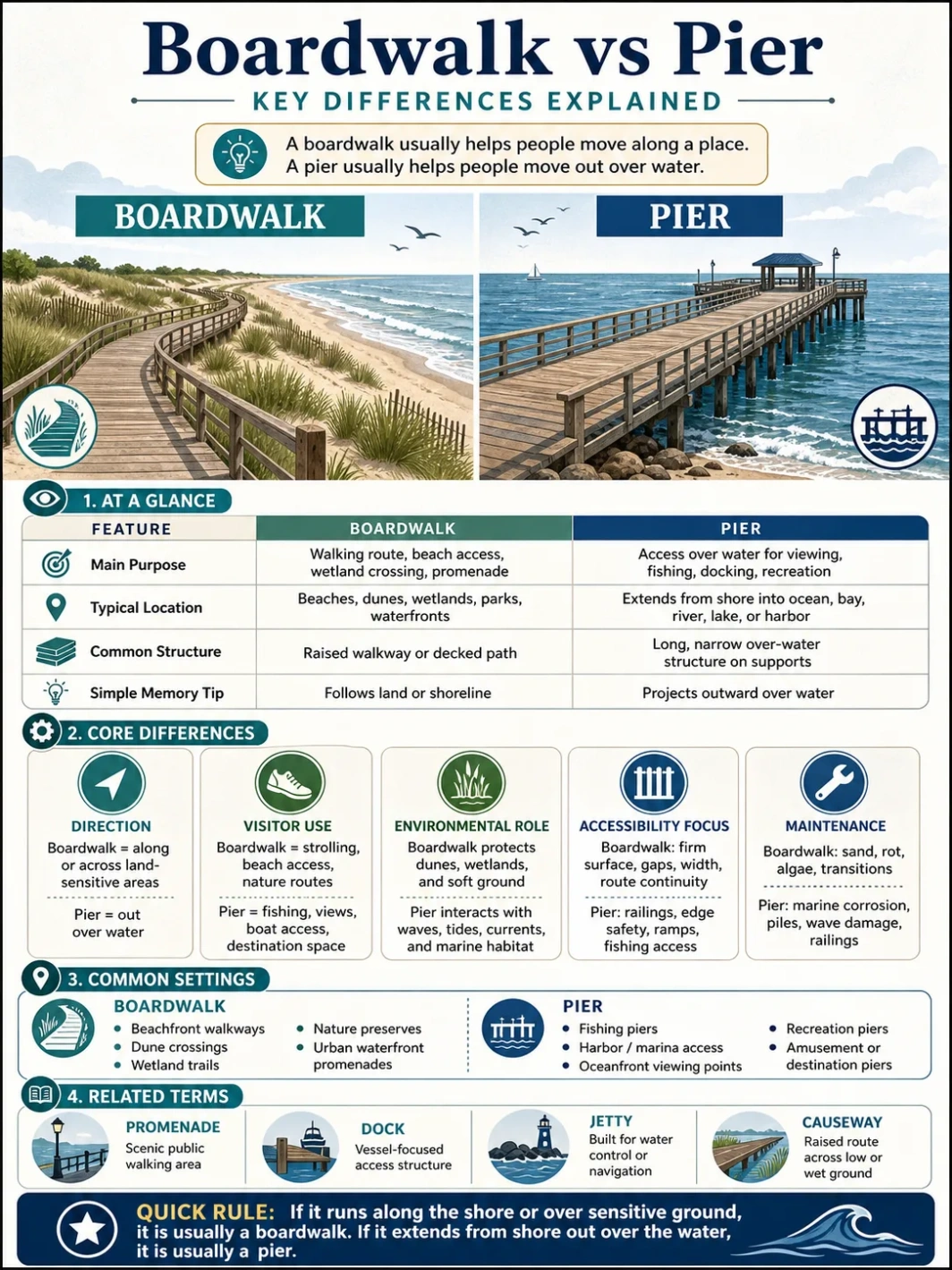
| Feature | Boardwalk | Pier | Simple Way to Remember |
|---|---|---|---|
| Main Purpose | Walking route, beach access, wetland crossing, nature trail, promenade, or visitor circulation. | Access over water for viewing, fishing, docking, landing, recreation, or waterfront activity. | A boardwalk usually follows the land or shoreline. |
| Typical Location | Beachfronts, dunes, marshes, wetlands, parks, lakesides, preserves, and nature trails. | Extends from shore into an ocean, bay, river, lake, harbor, or other body of water. | A pier usually projects outward over water. |
| Common Structure | Raised walkway, plank path, decked trail, or smooth pedestrian surface. | Long, narrow structure supported over water, often by piles, columns, or other marine supports. | A boardwalk is a path; a pier is an over-water structure. |
| Visitor Use | Strolling, wildlife viewing, dune protection, accessible trail travel, beach movement, and crowd flow. | Fishing, sightseeing, boat access, amusement uses, promenade space, and water views. | Boardwalks guide movement; piers create an over-water destination. |
| Environmental Role | Often reduces foot traffic on dunes, wetlands, vegetation, or soft soils. | May affect water flow, marine habitat, wave forces, and shoreline activity depending on design. | Boardwalk impact is often land-sensitive; pier impact is often water-sensitive. |
| Accessibility Focus | Surface firmness, slope, width, openings between boards, resting areas, and route continuity. | Surface safety, railings, transitions, edge protection, slopes, fishing access, and crowd management. | Both can be accessible, but the design questions differ. |
What Is a Boardwalk?
A boardwalk is a constructed pedestrian route, often raised, that lets people cross or move beside beaches, wetlands, marshes, dunes, lakesides, or park landscapes without walking directly on fragile or unstable ground. The National Park Service describes boardwalks as walkways crossing water or marshy ground, usually made from wood or other smooth materials.[a]
Not every boardwalk is beside the ocean. Some are short dune walkovers from a parking area to a beach. Others are long wetland trails, urban waterfront promenades, or raised nature paths through forests and marshes. The shared idea is controlled pedestrian access over a surface that needs protection, structure, or both.
Common Boardwalk Settings
- Beachfront resort areas where people walk parallel to the shore.
- Dune crossings that keep visitors off fragile vegetation.
- Wetland preserves where a raised route protects soft soils and water flow.
- Nature trails where visitors need a dry, stable path.
- Urban waterfronts where the boardwalk works like a pedestrian promenade.
- Park overlooks where the structure leads to a viewing platform.
What Is a Pier?
A pier is a structure built from the shore out over water. NOAA’s coastal glossary defines a pier as a long, narrow structure extending into the water for uses such as vessel berthing or a promenade.[b] In everyday visitor language, a pier is often the place people go for fishing, ocean views, boat access, restaurants, rides, or sunset viewing.
Piers can be simple and functional, such as a fishing pier on a lake, or large public destinations with shops, amusements, and viewing areas. Their main difference from boardwalks is direction and setting: a pier goes out over water; a boardwalk usually runs across land, marsh, dune, beach edge, or waterfront ground.
Common Pier Settings
- Oceanfront recreation areas.
- Fishing locations on beaches, lakes, rivers, or bays.
- Harbors, marinas, and ferry or vessel access points.
- Historic waterfronts with promenade-style public access.
- Amusement districts where the pier itself becomes a destination.
- Viewing platforms built over water.
The Core Difference: Along the Shore vs Out Over Water
The strongest difference is the relationship to water. A boardwalk can be near water, over wet ground, or along a beach, but it does not have to project into open water. A pier is defined by that outward movement from land into a water body.
This difference affects almost everything else: how the structure is supported, what hazards it faces, how people use it, and what maintenance problems managers watch for. A wooden beach boardwalk may deal with sand, sun, foot traffic, and storm exposure. A pier must also handle wave action, water levels, marine corrosion, pile condition, and edge safety.
Boardwalk vs Pier by Purpose
Boardwalks are often built to organize movement. They help visitors reach a beach, cross wet ground, protect vegetation, avoid muddy trail sections, or enjoy a waterfront route. In protected landscapes, a boardwalk can reduce the number of informal footpaths that damage soil, roots, dunes, or marsh plants.
Piers are often built to create access to water. That access may be practical, recreational, or scenic. A pier may support fishing stations, small vessel landings, benches, viewing rails, lighting, restaurants, amusements, or public gathering space. In many coastal towns, the pier is not just a path; it is the destination.
| Use Case | More Common for a Boardwalk | More Common for a Pier |
|---|---|---|
| Moving through a wetland | Yes. Raised boardwalks are common in marshes, bogs, swamps, and floodplain trails. | Rare. A pier normally extends over open water rather than across wet ground. |
| Crossing dunes to a beach | Yes. Dune walkovers protect vegetation and control visitor access. | No. A pier starts at the shore and extends into water. |
| Fishing from a public structure | Possible, but not the usual purpose. | Yes. Fishing is one of the most common pier uses. |
| Boat docking or landing | Usually no. | Yes, depending on the pier type and local rules. |
| Beachfront walking district | Yes. Many seaside boardwalks function as pedestrian streets. | Sometimes, if the pier includes a promenade deck. |
| Wildlife viewing in sensitive habitat | Yes. Boardwalks are often used to keep people on a defined route. | Sometimes, especially for birding or water views, but this is not the core definition. |
Structural Differences
A boardwalk can be low, lightly raised, or fully elevated. In wet areas, it may use sleepers, sills, cribbing, piles, helical supports, or other site-specific foundations. USDA Forest Service wetland trail guidance explains that wetland trail structures can vary from simple older methods to pile-supported boardwalks and floating trail techniques, depending on site conditions.[c]
A pier usually needs a stronger over-water support system because it projects into a water body. Its supports may face wave movement, tides, currents, boat impact, corrosion, floating debris, and changing water levels. That does not automatically make every pier larger than every boardwalk, but it changes the engineering questions.
Boardwalk Structure in Simple Terms
- Decking: the walking surface, often wood, composite, concrete, metal grating, or another firm surface.
- Stringers or joists: the members below the walking surface that support the deck.
- Foundations: sleepers, posts, piles, cribbing, helical supports, or other systems chosen for the soil and water conditions.
- Edge treatment: curbs, rails, toe boards, or open edges depending on height, use, and local rules.
- Transitions: the places where the boardwalk meets a trail, parking area, sidewalk, beach, bridge, or viewing platform.
Pier Structure in Simple Terms
- Deck: the surface visitors walk on above the water.
- Piles or columns: vertical supports driven or placed into the seabed, lakebed, riverbed, or harbor bottom.
- Beams and caps: horizontal members that connect supports and hold the deck system.
- Railings and edge protection: important because visitors are above water and often near open edges.
- Marine details: may include boat cleats, ladders, lighting, fishing stations, utilities, or fender systems, depending on use.
Material Differences
Boardwalks and piers may both use wood, but material choice depends on exposure. A shaded wetland boardwalk, a saltwater pier, a dune walkover, and a busy beachfront promenade do not age in the same way. Moisture, salt, sun, insects, abrasion, flooding, and maintenance access all matter.
| Material | Common Use | Strengths | Limits |
|---|---|---|---|
| Wood | Traditional boardwalk decking, dune walkovers, nature paths, fishing piers, and historic waterfront structures. | Natural look, familiar walking feel, repairable in sections. | Can weather, splinter, rot, or become slick if not maintained. |
| Composite Decking | Boardwalks and promenade surfaces where lower routine maintenance is desired. | Consistent boards, fewer splinters, often less staining or sealing than natural wood. | Heat, expansion, texture, fasteners, and replacement matching still need attention. |
| Concrete | Urban promenades, some piers, approaches, ramps, and high-traffic waterfronts. | Durable, firm, stable, and suitable for many accessible routes. | Less natural look; cracking, drainage, edge details, and salt exposure must be managed. |
| Steel or Aluminum | Rails, frames, grating, marine structures, ramps, and some pier components. | Strong and useful for long spans or modular systems. | Corrosion control, heat, traction, and maintenance planning are important near saltwater. |
| Recycled Plastic Lumber | Some wetland boardwalks, parks, and waterfront paths. | Resists rot and can reduce some wood-maintenance needs. | Structural design, stiffness, heat, and fastening details need careful review. |
Accessibility Differences
Both boardwalks and piers can be accessible, but accessibility is not automatic just because the surface is flat. The U.S. Access Board’s outdoor developed area guidance covers trail features such as surface, clear tread width, openings, running slope, cross slope, resting intervals, and protruding objects.[d]
For visitors, the practical questions are simple: Is the surface firm? Are gaps between boards small enough? Are slopes manageable? Are there railings where needed? Are transitions smooth? Is there enough width for mobility devices, strollers, or two-way passing?
Accessible walking surfaces should generally be stable, firm, and slip resistant. The U.S. Access Board explains that stable surfaces resist movement, firm surfaces resist deformation, and accessible surfaces remain usable under external forces such as wheels, canes, or foot traffic.[e]
Boardwalk Accessibility Notes
- Board gaps matter because wheels, cane tips, and crutch tips can catch in openings.
- Wet wood can become slick, especially in shaded forests, marshes, or rainy climates.
- Long boardwalks may need resting areas, passing spaces, benches, or wider viewing areas.
- Transitions from sand, gravel, pavement, or trail tread can affect real-world usability.
- Raised edges, curbs, or rails may be needed depending on height and site design.
Pier Accessibility Notes
- Approach ramps can be a major issue where the pier connects to a beach, seawall, harbor, or parking area.
- Rail height and viewing gaps affect people seated in wheelchairs and children.
- Fishing piers may need accessible fishing spaces, edge protection, and clear turning areas.
- Wet decking, fish-cleaning areas, sea spray, and crowding can create surface concerns.
- Seasonal closures or storm damage can change access, so visitors should check the managing agency before relying on a route.
Safety Differences for Visitors
Boardwalk safety usually focuses on surface condition, crowd flow, edges, wet areas, and protecting the landscape. Loose boards, raised fasteners, algae, leaf litter, puddles, missing rails, and sudden transitions are common things visitors and managers notice.
Pier safety adds over-water risks. Visitors may be near railings, fishing lines, wet deck areas, boat operations, wind, waves, and open edges. A pier can feel like a sidewalk, but it is still a structure above water. Local rules often cover fishing, jumping, swimming nearby, pets, bikes, alcohol, hours, and storm closures.
Simple Visitor Checklist
- Check official park, city, or pier pages for closures, hours, repairs, and seasonal rules.
- Use marked entrances instead of cutting across dunes, marsh plants, or private property.
- Walk carefully after rain, sea spray, frost, or heavy leaf fall.
- Keep children close near railings, fishing areas, stairs, and open edges.
- Do not climb rails, sit on unsafe edges, or enter closed sections.
- Respect wildlife viewing distances, especially in wetlands and nesting areas.
- For accessibility needs, confirm surface type, slope, parking, restrooms, and route length before visiting.
Environmental Differences
Boardwalks are often used because the ground itself needs protection. In wetlands and dunes, repeated foot traffic can damage vegetation, compact soil, disturb habitat, and create informal trails. A boardwalk concentrates movement on a defined route and can let water, roots, and small wildlife pass beneath, depending on design.
Piers interact more directly with the water environment. Their piles and deck layout can affect shading, water movement, sediment patterns, marine habitat, and navigation. A small lake fishing pier and a large ocean pier have very different review needs, but both are over-water structures rather than simple shoreline paths.
Permits and environmental review depend on location. Wetlands, dunes, shorelines, navigable waters, protected species, flood zones, and local coastal rules can all matter. For construction or repair decisions, land managers, local authorities, engineers, and environmental agencies should be checked rather than relying on a generic design rule.
Real Examples That Show the Difference
Atlantic City is a classic boardwalk example. Atlantic County’s official history notes that the first section of the Atlantic City Boardwalk opened along the New Jersey beach on June 26, 1870.[f] Its purpose fits the boardwalk idea: a beachside pedestrian route serving a shorefront district.
A wetland boardwalk gives a different example. The National Park Service identifies the Congaree National Park Boardwalk Loop as a 2.6-mile boardwalk with a flat surface that gives visitors a way to experience the park’s floodplain forest.[g] This is not a seaside promenade; it is a raised visitor route through a sensitive landscape.
Santa Monica Pier shows the pier category more clearly. It extends over the Pacific shoreline and functions as a recreation and viewing destination with attractions, fishing, food, and public waterfront activity. Even when visitors stroll on it like a promenade, its identity is still tied to being an over-water pier.
Boardwalk, Pier, Promenade, Dock, and Jetty
These words are often mixed together because waterfront places combine several structures. A beach town may have a boardwalk along the shore, a pier extending over the water, a promenade beside a seawall, and docks in a marina. The names overlap in casual speech, but they do not mean the same thing.
| Term | Simple Meaning | Common Use | How It Differs |
|---|---|---|---|
| Boardwalk | A pedestrian walkway, often raised or decked. | Beaches, wetlands, parks, dunes, and waterfront districts. | Usually guides walking along or across land, sand, wet ground, or shoreline space. |
| Pier | A structure extending from shore into water. | Fishing, viewing, docking, landing, promenade, or amusement uses. | Its defining feature is outward extension over water. |
| Promenade | A public walking area, often scenic and urban. | Waterfronts, parks, resort towns, and city edges. | It describes the walking function more than the structural system. |
| Dock | A structure or area used for vessels. | Boat access, mooring, loading, and marinas. | More vessel-focused than visitor-strolling-focused. |
| Jetty | A structure built to influence water movement, sediment, or navigation. | Inlets, harbors, river mouths, and coastal engineering projects. | Its purpose is usually coastal control or navigation, not casual walking. |
| Causeway | A raised route across low or wet ground or water. | Roads, paths, trails, and crossings. | Can be broader than a boardwalk and may carry vehicles or fill-based paths. |
When a Boardwalk and Pier Overlap
Some places blur the line. A large seaside boardwalk may include piers. A pier may have a broad deck that feels like a boardwalk. A waterfront promenade may include short boardwalk sections, concrete paths, viewing decks, and over-water platforms.
The best way to name the structure is to look at its main form and purpose. If it runs along the beach, across dunes, or through a wetland, it is probably a boardwalk. If it projects from the shore over water, it is probably a pier. If it is a broad public walking route along a waterfront, “promenade” may be the better word.
Which One Is Better for Visitors?
Neither is better in every case. A boardwalk is usually better for a relaxed walk, wetland viewing, dune protection, beach access, and accessible movement through a park or shore district. A pier is usually better for water views, fishing, watching waves, boat activity, or reaching a point that feels separated from the land.
For families, accessibility needs, and short walks, the details matter more than the label. A wide, well-maintained boardwalk may be easier than a narrow pier with stairs. A modern pier with smooth approaches and railings may be easier than an older wooden boardwalk with uneven boards. Always check the official managing source when hours, fees, repairs, storms, or accessibility details may change.
Maintenance Differences
Boardwalk maintenance often focuses on walking-surface wear, loose boards, fasteners, rot, drainage, algae, vegetation growth, sand buildup, rail condition, and transitions at entrances. Wetland boardwalks may also need checks after flooding, shifting soils, or fallen branches.
Pier maintenance must include the walking deck, but it also adds marine exposure. Managers may need to inspect piles, beams, corrosion, wave damage, storm effects, railings, lighting, utility lines, ladders, boat-contact areas, and fishing-related wear. Saltwater piers can be especially demanding because salt, wind, and moisture work together.
General Maintenance Watch Points
- Loose, raised, cracked, or missing deck boards.
- Fasteners that create trip points.
- Slippery algae, mildew, wet leaves, or sand buildup.
- Railings that are loose, damaged, or missing where needed.
- Board openings that may catch wheels, canes, or small footwear.
- Uneven transitions between the structure and nearby paths.
- Storm damage, flood debris, erosion, or undermined supports.
- Signs that no longer match current closures, rules, or route conditions.
Common Mistakes When Using the Terms
The most common mistake is calling every wooden waterfront path a pier. Wood does not make a pier. Direction and function matter more. A wooden path through a marsh is a boardwalk. A concrete structure extending into the sea can still be a pier.
Another mistake is assuming a boardwalk must be only a beach attraction with shops and amusements. Many boardwalks are quiet park structures used for wetland access, wildlife observation, accessible trails, or dune protection.
A third mistake is assuming a pier is only for boats. Some piers do support vessel access, but many public piers are mainly recreational. Fishing, sightseeing, food, amusement rides, and waterfront gathering can all be pier uses.
Frequently Asked Questions
Is a Boardwalk the Same as a Pier?
No. A boardwalk is usually a pedestrian path along or over land, sand, wetland, or waterfront ground. A pier extends from the shore out over water.
Can a Pier Have a Boardwalk on It?
In casual speech, people may describe the walking deck of a pier as boardwalk-like, especially if it uses timber planks. Structurally, the whole feature is still a pier if it projects over water.
Are Boardwalks Always Made of Wood?
No. Many boardwalks use wood, but modern boardwalks can also use composite decking, concrete, metal grating, recycled plastic lumber, or mixed materials.
Are Piers Only Used for Boats?
No. Some piers support docking or landing, but public piers are also used for fishing, walking, viewing, restaurants, amusements, and waterfront recreation.
Which Is More Accessible, a Boardwalk or a Pier?
Either can be accessible if designed and maintained well. Surface firmness, slope, width, openings, transitions, railings, and route condition matter more than the name of the structure.
Why Do Parks Build Boardwalks in Wetlands?
Parks use boardwalks in wetlands to provide visitor access while reducing damage to soft soils, plants, roots, water flow, and wildlife habitat.
Resources Used
- [a] National Park Service — Types of Trails — Used for the boardwalk definition and common trail context. The source is reliable because it is an official U.S. National Park Service educational page.
- [b] NOAA National Geodetic Survey — C-COAST Glossary — Used for the pier definition as a structure extending into water. The source is reliable because it comes from NOAA, a U.S. federal scientific agency.
- [c] USDA Forest Service — Wetland Trail Design and Construction — Used for wetland trail and boardwalk structure context. The source is reliable because it is a USDA Forest Service technical publication.
- [d] U.S. Access Board — Outdoor Developed Areas Guide — Used for trail accessibility features such as surface, slope, width, openings, and resting intervals. The source is reliable because the U.S. Access Board is the federal agency responsible for accessibility guidelines and standards.
- [e] U.S. Access Board — Floor and Ground Surfaces — Used for stable, firm, and slip-resistant surface language. The source is reliable because it explains ADA accessibility requirements and guidance.
- [f] Atlantic County, New Jersey — Atlantic City’s First Boardwalk — Used for the Atlantic City Boardwalk historical example. The source is reliable because it is an official county government history page.
- [g] National Park Service — Congaree Boardwalk Loop — Used for a real wetland/floodplain boardwalk example. The source is reliable because it is the official National Park Service page for the boardwalk route.