Boardwalks are built to move people safely through places where ordinary paths would damage the land, sink into wet ground, block natural water flow, or exclude visitors who need a firmer, more predictable walking surface.
A boardwalk is not only a scenic walkway. In parks, beaches, wetlands, preserves, and waterfront districts, it often works as a controlled access route, a protective structure, a trail surface, a viewing platform, and a maintenance solution at the same time.
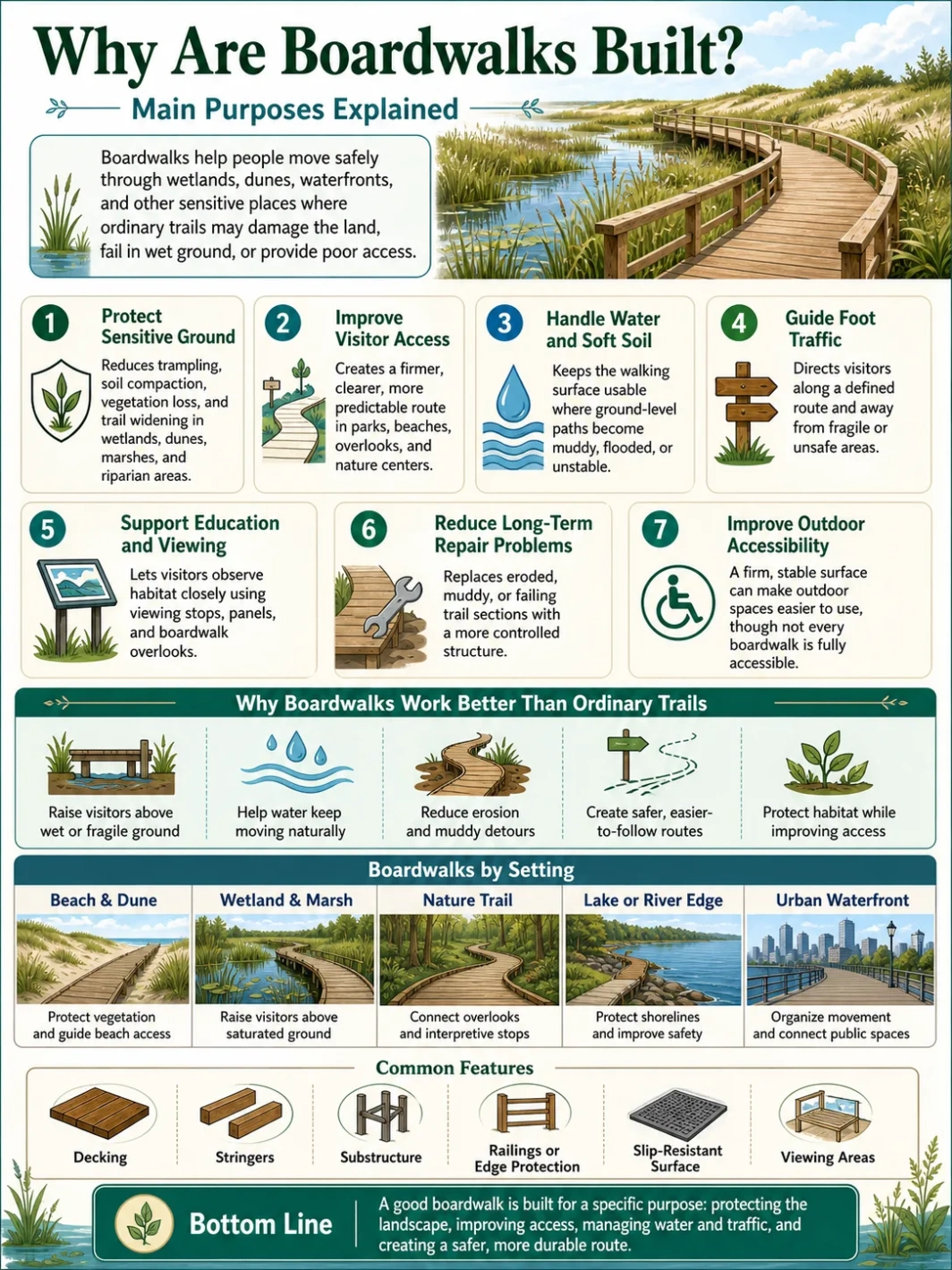
| Purpose | Where It Is Common | What It Solves | Simple Example |
|---|---|---|---|
| Protect Sensitive Ground | Wetlands, dunes, marshes, bogs, riparian areas | Reduces trampling, soil compaction, vegetation loss, and informal trail widening | A raised wetland boardwalk keeps visitors above saturated soil |
| Improve Visitor Access | Parks, nature centers, beaches, overlooks, lake edges | Creates a clearer, firmer, more predictable route | A level boardwalk loop can make a marsh or lakeshore easier to visit |
| Handle Water and Soft Soil | Flood-prone trails, swampy ground, shorelines | Keeps the walking surface usable when ground-level paths become muddy or unstable | A boardwalk crosses a wet section without filling the wetland |
| Guide Foot Traffic | Popular beaches, fragile dunes, hot springs, overlooks | Keeps visitors on a defined path and away from fragile or unsafe areas | A dune walkover directs people to the beach at marked crossings |
| Support Education and Viewing | Nature trails, interpretive wetlands, wildlife viewing areas | Lets visitors observe habitat closely without stepping into it | A marsh boardwalk includes exhibit panels and viewing stops |
| Reduce Long-Term Repair Problems | High-use trails, wet trails, storm-affected parks | Replaces eroded, muddy, or deteriorated trail sections with a more controlled structure | A damaged lakeside trail section is rebuilt with a stronger boardwalk substructure |
Main Purposes of Boardwalks
The main purpose of a boardwalk is to create access where a normal path is not the best fit. That can mean access over wetland soil, across beach dunes, through a nature preserve, beside a lake, along a waterfront, or into a visitor area that needs a stable walking surface.
Most boardwalks are built for more than one reason. A beach boardwalk may protect dunes, organize foot traffic, and give visitors a safer route to the sand. A wetland boardwalk may protect habitat, preserve water movement, and make a nature trail usable for more people.
For federal outdoor recreation areas, accessibility planning can include trails, viewing areas, beach access routes, and other outdoor developed features. The U.S. Access Board explains that accessibility should be considered early in the planning process, while still accounting for terrain and outdoor limits.[a]
Why Boardwalks Are Used Instead of Ordinary Trails
An ordinary dirt, gravel, or paved trail sits directly on the ground. That works well in many parks, but it can fail in places where the soil is wet, loose, shifting, protected, or easy to erode.
A boardwalk raises the walking surface above the ground. Depending on the site, it may rest on posts, piles, beams, sleepers, sills, frames, or other support systems. The exact structure depends on soil, water, expected use, climate, maintenance capacity, and local rules.
USDA Forest Service wetland trail material lists boardwalks alongside trail techniques such as puncheon, turnpikes, drainage work, and wetland trail planning. That is a useful reminder: a boardwalk is one option within a larger trail design toolbox, not a one-size answer for every wet area.[b]
Boardwalks Help Avoid Common Trail Problems
- Mud and standing water: A raised surface can keep visitors above wet or saturated ground.
- Trail widening: When a trail becomes muddy, people often walk around it. A boardwalk helps keep use on one defined line.
- Plant damage: Roots, grasses, dune plants, marsh plants, and shoreline vegetation can be harmed by repeated foot traffic.
- Drainage issues: Ground-level trail fill can change how water moves. A raised structure can reduce that problem when designed well.
- Visitor confusion: A clear boardwalk route shows where people are supposed to walk.
Purpose 1: Protecting Wetlands, Dunes, and Fragile Habitat
Many boardwalks are built because the landscape is worth protecting. Wetlands, dunes, salt marshes, freshwater marshes, bogs, fens, hot spring basins, and riparian areas can be damaged when visitors create informal paths across them.
In coastal areas, boardwalks and dune walkovers give people a marked route across dunes instead of letting foot traffic spread over vegetation. On Cumberland Island, the National Park Service tells visitors to use boardwalks where they exist to help protect dunes.[c]
This matters because dune plants help hold sand in place. When people cut across dunes randomly, the damage can create blowouts, widen paths, and make the dune system less stable. A boardwalk does not remove every impact, but it concentrates movement in a planned corridor.
In wetlands, the issue is often softer and less visible. Repeated stepping can compact soil, crush plants, disturb small habitat zones, and create muddy channels. A raised boardwalk lets visitors experience the place while reducing direct contact with the ground.
Purpose 2: Giving Visitors Safe, Clear Access
Boardwalks are also built to make routes easier to follow. A visitor does not need to guess where to walk through a marsh, dune field, hydrothermal basin, lakeshore edge, or crowded waterfront. The route itself gives direction.
This is especially useful where leaving the path could harm the site or create a safety concern. In a hydrothermal area, a boardwalk can keep people away from unstable ground. In a dune system, it can guide visitors to official beach access points. In a wetland, it can keep people out of deep mud and standing water.
At Lassen Volcanic National Park, the Bumpass Hell boardwalk was rebuilt to maintain visitor access in a hydrothermal basin while protecting fragile environments. The park also used recycled plastic lumber reinforced with fiberglass rods because the active hydrothermal setting exposes materials to acidic gases and caustic elements.[d]
The lesson is simple: the purpose of a boardwalk often comes from the place. A lakeside boardwalk, beach boardwalk, wetland boardwalk, and hot spring boardwalk may look similar from a visitor’s point of view, but they are solving different site problems.
Purpose 3: Improving Accessibility in Outdoor Places
Boardwalks can make outdoor spaces easier to use for visitors with wheelchairs, mobility devices, strollers, or limited balance. A firm, stable, and more predictable surface can be easier than sand, mud, roots, rocks, or uneven natural tread.
This does not mean every boardwalk is automatically accessible. Slope, width, passing space, surface gaps, edge protection, transitions, cross slope, resting intervals, railings, and route connections all matter. Local codes and the managing agency’s standards should always be checked.
The National Park Service describes Sand Point Marsh Trail at Pictured Rocks National Lakeshore as a half-mile wheelchair-accessible loop, with most of the trail on a level boardwalk elevated over wetlands and the rest paved as it loops through forest.[e]
That kind of design can turn a wet or sensitive habitat into a place more visitors can experience. It can also provide a better route for families, older visitors, school groups, and people who prefer a shorter, steadier path.
Purpose 4: Keeping Water Moving Naturally
In wet landscapes, one of the biggest design questions is water movement. A ground-level path, if built poorly, can act like a small dam. It can block sheet flow, trap water on one side, dry another area, or push water into a new channel.
A raised boardwalk can allow water to move under the route. That does not mean every boardwalk has no hydrologic effect, but it can be a better choice than filling a wetland or building a raised embankment in the wrong place.
At Acadia National Park’s Great Meadow project, the National Park Service described plans for a boardwalk-style trail over wetland features and above flooded wetland areas to improve access while supporting wetland connectivity.[f]
This is one reason boardwalk design usually needs site-specific review. Water depth, seasonal flooding, soil strength, ice, sediment, vegetation, and storm patterns can all affect what type of structure makes sense.
Purpose 5: Reducing Erosion and Trail Damage
Boardwalks can reduce erosion by moving foot traffic onto a durable surface. This is useful on steep approaches, lake edges, dune crossings, wet trail sections, and popular viewpoints where visitors gather in one small area.
When a trail surface breaks down, visitors often step around puddles, exposed roots, holes, or rough patches. Over time, that behavior can make the damaged zone wider. A boardwalk can narrow the impact area and create a route that is easier to inspect and repair.
At Rocky Mountain National Park, the Sprague Lake boardwalk replacement addressed an old elevated boardwalk that had outlived its lifespan. The project improved the substructure, protected wetland areas, widened the route, improved accessibility for visitors using wheelchairs and strollers, and improved scenic overlooks.[g]
That example shows how boardwalk work is not only about adding planks. A replacement project may include substructure, width, overlook layout, surface materials, drainage behavior, accessibility, and long-term maintenance needs.
Purpose 6: Creating Better Viewing and Learning Spaces
Some boardwalks are built so people can observe a landscape without entering it. Wetlands, birding areas, marsh overlooks, lake edges, and interpretive trails often use boardwalks to place visitors close enough to notice details while keeping them on a controlled path.
A boardwalk can include widened viewing areas, benches, railings, low-profile signs, tactile exhibits, or small overlooks. These features can slow visitors down and make the route feel less like a pass-through path and more like an outdoor learning space.
For nature trails, this purpose is often just as important as transportation. A short boardwalk through a marsh may teach visitors about water quality, plant communities, birds, amphibians, seasonal change, or the role of wetlands in the local landscape.
Purpose 7: Managing Crowds and Visitor Flow
In busy places, a boardwalk helps manage movement. Beach towns, waterfront parks, national park overlooks, and nature preserves may use boardwalks to separate walking routes from roads, parking areas, dunes, sensitive habitat, or water edges.
This can make the visitor experience calmer. People know where to enter, where to stop, where to view, and where not to walk. Managers can also place signs, railings, edge protection, trash points, or interpretive panels where they are most useful.
In urban waterfronts, a boardwalk or promenade can also connect shops, piers, beaches, parks, benches, playgrounds, and transit stops. In a nature preserve, the same basic idea is quieter: the boardwalk connects parking, trailheads, overlooks, and habitat viewing points.
Boardwalks by Setting
| Setting | Main Reason for Building | Common Design Concerns | Visitor Benefit |
|---|---|---|---|
| Beach and Dune | Protect dune vegetation and guide beach access | Sand movement, storm exposure, stairs or ramps, beach access rules | Clear route to the beach with less trampling of dunes |
| Wetland or Marsh | Raise visitors above saturated ground and reduce habitat damage | Water flow, soft soils, piles or supports, slippery surfaces | Close habitat viewing without walking through wet ground |
| Nature Trail | Connect sensitive areas, overlooks, and interpretive stops | Width, resting points, route grade, maintenance access | Easier walking route and better learning opportunities |
| Lake or River Edge | Protect shoreline and keep visitors away from unstable edges | Flooding, erosion, railings, ice, bank stability | Safer viewing and a more defined path near water |
| Urban Waterfront | Organize pedestrian movement and connect public spaces | Crowd flow, lighting, railings, surfacing, maintenance load | Continuous walking route near shops, parks, piers, or beaches |
| Special Natural Area | Allow controlled access to fragile or hazardous terrain | Material durability, visitor barriers, signs, limited off-path access | Close viewing while staying on a managed route |
Plain-English Design Terms
Boardwalk articles often use technical words that can feel heavier than they need to be. These simple definitions help explain why different structures are chosen in different places.
| Term | Simple Meaning | Why It Matters |
|---|---|---|
| Boardwalk | A raised walking surface, often made of wood, composite, metal, or plastic lumber | Used when the ground below should not be walked on directly |
| Dune Walkover | A boardwalk or raised route crossing dunes to reach a beach | Helps keep beach access in marked areas |
| Puncheon | A low wooden or framed trail structure over wet ground | Often used for short wet trail sections |
| Turnpike | A raised trail bed built with side logs or edging and filled with material | Can work where water and soil conditions allow a ground-based solution |
| Stringer | A long support beam under the walking surface | Helps carry the deck boards and visitor load |
| Decking | The boards or panels people walk on | Affects traction, gaps, maintenance, and comfort |
| Substructure | The frame, supports, posts, piles, or base under the deck | Often determines how long the boardwalk performs well |
Materials Are Chosen for Purpose, Not Just Appearance
Boardwalk materials vary widely. Wood, treated lumber, composite decking, recycled plastic lumber, fiberglass-reinforced products, steel framing, aluminum, concrete, and hybrid systems may all appear in different projects.
The best material depends on the setting. A quiet woodland boardwalk may use a different surface than a salt-exposed beach boardwalk. A hot spring basin may need materials that tolerate gases and unusual chemistry. A busy urban boardwalk may need a surface that can handle heavier use and easier maintenance access.
- Wood can look natural and is familiar to many trail crews, but it may need more maintenance in wet or shaded places.
- Composite or recycled plastic lumber can resist rot, but strength, heat, traction, fastening, and support spacing still need review.
- Metal framing can support longer service life in some projects, but corrosion and site exposure matter.
- Concrete or modular panels may appear in urban or high-use settings, though they are not always suitable for sensitive wetlands.
No material is perfect everywhere. Maintenance access, expected visitor use, water exposure, environmental permits, available budget, and replacement planning all shape the final choice.
Safety Reasons Boardwalks Are Built
Boardwalks can improve safety by creating a more predictable walking surface, especially where natural ground is wet, uneven, narrow, or close to sensitive features. They can also provide edges, railings, signs, and controlled overlooks where visitors might otherwise spread out.
Safety design is not only about preventing falls. It can also involve keeping people away from unstable ground, protecting visitors from hidden water, reducing conflicts between pedestrians and bikes, guiding movement in crowded places, and making emergency or maintenance access easier.
Common Safety Features
- Slip-resistant walking surfaces where wet boards, algae, frost, or sand may be present
- Railings or edge protection where height, water, or site rules require them
- Clear transitions from parking areas, sidewalks, beaches, or trails
- Resting spots or widened areas where people may stop to view scenery
- Signs that explain stay-on-trail rules, sensitive habitat, or changing conditions
- Routine inspection for loose boards, raised fasteners, damaged supports, or soft approaches
Specific safety requirements can vary by location and managing agency. Public agencies, park managers, engineers, architects, and accessibility specialists may all be involved in the final design.
Environmental Reasons Boardwalks Are Built
A boardwalk can reduce direct contact between visitors and the landscape, but it still has an environmental footprint. Posts, piles, shade, construction access, materials, railings, and visitor concentration all affect the site in some way.
Good boardwalk planning tries to reduce the tradeoffs. Designers may choose an alignment that avoids the most sensitive plants, allows water to pass, limits construction disturbance, provides viewing without off-trail travel, and can be maintained without repeated damage to surrounding ground.
In many natural areas, the goal is not to make the landscape feel built-up. The goal is to give people a route that protects the place better than scattered informal use would.
Maintenance Reasons Boardwalks Are Built
Boardwalks are sometimes built because maintaining a normal trail has become too difficult. A constantly muddy trail, storm-damaged shoreline path, failing lake-edge route, or wetland crossing may require repeated repairs without solving the root problem.
A well-planned boardwalk can make maintenance more predictable. Crews can inspect boards, fasteners, framing, approaches, railings, and drainage points. Damaged sections may still need repair, but the work is easier to define than a spreading muddy trail.
Typical Boardwalk Maintenance Checks
- Loose, cracked, warped, or missing deck boards
- Raised screws, nails, bolts, or other fasteners
- Slippery algae, leaf buildup, sand, ice, or wet debris
- Soft or eroded approaches at each end of the boardwalk
- Damaged railings, curbs, edge boards, or kick rails
- Movement in posts, piles, beams, frames, or support points
- Blocked drainage or water pooling where the route meets the ground
- Vegetation growing into the walking space
Maintenance needs should be part of the original design. A beautiful boardwalk that cannot be inspected, cleaned, repaired, or reached by crews may become a problem later.
When a Boardwalk May Not Be the Best Choice
Boardwalks are useful, but they are not always the right answer. Some sites may work better with a rerouted trail, stepping stones, a turnpike, improved drainage, a bridge, seasonal closure, or no public access at all.
A boardwalk may be less suitable where flood forces are too strong, ice movement is severe, maintenance access is poor, the route would encourage too much visitor pressure, or the structure would harm the feature it is meant to protect.
Cost can also be a reason to consider alternatives, but cost should not be judged only by the first build. Long-term repair, material life, storm damage, visitor safety, accessibility, and environmental review can change the real value of each option.
What Makes a Good Boardwalk Work Well?
A good boardwalk fits its setting. It does not feel randomly placed, and it does not solve one problem while creating several new ones. The route, height, width, materials, edges, and viewing points should match the landscape and expected use.
Useful Planning Questions
- What problem is the boardwalk meant to solve?
- Is the goal access, habitat protection, drainage, safety, education, or several of these?
- What are the wettest, softest, or most sensitive parts of the site?
- How will water move under or around the structure?
- Who will use the route, and what level of accessibility is required?
- How will the boardwalk be inspected and repaired?
- Will visitors be tempted to step off the route, and why?
- Which local permits, codes, land manager rules, or environmental reviews apply?
These questions matter because boardwalks are not only walking surfaces. They are small pieces of infrastructure placed inside real landscapes.
Common Mistakes in Boardwalk Planning
- Building too low in wet areas: A low boardwalk may be flooded or buried by debris more often than expected.
- Ignoring the approaches: The first and last few feet often fail if water, mud, or erosion is not handled.
- Choosing material by looks alone: Wet shade, salt air, sand, heat, and heavy traffic can change material performance.
- Forgetting maintenance access: Crews need a practical way to inspect and repair the structure.
- Adding access without managing behavior: Signs, edges, overlooks, and route design help keep visitors from stepping into sensitive areas.
- Assuming every boardwalk is accessible: Accessibility depends on the full route, not just the presence of boards.
Real Examples of Boardwalk Purposes
| Example | Managing Source | Purpose Shown | What It Teaches |
|---|---|---|---|
| Cumberland Island Beach Crossings | National Park Service | Dune protection and marked beach access | Boardwalks can keep visitors on official crossings through fragile dunes |
| Sand Point Marsh Trail | National Park Service | Wetland access, education, and wheelchair-accessible route design | A boardwalk can support close habitat viewing while keeping visitors above wetlands |
| Sprague Lake Boardwalk | National Park Service | Wetland protection, accessibility improvement, and replacement of an aging structure | Boardwalk projects often include substructure, width, overlooks, and long-term use |
| Great Meadow Wetland Project | National Park Service | Access through flooded wetland areas and wetland connectivity | Raised routes can help keep trails usable while allowing water movement |
| Bumpass Hell Boardwalk | National Park Service | Safe access in a fragile hydrothermal setting | Material choice and route control can be shaped by unusual site conditions |
Frequently Asked Questions
Why are boardwalks built in wetlands?
Boardwalks are built in wetlands to keep visitors above saturated soil, reduce trampling of plants, limit informal trail widening, and allow people to observe habitat without walking directly through it.
Why are boardwalks built over sand dunes?
Boardwalks and dune walkovers are built over sand dunes to guide beach access and reduce damage to dune vegetation. This helps concentrate foot traffic on a planned route instead of letting people create many informal paths.
Are boardwalks better than normal trails?
Boardwalks are better in some settings, especially wet, soft, fragile, or heavily visited areas. Normal trails may be better on stable ground where a raised structure is unnecessary or would create more impact than benefit.
Are all boardwalks wheelchair accessible?
No. A boardwalk may provide a firm surface, but accessibility also depends on slope, width, cross slope, surface gaps, transitions, resting spaces, railings, and the route leading to and from the boardwalk.
Do boardwalks damage the environment?
Boardwalks can have environmental impacts, especially during construction. When planned well, they can reduce repeated visitor damage by keeping people on a defined route and allowing sensitive ground or water flow to remain less disturbed.
What materials are used to build boardwalks?
Common materials include wood, treated lumber, composite decking, recycled plastic lumber, fiberglass-reinforced products, steel framing, aluminum, and concrete elements. The right choice depends on water, climate, expected use, maintenance, and local rules.
Why do some boardwalks have railings?
Railings may be used where height, water, crowding, overlooks, accessibility rules, or safety conditions require edge protection. Some low boardwalks use curbs or edge boards instead, depending on the site and applicable standards.
Resources Used
- [a] U.S. Access Board, Chapter 10: Outdoor Developed Areas — Used for accessibility context related to trails, outdoor developed areas, viewing areas, and beach access routes. The source is reliable because the U.S. Access Board is a federal agency responsible for accessibility guidelines and standards.
- [b] USDA Forest Service, Wetland Trail Design and Construction: 2007 Edition — Used for wetland trail design context, including boardwalks, puncheon, drainage, trail planning, and maintenance. The source is reliable because it comes from the USDA Forest Service National Technology and Development Program.
- [c] National Park Service, Cumberland Island National Seashore: On Island — Used for the example of boardwalks and designated crossings helping protect dunes. The source is reliable because it is the official National Park Service page for the site.
- [d] National Park Service, Bumpass Hell Trail and Boardwalk Rehabilitation — Used for the example of boardwalks supporting safe access and resource protection in a hydrothermal area. The source is reliable because it is an official National Park Service project page.
- [e] National Park Service, Sand Point Marsh Trail Exhibit — Used for the example of a half-mile wheelchair-accessible loop with a level boardwalk elevated over wetlands. The source is reliable because it is an official National Park Service place page.
- [f] National Park Service, Great Meadow Wetland Rehab to Reclaim More Natural Flow — Used for boardwalk-style trail context related to flooded wetland access and wetland connectivity. The source is reliable because it is an official National Park Service article.
- [g] National Park Service, Sprague Lake Boardwalk Replacement Project — Used for the example of boardwalk replacement improving substructure, wetland protection, accessibility, and overlooks. The source is reliable because it is an official National Park Service news release.