A boardwalk is usually defined by its structure: a pedestrian path made with boards or deck-like surfacing, often raised over sand, wetland, dunes, or sensitive ground. A promenade is defined more by its use: a public walking place made for strolling, often along a waterfront, seafront, park edge, or urban scenic route. Some boardwalks work as promenades, but the two words do not mean exactly the same thing.[a]
| Feature | Boardwalk | Promenade |
|---|---|---|
| Core Meaning | A constructed pedestrian walkway, often made of timber planks, composite decking, concrete panels, or other deck-like materials. | A public place or route for walking, strolling, viewing, and social use. |
| Main Identifier | Structure, surface, and elevation. | Function, setting, and public experience. |
| Common Setting | Beaches, dunes, wetlands, marshes, forests, lakeshores, piers, parks, and nature trails. | Seafronts, waterfronts, urban parks, cliff tops, river edges, resort areas, and civic walking routes. |
| Typical Surface | Deck boards, timber planks, recycled plastic lumber, composite decking, concrete boardwalk panels, or modular beach access mats. | Paving, stone, asphalt, concrete, brick, timber decking, or a mixed public-realm surface. |
| Primary Purpose | To carry people over difficult or sensitive ground while limiting disturbance. | To provide a comfortable public walking space, often with views, seating, lighting, cafés, or nearby attractions. |
| Can It Be Elevated? | Often yes, especially over wetlands, dunes, flood-prone forest, or fragile habitat. | Sometimes, but many promenades are at grade along a street, sea wall, river edge, or park path. |
| Best Simple Test | Ask: “Is this walkway built like a deck or raised path?” | Ask: “Is this public route mainly for strolling and enjoying the waterfront or scenery?” |
Direct Answer
The easiest difference is this: a boardwalk is a type of walkway, while a promenade is a type of public walking experience. A boardwalk can be part of a promenade if it runs along a beach or waterfront and is used for strolling. A promenade does not have to be a boardwalk because it may be paved, stone, concrete, brick, or asphalt.
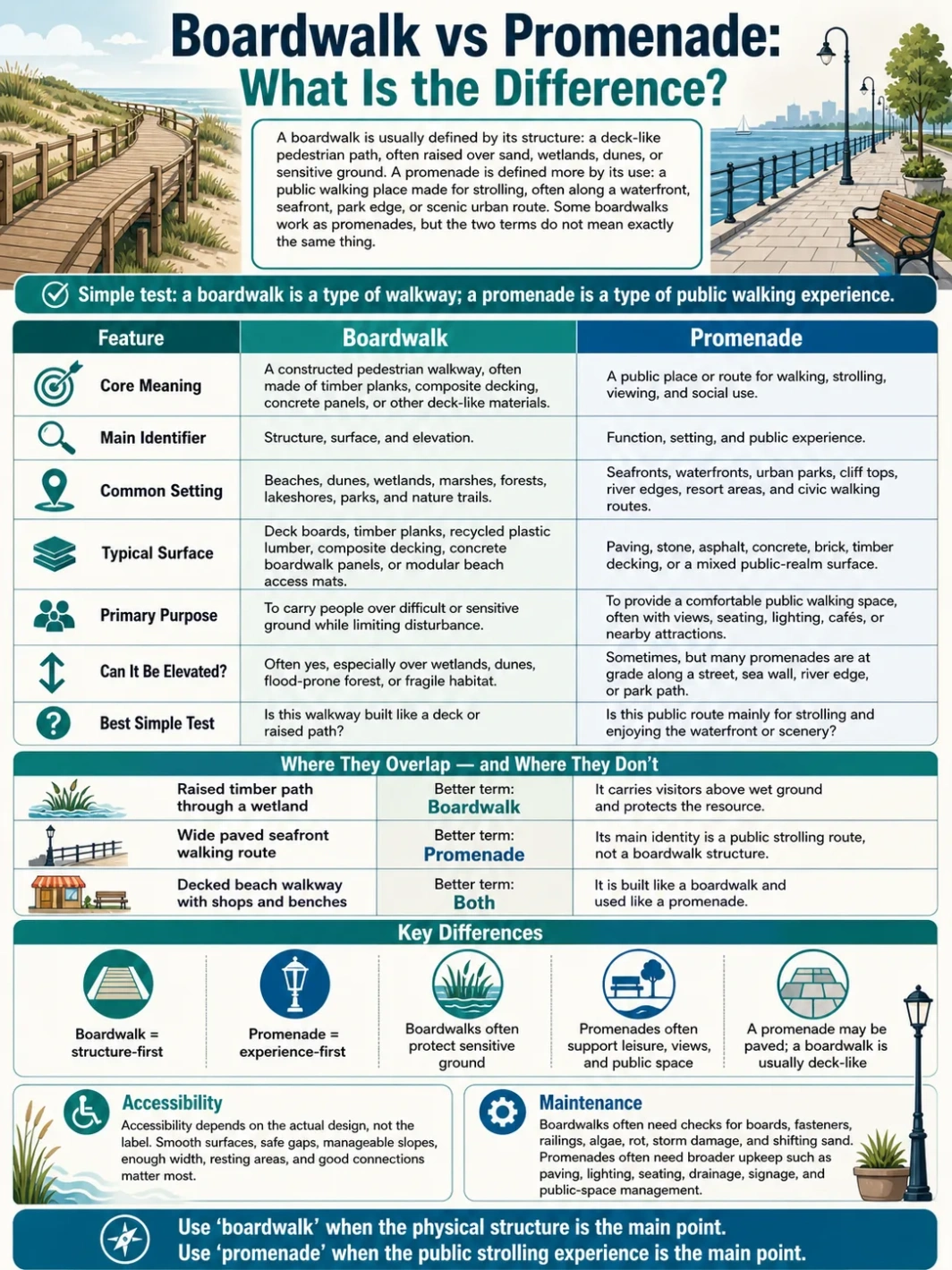
In everyday speech, people sometimes use the words together, especially in seaside towns. A beach boardwalk with shops, benches, views, and steady foot traffic may feel like a promenade. In design, planning, accessibility, and maintenance, the difference matters because each term points to a different set of decisions.
What Is a Boardwalk?
A boardwalk is a pedestrian route built with a deck-like surface. Traditional boardwalks used wooden boards, which is why the word still strongly suggests planks. Modern boardwalks may also use composite materials, recycled plastic lumber, concrete decking, aluminum framing, or modular panels, depending on the site.
Boardwalks are often used where an ordinary path would be unstable, muddy, sandy, flood-prone, or damaging to the landscape. In wetlands, a raised boardwalk can let visitors cross saturated ground without creating a wider informal trail. In dune areas, a dune walkover can guide foot traffic over vegetation that helps hold sand in place. In forests and parks, a boardwalk can keep visitors above roots, water, or seasonally soft soil.
Cambridge Dictionary defines a boardwalk as a path usually made of wooden boards near the sea and often raised above the back part of a beach. That is a narrow dictionary definition, but real-world boardwalks also appear in marshes, swamps, lakeside parks, redwood groves, nature preserves, and urban waterfronts.
Common Boardwalk Uses
- Beach access across sand, dunes, or coastal vegetation.
- Wetland trails where the ground is too soft for a normal path.
- Nature observation routes through marsh, swamp, forest, or lake-edge habitat.
- Flood-prone park trails where a raised tread can improve seasonal access.
- Visitor routes that protect sensitive soil, plant roots, wildlife areas, or restoration zones.
- Short access links between parking, viewing decks, beach entrances, piers, or trailheads.
What Is a Promenade?
A promenade is a public place for walking. Merriam-Webster defines it as “a place for strolling” and also as a leisurely walk or ride in a public place.[b] In physical planning, the word often describes a pleasant, open pedestrian route along a waterfront, seafront, river, park edge, resort frontage, or scenic overlook.
A promenade may be formal and urban, with paving, lighting, railings, planting, benches, cafés, and sea views. It may also be simpler, such as a flat coastal path beside a beach or a wide public walkway along a harbor. The defining idea is not the material. The defining idea is that people go there to walk, linger, look around, and move through public space comfortably.
Common Promenade Uses
- Seafront walking routes in towns and resort areas.
- Urban waterfront paths beside rivers, bays, canals, or harbors.
- Public scenic routes with benches, lighting, railings, and viewpoints.
- Pedestrian links between beaches, parks, cafés, piers, playgrounds, and transit stops.
- Accessible walking routes where the main purpose is easy public movement and leisure.
Why the Words Get Confused
The confusion happens because many famous seaside boardwalks are also promenades in daily use. Visitors do not only use them to cross sand or wetlands. They walk, eat, sit, shop, exercise, people-watch, and move between attractions. In that setting, “boardwalk” describes the structure, while “promenade” describes the social use.
The overlap is real, but it is not universal. A narrow wetland boardwalk through a marsh is usually not called a promenade because it is a trail structure, not a social waterfront boulevard. A paved seafront promenade is usually not called a boardwalk unless it has a deck-like board surface or a local name that uses the word.
| Situation | Better Term | Why |
|---|---|---|
| Raised timber path through a wetland | Boardwalk | The structure carries visitors above wet ground and protects the resource. |
| Wide paved seafront walking route | Promenade | The surface is not board-like, and the main identity is a public strolling route. |
| Decked beach walkway with shops and benches | Both | It is built like a boardwalk and used like a promenade. |
| Urban riverfront walkway with stone paving | Promenade | The route supports strolling and public access, but it is not a boardwalk structure. |
| Short dune crossing from parking to beach | Boardwalk or dune walkover | The main job is controlled beach access over sensitive dune terrain. |
| Cliff-top public path with seating and sea views | Promenade or esplanade | The route is a public scenic walk, not necessarily a decked structure. |
Structural Differences
A boardwalk has a stronger construction meaning than a promenade. Designers think about joists, decking, piles, sleepers, posts, edge protection, load, drainage, fasteners, slip resistance, and replacement cycles. Even a simple low boardwalk still has structural choices that affect cost, maintenance, and visitor safety.
Wetland boardwalks may use sleepers, cribbing, or pile foundations. The USDA Forest Service notes that wetland trail structures can include several construction types, and that boardwalks and bog bridges are often supported by pile foundations in wet sites.[d] That kind of detail is usually not what people mean when they say “promenade.”
A promenade may need engineering too, especially when it sits beside a seawall, river edge, cliff, or busy waterfront. Still, the word itself does not tell you the structure. A promenade can be a sidewalk, paved plaza, sea wall path, terrace, esplanade, park walk, or decked waterfront route.
Surface and Foundation
Boardwalk surfaces are often modular: individual boards, planks, panels, or deck sections can be inspected and replaced. Promenade surfaces are often continuous: concrete, asphalt, pavers, stone, or brick may be used to create a smooth public route. These are patterns, not fixed rules. A waterfront promenade can include timber decking, and a boardwalk can include concrete deck panels.
The foundation difference is usually larger than the surface difference. Boardwalks may be raised on piles or posts so water, sand, roots, or vegetation can remain below. Promenades are often built as part of a larger public realm system, tied to drainage, lighting, seating, railings, sea walls, landscaping, and nearby streets.
Location and Setting Differences
Boardwalks often appear where a normal ground path would cause problems. Wetland soils can rut and widen under foot traffic. Dunes can be damaged when visitors create many informal paths. Floodplain forests may have standing water during part of the year. A boardwalk organizes movement while reducing direct pressure on the ground.
Promenades often appear where public walking is the main attraction. Seafront towns use promenades to create a clear walking edge between buildings, beach, roads, parks, and water views. Riverfront cities use promenades to turn the water’s edge into a public space rather than a back-of-house service zone.
Beach Settings
On a beach, a boardwalk may cross sand or dunes, run parallel to the shoreline, or connect parking and beach entrances. A promenade may run along the upper beach edge, sea wall, resort frontage, or town waterfront. Where a decked beach walkway becomes a popular strolling zone, both terms can apply naturally.
Wetland and Nature Settings
In wetlands and nature preserves, “boardwalk” is usually the more accurate term. The route is often narrow, controlled, and designed to keep visitors on a fixed path. Benches, railings, interpretive signs, and viewing decks may be added, but the structure’s job is still access across sensitive or wet ground.
Urban Waterfront Settings
In urban waterfront settings, “promenade” often works better. These places usually support many activities at once: walking, jogging, sitting, stroller use, wheelchair access, public events, outdoor dining, cycling where allowed, and movement between parks or transit. The surface may be paved rather than decked.
Visitor Experience Differences
A boardwalk often gives visitors a guided route through a specific environment. It may feel linear, narrow, and interpretive. You are usually meant to stay on the path. Signs may explain plants, wildlife, tides, dunes, forest ecology, geology, or restoration work. Leaving the route may damage habitat or create safety concerns, depending on the site.
A promenade often feels more open-ended. Visitors may walk a short section, stop at benches, turn around, meet friends, watch the water, move between attractions, or use it as part of a daily exercise route. It is less about crossing difficult ground and more about making public space enjoyable and easy to use.
Accessibility Differences
Accessibility depends on the actual design, not the label. A boardwalk can be highly accessible if it has a firm, stable surface, manageable slopes, adequate width, safe transitions, and well-placed passing or resting areas. A promenade can also be accessible, especially when it is wide, level, well-maintained, and connected to parking, transit, toilets, seating, and curb-free routes.
The U.S. Access Board’s outdoor developed area guidance explains that trail surfaces, passing spaces, and resting intervals should be firm and stable. It also gives detailed guidance on openings between boards, passing spaces, beach access routes, slopes, and obstacles in outdoor routes.[c] Those details matter for boardwalks because gaps, raised boards, cross slopes, wet surfaces, and narrow widths can affect people using wheelchairs, walkers, canes, strollers, or mobility scooters.
| Design Feature | Why It Matters | Boardwalk Impact | Promenade Impact |
|---|---|---|---|
| Firm, Stable Surface | Supports wheelchairs, walkers, strollers, and steady walking. | Boards or panels should not flex, rot, lift, or create uneven joints. | Paving should avoid broken sections, settlement, loose edges, or ponding water. |
| Width | Allows passing, turning, and comfortable shared use. | Narrow boardwalks may need passing spaces or wider viewing areas. | Busy promenades often need more width because users move at different speeds. |
| Surface Openings | Gaps can trap wheels, canes, crutch tips, or small stroller wheels. | Deck spacing and drainage gaps need careful design and maintenance. | Drain grates and paving joints should be placed and sized carefully. |
| Slope and Cross Slope | Steep or tilted surfaces make travel harder for many visitors. | Ramps, dune crossings, and transitions need special attention. | Sea wall paths and riverfront routes should manage drainage without creating harsh cross slopes. |
| Resting and Viewing Areas | Benches, pullouts, and overlooks help visitors move at their own pace. | Small decks can prevent people from blocking a narrow trail. | Seating and viewing zones make long public walks more comfortable. |
| Clear Edges and Barriers | Edges help people understand where the safe route is. | Raised boardwalks may need curbs, edge protection, railings, or detectable edges based on site risk. | Promenades near roads, drops, water, or cycle routes may need clear separation. |
Safety and Maintenance Differences
Boardwalk maintenance is often focused on the deck and supporting structure. Managers may inspect boards, fasteners, transitions, railings, posts, piles, edge protection, algae buildup, rot, storm damage, flood debris, and settlement. In wet or coastal places, maintenance can be shaped by salt, moisture, UV exposure, tides, storms, insects, and shifting sand.
Promenade maintenance is often broader because promenades are public spaces as well as walking routes. Maintenance may include paving, lighting, benches, railings, planting, drainage, litter, sea wall conditions, signage, curb ramps, street furniture, and conflicts between walkers, cyclists, scooters, pets, and event use.
Practical Maintenance Checklist
- Check for raised boards, loose fasteners, broken planks, cracked paving, or uneven transitions.
- Look for slippery buildup from algae, sand, leaves, mud, or standing water.
- Inspect railings, edge protection, curbs, and viewing decks where drops or water are nearby.
- Keep drainage paths clear so water does not sit on the walking surface.
- Review signage where users need to stay on the path, avoid dunes, or follow seasonal rules.
- Confirm that benches, pullouts, and passing spaces remain usable and not blocked.
- Check official park, city, or land-manager notices before relying on hours, closures, parking rules, or seasonal access.
Environmental Differences
Boardwalks often have a direct conservation role. They concentrate foot traffic so visitors do not spread across wetlands, dunes, meadow vegetation, tree roots, or restoration zones. A raised structure may also allow water, small wildlife movement, and some plant processes to continue underneath, though every site needs its own design review.
Promenades can also support environmental goals, but usually at a public-realm scale. A waterfront promenade may include stormwater drainage, coastal planting, erosion-resistant edges, shade trees, habitat buffers, or managed access to beach entrances. In cities, a promenade can shift the waterfront from vehicle-dominated space to pedestrian public space.
Neither term automatically means “low impact.” Poorly placed boardwalks can disturb habitat, block water movement, or require heavy maintenance. Poorly designed promenades can harden shorelines, create runoff problems, or crowd sensitive areas. Site conditions, permits, materials, water level, visitor volume, and long-term maintenance all matter.
Real Examples That Show the Difference
Congaree National Park Boardwalk Loop
Congaree National Park’s Boardwalk Loop in South Carolina is a clear boardwalk example. The National Park Service describes it as a 2.6-mile boardwalk with a flat, accessible surface that introduces visitors to the Congaree wilderness.[e] Its identity comes from the raised trail structure and the way it carries visitors through bottomland forest.
Oso Flaco Lake Boardwalk Trail
Oso Flaco Lake in California shows another boardwalk role. The official California State Parks page describes a trail that moves through riparian habitat, crosses a lake area by bridge pathway, and continues as a boardwalk trail through coastal dune habitat toward the shoreline.[g] The boardwalk is not just a pleasant walking surface; it organizes access through lake, wetland, and dune environments.
Llanfairfechan Promenade on the Wales Coast Path
Llanfairfechan Promenade in Conwy is a useful promenade example. Wales Coast Path describes it as a gentle, flat seafront walk that follows the promenade toward Bangor and Anglesey, with nearby parking, toilets, a café, bus access, and a route connection into a nature reserve.[f] Here, the word “promenade” points to a seafront public walk rather than a decked structure.
Boardwalk vs Promenade in Plain Language
Use “boardwalk” when the physical structure is the main point. This is the better word for raised paths, plank surfaces, wetland crossings, dune walkovers, and nature trails built to protect the ground below. Use “promenade” when the public walking experience is the main point. This is the better word for seafront routes, urban waterfront paths, and scenic public walking spaces.
When a place has both qualities, the terms can sit together naturally. A beach boardwalk with benches, shops, views, and a steady stream of walkers can be described as a boardwalk promenade. A paved waterfront promenade should not be called a boardwalk unless local naming or actual deck-style construction supports that term.
Common Mistakes
- Calling every waterfront walkway a boardwalk, even when it is paved.
- Calling every boardwalk a promenade, even when it is a narrow wetland trail.
- Assuming boardwalks are always wooden; many modern boardwalks use composite, recycled plastic, concrete, or mixed materials.
- Assuming promenades are always beside the sea; they can also follow rivers, harbors, lakes, parks, or urban scenic corridors.
- Using the name alone to judge accessibility; the actual surface, slope, width, transitions, and maintenance condition matter more.
- Giving fixed parking fees, opening hours, or access rules without checking the current official park or city source.
Which Term Should You Use?
For writing, signage, planning notes, or visitor information, choose the word that gives the reader the clearest expectation. If the route is raised, decked, and built over difficult ground, “boardwalk” is usually clearer. If the route is a broad public walk along a seafront or waterfront, “promenade” is usually clearer.
For official visitor pages, it is best to match the land manager’s own name for the place. If a park calls its route “Boardwalk Loop,” use that name. If a town calls its seafront route “Promenade,” use that name. Local names often carry history, maintenance responsibility, wayfinding value, and search behavior.
Frequently Asked Questions
Is a Boardwalk the Same as a Promenade?
No. A boardwalk is usually defined by its deck-like structure or board surface. A promenade is defined by its use as a public walking place. Some seaside boardwalks are also promenades, but many promenades are paved and many boardwalks are nature trails.
Can a Promenade Be Made of Wood?
Yes. A promenade can include timber or composite decking if it is designed as a public strolling route. Material alone does not decide the word. The same place may be both a boardwalk and a promenade if it has a decked structure and a public strolling function.
Why Are Boardwalks Used in Wetlands?
Boardwalks are used in wetlands because they can carry visitors over soft or wet ground while keeping foot traffic on a fixed route. This can reduce trampling, rutting, informal trail widening, and direct disturbance to sensitive soil or vegetation.
Are Promenades Always Along the Sea?
No. Many promenades are beside the sea, but the word can also describe public walking routes beside rivers, lakes, harbors, parks, plazas, or urban scenic edges. The common thread is public strolling, not one fixed landscape type.
Are Boardwalks More Accessible Than Promenades?
Not automatically. A boardwalk can be accessible if it has a firm, stable surface, safe gaps, manageable slopes, and enough width. A promenade can also be accessible when it is smooth, wide, well-connected, and maintained. The built details matter more than the label.
What Is the Difference Between a Promenade and an Esplanade?
The words often overlap. A promenade usually emphasizes strolling. An esplanade often suggests a long, open, level public walk, commonly along water or open land. Local usage varies, so official place names should be followed when describing a specific site.
Resources Used
- [a] Cambridge Dictionary — Boardwalk Definition — Used for the baseline meaning of “boardwalk” as a board-built path near the sea. (Reliable because it is published by Cambridge University Press, a long-standing academic publisher.)
- [b] Merriam-Webster — Promenade Definition — Used for the baseline meaning of “promenade” as a place for strolling. (Reliable because Merriam-Webster is an established dictionary publisher with editorial review.)
- [c] U.S. Access Board — Outdoor Developed Areas Guide — Used for accessible outdoor route concepts such as firm and stable surfaces, openings, passing spaces, and beach access route details. (Reliable because it is an official U.S. federal accessibility source.)
- [d] USDA Forest Service — Wetland Trail Design and Construction — Used for wetland trail structure and boardwalk foundation context. (Reliable because it is a technical publication from the USDA Forest Service.)
- [e] National Park Service — Congaree Boardwalk Loop — Used as a real boardwalk example with official route length and accessibility description. (Reliable because it is the official National Park Service page for the site.)
- [g] California State Parks — Oso Flaco Lake — Used as a real coastal lake, dune, and boardwalk trail example. (Reliable because it is an official California State Parks page.)
- [f] Wales Coast Path — Llanfairfechan Promenade, Conwy — Used as a real promenade example with route, access, and setting details. (Reliable because it is an official Wales Coast Path resource managed through Natural Resources Wales.)