A boardwalk is a pedestrian walkway made with boards, planks, decking, or similar raised surface materials. It is often built over sand, wetlands, dunes, marshes, fragile soils, or waterfront areas so people can walk safely while the ground, habitat, or beach edge stays protected. [a]
Main Details
| Term or Feature | Simple Meaning | Common Use | Example Setting |
|---|---|---|---|
| Boardwalk | A walkway built with planks, decking, or a raised walking surface. | Pedestrian access across sensitive, wet, sandy, or busy waterfront areas. | Beachfronts, wetlands, parks, dunes, nature preserves, and resort districts. |
| Beach Boardwalk | A walkway along or near a beach, often used as a public promenade. | Walking, beach access, visitor circulation, shops, attractions, and ocean viewing. | Atlantic City, Coney Island, Ocean City, or similar seaside areas. |
| Wetland Boardwalk | A raised trail across marsh, swamp, bog, or seasonally wet ground. | Nature viewing, habitat protection, education, and trail access. | Marsh trails, wildlife refuges, national parks, and local preserves. |
| Dune Walkover | A boardwalk-style crossing over coastal dunes. | Beach access while reducing trampling on dune plants and sand slopes. | National seashores, coastal parks, and managed public beaches. |
| Accessible Outdoor Pathway | A firm, stable, planned route that may use boards or other materials. | Access for visitors using wheelchairs, strollers, walkers, or other mobility devices. | Trailheads, viewing platforms, beach access routes, and interpretive trails. |
What a Boardwalk Means
In everyday use, a boardwalk usually means a walkway made from wooden boards near a beach. In park and trail design, the meaning is broader. A boardwalk can also mean a raised structure built over wet soil, shallow water, dunes, roots, mud, or fragile habitat.
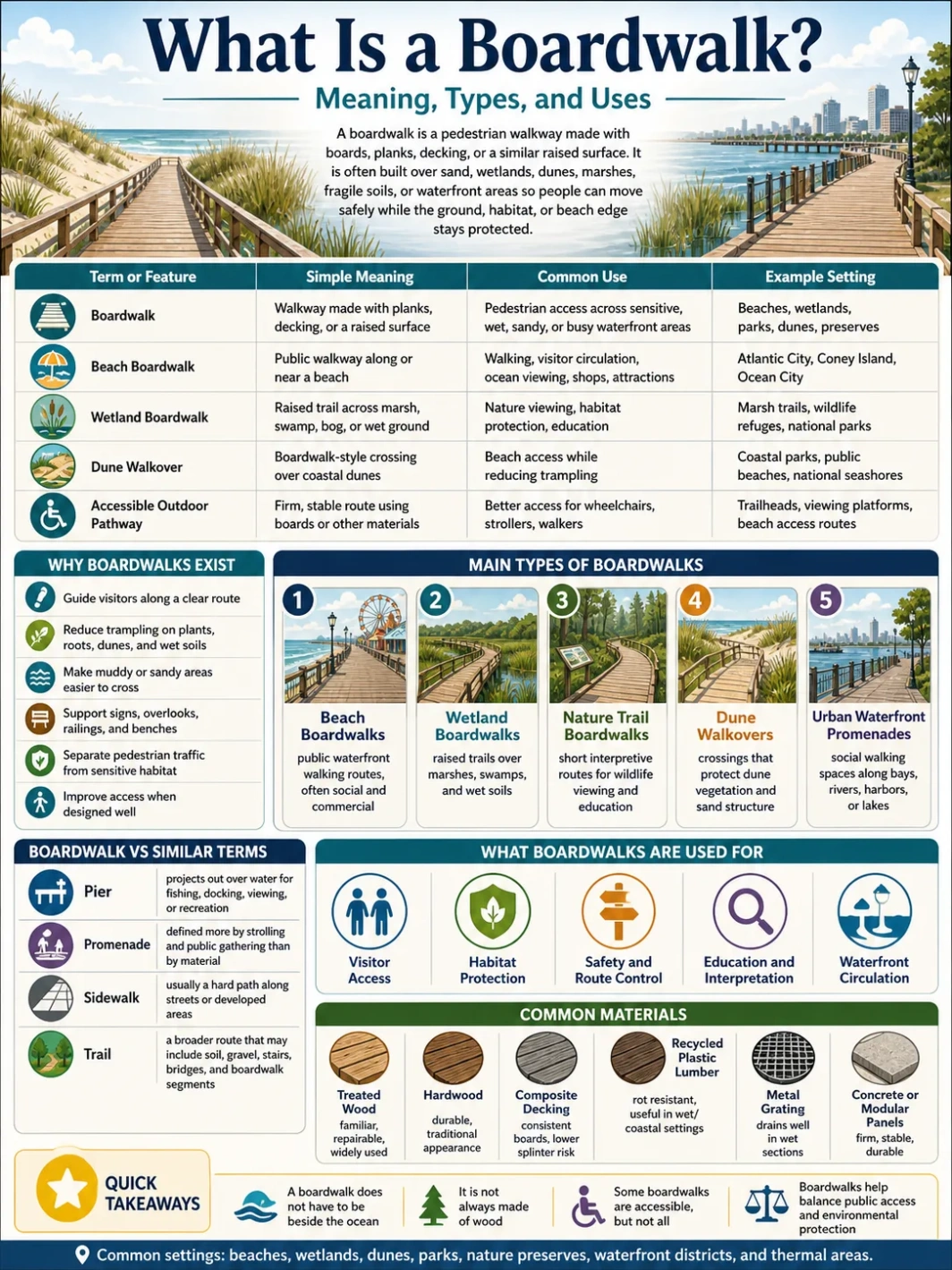
The word is not limited to old wooden beach promenades. Modern boardwalks may use treated lumber, hardwood, recycled plastic, composite decking, concrete panels, metal grating, or removable beach access materials. The right material depends on the site, climate, expected foot traffic, maintenance budget, and environmental limits.
A boardwalk is different from a normal sidewalk because it is often designed for a place where a simple paved path may not work well. Sand shifts. Wetlands hold water. Dunes need vegetation. Coastal areas face storms and salt air. A boardwalk gives people a defined route through these conditions.
Why Boardwalks Exist
Boardwalks solve two problems at the same time: they help people move through a place, and they reduce damage to the place being visited. In a beach town, the boardwalk may organize heavy visitor traffic. In a marsh, it may keep feet above wet soil. In a dune area, it may keep people away from plants that hold sand in place.
They are also useful where a route needs to stay open after rain, seasonal flooding, or high visitor use. A well-planned boardwalk can make a trail cleaner, easier to follow, and less harmful to the surrounding ground than an informal footpath.
- They guide visitors along a clear route.
- They reduce trampling on plants, roots, dunes, and wet soils.
- They can make a muddy or sandy area easier to cross.
- They can support interpretive signs, viewing areas, railings, and benches.
- They can help separate pedestrian movement from sensitive habitat.
- They can improve access when designed with accessibility needs in mind.
Main Types of Boardwalks
Boardwalks are often grouped by setting rather than by one universal design standard. A busy seaside boardwalk and a narrow wetland boardwalk may share the same basic idea, but they serve different users and face different site conditions.
Beach Boardwalks
A beach boardwalk is usually a public walkway along the shore or just behind the beach. It may connect hotels, shops, amusement areas, restrooms, lifeguard access points, viewing decks, and beach entrances. In older resort towns, the boardwalk may also be part of the place’s public identity.
Atlantic City is one of the best-known examples in the United States. The first section of its boardwalk opened along the New Jersey beach on June 26, 1870, and the early walkway helped keep beach sand out of railroad cars and hotels. [b]
Wetland Boardwalks
A wetland boardwalk carries visitors across marshes, swamps, bogs, wet meadows, or poorly drained soil. It may be narrow and simple in a quiet preserve, or wider and more developed near a visitor center. Its main job is to provide a stable walking surface while limiting soil disturbance and informal trail widening.
In technical trail language, a boardwalk is often treated as a raised structure supported by piers or bents, with stringers carrying a deck surface. The USDA Forest Service describes boardwalks in wetland trail work as more complex structures, often suited to high-use sites such as visitor centers and interpretive trails. [c]
Nature Trail Boardwalks
Nature trail boardwalks are built for slow walking, wildlife viewing, plant interpretation, school groups, and short park visits. They may include signs, overlooks, benches, or small platforms. These boardwalks are common in marshes, coastal forests, cypress swamps, birding areas, and dune habitats.
A nature boardwalk is not always long. Some of the most useful examples are short loops or out-and-back routes that let visitors experience a habitat without cutting many informal paths through it.
Dune Walkovers
A dune walkover is a boardwalk or raised crossing that leads people over a dune system to the beach. It matters because dune plants help trap sand and stabilize dunes. Walking off the route can damage plant roots, expose sand, and spread invasive plant seeds in some coastal settings. [d]
Dune walkovers may include stairs, ramps, railings, landings, viewing spots, or simple decking. The exact design depends on dune height, shoreline rules, erosion patterns, turtle nesting concerns, storm exposure, and local permits.
Urban Waterfront Promenades
Some urban boardwalks work more like promenades. They are social spaces as much as walking routes. They may sit beside bays, rivers, harbors, lakes, or oceanfront districts, and they often include lighting, seating, railings, bike rules, food stands, fishing areas, and public art.
Not every promenade is a boardwalk. A paved esplanade, concrete seawall path, or stone waterfront walk may serve a similar visitor purpose without being built from decking or raised boards.
Accessible Boardwalk Routes
An accessible boardwalk route is planned so more visitors can use it with fewer barriers. Design details may include firm and stable surfaces, enough clear width, careful slope control, edge protection where needed, resting areas, and safe transitions between surfaces.
In the United States, the U.S. Access Board provides federal guidance for outdoor developed areas, including trails, viewing areas, outdoor recreation access routes, and beach access routes. Those rules apply in specific federal contexts, while state, local, and private sites may have additional requirements. [e]
Boardwalk vs Pier, Promenade, Sidewalk, and Trail
| Feature | Boardwalk | Similar Term | Main Difference |
|---|---|---|---|
| Pier | A walkway or platform may be near water, but a boardwalk usually follows land, beach, dune, or wetland routes. | Pier | A pier usually projects over water for fishing, docking, viewing, or recreation. |
| Promenade | A boardwalk can function as a promenade if it is used for strolling and public gathering. | Promenade | A promenade describes the social walking use, not necessarily the material. |
| Sidewalk | A boardwalk may be raised or built from decking over unstable or sensitive ground. | Sidewalk | A sidewalk is usually a hard path along streets or within developed areas. |
| Trail | A boardwalk can be one surface type within a trail system. | Trail | A trail may include soil, gravel, rock, pavement, stairs, bridges, and boardwalk segments. |
| Dune Crossing | A boardwalk may cross dunes using ramps, stairs, or decking. | Dune Walkover | A dune walkover is a specific coastal access structure over or through dunes. |
What Boardwalks Are Used For
The use of a boardwalk depends on the setting. Some are designed for heavy visitor movement. Others are quiet habitat routes. A few are mostly protective structures, keeping people on one path so the surrounding land can recover or stay undisturbed.
Visitor Access
Boardwalks make it easier to reach beaches, overlooks, marsh viewing areas, visitor centers, fishing spots, and scenic points. They can connect parking areas to beaches, link different parts of a park, or form a short loop trail for visitors who do not want a long hike.
At Pictured Rocks National Lakeshore, the Sand Point Marsh Trail is described by the National Park Service as a 0.5-mile loop boardwalk trail through wetlands, with wheelchair access when ice and snow are absent. [f]
Habitat Protection
In wetlands and dunes, repeated foot traffic can widen informal trails, compact soil, break plants, and disturb wildlife areas. A boardwalk concentrates movement onto a planned route. That does not remove every impact, but it can reduce random damage from scattered walking paths.
Safety and Route Control
Boardwalks also mark where visitors should walk. This is especially useful in thermal areas, steep dunes, marshes, and coastal zones with fragile crusts or hidden water. At Yellowstone National Park, visitors in thermal basins are told to stay on boardwalks and designated trails because hot springs and thin crust can be dangerous. [g]
Education and Interpretation
Many boardwalks are designed as outdoor classrooms. Signs may explain plant communities, bird habitat, geology, dune movement, wetland hydrology, or cultural history. A raised route gives visitors a close view without asking them to step into the habitat being explained.
Waterfront Circulation
In beach towns and waterfront districts, boardwalks organize movement between shops, hotels, public restrooms, beach entrances, attractions, seating areas, and transit stops. Their value is not only scenic. They help manage crowds and give pedestrians a predictable public route.
How Boardwalks Are Built
A boardwalk is not just boards placed on the ground. Even a simple one has a walking surface, support system, edges, drainage behavior, and connections to nearby paths. Larger or higher boardwalks need structural design, site review, environmental checks, and maintenance planning.
Decking
The deck is the walking surface. It may be made of wood planks, composite boards, recycled plastic lumber, metal grating, concrete panels, or modular mats. Decking should be comfortable to walk on, drain well, resist local weather, and avoid gaps that can catch wheels, canes, shoes, or crutch tips.
Stringers, Joists, Bents, and Piers
Many boardwalks use stringers or beams beneath the deck. These rest on supports such as bents, piers, piles, sleepers, or other foundations. A low backcountry bog bridge may be simple, while a wide public boardwalk near a visitor center may need more complex supports and engineering review.
Curbs, Edges, and Railings
Edges help visitors understand where the walking surface ends. Low curbs can help guide wheels and feet along the deck. Railings may be needed where there is a drop, water, stairs, crowding, or a viewing platform. The right choice depends on height, expected users, local rules, and site risks.
Transitions
Many boardwalk problems happen where the structure meets soil, sand, pavement, gravel, or stairs. A good transition should reduce abrupt height changes, ponding water, loose edges, and confusing route changes. In accessible routes, transitions are especially important because small bumps can become real barriers.
Common Boardwalk Materials
| Material | Common Use | Strengths | Limits | Maintenance Level |
|---|---|---|---|---|
| Treated Wood | Wetland trails, beach access routes, park boardwalks, and small structures. | Familiar look, workable, widely used, repairable in sections. | Can weather, splinter, decay, or need fastener checks over time. | Medium to high, depending on moisture and use. |
| Hardwood | High-traffic public boardwalks and waterfront promenades. | Dense, durable, traditional appearance. | Cost, sourcing concerns, weathering, and replacement planning matter. | Medium. |
| Composite Decking | Parks, visitor areas, and replacement projects. | Consistent boards, lower splinter risk, available in many profiles. | Heat, expansion, fastener systems, and surface grip need review. | Low to medium. |
| Recycled Plastic Lumber | Wet, coastal, or high-moisture settings. | Rot resistance and recycled-content options. | Flex, heat movement, structural limits, and fastening details must be considered. | Low to medium. |
| Metal Grating | Short wet sections, industrial-style crossings, and drainage-heavy areas. | Good drainage and traction when correctly specified. | May be uncomfortable for some users, wheels, paws, or barefoot beach visitors. | Low to medium. |
| Concrete or Modular Panels | Urban waterfronts, access routes, or durable public paths. | Firm, stable, and durable when installed well. | Heavier construction, drainage planning, and ground movement need attention. | Low to medium. |
No single material is best for every boardwalk. A shaded wetland trail has different needs from a sunny beach access route. Salt, floodwater, ice, sand movement, vandalism, maintenance access, and visitor volume can change the best choice.
Accessibility Notes
An accessible boardwalk is not defined only by the word “boardwalk.” It depends on the actual route. Surface firmness, width, openings between boards, running slope, cross slope, resting intervals, edge protection, transitions, and obstacles all affect how usable the route is.
For visitors, the most useful access information is practical: parking location, distance, grade, surface type, stairs, railings, rest areas, seasonal closures, and whether snow, sand, or wet decking changes conditions. A boardwalk can be friendly for strollers and wheelchairs in dry weather but harder to use when boards are slick, warped, icy, or partly covered by sand.
For site owners and designers, accessibility should be reviewed early rather than added late. Local rules may vary, and outdoor conditions can trigger exceptions or design choices that do not apply to indoor routes.
Safety Notes for Visitors
Most boardwalk safety advice is simple: stay on the route, watch for wet or uneven surfaces, use handrails where provided, follow posted signs, and check official park updates before relying on a trail being open.
- Walk, do not run, especially on wet boards.
- Keep children close near water, dunes, railings, stairs, and thermal areas.
- Do not step off boardwalks in protected dunes, wetlands, or thermal zones.
- Respect closures after storms, flooding, repairs, fire, erosion, or wildlife activity.
- Use official parking, trailhead, and access information because hours and fees can change by season.
- Be careful with pets, bikes, scooters, and strollers; rules can change by site.
A boardwalk is a managed route, not a guarantee that every nearby area is safe. Mud, thin crust, water, wildlife, heat, sharp vegetation, and unstable sand can exist close to the walking surface.
Environmental Role of Boardwalks
Boardwalks are often used where access and protection need to work together. In dunes, they help keep feet off plants that hold sand. In wetlands, they reduce trampling and trail braiding. In forests, they can protect shallow roots and wet soils. In thermal areas, they separate visitors from fragile crusts and hot water.
Still, a boardwalk can create its own impacts. Posts may disturb soil. Shade can affect plants below the deck. Railings can catch flood debris. Construction can require permits. Materials eventually need replacement. Good design tries to keep the structure only as large as the site and visitor use require.
Real Examples of Boardwalk Settings
| Example Type | Where It Appears | Main Purpose | Visitor Experience |
|---|---|---|---|
| Historic Beach Boardwalk | Atlantic City, New Jersey | Beachfront circulation, resort access, and public promenade use. | Long oceanfront walking route with shops, history, and beach access. |
| Wetland Nature Boardwalk | Marshes, swamps, bogs, and wet forest trails | Access across soft or wet ground while limiting trail widening. | Slow walking, wildlife viewing, interpretive signs, and quiet observation. |
| Dune Walkover | Coastal parks and managed beaches | Beach access while protecting dune vegetation and sand structure. | Defined route to the beach, sometimes with stairs, ramps, or viewpoints. |
| Thermal Area Boardwalk | Geyser basins and hot spring areas | Visitor separation from dangerous and fragile ground. | Close viewing from a controlled path with strict stay-on-route rules. |
| Accessible Interpretive Boardwalk | Visitor centers, short trails, and scenic overlooks | Short, firm, easier routes for a wider range of visitors. | Rest areas, signs, overlooks, and route information near parking or facilities. |
Maintenance and Inspection Basics
Boardwalk maintenance is not just about appearance. Loose boards, raised fasteners, slick surfaces, algae, sand cover, broken railings, drainage problems, and washed-out approaches can affect safety and access. Coastal and wetland boardwalks may need more frequent checks after storms, floods, freeze-thaw cycles, or heavy visitor seasons.
Common Maintenance Checks
- Look for loose, cracked, cupped, warped, or missing boards.
- Check fasteners for raised heads, corrosion, or missing hardware.
- Inspect railings, curbs, edge protection, and stairs.
- Remove sand, leaves, algae, ice, or debris where they create slipping or access problems.
- Watch for settlement at transitions between boardwalk and ground.
- Check drainage so water does not stay trapped against wood or approaches.
- Review signs, closures, and route markings after storm events.
- Confirm that accessible route information still matches current conditions.
For private landowners, parks, or local agencies, structural concerns should be reviewed by qualified professionals. Soil, flood levels, span length, railing height, load, corrosion, and permit requirements are site-specific. A small backyard walkway is not the same as a public wetland boardwalk or coastal dune access structure.
Common Misunderstandings
A Boardwalk Does Not Have to Be Beside the Ocean
Many people first think of beach boardwalks, but boardwalks also appear in forests, wetlands, deserts, dunes, parks, gardens, hot spring areas, and riverfront preserves. The shared idea is a defined walking surface, often raised or built from boards or decking.
A Boardwalk Is Not Always Fully Accessible
Some boardwalks are accessible, while others include stairs, narrow decks, steep slopes, uneven transitions, or seasonal surface issues. A site’s official accessibility page is the best place to confirm current conditions before visiting.
Wood Is Common, but It Is Not the Only Option
The name comes from boards, but modern boardwalks may include composite, recycled plastic, concrete, metal, or modular surfaces. The best material depends on moisture, heat, salt, traffic, budget, repair access, and environmental limits.
Boardwalks Still Need Rules
A boardwalk may look simple, but it often crosses a managed area. Rules about pets, bikes, fishing, beach access, hours, drones, fires, or stepping off the route are usually set by the land manager, not by the boardwalk itself.
Frequently Asked Questions
What is a boardwalk in simple words?
A boardwalk is a walking path made with boards, planks, decking, or a raised surface. It is often used near beaches, wetlands, dunes, parks, and waterfront areas.
Why are boardwalks built instead of normal paths?
Boardwalks are used where normal paths may damage the ground or become hard to use. Sand, mud, wet soil, roots, fragile plants, and seasonal water are common reasons.
Are boardwalks always made of wood?
No. Traditional boardwalks often use wood, but modern ones can use composite decking, recycled plastic, concrete panels, metal grating, or modular access materials.
What is the difference between a boardwalk and a pier?
A boardwalk usually follows land, beach, dune, wetland, or waterfront edges. A pier usually projects out over water for viewing, fishing, docking, or recreation.
Are boardwalks wheelchair accessible?
Some are, but not all. Accessibility depends on width, slope, surface condition, gaps, transitions, stairs, railings, and seasonal conditions such as snow, sand, or wet boards.
Why do parks tell visitors to stay on boardwalks?
Parks use boardwalks to protect visitors and sensitive places. Staying on the route helps avoid fragile plants, unstable ground, wetland soils, thermal areas, wildlife habitat, and unsafe surfaces.
Resources Used
- [a] Cambridge Dictionary: Boardwalk — Supports the plain-language meaning of “boardwalk” as a path usually made of wooden boards near the sea. (Cambridge University Press is a long-established academic publisher and dictionary source.)
- [b] Atlantic County, NJ: Atlantic City’s First Boardwalk — Supports the historical note about the first Atlantic City Boardwalk section opening in 1870. (Official county government page using Library of Congress historical material.)
- [c] USDA Forest Service: Wetland Trail Design and Construction, Boardwalk Section — Supports the technical explanation of wetland boardwalk structure, including bents, piers, stringers, decking, and high-use interpretive trail settings. (Official USDA Forest Service technical publication.)
- [d] National Park Service: Be a Dune Protector — Supports the explanation of why staying on boardwalks helps protect dune grasses, roots, and fragile dune habitat. (Official National Park Service page.)
- [e] U.S. Access Board: Chapter 10, Outdoor Developed Areas — Supports accessibility context for trails, viewing areas, outdoor recreation access routes, and beach access routes. (Official federal accessibility guidance source.)
- [f] National Park Service: Sand Point Marsh Trail — Supports the real example of a 0.5-mile wetland boardwalk loop with seasonal wheelchair-accessibility notes. (Official National Park Service trail page.)
- [g] National Park Service: Yellowstone Geysers and Hot Springs Safety — Supports the visitor safety note about staying on boardwalks and designated trails in thermal areas. (Official National Park Service safety page.)