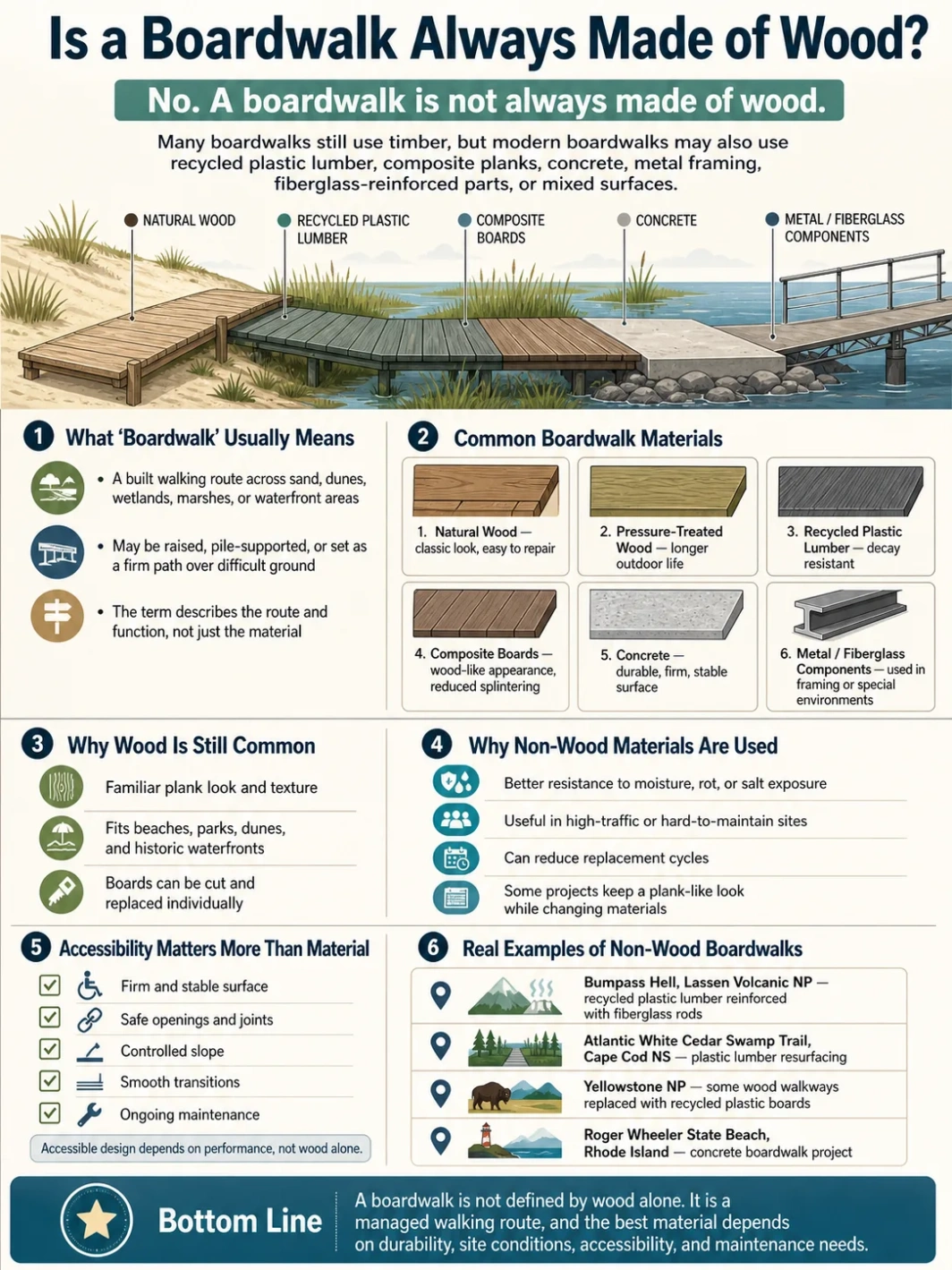
No. A boardwalk is not always made of wood. Many boardwalks still use timber, but modern boardwalks may also use recycled plastic lumber, composite planks, concrete, metal framing, fiberglass-reinforced materials, or mixed surfaces chosen for access, durability, wet-site conditions, and maintenance needs.
Main Details
| Question | Short Answer | Why It Matters |
|---|---|---|
| Is every boardwalk made of wood? | No. | The word “boardwalk” often describes an elevated or defined walking route, not only the material. |
| Why do many people picture wood? | Traditional beach and park boardwalks commonly used wooden planks. | Wood gives the familiar plank look, sound, and texture many visitors associate with classic boardwalks. |
| What materials are used today? | Wood, recycled plastic lumber, composite boards, concrete, metal supports, fiberglass-reinforced components, and mixed systems. | Different sites need different resistance to moisture, salt, flooding, soil movement, sun exposure, and visitor traffic. |
| What matters most for accessibility? | A firm, stable surface with safe openings, slopes, width, transitions, and maintenance. | The U.S. Access Board describes outdoor recreation routes, trails, and beach access routes in terms of surface performance, clear width, openings, obstacles, and slopes.[a] |
| Can a concrete walkway be called a boardwalk? | Sometimes, especially in coastal projects where the public route replaces or continues an established boardwalk corridor. | Visitor language, city project names, historic use, and function can influence the term. |
What “Boardwalk” Usually Means
A boardwalk is usually a built walking route that carries people across sand, wetlands, dunes, marshy ground, fragile vegetation, or busy waterfront areas. It may be raised above the ground, set on sleepers, built on piles, or placed as a firm route over a difficult surface.
The word comes from the familiar image of boards laid side by side, but modern use is broader. A visitor may still call a coastal promenade a boardwalk even when the walking lane includes concrete, pavers, recycled plastic planks, or a mix of materials.
For practical use, the main idea is not “wood only.” A boardwalk creates a controlled walking path. It protects visitors from difficult terrain and helps protect sensitive places from repeated foot traffic.
Common Boardwalk Materials Compared
| Material | Common Use | Strengths | Limits | Maintenance Level |
|---|---|---|---|---|
| Natural Wood | Classic beach boardwalks, park trails, dune walkovers, wetland paths | Familiar look, easy to cut and repair, warm natural texture | Can rot, splinter, warp, loosen, or become slick when wet | Medium to high, depending on climate and treatment |
| Pressure-Treated Wood | Outdoor structures, railings, decking, support members | Longer outdoor life than untreated wood | Preservatives, site rules, contact surfaces, and environmental concerns must be considered | Medium |
| Recycled Plastic Lumber | Wetlands, parks, coastal repairs, replacement planks | Decay resistant and often shaped like standard lumber | Can expand, contract, weigh more than wood, and may need reinforcement or special detailing | Often lower for rot, but design and fastening still matter |
| Wood-Plastic Composite | Walking surfaces where a wood-like appearance is wanted | Consistent boards, reduced splintering, wood-like appearance | Heat, expansion, texture, long-term movement, and fastening details vary by product | Low to medium |
| Concrete | High-traffic waterfronts, beach access corridors, resilient coastal projects | Durable, firm, stable, suitable for many accessible routes | Can feel less like a traditional plank boardwalk; drainage, heat, cracking, and finish need attention | Low to medium |
| Metal Framing or Hardware | Supports, railings, fasteners, piles, structural connections | Strength, consistency, useful with other decking materials | Corrosion protection matters in salt, wetland, and humid settings | Medium, depending on exposure |
| Fiberglass-Reinforced Components | Special environments, trail structures, reinforced recycled planks | Useful where corrosion, chemicals, moisture, or weight are concerns | Product-specific design and engineering review are needed | Low to medium |
Why Wood Is Still So Common
Wood remains common because it is familiar, workable, and visually suited to beaches, parks, marshes, and historic waterfronts. Crews can cut, replace, and fasten individual boards with ordinary tools. In many settings, a wooden boardwalk also blends more naturally into dunes, forests, and wetlands than a broad paved path.
Wood also has a visitor-experience role. The plank pattern, slight sound underfoot, and raised walking feel are part of what people expect from many classic boardwalks. That is why some replacement projects try to keep a wood-like appearance even when the actual material changes.
Still, wood is not the automatic best choice. Wet ground, salt spray, freeze-thaw cycles, heavy traffic, flooding, termites, rot, and loose fasteners can make long-term upkeep more demanding. Local climate and site conditions matter more than the name of the material.
Why Some Boardwalks Use Recycled Plastic or Composite Planks
Recycled plastic lumber is often made in shapes similar to standard lumber, so it can look and install somewhat like boards. The USDA Forest Service notes that recycled plastic can be sawed, drilled, nailed, screwed, bolted, and painted, while also being decay resistant.[b]
That does not make plastic lumber a simple one-for-one replacement in every situation. Plastic can expand and contract differently from wood, concrete, or steel. Some products may need reinforcement, special fastener spacing, or design details that allow movement.
Composite and recycled materials are often selected when managers want a longer-lasting surface, less frequent board replacement, or reduced use of new wood. They can also help keep a boardwalk-like appearance where visitors expect planks.
Real Examples of Non-Wood Boardwalk Materials
Bumpass Hell Boardwalk, Lassen Volcanic National Park
At Bumpass Hell in Lassen Volcanic National Park, the reconstructed boardwalk uses recycled plastic lumber reinforced with fiberglass rods. The National Park Service describes this choice as a way to better withstand acidic gases and caustic elements in an active hydrothermal area.[c]
Atlantic White Cedar Swamp Trail, Cape Cod National Seashore
At Cape Cod National Seashore, the National Park Service reported that most of the 2,500-foot Atlantic White Cedar Swamp boardwalk had been resurfaced with plastic lumber in the early 2000s. The same project described a remaining wooden section being replaced and noted the use of recycled material for environmental compatibility.[d]
Yellowstone Boardwalk Replacement Work
Yellowstone National Park has more than 15 miles of wood boardwalk, yet the park has also replaced some wood walkways with boards made of recycled plastic to reduce pollutants and the use of new wood products.[e]
Roger Wheeler State Beach, Rhode Island
The Rhode Island Department of Environmental Management announced a project at Roger Wheeler State Beach featuring a new concrete boardwalk, ADA-compliant access ramps, shade structures, sidewalks, foot washing stations, and concrete benches.[f]
Boardwalk Surface vs Boardwalk Structure
When people ask whether a boardwalk is made of wood, they often mean the walking surface. A boardwalk, however, has several parts. The visible deck is only one of them.
- Decking: the walking surface, often made of boards, composite planks, concrete, or another firm material.
- Stringers or joists: horizontal support members below the deck.
- Piles, posts, sleepers, or piers: foundation elements that hold the walkway above sand, mud, wetland soil, or uneven ground.
- Railings, curbs, or edge protection: safety features used where there is a drop-off, water edge, dune crossing, or access need.
- Fasteners and connectors: screws, bolts, brackets, clips, or other hardware that keep the structure stable.
This means a boardwalk can have recycled plastic decking on a steel frame, timber decking on concrete piles, concrete walking surfaces with metal rails, or a mixed system. The material visible to visitors is not always the same as the structural system underneath.
Accessibility Is About Performance, Not Just Material
A wooden surface is not automatically accessible, and a non-wood surface is not automatically better. The surface must be firm and stable, transitions must be manageable, openings must not create hazards, and the route must be maintained over time.
For outdoor recreation routes, trails, and beach access routes, official accessibility guidance focuses on practical details such as clear width, slope, openings, obstacles, resting intervals, and trailhead information. A boardwalk with loose planks, raised board edges, wide gaps, or slick algae can become difficult even if it was well designed at first.
| Design Feature | Why It Matters | Visitor Impact | Source or Rule Note |
|---|---|---|---|
| Firm and stable surface | Helps wheels, canes, strollers, and steady walking. | Improves comfort and predictability. | Used in federal outdoor accessibility language. |
| Narrow surface openings | Reduces the chance of wheels, cane tips, or heels catching in gaps. | Safer movement across plank joints or grates. | Openings are addressed in U.S. Access Board standards. |
| Controlled slope | Limits steep grades and cross slopes where accessible routes are required. | Reduces effort and side-tilt for mobility devices. | Exact requirements depend on route type and setting. |
| Flush transitions | Prevents abrupt bumps at entrances, exits, repairs, and material changes. | Helps visitors move from parking areas, trails, beaches, or platforms onto the boardwalk. | Maintenance is part of real access. |
| Resting and passing space | Gives people room to pause or pass on narrow routes. | Helpful on long wetland walks, beach access routes, and raised paths. | Often considered where routes are narrow or heavily used. |
When Wood Makes Sense
Wood can be a good fit where the site needs a natural appearance, individual board replacement is useful, loads are moderate, and the environment is not too harsh. It is also common in parks where the boardwalk is short, shaded, easy to inspect, and built with known local maintenance routines.
- Nature trails where the boardwalk should visually blend with trees, marsh plants, or dunes.
- Historic waterfronts where plank character is part of the visitor experience.
- Short dune walkovers where crews can inspect and replace boards regularly.
- Low to moderate traffic paths where traditional materials match the setting.
The tradeoff is upkeep. Wood may need inspection for rot, raised fasteners, splinters, loose boards, algae growth, insect damage, or storm damage. In shaded and wet locations, slip resistance and drainage become especially important.
When Non-Wood Materials Make Sense
Non-wood materials are often chosen when the boardwalk must handle heavy public use, wet conditions, salt exposure, difficult maintenance access, or environmental goals. A coastal city, national park, or wetland preserve may choose a non-wood surface to reduce replacement cycles or improve resilience.
- Recycled plastic lumber: useful where decay resistance is a priority and a plank-like look is desired.
- Composite boards: useful where a consistent walking surface and reduced splintering are priorities.
- Concrete: useful for high-traffic access routes, coastal resilience work, and areas needing a very firm surface.
- Fiberglass-reinforced components: useful in special environments where moisture, chemicals, or corrosion are concerns.
- Metal framing: useful as a support system when paired with wood, composite, concrete, or plastic decking.
These materials still need careful design. Recycled plastic can move with temperature changes. Concrete needs proper finish and drainage. Metal needs corrosion protection. Composite products vary by manufacturer. The right choice depends on the site, not a single universal ranking.
Visitor Clues: How to Tell What a Boardwalk Is Made of
Visitors can often identify the walking surface without touching or testing it. A natural wood board usually shows grain, end checks, knots, and color variation. Recycled plastic or composite planks often look more uniform, with repeated texture and fewer natural defects.
- Wood: visible grain, knots, weathering, occasional splinters, individual boards with natural variation.
- Recycled plastic lumber: uniform plank shape, less natural grain, sometimes a slightly plastic or molded surface texture.
- Composite: manufactured texture, repeated board pattern, often designed to resemble wood from a distance.
- Concrete: continuous slabs, broom finish, expansion joints, or stamped texture.
- Metal or fiberglass grating: open grid or ribbed panels, often used where drainage, airflow, or special site needs matter.
Material appearance can be misleading. Some concrete is colored or textured. Some composite boards are designed to look like wood. Some boardwalks combine a concrete lane with plank-style side areas, or a plank deck with concrete foundations below.
Safety and Maintenance Issues by Material
Every boardwalk material can perform well when it is suited to the location and maintained properly. Most visitor problems come from wear, weather, loose parts, poor drainage, algae, sand buildup, flooding, or uneven transitions rather than from one material alone.
| Material | Common Watch Points | Practical Maintenance Focus |
|---|---|---|
| Wood | Rot, splinters, loose fasteners, raised boards, algae, warping | Replace damaged boards, tighten fasteners, manage drainage, clean slick growth |
| Recycled Plastic | Thermal movement, sagging if not supported, surface wear, fastening details | Allow for expansion, inspect supports, follow product-specific installation guidance |
| Composite | Heat, surface slickness, board movement, fastener compatibility | Check manufacturer limits, clean surface buildup, inspect clips or screws |
| Concrete | Cracks, uneven joints, puddling, surface polish, edge settlement | Repair trip points, maintain drainage, keep transitions flush |
| Metal Components | Corrosion, loose bolts, sharp edges, vibration | Inspect coatings, connections, railing stability, and drainage exposure |
Environmental Considerations
Boardwalk material choices can affect wetlands, dunes, beaches, forests, and waterways. Land managers may consider how materials are sourced, whether preservatives are needed, how often parts must be replaced, how construction disturbs soil or vegetation, and whether the structure changes water movement.
In wetlands, the route may need to cross saturated soil while allowing water to move under or through the structure. In dunes, posts, ramps, and stairs may need to reduce damage to vegetation and sand movement. On beaches, salt, sun, wind, and storms can shorten the life of materials that perform well elsewhere.
There is no single “greenest” boardwalk material for every site. A recycled plastic board may reduce wood use, but it still needs suitable support, fastening, and long-term performance. Wood may fit a natural setting, but replacement frequency and preservative choices matter. Concrete can last a long time, but it has a different look, heat feel, and construction footprint.
Technical Notes for Design and Construction Topics
Boardwalk construction depends on site conditions. Soil type, water level, flood exposure, coastal permits, wetland rules, visitor load, accessibility requirements, and local codes can all change the design. A small park boardwalk and a major oceanfront boardwalk are not the same kind of project.
For general planning, material selection usually starts with the route’s purpose. A wetland nature trail may favor raised planks that limit soil disturbance. A beach access route may need a firm and stable surface over sand. A city waterfront may need a durable surface that handles crowds, maintenance vehicles, and storm cleanup.
For actual construction, professional review may be needed. Structural loads, foundations, railings, slopes, drainage, fasteners, and environmental permits should be checked against local rules and the requirements of the land manager.
Simple Answer for Visitors
If you are visiting a boardwalk, do not assume it is wood. It may look like wood from a distance but use recycled plastic or composite planks. It may also include concrete sections, metal rails, plastic decking, or mixed surfaces where the route crosses dunes, marshes, parking areas, overlooks, or beach access points.
For comfort and safety, pay more attention to current surface condition than material name. Watch for wet or sandy sections, raised edges, loose boards, narrow turns, steep ramps, or closed areas after storms. If parking fees, seasonal hours, beach access rules, or temporary closures matter for your visit, check the official park or city page before you go.
Common Misunderstandings
“Boardwalk” Does Not Always Mean Wooden Boards
The term often keeps its older meaning even when the surface changes. A rebuilt boardwalk corridor may still be called a boardwalk because of its location, history, visitor use, and function.
Plastic Lumber Is Not the Same as Ordinary Plastic
Recycled plastic lumber is manufactured as a building product, often in lumber-like shapes. Its strength, weight, expansion, texture, and support needs vary by product, so it should not be treated as identical to wood.
Concrete Can Be Part of a Boardwalk System
Concrete may appear in foundations, ramps, access routes, benches, seawalls, or walking surfaces. In some coastal projects, a concrete route is still part of a named boardwalk corridor.
Accessible Does Not Mean Maintenance-Free
A boardwalk can be designed for access and still need regular care. Sand, leaves, algae, storm debris, shifting soil, and worn boards can change how the surface feels underfoot or under wheels.
Frequently Asked Questions
Is a boardwalk always made of wood?
No. Many boardwalks are wooden, but modern boardwalks may use recycled plastic lumber, composite planks, concrete, metal supports, fiberglass-reinforced materials, or a mix of surfaces.
Why are boardwalks often made of wood?
Wood is traditional, easy to work with, visually suited to parks and beaches, and simple to repair in individual boards. It also gives the familiar plank look many visitors expect.
Are recycled plastic boardwalks real boardwalks?
Yes. Recycled plastic lumber can be shaped like planks and used as a walking surface. Many parks use it where decay resistance, reduced wood use, or longer service life is desired.
Is concrete still considered a boardwalk material?
Concrete can be part of a boardwalk route, especially in high-traffic coastal access projects. Some places keep the boardwalk name because the route serves the same public waterfront or beach-access function.
Which boardwalk material lasts the longest?
There is no universal answer. Concrete, recycled plastic, treated wood, and composite materials can all last well when they match the site conditions and are installed and maintained correctly.
What makes a boardwalk accessible?
Accessible boardwalks generally need a firm and stable surface, manageable slopes, safe openings, smooth transitions, enough width, and ongoing maintenance. Exact requirements depend on the route type and local rules.
Resources Used
- [a] U.S. Access Board — ABA Standards, Chapter 10: Recreation Facilities — Used for outdoor recreation route, trail, and beach access route concepts such as firm and stable surfaces, openings, clear width, obstacles, and slopes. (Official U.S. federal accessibility agency.)
- [b] USDA Forest Service — Wetland Trail Design and Construction: Recycled Plastic — Used for recycled plastic lumber properties, workability, weight, decay resistance, expansion, and reinforcement cautions. (Official U.S. Forest Service technical publication.)
- [c] National Park Service — Bumpass Hell Trail and Boardwalk Rehabilitation — Used as a real example of recycled plastic lumber reinforced with fiberglass rods in a hydrothermal setting. (Official National Park Service project page.)
- [d] National Park Service — Atlantic White Cedar Swamp Trail Repair — Used as a real example of plastic lumber resurfacing and replacement of a remaining wooden boardwalk section. (Official National Park Service news page.)
- [e] National Park Service — Yellowstone Conservation Measures — Used for Yellowstone’s wood boardwalk mileage and use of recycled plastic boards in some replacements. (Official National Park Service conservation page.)
- [f] Rhode Island Department of Environmental Management — Roger Wheeler State Beach Boardwalk and Bulkhead Project — Used as an official example of a new concrete boardwalk and access improvements at a state beach. (Official state environmental management agency page.)