A boardwalk is usually an elevated walking structure built over sand, wetlands, dunes, water, or sensitive ground. A sidewalk is usually a ground-level pedestrian path beside streets, buildings, or public spaces. Both support walking, but they differ in setting, structure, materials, drainage, maintenance, and access rules.
Main Details
| Feature | Boardwalk | Sidewalk | Best Use |
|---|---|---|---|
| Basic Meaning | A raised or deck-like walking route, often made from timber, composite, recycled plastic, or concrete panels. | A paved pedestrian path, usually at ground level and commonly placed along streets. | Use “boardwalk” for elevated paths over sensitive or wet ground; use “sidewalk” for urban pedestrian routes. |
| Typical Setting | Beaches, dunes, wetlands, marshes, parks, nature trails, pierside areas, and waterfronts. | Streets, neighborhoods, downtowns, campuses, transit areas, commercial districts, and civic spaces. | Boardwalks suit natural or coastal settings; sidewalks suit everyday public circulation. |
| Structure | Often supported by posts, sleepers, piles, framing, or modular supports above the ground. | Usually built on a prepared base with concrete, asphalt, pavers, or similar pavement. | Boardwalks solve ground or habitat issues; sidewalks provide stable urban access. |
| Drainage | Water can often pass under or between parts of the structure, depending on design. | Surface slope, curb design, gutters, and stormwater systems usually manage water. | Boardwalks are useful where water or shifting ground would damage a standard pavement path. |
| Visitor Experience | Often scenic, slower, and closely tied to landscape viewing. | Often practical, direct, and tied to daily transportation. | Boardwalks support access to fragile places; sidewalks support routine movement. |
What “Boardwalk” Means
A boardwalk is a constructed pedestrian route that uses a deck, planks, panels, or similar walking surface. It may sit just above damp ground, rise over marsh vegetation, cross a dune, or form part of a waterfront promenade. The name comes from the idea of walking on boards, but modern boardwalks are not always made of wood.
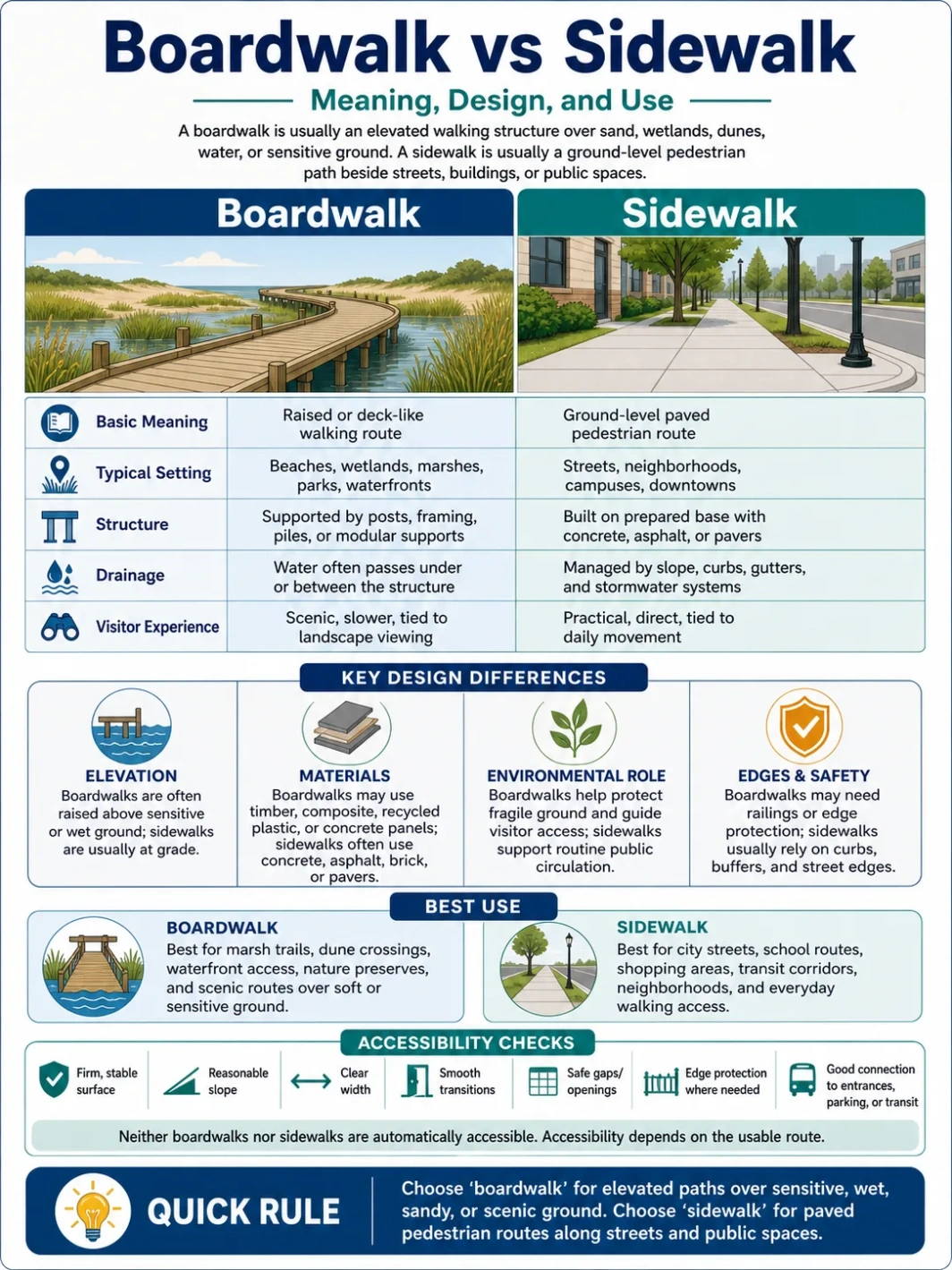
The main purpose is not only to create a path. A boardwalk can protect the land below it, guide visitors through a controlled route, reduce trampling, improve access across soft ground, and keep feet above mud, sand, standing water, or fragile vegetation. In wetland trail work, the USDA Forest Service describes boardwalk-related structures such as puncheon and bog bridges as ways to cross wet areas where normal tread construction may not work well.[a]
Common Boardwalk Settings
- Beachfronts and seaside resort areas
- Wetlands, marshes, bogs, and nature preserves
- Dune crossings where foot traffic needs to stay off vegetation
- Waterfront parks and lake edges
- Accessible nature trails in parks and preserves
- Observation routes near wildlife viewing areas
- Short crossings over soft soil, drainage channels, or seasonal wet ground
What “Sidewalk” Means
A sidewalk is a pedestrian walking surface usually placed beside a street, road, driveway, building frontage, or public right-of-way. In many places, sidewalks are part of a larger street system that includes curb ramps, crossings, driveways, transit stops, street furniture, lighting, and drainage.
Sidewalks are not just “extra pavement.” The Federal Highway Administration describes sidewalks, curb ramps, and related features as pedestrian facilities within the public right-of-way that must account for access by people with disabilities under public agency responsibilities.[b]
Common Sidewalk Settings
- Residential streets
- Downtown commercial streets
- School and campus routes
- Transit stops and station areas
- Public building frontages
- Shopping districts and civic plazas
- Bridges, underpasses, and road corridors where pedestrians need separated space
Boardwalk vs Sidewalk in Simple Terms
The easiest difference is this: a boardwalk is usually a built walking structure, while a sidewalk is usually a paved walking surface. A boardwalk often responds to difficult ground. A sidewalk often responds to street movement, daily access, and pedestrian separation from vehicles.
| Question | Boardwalk Answer | Sidewalk Answer |
|---|---|---|
| Is it usually elevated? | Often, yes. Some are low and close to grade, but many are raised above sand, water, soil, or vegetation. | Usually no. Sidewalks are commonly at ground level, though they may be on bridges or raised street structures. |
| Is it always made of boards? | No. Wood is common, but composite, recycled plastic, concrete, metal grating, and modular systems may be used. | No. Concrete is common, but asphalt, stone, brick, pavers, and other pavement types may be used. |
| Is it mainly recreational? | Often recreational or scenic, but it can also serve as a practical access route. | Often practical and transportation-focused, but it can also be part of a pleasant public space. |
| Does it protect the environment? | Often, yes. It can keep visitors on a defined route above fragile ground. | Sometimes, but environmental protection is not usually the main reason for a sidewalk. |
| Who manages it? | Park agencies, coastal managers, cities, preserves, private waterfront districts, or land managers. | Usually cities, counties, transportation agencies, campuses, property owners, or public works departments. |
Design Differences
Boardwalk and sidewalk design begins with different problems. A sidewalk asks, “How do people move safely and directly along a street or public route?” A boardwalk often asks, “How can people cross or view this place without damaging the ground, sinking into it, or disturbing the setting more than necessary?”
Foundation and Support
A sidewalk normally depends on subgrade preparation, base material, pavement thickness, joints, slopes, and drainage. If the base settles, tree roots lift the slab, or water undermines the pavement, the walking surface can crack or shift.
A boardwalk may use sleepers, posts, piles, beams, joists, stringers, or modular supports. In wet or uneven places, the structure spreads loads and lifts the walking surface above the problem area. The right support method depends on soil, water level, visitor load, freeze-thaw conditions, local rules, and environmental review.
Surface and Materials
Sidewalk surfaces are often concrete because it is durable, predictable, and familiar to public works departments. Asphalt, brick, stone, and unit pavers are also used, especially where cost, repair style, historic character, or drainage goals differ.
Boardwalk surfaces vary more. Wood can look natural and feel warm underfoot, but it needs inspection for rot, splintering, and loose fasteners. Recycled plastic and composite boards can resist moisture better in some settings, but they may expand, flex, heat up, or need specific structural spacing. Concrete or fiberglass systems may be chosen where durability, fire behavior, salt exposure, or maintenance access matters.
Drainage and Water Movement
Drainage is one of the biggest differences. A sidewalk typically sheds water across its surface toward a curb, gutter, swale, or drainage system. A boardwalk can allow water, sediment movement, vegetation, and small wildlife passage below the deck, depending on height and design.
This does not mean every boardwalk is environmentally harmless. Poor alignment, heavy shading, deep footings, poor construction access, or blocked water movement can still affect a sensitive site. Good boardwalk design starts with the land manager’s goals and the site’s water, soil, habitat, and visitor pressure.
Edges, Railings, and Drop-Offs
Sidewalks usually rely on curbs, buffers, street furniture zones, planting strips, or building edges to define the route. Railings are not typical unless the sidewalk is next to a drop-off, bridge, retaining wall, water edge, or other hazard.
Boardwalks often need clearer edge decisions. A low boardwalk over level ground may use curbs, edge boards, or visual contrast. A higher boardwalk, overlook, bridge-like segment, or water crossing may need railings. The right choice depends on height, user group, exposure, crowding, and the standards used by the managing agency.
Use Differences
A sidewalk is usually built for daily movement. It connects homes, stores, transit stops, schools, offices, parking areas, and public services. It helps separate people from vehicles and gives a predictable place to walk along streets.
A boardwalk is often built for access through a specific landscape. It may guide visitors through a wetland, across a beach dune, over a marsh, along a river edge, or toward an overlook. The route may be short, slow, and interpretive rather than direct and transportation-focused.
| Situation | Better Fit | Reason |
|---|---|---|
| A city street with stores and transit stops | Sidewalk | It supports daily pedestrian movement, crossings, curb ramps, and public right-of-way access. |
| A marsh trail with standing water | Boardwalk | It can raise visitors above wet ground and reduce damage to vegetation and soil. |
| A neighborhood route to school | Sidewalk | It gives a direct walking route separated from traffic. |
| A dune crossing to a beach | Boardwalk | It can focus foot traffic and reduce trampling of dune plants. |
| A downtown waterfront promenade | Depends on design | Some are boardwalk-like deck structures; others are paved sidewalks or promenades. |
| A nature preserve viewing route | Boardwalk | It can provide controlled access while limiting disturbance to sensitive areas. |
Accessibility Differences
A boardwalk is not automatically accessible, and a sidewalk is not automatically accessible. The surface, slope, width, edge protection, passing space, openings, transitions, maintenance, and route connections all matter.
For public rights-of-way, the U.S. Access Board’s technical requirements include limits for pedestrian access route cross slope, including a 1:48 maximum cross slope in many non-crosswalk conditions.[c] Sidewalk accessibility is therefore not only about having pavement; it is about the usable route within the pedestrian path.
Outdoor settings use a different context. The U.S. Access Board’s outdoor developed areas guidance covers trails, beach access routes, viewing areas, camping areas, and picnic areas on federal sites, with conditions that may differ from urban sidewalk rules.[d] A boardwalk in a marsh or on a beach may need to balance access, terrain, habitat, flooding, and maintenance access.
Accessibility Features to Check
- Firm and stable walking surface
- Reasonable slope for the setting
- Limited cross slope where required
- Clear width for mobility devices and passing
- Smooth transitions at entrances and ramps
- Gaps between boards or panels that do not trap wheels, cane tips, crutch tips, or shoe heels
- Edge protection where needed
- Railings or guards where drop-offs create risk
- Resting areas on longer or sloped routes
- Clear connection to parking, transit, restrooms, overlooks, or trailheads where provided
Safety and Maintenance Differences
Sidewalk maintenance often focuses on cracking, heaving, settlement, snow and ice, debris, drainage, driveway crossings, curb ramps, and obstruction clearance. Tree roots, utility work, freeze-thaw cycles, and heavy vehicle crossings can all affect sidewalk condition.
Boardwalk maintenance often focuses on loose boards, worn fasteners, algae, wet or slippery surfaces, railing movement, settlement at approaches, deck gaps, storm damage, rot, corrosion, and changes in the ground or water below. Coastal and wetland boardwalks may need more frequent inspection after storms or seasonal flooding.
Simple Maintenance Checklist
- Look for uneven transitions where the path begins or ends.
- Check for loose, lifted, cracked, or missing walking surface elements.
- Watch for slippery algae, sand buildup, wet leaves, ice, or moss.
- Check railings, curbs, and edge boards for movement or damage.
- Keep drainage paths open so water does not pool where people walk.
- Trim vegetation that narrows the usable route or blocks visibility.
- Review signs at closures, construction zones, steep sections, and sensitive habitat areas.
- Use official inspection practices for public facilities rather than informal visual checks alone.
Environmental Differences
Boardwalks often appear in places where standard pavement would be too disruptive, too unstable, or too hard to maintain. A raised route can reduce repeated trampling, help visitors stay out of restricted habitat, and keep access open through wet or sandy areas.
Sidewalks are usually part of built infrastructure. Their environmental questions often involve stormwater runoff, heat, tree space, permeable materials, curb design, and the way pedestrian routes connect with transit and nearby destinations.
The better choice depends on the site. A boardwalk may be the better option over wetland soil, but a sidewalk may be more durable and easier to maintain along a normal street. Local codes, environmental permits, public access goals, and professional review may be needed for real projects.
Real Examples
Real places show how the word “boardwalk” is used in practice. At Kenilworth Park & Aquatic Gardens in Washington, DC, the National Park Service describes a boardwalk that extends over a tidal wetland and passes through low, medium, and high marsh zones.[e] That is a classic boardwalk use: access into a wetland without turning the marsh itself into a normal paved walkway.
At Big Bend National Park, the National Park Service describes the first 100 yards of the Rio Grande Village Nature Trail as wheelchair accessible, mostly level, about 4 feet wide, and made from recycled plastic boards with metal railings.[f] This example shows that a boardwalk can be both a nature route and a designed access feature.
A sidewalk example is less tied to one named attraction because sidewalks form networks. A city sidewalk may connect a bus stop, curb ramp, storefront, school entrance, crosswalk, and public building in one continuous walking system. Its value comes from connection and reliability, not from being a destination by itself.
Common Mistakes
Calling Every Waterfront Walk a Boardwalk
Some waterfront walks are true deck structures. Others are paved promenades, esplanades, seawall paths, sidewalks, or shared-use paths. The word “boardwalk” is often used casually, but the actual structure may be concrete, stone, asphalt, or a deck system.
Assuming Boardwalk Means Wood
Many boardwalks use wood, but modern boardwalks may also use recycled plastic lumber, composite decking, fiberglass grating, concrete panels, metal framing, or hybrid systems. The material choice depends on moisture, load, expected life, maintenance access, budget, climate, and land manager preferences.
Assuming Sidewalk Means Accessible
A sidewalk can still be hard to use if it has steep cross slope, broken panels, blocked clear width, missing curb ramps, poor driveway transitions, or slippery surfaces. Accessibility depends on the usable pedestrian route, not just the label “sidewalk.”
Using a Boardwalk Where a Simple Path Would Work
Boardwalks can cost more to build and inspect than simple ground-level paths. If the land is stable, dry, and not sensitive, a sidewalk, trail, or paved path may be easier to maintain. A boardwalk makes the most sense when elevation, protection, water movement, or visitor control solves a real site problem.
Visitor Notes
For visitors, the difference affects shoes, pace, weather planning, and expectations. A sidewalk usually suggests a public street environment with nearby crossings, traffic, buildings, and services. A boardwalk often suggests a more exposed route where sun, wind, water, sand, insects, wildlife viewing, or seasonal closures may matter.
- Check official park or city pages before visiting if hours, parking, storm damage, or seasonal closures may change.
- Use posted rules for bikes, pets, fishing, wildlife viewing, and beach access.
- Expect some boardwalks to be narrow, wet, sandy, or slippery after rain.
- Do not step off wetland or dune boardwalks where signs ask visitors to stay on the route.
- For accessibility needs, check the managing agency’s current access page rather than relying only on photos.
Frequently Asked Questions
Is a boardwalk the same as a sidewalk?
No. A boardwalk is usually a deck-like or elevated walking structure, often used over sand, wetlands, dunes, or waterfront areas. A sidewalk is usually a ground-level paved pedestrian route beside streets or buildings.
Can a boardwalk be made of concrete?
Yes. The word “boardwalk” often suggests wood, but some boardwalks use concrete panels, recycled plastic, composite decking, fiberglass, metal framing, or mixed materials. The structure and setting matter more than the material alone.
Why are boardwalks used in wetlands?
Boardwalks can raise visitors above wet soil and vegetation, keep people on a defined route, reduce trampling, and allow water movement below the walking surface. The exact design depends on the site and managing agency.
Are boardwalks accessible for wheelchairs?
Some are, but not all. Accessibility depends on width, slope, surface firmness, gaps, transitions, railings, maintenance, and the route leading to the boardwalk. Official park or site accessibility pages are the best place to confirm current conditions.
Is a promenade a boardwalk or a sidewalk?
A promenade is a public walking area, often along a waterfront or scenic edge. It may be built like a boardwalk, paved like a sidewalk, or designed as a wider plaza-like walkway. The term describes use and setting more than one exact construction type.
Which lasts longer, a boardwalk or a sidewalk?
There is no single answer. A well-built sidewalk may last many years in a stable urban setting, while a boardwalk may need more inspection in wet, salty, or storm-prone areas. Material, climate, drainage, visitor load, and maintenance quality all affect lifespan.
Resources Used
- [a] USDA Forest Service — Wetland Trail Design and Construction — Used for wetland trail structure context, including boardwalk-related construction methods. (Reliable because it is a U.S. Forest Service technical publication.)
- [b] Federal Highway Administration — Pedestrians and Accessible Design — Used for sidewalk, curb ramp, and public right-of-way access context. (Reliable because it is an official FHWA resource.)
- [c] U.S. Access Board — Public Right-of-Way Accessibility Guidelines Technical Requirements — Used for pedestrian access route cross slope requirements. (Reliable because the U.S. Access Board issues federal accessibility guidance.)
- [d] U.S. Access Board — Chapter 10: Outdoor Developed Areas — Used for outdoor trails, beach access routes, and recreation access context. (Reliable because it is an official accessibility guide for outdoor developed areas.)
- [e] National Park Service — Kenilworth Boardwalk Access — Used as a real boardwalk example over a tidal wetland. (Reliable because it is the official page of the managing park agency.)
- [f] National Park Service — Rio Grande Village Nature Trail — Used as a real accessible boardwalk example with material and width details. (Reliable because it is an official National Park Service visitor information page.)