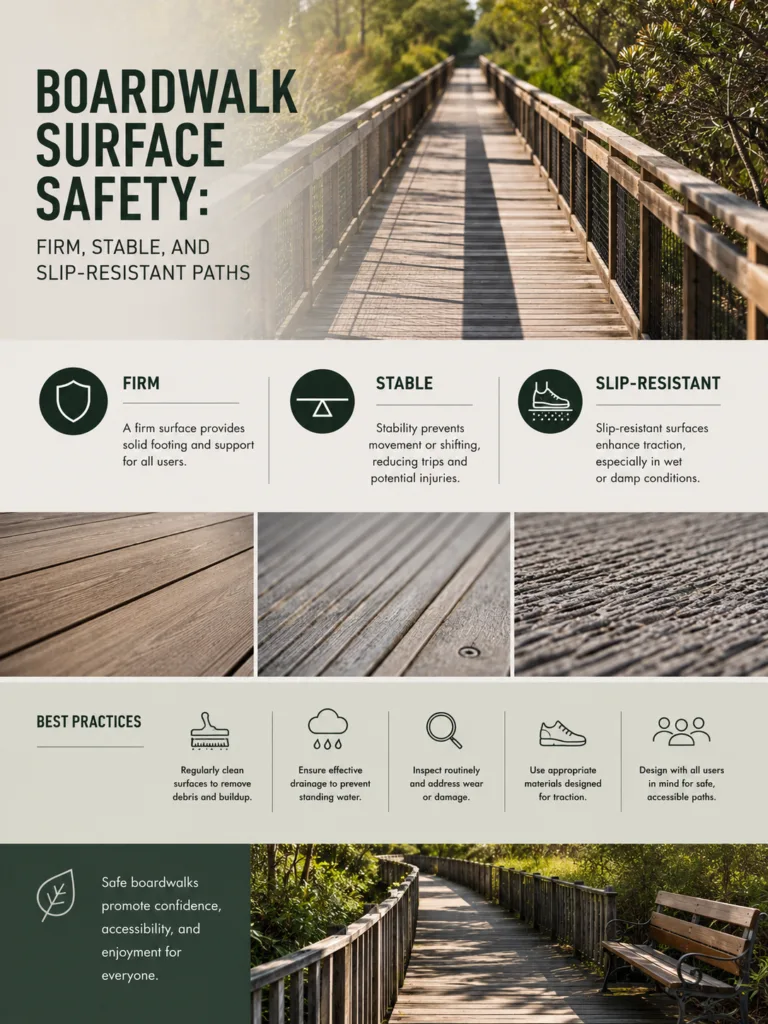
Boardwalk Surface Safety: Firm, Stable, and Slip-Resistant Paths
Walking a boardwalk should feel safe and confident. Learn how firm, stable, and slip-resistant surfaces keep...
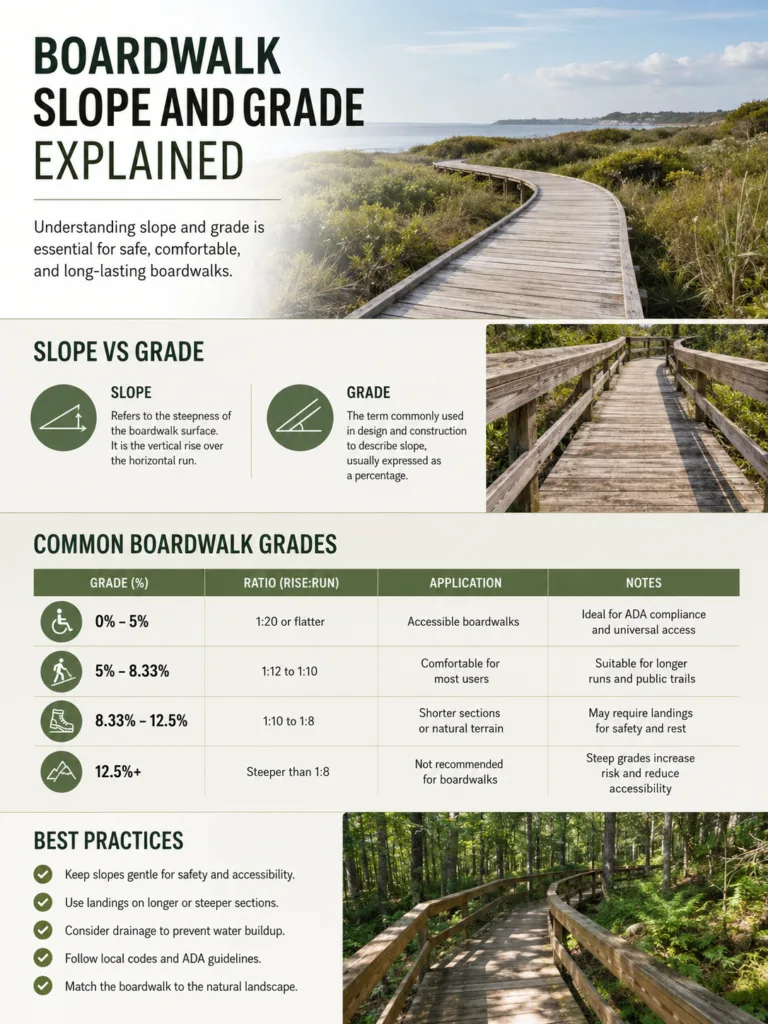
Boardwalk Slope and Grade Explained
Wondering what slope and grade really mean for your boardwalk? We break it down simply so...
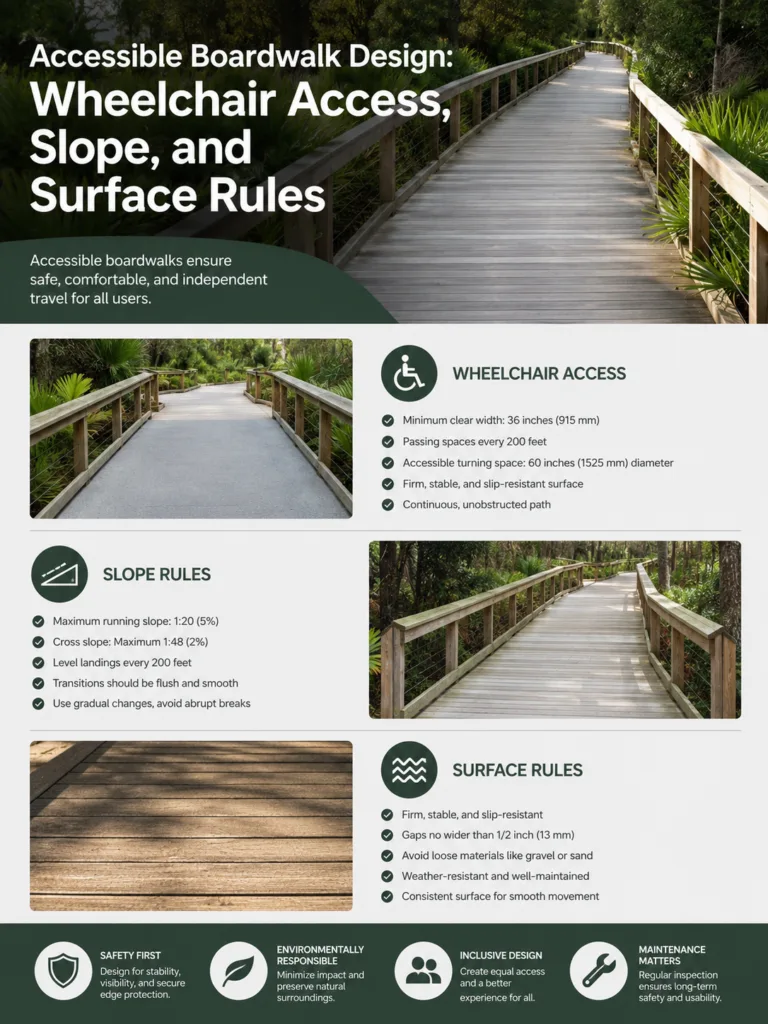
Accessible Boardwalk Design: Wheelchair Access, Slope, and Surface Rules
Designing a boardwalk everyone can enjoy? Learn how wheelchair access, proper slopes, and surface choices make...
3 articles in Accessibility
Boardwalk accessibility depends on the complete route
Wheelchair access is shaped by more than a ramp or a smooth deck. Arrival, parking, approaches, running slope, cross slope, clear width, surface openings, passing areas, edges, rest points and current maintenance conditions must work together.
Article library
Accessibility topics that need separate attention
A boardwalk may be manageable in one respect and difficult in another. A wide deck can still have an abrupt entrance lip. A nearly level route can pull a mobility device sideways when cross slope is excessive. A firm surface may become difficult after sand, algae or frost accumulates.
Accessible Boardwalk Design
Running slope, cross slope, clear width, stable surfaces, passing points, edges and visitor information considered as one access system.
Open article →GradeBoardwalk Slope and Grade
Running slope, cross slope, transitions and resting intervals explained without treating one percentage as a universal rule for every route type.
Open article →SurfaceBoardwalk Surface Safety
Firmness, stability, traction, openings, fasteners, drainage and changing outdoor conditions that affect walking aids, wheels and footing.
Open article →Clear spaceBoardwalk Width Guide
Clear movement space, two-way traffic, passing locations, viewing areas and the ways rails, benches or signs can narrow a nominal deck width.
Open article →EdgesBoardwalk Railings
Guards, handrails, curbs and edge conditions considered in relation to drop-offs, route type, visibility, drainage and usable clear width.
Open article →Route continuity
The deck is only one part of the trip
A technically usable boardwalk can remain inaccessible when the parking space, curb connection, ticket area, trail approach or restroom route does not connect to it. The reverse is also true: a strong arrival sequence does not solve a steep section, narrow gate or damaged transition farther along the route.
Real-world usability is influenced by distance and fatigue as well as technical geometry. A visitor may be able to enter a route but still need reliable places to rest, turn or pass. Long sections without shade or seating can affect people with limited stamina even when the walking surface remains level.
Detours deserve the same scrutiny. A closed accessible segment should not be replaced by a route with stairs, loose sand, steep cross slope or an unmarked curb. Temporary conditions can determine the actual experience for an entire season.
- Weakest-link principleOne blocked transition can interrupt an otherwise usable route.
- Distance mattersLength, rest points and return options affect practical access.
- Information is part of accessVisitors need conditions, surfaces, grades and obstacles before arrival.
- Maintenance changes performanceSettlement, lifted boards and loose approaches can alter the route after construction.
Design and field review
Elements that affect movement and confidence
| Element | What should be examined | Possible visitor effect | Common field warning |
|---|---|---|---|
| Running slope | Lengthwise grade, steep segments, landings and rest opportunities | Pushing effort, braking demand, fatigue and balance | A long climb with no level pause point |
| Cross slope | Side-to-side tilt, drainage pitch and uneven settlement | Sideways pull on wheelchairs, walkers and strollers | One deck edge visibly lower than the other |
| Clear width | Usable space between rails, curbs, signs, benches and other objects | Passing, turning and movement beside other visitors | A wide deck narrowed by furniture or gate hardware |
| Surface | Firmness, stability, flex, texture, gaps, joints and fasteners | Rolling resistance, vibration, cane-tip catches and trips | Rocking boards, raised screws or abrupt seams |
| Transitions | Connections to pavement, trail, sand mats, ramps and platforms | Entry and exit barriers even when the main deck is usable | Erosion, a lip, washed gravel or a soft edge |
| Passing and turning | Locations, spacing, shape and whether other users block them | Ability to reverse direction or allow two-way travel | A turnout occupied by a bench, bin or interpretive panel |
| Edges and rails | Drop-offs, edge protection, guards, handrails and protrusions | Wheel containment, fall protection and available clear width | Open edge beside a drop or rail supports projecting into the route |
| Rest points | Level space, seating, companion space, shade and route intervals | Stamina management and recovery on longer or steeper routes | Seats that block the path or provide no adjacent wheelchair space |
| Maintenance | Cleaning, inspection, drainage, board replacement and closure response | Whether intended access remains available over time | Algae, frost, sand piles, ponding or unrepaired damage |
Pre-visit information
“Accessible” is not enough detail for trip planning
A useful location page should describe the route rather than rely on one label. Equipment, strength, balance and comfort vary. Specific information allows visitors to decide for themselves and reduces uncertainty at places where the boardwalk begins far from parking or includes several connected surfaces.
- Route lengthState the distance to key viewpoints, facilities and the return point.
- Surface sequenceIdentify pavement, decking, compacted trail, sand mat, gravel and other transitions.
- Width and passingDescribe narrow sections, passing spaces and turning areas.
- GradeGive measured slope information when an official source provides it.
- ObstaclesNote gates, lips, stairs, soft approaches, damaged areas and seasonal barriers.
- Accessible parkingExplain location, route connection, payment and seasonal restrictions.
- Restrooms and seatingIdentify whether facilities connect to the same usable route.
- Beach accessSeparate boardwalk access from access onto sand or into water.
- Mobility devicesDistinguish ordinary public rules from exceptions for mobility devices.
- Current alertsLink to the responsible park, city or operator for closures and repairs.