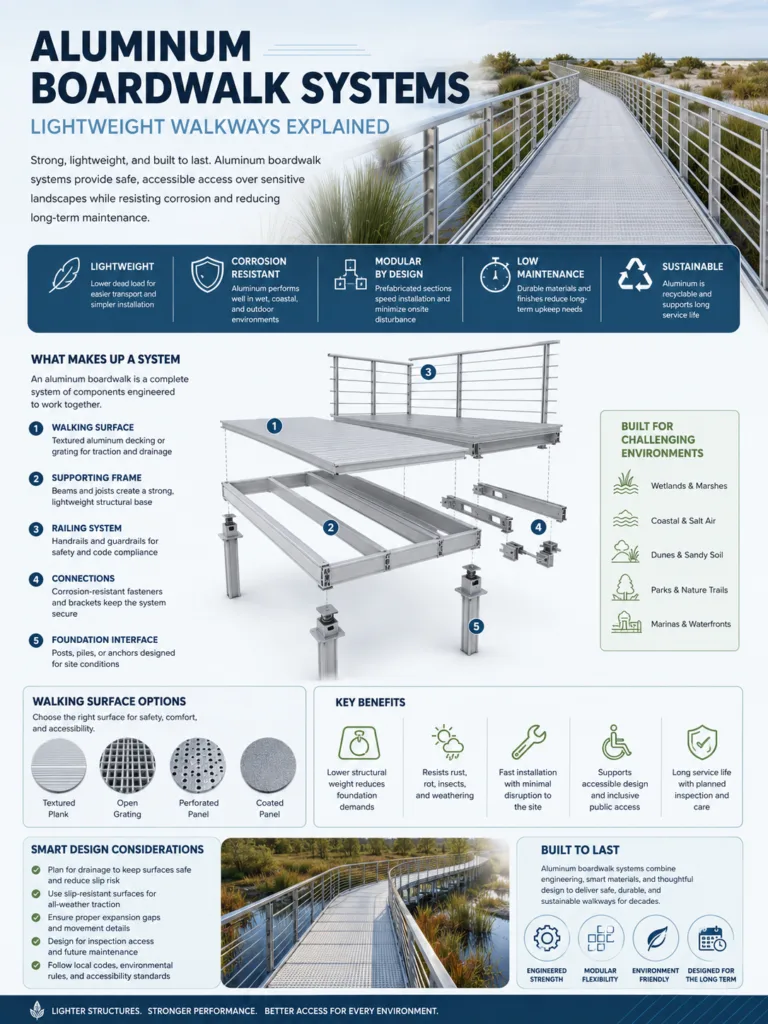
Aluminum Boardwalk Systems: Lightweight Walkways Explained
Aluminum boardwalk systems make waterfront and trail access easier than ever — lightweight, durable, and built...
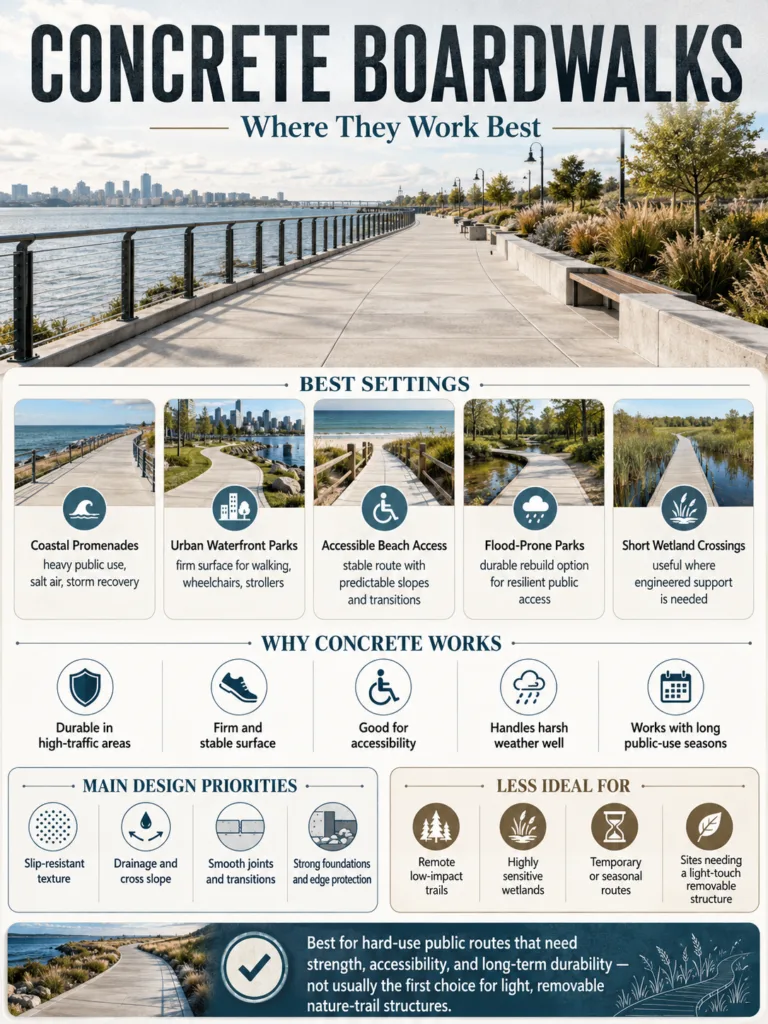
Concrete Boardwalks: Where They Work Best
Thinking about a concrete boardwalk for your project? Learn where this durable, low-maintenance option truly shines...
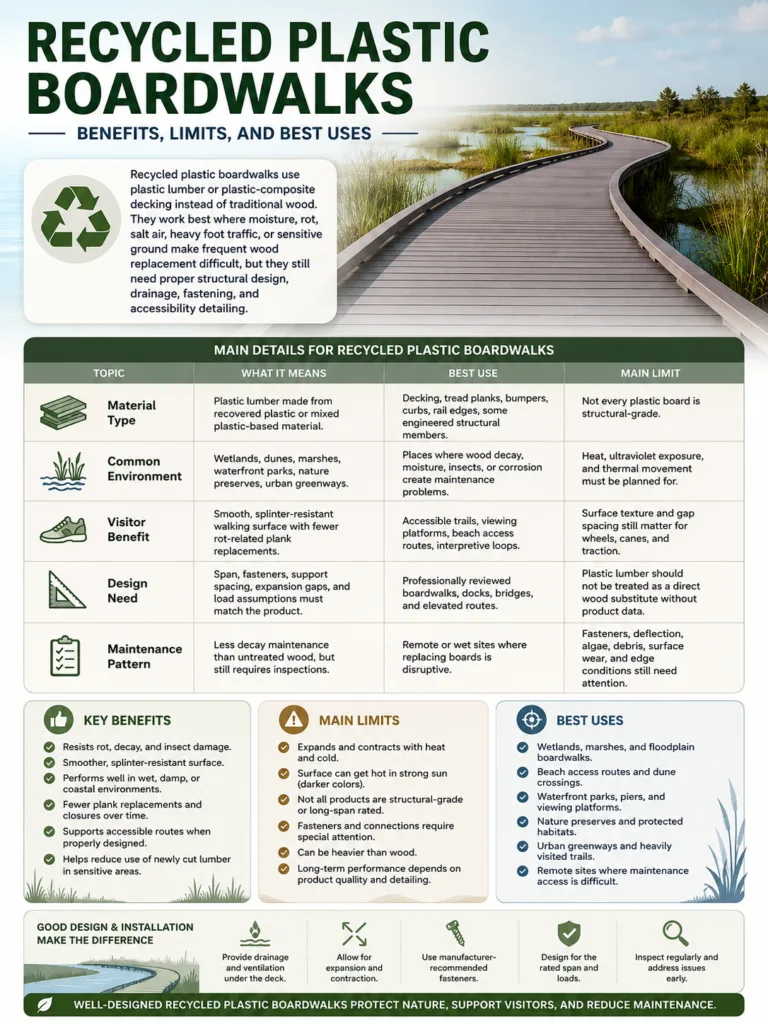
Recycled Plastic Boardwalks: Benefits, Limits, and Best Uses
Recycled plastic boardwalks offer lasting durability with minimal upkeep — here's what they do well, where...
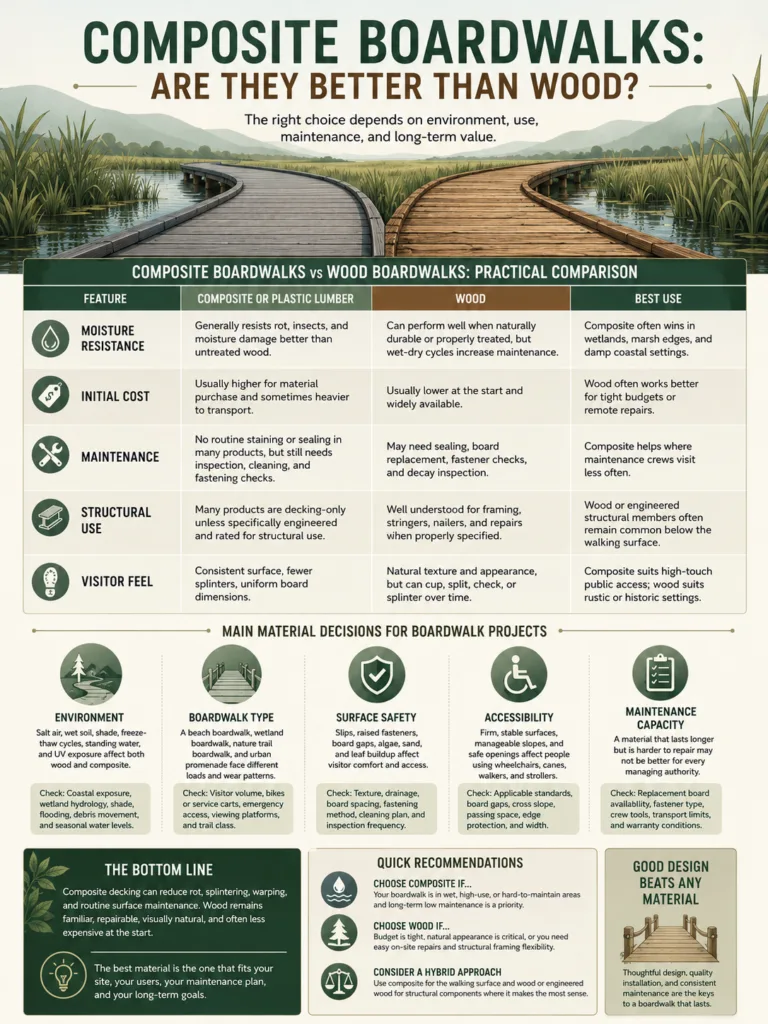
Composite Boardwalks: Are They Better Than Wood?
Thinking of a new boardwalk? Composite materials offer lasting beauty with less upkeep — here's how...
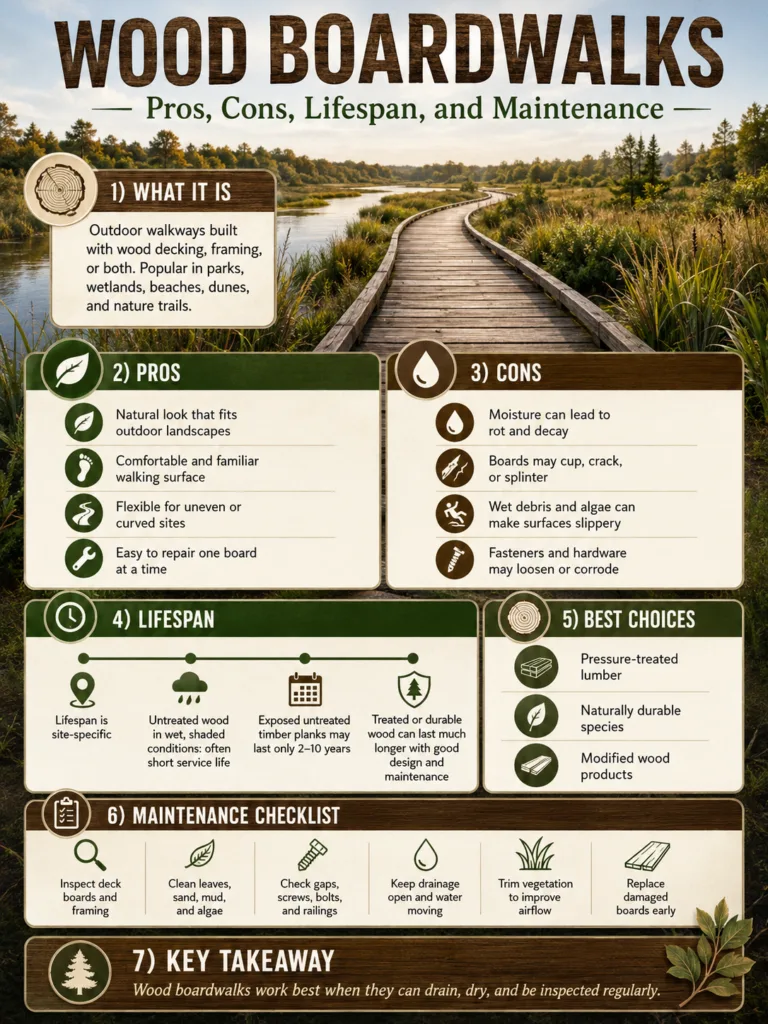
Wood Boardwalks: Pros, Cons, Lifespan, and Maintenance
Thinking about a wood boardwalk? Learn the real pros, cons, lifespan, and maintenance tips before you...
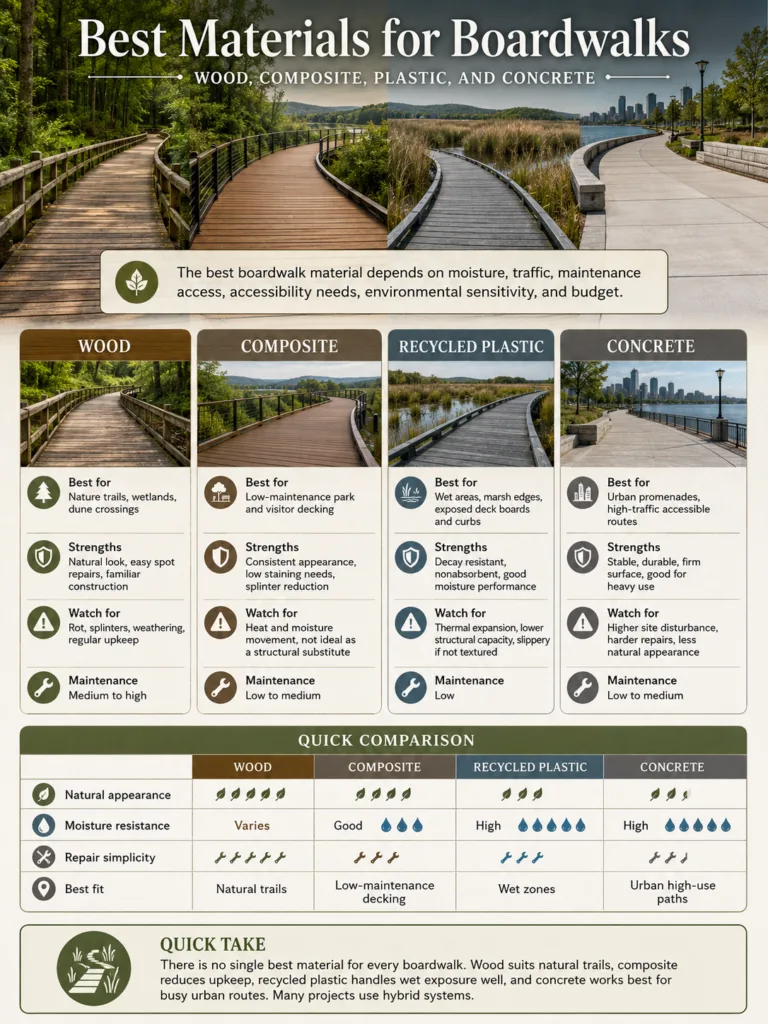
Best Materials for Boardwalks: Wood, Composite, Plastic, and Concrete
Choosing the right boardwalk material makes all the difference. Compare wood, composite, plastic, and concrete to...
6 articles in Materials
Boardwalk materials compared by exposure, structure and maintenance
Wood, composite, recycled plastic, concrete and aluminum behave differently under water, sun, salt, traffic and changing temperatures. Selection depends on verified performance, not a single universal ranking.
Material library
No material is best in every boardwalk setting
Material selection is a balance among exposure, span, weight, visitor volume, maintenance access, repair methods, initial cost and service life. A low-maintenance deck may still require frequent connection inspection. A familiar material can perform poorly when drainage or detailing traps moisture.
Best Materials for Boardwalks: Wood, Composite, Plastic, and Concrete
A broad comparison based on moisture, traffic, maintenance, accessibility, structure and project context.
Open article →WoodWood Boardwalks: Pros, Cons, Lifespan, and Maintenance
Natural appearance, repairability and structural familiarity balanced against moisture, decay, checking and routine inspection.
Open article →CompositeComposite Boardwalks: Are They Better Than Wood?
Product composition, span limits, heat, movement, fastening and maintenance compared with traditional wood decking.
Open article →Recycled plasticRecycled Plastic Boardwalks: Benefits, Limits, and Best Uses
Moisture resistance and recycled content considered alongside stiffness, thermal movement, surface temperature and support spacing.
Open article →ConcreteConcrete Boardwalks: Where They Work Best
Durability and high-use applications weighed against weight, foundations, cracking, repairs and construction access.
Open article →AluminumAluminum Boardwalk Systems: Lightweight Walkways Explained
Modular framing and decking options for corrosive or access-limited settings, with attention to connections, traction and product data.
Open article →Broad comparison
Strengths and constraints at a glance
| Material | Common strengths | Common constraints | Contexts often considered |
|---|---|---|---|
| Wood | Familiar framing, natural appearance, local repair and broad contractor experience | Decay, checking, splinters, fastener corrosion and recurring protective work | Nature routes, traditional beach settings and projects prioritizing repairable components |
| Composite | Consistent boards, decay resistance and reduced refinishing compared with many wood decks | Heat, movement, product-specific spans, fastening rules and replacement matching | Public decks and promenades where verified products suit the support layout |
| Recycled plastic | Moisture resistance, no wood decay and potential recycled content | Lower stiffness in some products, thermal expansion, heat and close support requirements | Wet settings and low-level paths when structural data supports the design |
| Concrete | High mass, wear resistance, familiar urban maintenance and strong performance under heavy use | Weight, foundations, cracking, difficult partial replacement and disruptive installation | Urban waterfronts, high-traffic promenades and ground-supported coastal routes |
| Aluminum | Low weight, modular assembly, corrosion resistance and factory-made components | Cost, proprietary connections, surface sound, thermal behavior and galvanic compatibility | Long spans, remote access, corrosive environments and modular systems |
Selection factors
Material choice starts outside the product catalog
The site usually eliminates unsuitable options before appearance becomes a serious question. Salt spray, standing water, abrasion from sand, freeze-thaw exposure, shade, wildfire criteria and access for replacement work can have more influence than the board’s advertised service life.
Structural framing and walking-surface material should also be considered separately. A composite or plastic deck does not automatically require the same support spacing as wood. Concrete changes the weight carried by foundations. Aluminum systems often rely on tested proprietary connections.
- ExposureSalt, fresh water, ultraviolet light, flooding, ice, sand and biological growth.
- Loads and spanPedestrians, maintenance equipment, emergency use, crowd loading and support spacing.
- Walking performanceFirmness, stability, slip resistance, gaps, heat, glare and changes at joints.
- Maintenance realityInspection frequency, available labor, replacement access and compatibility of future parts.
- Environmental contextSource material, transport, preservatives, end-of-life options and effects during installation.
Product review
Claims need project-level verification
Terms such as durable, sustainable, low maintenance and slip-resistant are incomplete without test methods, exposure conditions and maintenance assumptions. Product literature should be checked against structural calculations, accessibility requirements, fire criteria where applicable, warranties and actual installation details.