Skip to content

Types of Boardwalks

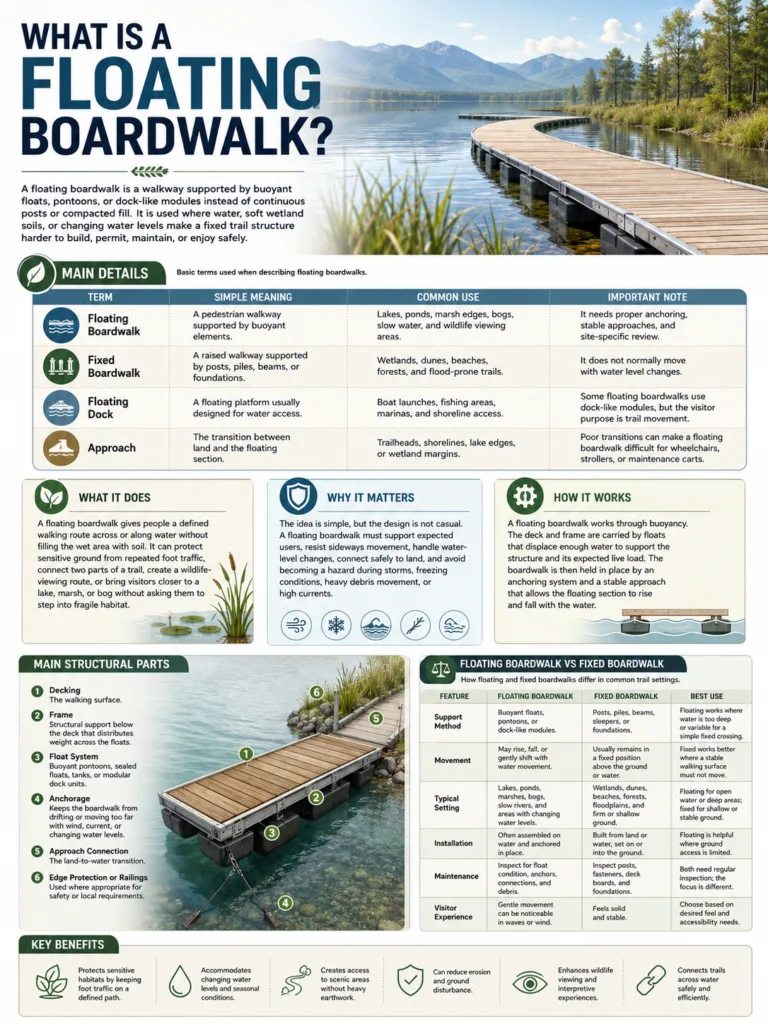
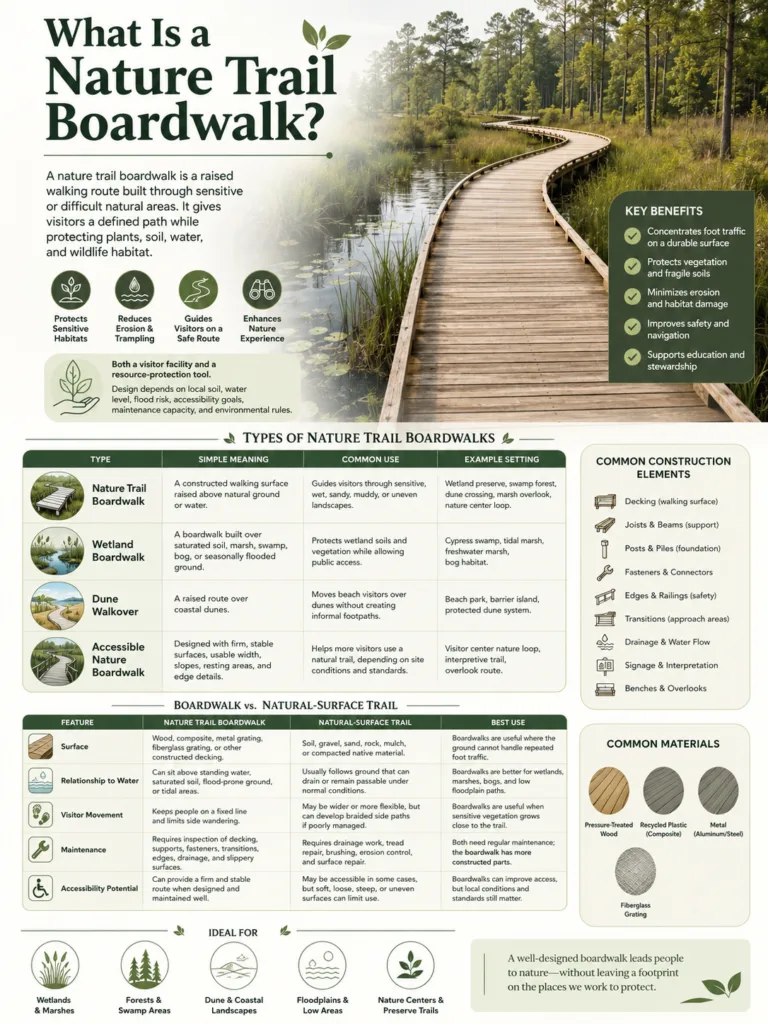
Explore boardwalk types by setting and function, including beach promenades, wetland paths, dune walkovers, nature-trail boardwalks, floating structures and other elevated walkways. Each article defines a distinct type and explains where it is used.
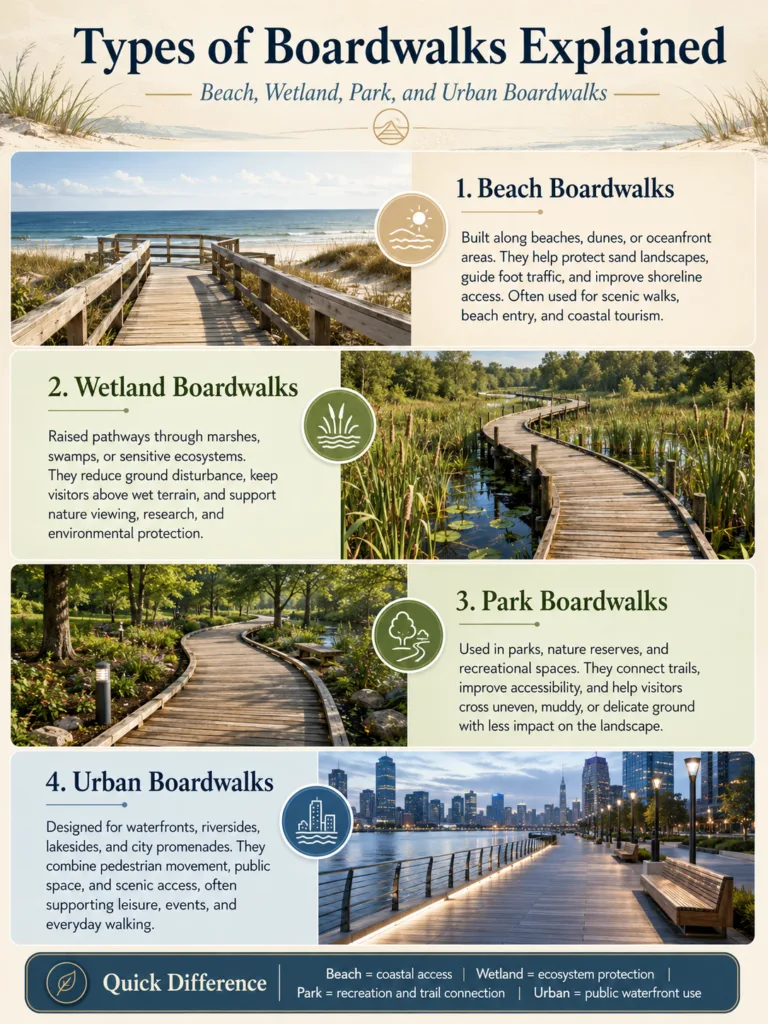
A boardwalk is a raised or paved pedestrian route designed to guide people across sand, wetlands, parks, shorelines, or dense urban areas while protecting the ground below. The main types are beach boardwalks, wetland boardwalks, park boardwalks, and urban boardwalks, each serving a different setting.

Main Details

Common boardwalk types and how they are usually used.
TypeSimple MeaningCommon UseTypical Visitor Experience
Beach BoardwalkA coastal walking route along sand, dunes, or an oceanfront district.Beach access, strolling, biking in some places, dune protection, waterfront businesses.Open views, many access points, strong sun and wind exposure.
Wetland BoardwalkAn elevated path over marsh, swamp, bog, floodplain, or saturated soil.Wildlife viewing, habitat protection, low-impact nature access.Quiet walking, interpretive signs, birding, water-level changes.
Park BoardwalkA boardwalk inside a park, preserve, campground, nature trail, or scenic area.Short trail segments, overlooks, sensitive terrain crossings, accessible routes where conditions allow.Often shorter than urban boardwalks, with benches, railings, trailheads, and natural surfaces nearby.
Urban BoardwalkA boardwalk, promenade, riverwalk, or elevated walkway built into a city setting.Public waterfront access, commuting, recreation, events, linear parks.Harder surfaces, lighting, railings, seating, nearby transit, shops, and mixed pedestrian traffic.

What a Boardwalk Means

A boardwalk is not defined only by wood planks. In common use, the word can describe a timber walkway, a composite walkway, a recycled-plastic trail, a concrete oceanfront promenade, or a raised pedestrian structure over fragile ground. The shared purpose is controlled pedestrian movement.

That control matters. A boardwalk can keep visitors out of dunes, mud, wetlands, hot spring areas, restoration zones, or road traffic. It can also make a route easier to understand by showing exactly where people should walk.

A boardwalk is different from a pier. A pier usually projects out over open water and is often used for fishing, docking, viewing, or access to boats. A boardwalk usually runs along, through, or across a landscape. Some waterfront places include both.

Beach Boardwalks

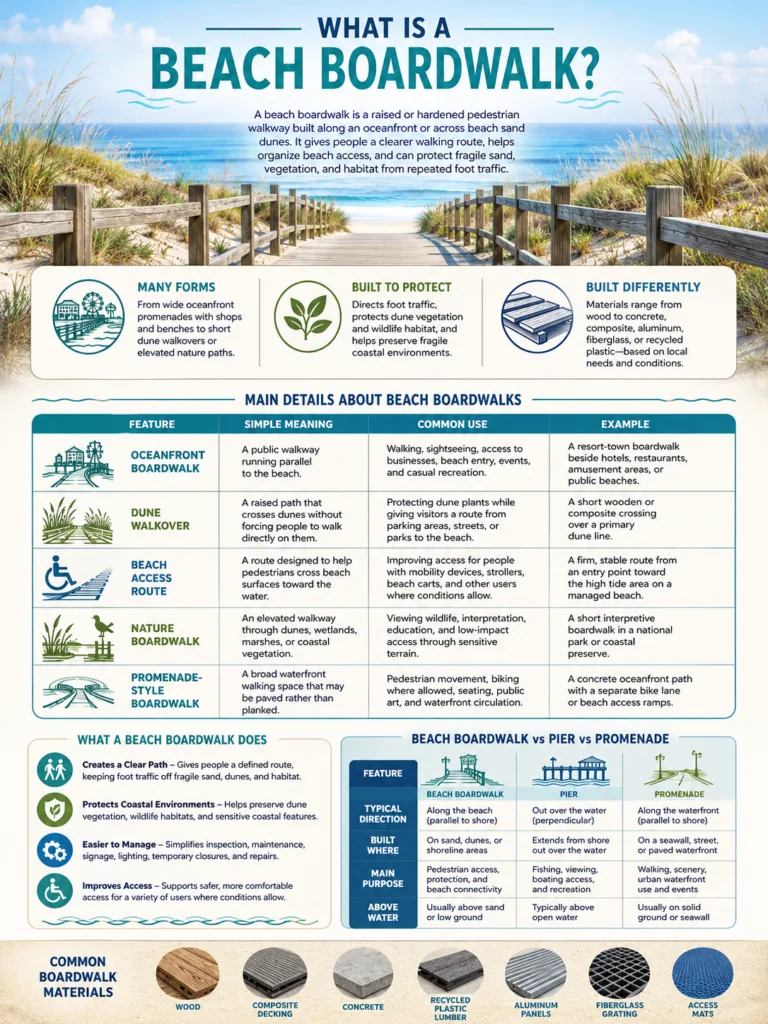
Beach boardwalks are built for coastal movement. They may run parallel to the beach as a long public promenade, cross dunes as a short walkover, or connect parking areas, restrooms, beach access points, and viewing areas.

The classic beach boardwalk is wide, social, and exposed. It often supports walking, jogging, sitting, sightseeing, and sometimes bicycles or small wheeled recreation where local rules allow. The Virginia Beach Boardwalk, for example, stretches from 2nd to 40th Streets along a three-mile oceanfront route.

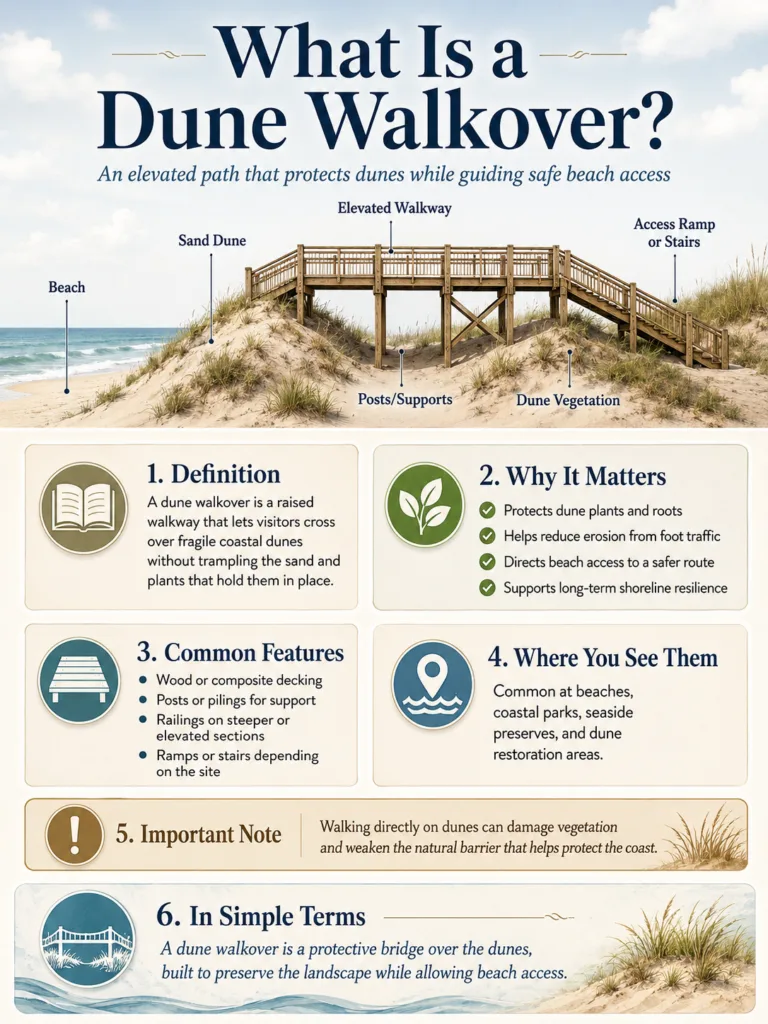
A dune walkover is more focused. Instead of creating a long waterfront promenade, it channels foot traffic over or through a dune system. Coastal dune walkover guidance commonly addresses siting, design, elevation, and beach access criteria near regulated coastal construction areas.

Where Beach Boardwalks Work Best

  • Oceanfront resort districts with many pedestrians.
  • Public beaches where visitors need clear access routes from parking or streets.
  • Dune systems where unmanaged footpaths could damage vegetation.
  • Coastal parks where sand, wind, flooding, and seasonal conditions make informal trails unstable.

Common Beach Boardwalk Features

  • Frequent beach entrances and exits.
  • Benches, overlooks, railings, lighting, and signs.
  • Transitions from hard surface to sand, sometimes with beach mats or ramps.
  • Materials selected for salt air, sun, sand abrasion, and storm exposure.
  • Seasonal maintenance after high tides, wind events, or storms.

Wetland Boardwalks

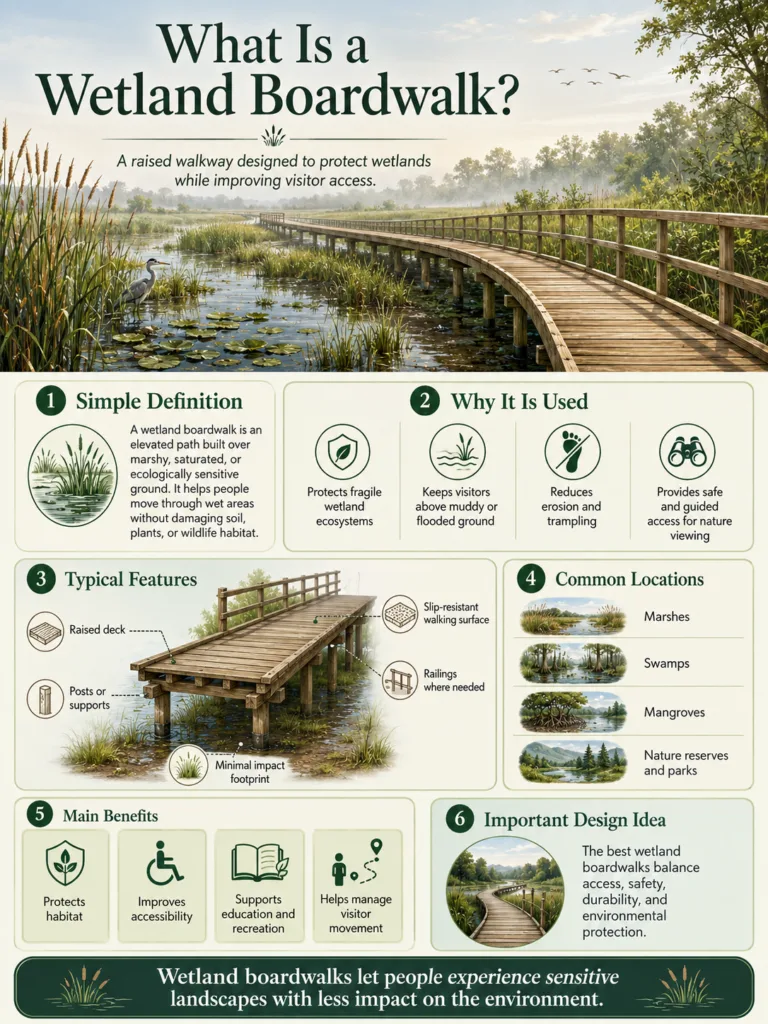
Wetland boardwalks are usually elevated above saturated ground. Their job is to let people experience marshes, swamps, bogs, sloughs, and floodplain forests without creating muddy informal paths or trampling sensitive plants.

Wetland boardwalks are often quieter than beach boardwalks. They may have narrower walking surfaces, wildlife-viewing platforms, interpretive signs, benches, and railings. The visitor experience is usually slower: birding, photography, plant observation, and short nature walks.

Two National Park Service examples show how this type works. Congaree National Park describes its Boardwalk Loop as a 2.6-mile boardwalk with a flat, accessible surface through the Congaree wilderness. Everglades National Park describes the Anhinga Trail as a 0.8-mile round-trip pavement and boardwalk route through sawgrass marsh and freshwater slough, with wheelchair access available on the route.

Why Wetland Boardwalks Are Often Elevated

Wetlands can hold water near or above the surface for part of the year. A raised structure can reduce rutting, soil compaction, and repeated trampling. It also helps visitors stay on a predictable route when the surrounding ground looks flat but may be soft, muddy, or ecologically sensitive.

Common Wetland Boardwalk Features

  • Elevated decking over water, mud, roots, or flood-prone soil.
  • Side rails or curbs where the edge drop, water depth, or visitor volume makes them useful.
  • Observation platforms where people can stop without blocking the route.
  • Gaps between boards kept small enough for safer walking and rolling where accessibility standards apply.
  • Seasonal closure signs when flooding, ice, damaged planks, or wildlife protection requires it.

Park Boardwalks

Park boardwalks are the broadest category. They can appear in national parks, state parks, city parks, botanical gardens, nature preserves, campgrounds, overlooks, and interpretive trails. Some are full trails. Others are short segments used only where the terrain needs protection or a stable walking surface.

A park boardwalk may cross a wetland, pass through dunes, connect a visitor center to an overlook, or keep visitors on a safe route through a sensitive area. In Yellowstone’s hydrothermal areas, visitors are instructed to stay on officially marked and maintained boardwalks or trails for safety and to protect fragile formations.

Park boardwalks often have a stronger interpretive role than urban boardwalks. Signs may explain wildlife, geology, plant communities, restoration work, or cultural history. The path is part of the lesson: it shows visitors where access is welcome and where the land manager wants the landscape left undisturbed.

Where Park Boardwalks Work Best

  • Short nature trails where the goal is learning rather than distance.
  • Scenic overlooks with fragile surrounding vegetation.
  • Campground or picnic-area connections where visitors need a firm walking route.
  • Thermal, floodplain, dune, or shoreline areas where staying on the route protects both visitors and the site.

Urban Boardwalks and Promenades

Urban boardwalks are designed for public movement in built environments. They may follow a waterfront, river, harbor, lake edge, former rail line, or redeveloped industrial corridor. In many cities, the surface may be concrete, stone, metal grating, composite decking, or a mix rather than traditional wood.

The urban version has different pressures than a wetland trail. It must handle heavier pedestrian volume, lighting, drainage, street crossings, seating, public events, nearby businesses, service access, and sometimes bicycles or micromobility. A successful urban boardwalk is not only a path; it is public space.

Urban boardwalks also blur categories. A beachfront promenade can be both a beach boardwalk and an urban boardwalk. A riverwalk can work like a promenade, a park edge, and a transportation route at the same time.

Beach, Wetland, Park, and Urban Boardwalks Compared

How the main boardwalk types differ in purpose, design, and visitor use.
FeatureBeach BoardwalkWetland BoardwalkPark BoardwalkUrban Boardwalk
Main PurposeBeach access, shoreline walking, dune protection, recreation.Access across wet or sensitive habitat.Guided park movement, interpretation, scenic access.Public circulation, waterfront access, recreation, city life.
Typical SettingBeachfronts, dunes, shorelines, coastal towns.Marshes, bogs, swamps, sloughs, floodplains.National, state, city, and nature parks.Riverfronts, harbors, redeveloped corridors, dense waterfront districts.
Common SurfaceWood, composite, concrete, pavers, mats, or mixed surfaces.Wood, recycled plastic, composite decking, or elevated panels.Wood, composite, recycled plastic, gravel transitions, or paved segments.Concrete, stone, steel, composite decking, pavers, or mixed hardscape.
Main Design ConcernSalt, sand, storms, dunes, heavy sun, seasonal crowding.Water level, habitat protection, footing stability, wildlife viewing.Visitor safety, site protection, interpretive use, local terrain.Heavy use, lighting, drainage, seating, crossings, maintenance access.
Best ForOcean views, beach access, casual walking, coastal recreation.Birding, nature study, quiet walking, wildlife observation.Short nature walks, accessible overlooks, sensitive terrain crossings.Everyday walking, tourism, waterfront dining areas, city recreation.

How Boardwalks Work as Structures

A boardwalk can be simple or complex. A short park boardwalk may rest on small supports over damp ground. A long urban boardwalk may need engineered foundations, drainage systems, lighting, utilities, code review, and long-term inspection planning. Site conditions shape the design.

Most boardwalks include three basic layers: a walking surface, a support system, and a connection to surrounding paths or access points. The walking surface is what visitors notice first. The support system is what keeps the route stable. The transitions decide whether the boardwalk feels easy to enter, exit, and use.

Common Structural Elements

  • Decking: The surface people walk on. It may be wood, composite, recycled plastic, concrete, metal, or another approved material.
  • Joists and Beams: The support members below the deck surface.
  • Posts, Piles, or Footings: The elements that transfer load into the ground.
  • Railings or Edge Protection: Used where height, water, crowds, or site rules call for more defined edges.
  • Transitions: The connection from pavement, sand, gravel, trail, stairs, ramp, or beach mat to the boardwalk.
  • Drainage and Openings: Gaps, slopes, and surface details that help shed water without creating unsafe wheel, cane, or heel traps.

This article gives general information, not engineering advice. Boardwalk construction can involve local building codes, accessibility rules, floodplain rules, environmental permits, coastal regulations, soil conditions, water levels, and professional design review.

Common Boardwalk Materials

The best boardwalk material depends on the setting. A salt-air beachfront, shaded wetland, urban riverwalk, and short park overlook do not age the same way. Cost, slip resistance, local availability, flood exposure, maintenance capacity, and environmental restrictions all matter.

General material differences for boardwalk planning and visitor understanding.
MaterialCommon UseStrengthsLimitsMaintenance Level
WoodTraditional beach, park, and nature boardwalks.Natural appearance, familiar feel, often easy to repair in sections.Can weather, splinter, rot, or become slippery depending on species, treatment, exposure, and upkeep.Moderate to high, depending on climate and use.
Composite DeckingUrban, park, and coastal routes where lower routine maintenance is desired.Consistent surface, less splintering than many wood installations, available in many profiles.Heat buildup, expansion, fastener details, and product specifications need review.Moderate.
Recycled Plastic LumberWetlands, parks, and short boardwalk segments.Resists moisture and decay, often used where wet conditions are expected.May flex, expand, or require closer structural spacing depending on product design.Low to moderate.
ConcreteUrban promenades, oceanfront districts, high-use public routes.Durable, firm, stable, and suitable for heavy pedestrian traffic.Less natural appearance; cracking, drainage, heat, and repair details need planning.Low to moderate.
Metal GratingSpecial crossings, industrial-style urban routes, drainage-heavy areas.Allows drainage and airflow; can be strong for certain applications.Openings, traction, cane tips, wheels, pets, and comfort must be considered carefully.Moderate.

Accessibility Notes

Boardwalk accessibility is not only about whether the surface looks flat. Width, slope, cross slope, openings, resting areas, passing spaces, edge conditions, ramps, handrails, transitions, and maintenance all affect how people use the route.

Outdoor accessibility guidance covers routes such as trails, viewing areas, and beach access routes, and recognizes that outdoor conditions may require careful planning from the beginning of a project.

For many outdoor recreation access routes in the United States, a minimum clear tread width of 36 inches is an important accessibility benchmark. Wider passing spaces may be needed where two wheelchair users need enough room to pass comfortably. Local rules and site-specific conditions still matter, especially outside federal lands.

Visitor-Facing Accessibility Details to Check

  • Is the route officially described as wheelchair accessible, stroller accessible, or only partially accessible?
  • Are there stairs, steep ramps, narrow turns, loose sand transitions, or uneven boards?
  • Are benches or resting points available along the route?
  • Are railings, curbs, or edge protection used where the boardwalk is raised?
  • Are pets, bicycles, scooters, or skates restricted?
  • Do seasonal conditions such as ice, flooding, storms, or repairs affect access?

Safety and Maintenance Notes

Most boardwalk safety problems are practical and visible: loose boards, slick algae, raised fasteners, uneven transitions, broken railings, sand buildup, storm damage, ponding water, and crowding at narrow points. Maintenance crews usually focus on finding these issues before they become difficult for visitors.

In coastal and wetland settings, the route can change after storms, tides, flooding, freeze-thaw cycles, or high visitor use. A boardwalk that was clear in spring may need repairs, cleaning, or temporary closure later in the season.

General Maintenance Checklist

  • Check decking for loose boards, raised screws, splinters, cracks, rot, or soft spots.
  • Inspect railings, curbs, and edge protection for movement or missing sections.
  • Remove sand, mud, leaves, algae, or standing water where they affect footing.
  • Review transitions between boardwalk, trail, pavement, sand, ramps, and stairs.
  • Confirm that signs, closures, and directional markers are still visible.
  • Look for drainage problems after heavy rain or unusually high water.
  • Document recurring damage so design changes can be considered during future repairs.

Environmental Considerations

Boardwalks often exist because the surrounding land should not absorb constant foot traffic. Dune vegetation, marsh plants, tree roots, thermal crusts, bog mats, and shoreline edges can be damaged by repeated shortcutting. A defined route reduces random paths.

That does not mean every natural area needs a boardwalk. Some locations are better served by a simple dirt trail, gravel path, seasonal closure, viewing platform, or no public access at all. The right choice depends on visitor demand, habitat sensitivity, maintenance capacity, safety, and the land manager’s goals.

In sensitive areas, boardwalks should make the desired behavior obvious. Visitors should not have to guess where to walk, where to stop for photos, where to view wildlife, or where the protected zone begins.

Real Examples of Boardwalk Types

Examples that show how different boardwalk types function in real places.
ExampleTypeLocationWhy It Matters
Virginia Beach BoardwalkBeach and urban boardwalkVirginia Beach, VirginiaA long oceanfront route used for strolling, biking, beach access, and public waterfront activity.
Congaree Boardwalk LoopWetland and park boardwalkCongaree National Park, South CarolinaA flat, accessible 2.6-mile route introducing visitors to a floodplain forest environment.
Anhinga TrailWetland boardwalkEverglades National Park, FloridaA short pavement-and-boardwalk route through sawgrass marsh and freshwater slough with wildlife viewing.
Norris Geyser Basin TrailsPark boardwalk in a sensitive thermal areaYellowstone National Park, WyomingA controlled route where staying on marked boardwalks and trails protects visitors and fragile hydrothermal features.
Dune Walkover GuidanceBeach access boardwalk planningFlorida coastal construction areasShows how coastal agencies treat dune walkovers as regulated access structures with siting and design considerations.

How to Read a Boardwalk Before You Walk It

You can learn a lot from the first few minutes at a boardwalk entrance. The width, surface, signs, railings, slope, and nearby terrain tell you what kind of route it is and how carefully you should plan your walk.

  • Wide, paved, busy, and lined with businesses: usually an urban or beach promenade.
  • Narrow, elevated, quiet, and surrounded by water or reeds: usually a wetland boardwalk.
  • Short route with signs, overlooks, and natural features: often a park interpretive boardwalk.
  • Raised route over dunes or sand: usually a beach access or dune walkover.
  • Strict stay-on-route signs: the surrounding area may be fragile, hazardous, under restoration, or all three.

Common Mistakes When Describing Boardwalks

Many short descriptions use “boardwalk” as if all boardwalks are the same. That misses the reason each type exists. A beach boardwalk is not planned like a wetland boardwalk. A city promenade is not maintained like a quiet bog trail. A thermal-area boardwalk is not simply a scenic path.

  • Assuming all boardwalks are wood: many modern boardwalks use concrete, composite, recycled plastic, metal, or mixed materials.
  • Ignoring the setting: saltwater, wetlands, floodplains, dunes, and cities create different design pressures.
  • Calling every waterfront path a boardwalk: some are promenades, riverwalks, piers, seawalls, trails, or shared-use paths.
  • Assuming accessibility from appearance: a flat-looking path may still have narrow sections, steep transitions, surface gaps, or seasonal barriers.
  • Forgetting maintenance: drainage, fasteners, surface texture, vegetation, and storm recovery can decide how usable a boardwalk feels.

Frequently Asked Questions

What Is the Difference Between a Beach Boardwalk and a Wetland Boardwalk?

A beach boardwalk usually serves shoreline recreation, beach access, dune crossings, or oceanfront movement. A wetland boardwalk is usually elevated over marsh, swamp, bog, or floodplain terrain to protect soft ground and let visitors observe habitat without walking through it.

Are All Boardwalks Made of Wood?

No. Boardwalks may use wood, composite decking, recycled plastic lumber, concrete, metal grating, pavers, or mixed materials. The best material depends on moisture, salt, visitor volume, maintenance capacity, accessibility needs, and local rules.

Are Boardwalks Wheelchair Accessible?

Some are, but not all. Accessibility depends on width, slope, surface gaps, transitions, resting areas, railings, passing spaces, and maintenance. Official park or city information should be checked before visiting because conditions and closures can change.

Why Do Parks Ask Visitors to Stay on Boardwalks?

Parks use boardwalks to guide visitors through areas where walking off-route may damage vegetation, disturb habitat, create erosion, or expose visitors to unsafe ground conditions. The rule is usually about both resource protection and visitor safety.

Is a Boardwalk the Same as a Pier?

No. A pier usually extends out over water for fishing, viewing, docking, or access to boats. A boardwalk usually runs along, through, or across a landscape such as a beach, wetland, park, waterfront, or urban corridor.

What Type of Boardwalk Is Best for Nature Viewing?

Wetland and park boardwalks are usually best for nature viewing because they slow visitors down and place them near plants, water, wildlife, and interpretive signs without requiring people to step into sensitive terrain.