A boardwalk maintenance checklist should cover surface condition, loose fasteners, railing stability, drainage, vegetation, structural supports, accessibility barriers, storm damage, visitor safety, and repair documentation. The checklist works best when routine inspections are paired with seasonal checks after flooding, high tides, heavy rain, freeze-thaw cycles, or peak visitor use.
| Maintenance Area | What to Check | Why It Matters | Typical Trigger |
|---|---|---|---|
| Walking Surface | Loose planks, lifted edges, gaps, slick algae, splintering, soft spots | Reduces trip, slip, and mobility-device hazards | Routine inspection, rain, shade, salt spray |
| Structure Below Deck | Posts, stringers, beams, connectors, settlement, scour, corrosion | Protects load path and long-term service life | Annual review, storm events, visible sagging |
| Railings and Edges | Loose rails, missing curb edges, damaged transitions, exposed drop-offs | Improves edge awareness and visitor control | High use, vandalism, fallen limbs |
| Drainage and Water Flow | Ponding, blocked culverts, sediment build-up, sand drift, vegetation mats | Limits moisture damage and keeps the route usable | Seasonal rain, tides, snowmelt, wetland flooding |
| Access and Information | Trailhead signs, closure notices, temporary barriers, accessible-route details | Helps visitors choose the right route before they enter | Repairs, storm closures, surface change |
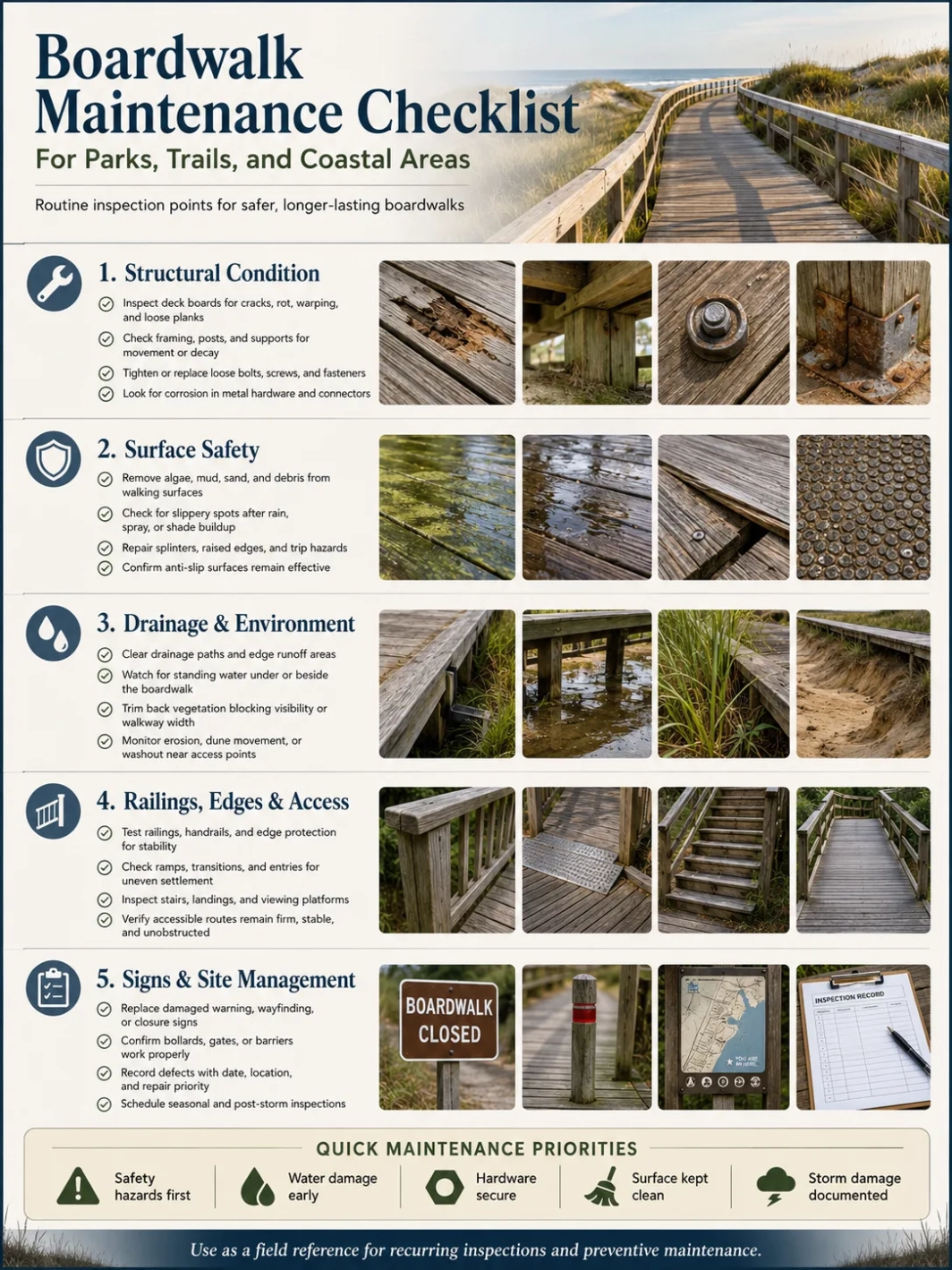
Highest Wear: entrances, ramps, turns, overlooks, stairs, and shaded wet sections.
Coastal Pressure: salt, sand, wind, waves, storm surge, and moving dunes.
Record Needed: date, issue, location, photos, action taken, and follow-up status.
What a Boardwalk Maintenance Checklist Should Cover
A boardwalk is exposed from above, below, and along its edges. Visitors see the deck first, but many failures begin under the surface: wet beams, corroded connectors, undermined posts, animal burrows, blocked water flow, or sand packed against the structure. A useful checklist separates visitor-facing hazards from structural warning signs so staff can respond at the right level.
Federal outdoor accessibility guidance also treats maintenance differently from alteration. The U.S. Access Board lists routine work such as debris removal, tread repair, drainage work, and repairing or replacing damaged boardwalk sections as maintenance activities; altered trail portions can trigger separate technical requirements when the original design, function, or purpose changes [a].
Technical note: This checklist is general maintenance guidance for park, trail, and public access teams. Structural design, load rating, permits, wetland rules, coastal engineering, and accessibility compliance should be reviewed through the managing agency’s standards and qualified professionals when repairs go beyond routine maintenance.
Routine Boardwalk Inspection Checklist
The most useful inspection is a slow walk in both directions. Many hazards look different when approached from the opposite side, especially raised board edges, surface lips at transitions, glare on wet decking, and narrow passing points near benches or overlooks.
Deck Surface
- Look for loose, cracked, cupped, splintered, rotted, or missing boards.
- Check for fasteners backing out above the walking surface.
- Mark sudden level changes at deck joints, ramps, thresholds, and bridge transitions.
- Note algae, moss, mud, leaf film, bird droppings, ice risk, or sand that changes traction.
- Measure or flag gaps that could catch canes, stroller wheels, bicycle tires, or mobility-device casters.
Edges, Rails, and Open Sides
- Test handrails and guardrails for movement, missing sections, loose posts, and sharp edges.
- Check curb edges, wheel guards, or raised side protection where provided.
- Look for vegetation pushing into the clear walking width.
- Inspect corners, overlooks, fishing platforms, and viewing decks for crowding and edge wear.
Supports and Connectors
- Check posts, beams, joists, stringers, bracing, hangers, bolts, brackets, and bearing points.
- Look for rust, staining, splitting, fungal decay, insect damage, settlement, or shifting.
- Note any bounce, sagging, leaning, twisting, or repeated vibration under normal foot traffic.
- Inspect areas where water, soil, sand, or plant debris stays in contact with structural members.
Drainage, Sand, and Vegetation
- Clear leaves, branches, wrack, wind-blown sand, and debris that trap moisture.
- Check that water can pass under wetland boardwalks without forcing visitors off route.
- Inspect beach walkovers for dune sand build-up against ramps, stairs, and lower rails.
- Trim vegetation only where allowed by the managing authority and habitat rules.
Signs, Closures, and Visitor Information
- Confirm that closure signs are visible before visitors reach a damaged section.
- Use firm barriers where a route is unsafe, not only caution tape in windy or crowded areas.
- Update map boards, trailhead notices, and web alerts when access changes.
- Record the exact segment, nearest landmark, and repair priority.
Inspection Timing for Parks, Trails, and Coastal Areas
| Setting | Routine Check | Seasonal Check | Event-Based Check | Extra Attention |
|---|---|---|---|---|
| Urban Waterfront | High-use surface walk-throughs | Fasteners, rails, lighting, benches, ramps | After festivals, flooding, high winds | Entrances, vendors, railings, crowd pinch points |
| Beach Boardwalk | Sand, surface wear, stairs, beach access points | Salt corrosion, dune movement, storm drain outfalls | After coastal storms, king tides, erosion events | Transitions from hard deck to soft sand |
| Wetland Boardwalk | Slick surfaces, plant encroachment, loose boards | Water level, settlement, wildlife activity, supports | After flooding, freeze-thaw, fallen trees | Shaded sections, low spots, soft approaches |
| Forest Trail Boardwalk | Branches, leaf litter, root pressure, rail condition | Rot, insects, drainage, dead trees nearby | After windstorms, snow load, heavy rain | Boardwalk ends and bridge approaches |
| Accessible Recreation Route | Surface firmness, clear width, level changes | Slopes, resting areas, signs, accessible features | After repairs or surface replacement | Gaps, cross slope, temporary barriers |
Accessibility note: The USDA Forest Service guide explains that outdoor recreation access route surfaces should be firm and stable, and that surfaces built with boards have tighter cross-slope expectations than natural or gravel surfaces because drainage and side slope affect mobility-device travel [b].
Documented Repair and Maintenance Examples
Real projects show why boardwalk maintenance is not only about replacing worn planks. Storms, flooding, habitat protection, deferred maintenance, accessibility, erosion, and rockfall can all drive repair decisions.
| Boardwalk or Trail | Location | Documented Issue | Repair or Maintenance Action | Visitor Impact | Official Source |
|---|---|---|---|---|---|
| Barataria Preserve Boardwalk Trails | Jean Lafitte National Historical Park and Preserve, Louisiana | Hurricane Ida damage, flooding, subsidence, and sea-level-rise exposure | NPS project to rebuild a subset of damaged boardwalk trails for better storm resilience | Some trail access depends on repair phasing and storm recovery | NPS ParkPlanning project page [c] |
| Salt Creek Boardwalk | Death Valley National Park, California | Damaged infrastructure after flooding and access-road impacts | Proposed replacement of accessible boardwalk, signs, access road, parking lot, and toilet area | Maintains visitor viewing while protecting the Salt Creek pupfish habitat | NPS public input notice [d] |
| Atlantic White Cedar Swamp Trail | Cape Cod National Seashore, Massachusetts | Boardwalk structure, walking surface, erosion damage, and visitor safety concerns | Replacement of boardwalk sections, erosion repair, and trail resurfacing | Reduces tripping hazards and protects a sensitive swamp setting | NPS project description [e] |
| Beech Forest Boardwalk | Cape Cod National Seashore, Massachusetts | Health, safety, accessibility, environmental, and deferred maintenance issues | Boardwalk section replacement using site-harvested cedar poles and recycled decking | Improves visitor access while protecting natural resources | NPS project description [e] |
| Paw Paw Tunnel Boardwalk | Chesapeake & Ohio Canal National Historical Park, Maryland | Rockfall hazards threatening the towpath boardwalk section | Rock scaling, stabilization, debris removal, and wooden boardwalk replacement | Detours and work-zone controls were used during construction; the boardwalk work was reported complete in 2023 | NPS project update [f] |
Surface, Fastener, and Gap Checks
Surface checks should be practical and repeatable. A board that feels slightly loose during a slow inspection may become a fall hazard during wet weather, crowding, or after several more weeks of use. Staff should mark location by segment, nearest entrance, or boardwalk feature rather than using vague notes such as “middle of trail.”
Loose Fasteners
Check: raised screws, nails, bolts, and brackets. Action: secure, replace, or flag for repair before the head becomes a trip point.
Board Gaps
Check: gaps widened by shrinkage, missing boards, or broken edges. Action: compare against the applicable accessibility or agency standard before replacement.
Slick Film
Check: shaded, damp, algae-prone sections. Action: clean with approved methods that do not damage habitat, decking, or nearby water.
End Transitions
Check: lips where boardwalk meets pavement, gravel, sand, stairs, or soil. Action: repair settled approaches and post warnings during temporary work.
Safety note: Surface cleaning should not create a new hazard. A freshly washed deck can be slick until dry, and pressure washing may damage wood fibers or push debris into sensitive wetlands. Use the method approved for the site, material, and surrounding habitat.
Structural and Environmental Warning Signs
Maintenance staff do not need to solve every structural issue during a routine inspection, but they do need to recognize warning signs that require escalation. A soft board can often be repaired quickly; a leaning post line, repeated sagging, washed-out support, or moving connection needs a more careful review.
| Warning Sign | Possible Cause | Field Response | Escalation Level |
|---|---|---|---|
| Deck Sagging | Damaged joist, post settlement, undersized or weakened support | Close or restrict the section if movement is visible under normal use | Structural review |
| Post Leaning | Scour, rot at waterline, soil movement, impact damage | Photograph, mark location, compare with prior inspection photos | Structural review |
| Connector Corrosion | Salt air, trapped moisture, dissimilar metals, aging hardware | Check nearby connectors and note pattern, not only the single defect | Maintenance lead or engineer |
| Undermined Approach | Erosion, wave run-up, poor drainage, visitor shortcuts | Block unsafe shortcut routes and stabilize only with approved methods | Land manager review |
| Standing Water Under Deck | Blocked flow, sediment build-up, altered wetland hydrology | Document water depth, debris, and whether flow is obstructed | Environmental review if habitat is sensitive |
Environmental note: In wetlands, marshes, dunes, and riparian areas, maintenance should keep visitors on the intended route without turning the work zone into a new disturbance. Debris removal, vegetation trimming, and access rerouting may require agency or permit review.
Coastal Boardwalk Maintenance Checks
Coastal boardwalks face a different maintenance pattern than inland park boardwalks. Salt accelerates corrosion, sand hides low edges, wind loosens signs, storms can remove beach access stairs, and dune movement can change the usable approach faster than the deck itself changes.
Do
- Inspect after named storms, high tides, wind-driven sand events, and wave overtopping.
- Check stairs, ramps, dune crossings, beach mats, rail ends, and shore-side transitions.
- Look below the deck for scour, exposed footings, debris impact, and damaged bracing.
- Document corrosion patterns on fasteners, rail hardware, lighting, and sign mounts.
Avoid
- Clearing dune vegetation without the correct habitat review.
- Reopening access points before stairs, rails, and transitions are stable.
- Assuming sand-covered damage is minor because the walking surface looks level.
- Using temporary ramps or mats without checking edge drop-offs and visitor flow.
Storm recovery projects often become long-term resilience projects. Rockaway Beach in New York and Barataria Preserve in Louisiana show how boardwalk repair can involve materials, flood exposure, public access, and future storm performance rather than simple plank replacement.
Maintenance Records That Make Repairs Easier
A boardwalk record should be simple enough for field staff to complete and detailed enough for a supervisor, engineer, grant reviewer, or public works crew to understand later. Photos are especially useful because boardwalk deterioration is often gradual.
Suggested Repair Log Fields
- Date and time: include weather and tide or water-level conditions if relevant.
- Exact location: entrance name, boardwalk segment, mile marker, junction, overlook, or GPS point if used by the agency.
- Issue type: surface, rail, support, drainage, vegetation, sign, access, storm damage, vandalism, or visitor report.
- Severity: monitor, repair soon, restrict access, close immediately, or request technical review.
- Photos: wide context photo plus close-up defect photo with scale when possible.
- Action taken: cleaned, tightened, replaced, blocked, signed, reported, or scheduled.
- Follow-up: responsible staff, target date, material needed, and reopening note.
Field note: Keep the same inspection route order each time. Repeated photo angles from the same access point help reveal slow changes such as settlement, widening gaps, rail movement, erosion, or vegetation pressure.
Common Boardwalk Maintenance Mistakes
- Only checking the deck: The walking surface may look acceptable while supports, connectors, or approaches are failing below.
- Ignoring shade and moisture: North-facing, forested, or wetland sections often stay slick longer after rain.
- Using vague repair notes: “Loose board near entrance” is hard to act on if there are several entrances.
- Reopening too soon after storms: Sand, debris, and standing water can hide damaged stairs, rails, and undermined supports.
- Replacing materials without context: Wood, composite, concrete, recycled plastic, and metal hardware behave differently under salt, shade, freeze-thaw, and heavy use.
- Forgetting temporary accessibility impacts: Detours, cones, barriers, and repair staging can block the route even when the permanent boardwalk is usable.
Maintenance Priority Table
| Priority | Typical Condition | Recommended Response | Example |
|---|---|---|---|
| Close or Restrict | Visible instability, missing rail at drop-off, storm-damaged stairs, major surface collapse | Block access, post notice, document, and request technical review | Undermined beach access ramp after a coastal storm |
| Repair Soon | Loose plank, lifted fastener, broken curb edge, small but clear trip hazard | Schedule repair before the next high-use period | Raised screw head near a wetland overlook |
| Monitor | Early staining, minor checking, vegetation beginning to encroach, small drainage issue | Photograph and compare during next inspection | Moisture staining under a shaded deck section |
| Routine Service | Leaves, sand, trash, small branches, sign cleaning, light vegetation trimming | Clear during normal maintenance if permitted by site rules | Leaf film creating slick conditions after rain |
Frequently Asked Questions
How often should a boardwalk be inspected?
High-use boardwalks may need frequent walk-throughs, while remote trail boardwalks may be checked on a seasonal schedule. Any boardwalk should be inspected after storms, flooding, fallen trees, heavy visitor events, or visible damage reports.
What is the most common boardwalk maintenance issue?
Common issues include loose planks, raised fasteners, slick organic film, vegetation encroachment, surface gaps, drainage problems, and worn transitions where boardwalks meet pavement, soil, sand, or gravel.
When should a boardwalk section be closed?
A section should be restricted or closed when there is visible instability, missing edge protection, broken stairs, storm undermining, major surface failure, active work nearby, or any condition that cannot be safely managed with a simple repair.
Do accessibility rules apply to boardwalk maintenance?
Routine maintenance is treated differently from alteration, but surface firmness, width, gaps, slopes, transitions, signs, and temporary detours can still affect real visitor access. Agencies should check the standards and policies that apply to their site.
Why do coastal boardwalks need extra checks after storms?
Storms can move sand, expose footings, damage stairs, loosen railings, corrode hardware, and leave debris under the deck. A surface that looks passable may still have hidden support or transition damage.
What should be included in a boardwalk repair record?
Include the date, exact location, defect type, severity, photos, temporary action, repair completed, materials used, staff initials, and follow-up date. Consistent records help track recurring trouble spots.
Resources Used
- [a] U.S. Access Board: Chapter 10, Outdoor Developed Areas — Used for the distinction between maintenance and alterations, plus trail technical topics such as surface, tread width, openings, passing spaces, slopes, and signs. The U.S. Access Board is the federal source for ABA accessibility guidance.
- [b] USDA Forest Service: Accessibility Guidebook for Outdoor Recreation and Trails — Used for firm and stable surface guidance, slope context, resting intervals, and outdoor recreation access route maintenance considerations. The Forest Service guide is a federal technical resource for recreation access.
- [c] NPS ParkPlanning: Trail Improvements at Barataria Preserve — Used as an official example of hurricane-related boardwalk trail repair and rebuilding for future storm, flooding, subsidence, and sea-level-rise exposure.
- [d] National Park Service: Salt Creek Boardwalk Replacement Notice — Used as an official example of damaged boardwalk infrastructure, access-road repair, visitor viewing, and habitat protection at Death Valley National Park.
- [e] National Park Service: Cape Cod National Seashore, Your Dollars at Work — Used for official repair examples at Atlantic White Cedar Swamp Trail and Beech Forest Boardwalk, including erosion, tripping hazards, accessibility, environmental protection, and deferred maintenance.
- [f] National Park Service: Paw Paw Tunnel Scaling Project — Used as an official example of rockfall hazard management, temporary visitor impacts, and replacement of the wooden boardwalk section carrying towpath traffic.