Coastal boardwalk storm damage is rarely limited to missing planks. A boardwalk may remain standing while waves have loosened its deck connections, currents have removed sand from around its piles, or floodwater has undermined the landward approach. The most dangerous damage is often below the walking surface, where loss of pile support, split beams, displaced connections, and hidden voids can reduce capacity without producing an obvious collapse.
A sound repair starts by identifying the forces that reached the structure: storm surge, breaking waves, upward pressure beneath the deck, shoreline erosion, local scour, wind, floating debris, rainfall runoff, and saltwater exposure. Replacing visible boards before tracing that damage path can leave the original failure mechanism in place.
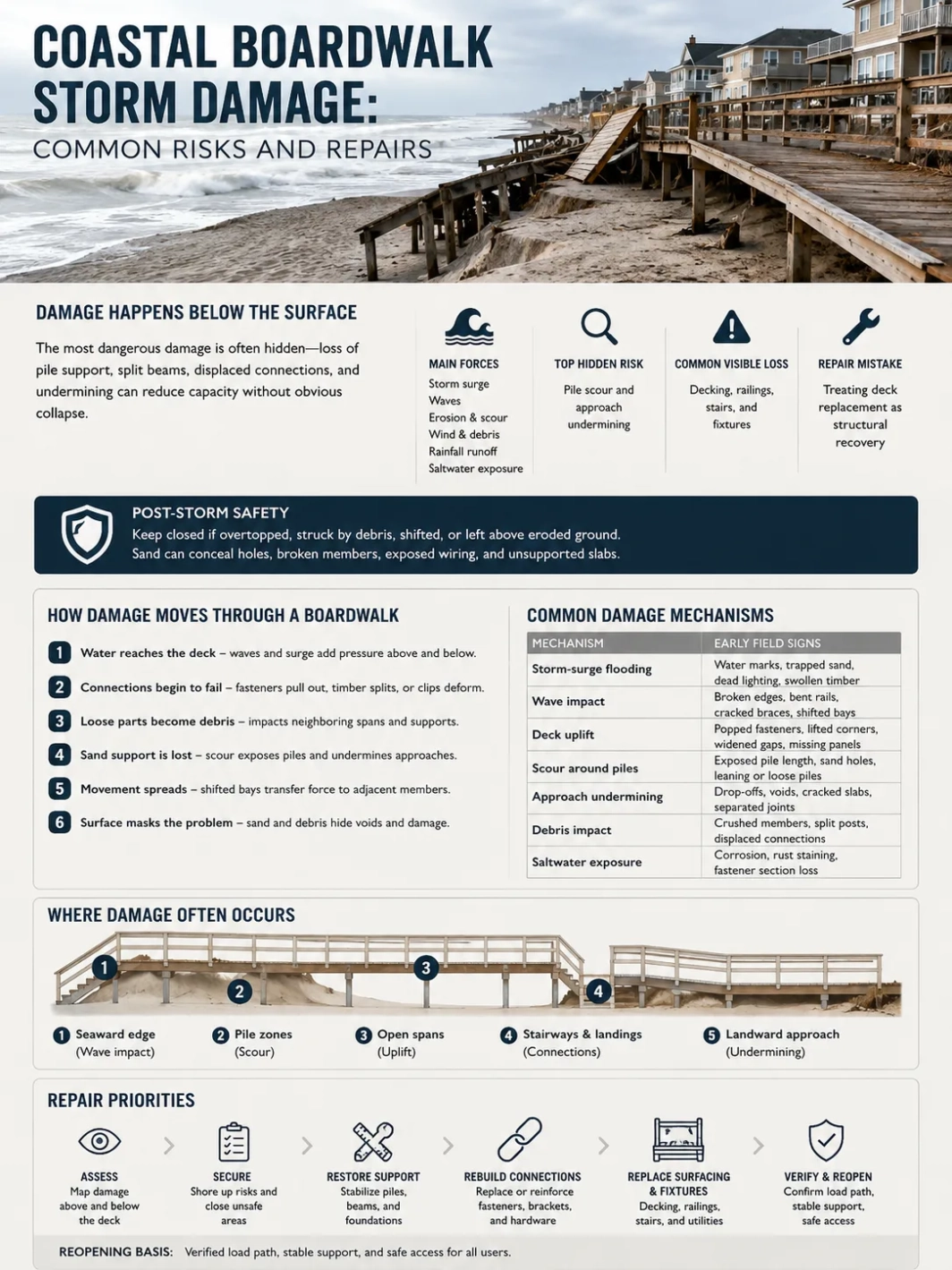
Highest hidden risk
Pile scour and approach undermining
Common visible loss
Decking, railings, stairs, and fixtures
Repair mistake
Treating deck replacement as structural recovery
Reopening basis
Verified load path, stable support, safe access
Post-storm safety: A boardwalk that was overtopped, struck by debris, shifted out of alignment, or left above newly eroded ground should remain closed until its support system and access route have been assessed. Sand can conceal holes, broken members, exposed wiring, and unsupported slabs.
How Storm Damage Moves Through a Boardwalk
A coastal storm does not apply one uniform load. Water level rises first, allowing waves to reach parts of the boardwalk that normally remain dry. Wave crests may then strike the deck edge or enter the open space below it. At the same time, fast-moving water begins carrying sand away from piles, dune crossings, drainage outlets, and the boardwalk-to-street connection.
Once a deck panel or railing section breaks free, it can become floating debris. That debris may hit another span, bend a pile, tear out a brace, or open a larger path for water. The structure can therefore damage itself as pieces detach and move through adjacent bays.
- Water reaches the deck: submerged surfaces experience buoyancy, wave impact, and pressure beneath boards or panels.
- Connections begin to fail: fasteners pull out, bolt holes enlarge, timber splits, or clips deform.
- Loose parts become debris: planks, benches, signs, stairs, and rail sections strike nearby components.
- Sand support is lost: scour exposes more pile length and undermines ramps, slabs, or retaining edges.
- Movement spreads: a shifted bay transfers force into neighboring members and utility lines.
- The surface masks the problem: debris and windblown sand cover voids, cracked members, and displaced connections.
Common Storm Damage Mechanisms and Their First Signs
| Damage mechanism | What it does | Early field signs | What the repair must address |
|---|---|---|---|
| Storm-surge flooding | Submerges decking, connections, utilities, and the landward approach | Water marks, trapped sand, dead lighting, swollen timber, displaced covers | Contamination, electrical testing, connection condition, drying, and support loss |
| Wave impact | Applies repeated horizontal and vertical force to deck edges, piles, braces, and rails | Broken outer-edge boards, bent rail posts, cracked braces, shifted bays | The complete load path from the struck member to the foundation |
| Deck uplift | Pushes boards or panels upward from below | Popped fasteners, lifted corners, widened gaps, missing panels | Joist condition, fastener withdrawal, panel spacing, and under-deck pressure paths |
| Local scour | Removes soil around individual piles, walls, or outlet structures | New holes, exposed pile length, leaning posts, abrupt settlement | Remaining embedment, pile condition, and a site-designed scour response |
| Shoreline erosion | Moves the broader beach, dune, bluff, or fill line landward | Lost dune toe, retreat near access stairs, unsupported approaches | Alignment, elevation, shoreline work, and the future position of the access route |
| Wind loading | Pushes against rails, signs, lighting, shelters, and closed vertical surfaces | Loose posts, rotated fixtures, torn signs, cracked anchors | Anchorage, exposed surface area, member capacity, and removable storm items |
| Floating debris | Creates concentrated impact loads that may exceed normal wave pressure at one point | Gouges, broken pile faces, localized frame distortion, missing cross-bracing | Impact-damaged members and the neighboring connections that absorbed the force |
| Runoff and drainage failure | Washes out fill from the land side or traps water behind walls and slabs | Sinkholes, pavement cracks, hollow areas, sediment at outfalls | Drainage route, backfill support, outlet protection, and transition details |
Storm Surge, Wave Impact, and Deck Uplift
Storm surge raises the starting level from which waves act. A boardwalk that normally sits well above routine tides may become partly submerged during a coastal storm. Once water reaches the underside of the deck, the structure is exposed to loads that do not occur during normal public use.
Deck uplift begins below the surface. Water moving into a narrow space beneath tightly laid boards or solid panels can create upward pressure. Repeated wave pulses then work fasteners back and forth. A screw may remain in place while its hole enlarges, a clip may bend without breaking, or a joist may split along the fastener line. Reattaching the same panel without inspecting those conditions can produce a weak repair.
The outer edge usually receives the first direct wave impact, but damage may also develop where the deck changes elevation, crosses a seawall, meets a building platform, or narrows around a stair opening. These transitions interrupt the regular structural layout and can concentrate force in a small group of members.
Repair check: Missing decking should trigger inspection of joists, blocking, edge beams, clips, bolts, and adjacent panels. The board itself may be the least costly part of the failed connection.
Scour and Erosion Below the Walking Surface
Scour and shoreline erosion are related but not interchangeable. Scour is concentrated soil loss around a pile, wall, footing, or drainage outlet where flowing water becomes more turbulent. Shoreline erosion is the wider retreat or lowering of the beach, dune, bluff, or placed fill supporting the boardwalk corridor.
A pile-supported boardwalk can appear level even after sand has been removed from around several piles. The exposed piles may still carry the deck during calm weather, yet the loss of lateral support and effective embedment can make the same section more vulnerable to the next wave event. The depth of the visible hole is not always the full depth of disturbed soil.
Landward approaches fail differently. Water flowing back toward the ocean can remove fill beneath concrete aprons, ramps, pavers, and street connections. The top surface may bridge over the empty space for a time, creating a concealed collapse hazard. Hollow sounds, edge cracking, new settlement, and sand emerging from joints are warning signs.
Field Signs That Point to Foundation Loss
- More pile length is visible than before the storm.
- A railing line rises and falls where it was previously straight.
- One span moves noticeably under foot while adjacent spans remain firm.
- A ramp has separated from the main deck or from the paved approach.
- New channels have formed beside stairs, dune walkovers, or outfalls.
- Concrete edges sound hollow or show unsupported corners.
- Piles lean in a common direction, suggesting current or debris loading.
Scour countermeasures are not routine landscaping. Stone, mats, geotextile systems, pile changes, or altered drainage can redirect flow toward another support or neighboring property. The response must match local soil, wave exposure, water depth, environmental limits, and the boardwalk foundation.
Wind, Debris, and Damage Above the Deck
Wind damage often concentrates in features that present a broad surface: solid rail infill, signs, privacy screens, kiosks, shade structures, light poles, and building attachments. Even when the main deck remains stable, a failed railing or lighting system can keep the boardwalk closed.
Benches, waste containers, temporary barriers, planters, and maintenance equipment also matter. Items that are neither removed before a storm nor designed for dependable anchorage may become projectiles. Detached boardwalk parts can produce the same problem; one lifted plank can strike a railing or pile several bays away.
Debris impact is usually localized, but the damaged area should not be assessed in isolation. A struck pile may transfer force into its cap, beam seat, bolts, and cross-bracing. A bent rail post may indicate movement in the deck edge rather than a railing-only repair.
Where Storm Damage Concentrates on a Boardwalk
| Boardwalk zone | Typical exposure | Frequent repair issue |
|---|---|---|
| Seaward edge | Direct wave impact, uplift, wind-driven spray, debris | Deck-edge beams, fascia, rails, and panel anchorage |
| Pile-supported main span | Scour, pile bending, brace loss, repeated wave force | Pile embedment, beam seats, cross-bracing, and alignment |
| Landward approach | Backflow, runoff, fill washout, trapped water | Hidden voids, ramp settlement, pavement separation, drainage |
| Beach stairs and dune crossings | Lower elevation, shifting sand, direct overwash | Lost lower flights, exposed supports, changed slopes |
| Outfall crossing | Combined ocean flow and inland drainage | Local scour, undermined headwalls, displaced channel alignment |
| Seawall or building connection | Different movement between rigid and flexible structures | Cracked joints, pulled anchors, step changes, water entry |
The boardwalk type also changes the failure pattern. A low timber walkway is more exposed to direct inundation and sand burial. A raised pile-supported boardwalk is more dependent on pile condition and bracing. A concrete promenade may keep its surface while losing soil beneath a slab. Composite decking can resist decay yet still detach when fasteners, clips, or the supporting timber fail.
Post-Storm Inspection Before Reopening
Debris clearance and structural clearance are separate tasks. Removing sand and broken boards may improve visibility, but it does not show that the structure can carry pedestrians, maintenance vehicles, emergency loads, or crowds.
Initial Site Control
- Close approaches that lead users toward missing decking, unstable rails, exposed wiring, or unsupported ground.
- Isolate utilities before touching submerged or damaged electrical equipment.
- Mark concealed drop-offs, scour holes, and pavement voids before moving loose sand.
- Secure or remove members that may fall, rotate, or detach during cleanup.
- Record the condition before debris removal changes the evidence.
Geometry and Structural Survey
The inspection should compare deck elevations, pile alignment, rail lines, joint widths, and approach slopes with pre-storm drawings, photographs, or survey points when available. Small changes across several bays may reveal movement that is difficult to see from one standing position.
Piles, caps, beams, joists, braces, bolts, clips, welds, and concrete interfaces should be traced as one load path. Underwater or below-deck areas may require trained dive crews, remote cameras, sounding, probing, or survey equipment. Inspection methods depend on water conditions, structure type, and access.
When Partial Reopening May Be Possible
A partial opening may be reasonable when the damaged segment can be physically and structurally isolated, the remaining route has verified support, and users have a safe way to enter, turn around, and leave. A temporary barrier alone is not enough when the open portion still transfers load into the damaged span.
- The open section has an intact deck, rail system, and foundation.
- The closure point cannot be bypassed from the beach or adjacent property.
- The accessible route remains usable or a clearly managed alternative is provided.
- Emergency access and evacuation do not depend on the damaged section.
- Lighting, edges, transitions, and temporary works have been checked.
- Future tide and wave conditions will not reach temporary barriers or exposed work.
Repair Methods by Structural Component
Decking and Panel Repairs
Deck repair begins with the supporting joists, not the replacement plank. Fastener holes may have enlarged, joist edges may have split, and hidden connectors may have deformed. Replacement boards or panels should match the structural spacing, attachment method, slip needs, thermal movement, and maintenance practice of the system.
Composite decking does not make a boardwalk storm-proof. It may reduce decay-related maintenance, but uplift still acts on its clips and screws, while the supporting frame may remain timber, steel, or concrete. Material weight and expansion also affect the repair detail.
Beams, Joists, and Bracing
Localized timber damage may be addressed through designed splices, sister members, partial replacement, new bearing details, or connection reinforcement. These repairs must restore the route by which deck loads, wave loads, and lateral movement reach the piles. Bolting a new board beside a split member is not enough when the original bearing seat or connection has moved.
Cross-bracing deserves separate attention. It may look secondary beside a large beam, yet it helps control sway and pile movement. Missing or loose braces can change how several spans behave together.
Piles and Foundation Repairs
Pile repair options may include structural jackets, splices, supplemental piles, new pile caps, localized replacement, or replacement of an entire support line. The correct choice depends on section loss, cracking, remaining embedment, soil disturbance, access for equipment, and the loads carried by the pile group.
FEMA coastal-facility guidance identifies inspection, repair, reinforcement, elevation, upgrading, and relocation as available mitigation paths for boardwalks and related public coastal structures. It also identifies splicing and reinforcing pier and pile components as possible boardwalk work. These are engineered repairs, not universal field details.
Concrete and Steel Elements
Concrete repairs may involve removal of loose material, treatment of exposed reinforcement, crack repair, patching, slab replacement, or filling verified voids beneath supported areas. Steel work may require measurement of section loss, replacement of corroded fasteners, coating repair, plating, or member replacement. Rust staining alone does not show how much capacity remains.
Utilities, Railings, and Site Fixtures
Saltwater-exposed electrical equipment should not be returned to service based only on drying. Cables, connections, enclosures, lighting, cameras, outlets, and emergency devices need qualified evaluation. Future work may place vulnerable equipment higher, reduce low-level junctions, and improve isolation between sections.
Railings, benches, signs, bins, and light poles require anchorage into members capable of receiving their loads. A railing replacement should also confirm edge condition, post spacing, openings, and continuity along repaired ramps and stairs.
Repair, Segment Replacement, or Full Reconstruction?
The visible amount of missing decking is a poor measure of project scope. A short section with widespread scour may need more work than a long section with cleanly detached surface boards. The decision depends on remaining capacity, repeat exposure, service life, access, permits, and the ability to connect new work to the old structure.
| Likely response | Conditions that may support it | Conditions that argue against it |
|---|---|---|
| Localized repair | Damage is confined, alignment is stable, piles retain support, and sound members can receive new connections | Unknown foundation condition, widespread splitting, recurring movement, or active erosion |
| Segment replacement | Several bays are damaged but adjoining sections have verified capacity and compatible geometry | The old and new sections cannot share loads safely or the shoreline has shifted beneath both |
| Full reconstruction | Multiple foundation lines have failed, deck elevation is repeatedly overtopped, or the remaining structure has limited service life | Localized damage with a well-documented, repairable load path |
| Elevation or realignment | Observed water and wave levels reach the existing deck, approaches repeatedly wash out, or shoreline retreat threatens the route | Changes would create unsafe access slopes, environmental conflicts, or new loading elsewhere without added design work |
| Relocation | The corridor sits within recurring erosion, dune migration, bluff retreat, or an unstable outlet channel | A stable site-specific protection and foundation solution can be maintained without shifting harm nearby |
Cost comparison needs matching scope. A per-foot decking estimate cannot be compared with a reconstruction estimate that includes piles, electrical work, ramps, shoreline protection, permitting, and temporary access.
Repairs That Reduce Repeat Storm Loss
Restoring the pre-storm arrangement may reproduce the same weak point. A repair project can also change how the boardwalk responds to the next event, provided each change is tested against site conditions and the complete structure.
- Raise vulnerable deck sections where wave and flood levels repeatedly reach the underside, while preserving workable access slopes and connections.
- Improve pile and beam continuity with designed splices, braces, bearing details, and connectors that can transfer lateral and uplift loads.
- Use corrosion-suitable connectors and avoid mixing metals that create accelerated deterioration in a wet salt environment.
- Reduce broad wind-catching surfaces on rail infill, signs, screens, and attachments where site and safety rules permit.
- Make vulnerable accessories removable before storms or anchor them to members designed for the resulting force.
- Keep drainage paths open so new slabs, walls, fill, or dune work do not trap runoff behind the boardwalk.
- Create inspectable details around pile heads, beam seats, utilities, and modular deck sections.
- Maintain baseline records with pile numbering, survey elevations, photographs, member sizes, repair dates, and known scour locations.
Replaceable panels can shorten future repair work, but they must remain securely attached under design loads. A panel that detaches unpredictably is debris, not a planned sacrificial element.
The Shoreline May Be Part of the Repair
A boardwalk repair can fail early when the beach, dune, bluff, drainage outlet, or retaining edge continues moving beneath it. The structure and shoreline should therefore be assessed together, especially where the storm created a new channel, removed a dune toe, lowered the beach, or exposed an older wall.
Possible companion work includes dune restoration, beach nourishment, drainage changes, outlet protection, revetment repair, wall work, or living shoreline measures on sheltered coasts. NOAA notes that living shorelines are generally suited to estuaries, bays, tributaries, and other sheltered settings rather than open-ocean beaches. Site wave energy, slope, habitat, and sediment movement determine where such methods can function.
Recent NOAA-supported dune research published in 2025 found that dunes are more likely to persist where beaches have lower wave energy and limited erosion, while narrow, high-energy beaches are more prone to long-term dune loss. That distinction matters when dune rebuilding is proposed as the only protection for a boardwalk with recurring open-ocean exposure.
Site effect matters: Hard shoreline work can alter reflection, current, and scour near the boardwalk or neighboring property. Natural and hybrid methods also have limits. No shoreline treatment should be selected from a generic detail alone.
Accessibility, Permits, and Damage Records
Accessibility Is Part of Structural Recovery
The main deck may survive while the accessible route fails. Ramp fill can wash out, running slopes can change, transitions can lift, edge protection can disappear, and the only usable beach access can become disconnected. Temporary repairs should not create narrow pinch points, abrupt level changes, unstable surfaces, or a dead-end route without a safe turnaround.
Current public boardwalk programs often package decking and piling work with new ramps and railings rather than treating access as a later cosmetic item. This approach reduces the chance that a structurally repaired boardwalk remains unusable for part of the public.
Emergency Work and Permanent Work May Follow Different Rules
Coastal permit rules vary by state, shoreline type, project footprint, funding source, and environmental setting. Some jurisdictions allow limited replacement of a legally existing boardwalk or dune walkover after an extreme weather event, while elevation changes, relocation, new shoreline armoring, in-water work, or an expanded footprint may require separate review.
Wildlife seasons, dune protection, wetlands, sediment control, historic features, public access, and equipment routes can affect the construction window. Emergency stabilization should document what is temporary and what still requires permanent design approval.
Document Damage Before It Is Removed
- Photograph each damaged bay, pile line, approach, stair, railing, and utility area.
- Record missing member dimensions and the direction in which parts moved.
- Measure scour holes, exposed pile length, settlement, and joint changes.
- Preserve pre-storm drawings, inspection reports, survey points, and maintenance records.
- Separate emergency cleanup, temporary stabilization, permanent repair, and added mitigation in the work record.
- Track labor, equipment, materials, disposal, testing, design, permit, and access costs by task.
This record supports engineering decisions, contractor scope, insurance or public assistance review, and later comparison if another storm affects the same location.
What Recent U.S. Boardwalk Programs Show
FEMA Treats Boardwalk Recovery as More Than Deck Replacement
FEMA’s public-facility coastal guidance lists a range of responses for boardwalks: monitor and inspect, repair, retrofit or reinforce, elevate, upgrade, and relocate. The range reflects a basic engineering point: the correct response depends on the remaining structure and future exposure, not only on the number of missing boards.
Rockaway Combined Boardwalk and Coastal Protection Work
After Hurricane Sandy, New York City’s Rockaway Boardwalk reconstruction paired a raised concrete boardwalk and new pile foundation with baffle-wall, dune, and sand measures. The project record described an elevation increase of up to three feet above the 100-year flood elevation. The lesson is not that every boardwalk should be concrete; it is that widespread failure may require a new elevation, foundation, material system, and shoreline response in one project.
New Jersey Bundled Decking, Piling, Safety, and Access Work
New Jersey awarded $100 million from its Boardwalk Preservation Fund to 18 municipalities in 2024. Eligible work included longer-lasting decking, deteriorated piling replacement, boardwalk infrastructure, and accessible ramps and railings. Grant funds are scheduled to be spent by the end of 2026, making these projects a current example of boardwalk renewal packages that combine structure, safety, and public access.
Common Questions About Storm-Damaged Boardwalks
Can a Boardwalk Be Unsafe When No Boards Are Missing?
Yes. Scour, split connections, pile movement, undermined approaches, damaged bracing, and saltwater-exposed electrical systems may not be visible from the deck. A standing surface is not proof of full structural capacity.
Why Do Boardwalk Planks Lift During Storm Surge?
Water and waves can reach the underside of the deck and apply upward pressure. Repeated pulses pull on fasteners and clips until a board lifts, the connection deforms, or the supporting joist splits.
Can Individual Boardwalk Piles Be Repaired?
Sometimes. Jackets, splices, supplemental piles, cap repairs, or pile replacement may be possible when the damage is localized and loads can be supported during the work. Remaining embedment and soil condition must be verified.
Is Composite Decking Better After a Coastal Storm?
Composite decking can reduce decay-related maintenance, but it does not solve pile scour, frame movement, wave uplift, or weak connections. The supporting structure and attachment system still govern storm performance.
Can an Undamaged Section Reopen Before Repairs Are Finished?
It may reopen when engineers and the managing agency confirm that the open segment is independently stable, the closure cannot be bypassed, utilities are safe, and an accessible exit or turnaround remains available.
Why Can Boardwalk Storm Repairs Take So Long?
Hidden foundation damage, marine access, surveys, utility replacement, shoreline permits, wildlife restrictions, material lead times, funding documentation, and seasonal public access can extend the work far beyond the time needed to replace surface boards.
Official Sources and Technical References
- FEMA — Hurricane and Flood Mitigation Handbook for Public Facilities, including the Coastal Facilities fact sheet and boardwalk mitigation options.
- FEMA — Coastal Construction Manual, Volume II, covering coastal loads, foundations, erosion, scour, materials, and construction practice.
- FEMA — Building Designer’s Guide to Calculating Flood Loads, including wave, debris, erosion, and scour considerations.
- NOAA Habitat Blueprint — Living Shorelines, with site-use limits and shoreline stabilization principles.
- NOAA NCCOS — 2025 Research on Dune Persistence and Flood Protection.
- New York City — Rockaway Boardwalk Reconstruction and Coastal Protection Project Record.
- New Jersey Department of Community Affairs — Boardwalk Preservation Fund Awards and Eligible Work.