Choosing between boardwalk repair and replacement begins with a question that price alone cannot answer: which existing components can still carry their intended loads for the required service period? Localized repairs are often appropriate when deterioration is confined to replaceable decking, railings, connectors, or a limited number of framing members. Replacement becomes easier to defend when decay, corrosion, settlement, storm damage, or obsolete geometry extends through several structural levels.
The choice is rarely limited to patching a few boards or demolishing the entire structure. Most projects fall somewhere between those ends, using a combination of maintenance, component replacement, sectional rehabilitation, superstructure renewal, foundation work, and full reconstruction. A useful comparison therefore examines scope, remaining service life, structural uncertainty, future exposure, access requirements, construction disruption, and life-cycle cost together.
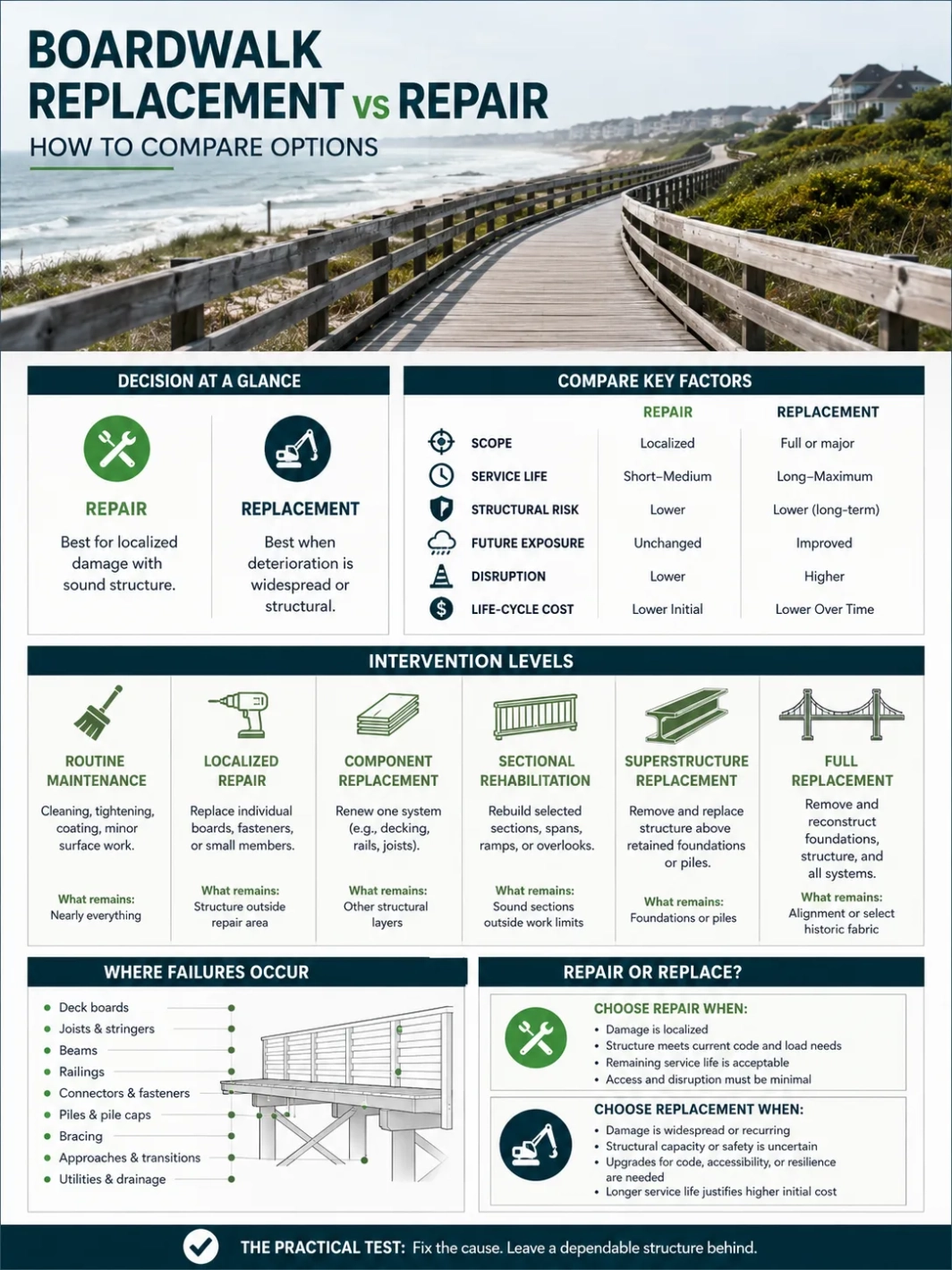
The practical test: repair is persuasive when it corrects the cause of deterioration and leaves a dependable structure behind. Replacement is persuasive when the retained structure would continue to limit safety, capacity, accessibility, resilience, or service life.
Repair, Rehabilitation, and Replacement Are Different Scopes
Project descriptions often use repair, rehabilitation, reconstruction, and replacement interchangeably. That can make cost proposals appear comparable when they include very different work. Each option should be defined by the components being retained, altered, or removed.
| Intervention | Typical Work | What Usually Remains | Primary Limitation |
|---|---|---|---|
| Routine maintenance | Fastener tightening, cleaning, coating, minor surface correction, isolated splinter removal | Nearly the entire structure | Does not restore lost structural section or correct widespread deterioration |
| Localized repair | Replacement of individual deck boards, connectors, rail sections, or a small number of framing members | Deck system, framing, piles, and geometry outside the repair area | Effective only when deterioration is truly local |
| Component replacement | Renewal of one system such as decking, railings, joists, pile caps, or lighting | Other structural layers and the existing alignment | The retained components may determine the project’s actual life |
| Sectional rehabilitation | Rebuilding selected blocks, spans, ramps, overlooks, or access points | Sound sections outside the work limits | Transitions between old and new work require careful detailing |
| Superstructure replacement | Removal of decking, joists, beams, bracing, and railings above retained foundations or piles | Verified foundations, piles, or pile caps | The retained substructure must last long enough to justify the new work |
| Full replacement | Removal and reconstruction of foundations, framing, deck, rails, ramps, utilities, and related features | Sometimes only the alignment or selected historic fabric | Higher initial cost, permitting effort, and construction disruption |
A project that replaces every deck board is not necessarily a full replacement. A project that retains old piles but renews everything above them may be more accurately described as a superstructure replacement. Clear terminology prevents a low-cost repair proposal from being compared with a replacement proposal that includes structural, drainage, accessibility, and utility improvements.
Identify Which Structural Layer Is Failing
Visible surface wear attracts attention because it affects walking comfort and appearance. It is not always the condition that controls the repair decision. The load path may include decking, joists, beams or stringers, pile caps, bracing, piles, footings, and connections between those parts. Failure at any one level can reduce the value of work performed above it.
| Boardwalk Component | Common Deterioration | Why It Matters |
|---|---|---|
| Deck boards | Splitting, checking, decay, wear, warping, loose fasteners, excessive gaps | Can create trip, wheel, cane, and slip hazards even when the framing remains sound |
| Joists and stringers | End decay, moisture traps, notching damage, splits, connector failure | Support the walking surface and can lose capacity before damage becomes obvious from above |
| Pile caps and beams | Decay at bearing points, crushing, splitting, corroded bolts, movement at joints | Distribute loads between the superstructure and piles |
| Timber piles | Internal decay, marine-borer damage, abrasion, section loss, splitting, impact damage | May be difficult to inspect and expensive to replace after a new deck is installed |
| Steel piles and connectors | Corrosion, coating loss, section loss, pack rust, galvanic interaction | Hidden corrosion can weaken connections and supports in splash or saltwater zones |
| Concrete supports | Cracking, spalling, exposed reinforcement, abrasion, settlement | Repair scope depends on whether damage is superficial or linked to reinforcement and foundation movement |
| Bracing | Loose bolts, broken members, corrosion, storm or debris impact | Controls lateral movement and helps the structure resist wind, water, and crowd-induced forces |
| Railings and edge protection | Loose posts, failed anchors, rot, corrosion, noncompliant openings | Rail failure may originate in the supporting edge beam rather than in the visible rail alone |
| Ramps and landings | Settlement, excessive slope, cross-slope changes, abrupt transitions | Can make an otherwise usable boardwalk difficult or unsafe to access |
| Utilities | Water intrusion, corroded conduit, damaged lighting, unsupported lines | Replacement may require opening deck areas that appear structurally serviceable |
A deteriorated surface does not prove that the substructure has failed. The reverse is also true: recently installed boards can conceal old joists, corroded connectors, or piles with reduced cross-sections.
Separate Surface Defects from Structural Deterioration
Isolated splinters, worn coatings, several loose boards, or a damaged rail panel may support a narrow repair scope. Repeated board breakage, unusual vibration, sagging spans, shifting rail posts, misaligned joints, or differential settlement point toward a condition below the walking surface.
- Soft joist ends: moisture often collects near bearings, bolts, deck penetrations, and end grain.
- Recurring fastener loosening: the problem may be member movement, decayed wood, oversized holes, or an unsuitable connection detail.
- Localized deck failure in repeating patterns: deterioration may follow joist lines, drainage paths, shaded zones, or salt-spray exposure.
- Movement across several spans: bracing, pile alignment, connections, or foundation conditions may be involved.
- Changes after a storm: displacement, uplift, scour, debris impact, and concealed pile damage require more than a surface walk-through.
Base the Decision on Measured Condition
A single rating such as “poor condition” does not show where deterioration is located or how it affects capacity. The investigation should document the condition of individual elements or repeatable groups of elements. Each recorded defect should identify its location, extent, likely cause, previous repair history, and effect on the proposed work.
Map Damage by Component and Span
A condition map is more useful than a percentage alone. Replacing 20 percent of the deck boards is a different problem from losing 20 percent of the pile cross-section. The map should distinguish visible defects from conditions confirmed through testing.
| Recorded Field | Purpose |
|---|---|
| Element and location | Connects the defect to a particular span, support line, ramp, edge, or access point |
| Material and member size | Supports structural calculations and replacement quantities |
| Defect type | Separates decay, corrosion, splitting, abrasion, impact, settlement, and wear |
| Measured extent | Shows section loss, depth, length, affected area, or movement |
| Likely moisture or exposure source | Helps determine whether a repair will stop recurrence |
| Previous repair | Shows whether the location has a repeating failure pattern |
| Immediate action | Identifies closures, shoring, load limits, rail isolation, or temporary surfacing needs |
| Recommended treatment | Links the field finding to maintenance, repair, rehabilitation, or replacement |
Check for Internal Timber Decay
Visual inspection remains useful for locating open cracks, fungal growth, impact damage, loose connections, staining, and soft areas. It cannot reliably quantify every internal void. Timber can retain a sound-looking outer shell while decay develops within the member.
Probing, sounding, moisture measurements, coring, and resistance microdrilling can provide additional evidence. Federal Highway Administration material describes resistance microdrilling as a method for locating and measuring low-density areas within wood. The result is a resistance profile through the member rather than a judgment based only on surface appearance.
For piles in water, inspection may also require representative diameter or perimeter measurements. Abrasion, decay, and marine-borer attack can reduce the pile section without producing a clear defect visible from the deck. The test locations still need professional selection because localized readings do not automatically describe every member.
Structural decisions require qualified evaluation. Loose boards and damaged rail panels may be suitable for maintenance staff to record, but remaining capacity, pile condition, load restrictions, shoring, and reuse of structural members should be determined by professionals familiar with the structure and its exposure.
When Repair Is a Defensible Long-Term Choice
Repair is not merely the option with the smallest construction contract. It should leave the boardwalk with a defined period of dependable service and a maintenance burden that the owner can support.
- Deterioration is confined to identifiable boards, connectors, rail sections, joists, caps, or limited spans.
- The primary load path remains sound or can be restored without extensive concealed work.
- Piles, footings, or other retained supports have enough verified life for the repaired superstructure.
- The cause of failure can be corrected through drainage changes, improved detailing, better fasteners, ventilation, coating, or material selection.
- New members can be connected without weakening or overstressing the retained structure.
- The existing width, elevation, slope, alignment, and access arrangement still suit the boardwalk’s use.
- Repair does not preserve an obsolete detail that has already produced repeated failures.
- Future inspection and replacement access remain practical.
- Construction can be limited to a manageable area without transferring loads unpredictably into adjacent spans.
A localized repair should address why the component failed. Replacing a decayed board while leaving trapped water, exposed end grain, a leaking utility penetration, or an unsuitable metal connector in place only resets the visible symptom.
When Replacement Becomes Easier to Defend
Replacement is usually considered when the structure no longer offers a reliable platform for further investment. The deciding condition may be widespread deterioration, but geometry, access, coastal exposure, maintenance history, and operational demands can carry equal weight.
- Decay, corrosion, or damage appears across several spans and more than one structural layer.
- Piles or foundations cannot be verified, or their remaining life is shorter than the proposed new superstructure.
- Repeated repairs have created a patchwork of member sizes, connector types, and material ages.
- Repair requires removal of so much surrounding work that the retained portion offers little economic benefit.
- The existing structure cannot reasonably accommodate required width, load, guard, ramp, or circulation changes.
- Storm surge, waves, debris, scour, erosion, or changing shoreline conditions exceed the assumptions behind the existing configuration.
- The boardwalk must support new emergency, service, crowd, maintenance, or mobility demands.
- Hidden-condition allowances make the repair budget nearly as uncertain as replacement.
- Continuing repair would require frequent closures during the boardwalk’s busiest operating periods.
Replacement does not always mean rebuilding the same structure in the same position. A defensible replacement study may evaluate a new elevation, revised pile spacing, shorter unsupported spans, altered access points, improved drainage, removable storm-exposed sections, a shifted alignment, or a different division between fixed and replaceable components.
Do Not Let One Cost Percentage Decide the Project
A statement such as “repair once the cost is below 50 percent of replacement” may be useful as an internal screening threshold, but it is not a universal engineering rule. The same repair-to-replacement ratio can describe very different outcomes.
| Cost Situation | What Changes the Decision |
|---|---|
| Low-cost repair with a short extension | A modest contract may still be poor value if major work returns within a few years |
| Higher-cost rehabilitation with a long extension | Retaining foundations may be worthwhile when their capacity and remaining life are verified |
| Repair with repeated seasonal closures | Business access, public use, staff time, and temporary routing can outweigh the construction saving |
| Replacement with major permitting impacts | Habitat limits, in-water work, staging, and disposal may make a narrower rehabilitation scope preferable |
| Repair with uncertain piles | A low bid does not remove the risk of installing new work over supports that may soon require replacement |
| Replacement that corrects several deficiencies | One project may address structure, access, railings, drainage, utilities, lighting, and storm exposure together |
The more useful comparison is cost per dependable service year, adjusted for inspection, maintenance, operational disruption, risk, and the next major intervention.
Compare the Life of Retained and New Components
A repair estimate should state the expected service extension, not simply the number of boards or joists being replaced. A replacement estimate should identify whether its stated design period applies to the complete structure or only to new materials.
The shortest-lived load-bearing component often governs the practical project life. New decking may have a long expected material life, yet its value is limited if old joists, pile caps, or piles are expected to need major work much sooner.
Service-life mismatch example: installing a new deck expected to remain usable for several decades does not create a multi-decade project when the retained supports have only a limited and uncertain remaining period. The comparison should use the life of the assembled system, not the longest product warranty.
Service-Life Figures That Each Option Should State
- Expected remaining life with no work beyond routine maintenance
- Expected extension after localized repairs
- Expected life after sectional rehabilitation
- Expected life of a new superstructure over retained foundations
- Expected life of full replacement
- The component expected to control the next major intervention
- The inspection interval needed to support the estimate
- The assumptions that would shorten the estimate, such as storm damage, marine borers, drainage failure, or abnormal loading
Service-life estimates should be presented as planning assumptions rather than guarantees. Exposure, workmanship, maintenance, material variability, user loading, and severe weather can alter performance.
Build a Life-Cycle Cost Comparison
Initial construction cost is only one part of the financial comparison. National Park Service facility policy calls for economic analysis over a facility’s useful life and includes installation, operation, maintenance, environmental effects, and eventual disposal or deconstruction. That same approach is useful for municipal, park, waterfront, and trail boardwalk decisions.
| Cost Category | Items to Include |
|---|---|
| Investigation and design | Survey, structural assessment, underwater inspection, testing, engineering, accessibility review, environmental review |
| Construction | Demolition, materials, labor, equipment, temporary works, marine access, utilities, drainage, railings, ramps, lighting |
| Site access and staging | Barges, cranes, temporary platforms, restricted work areas, traffic control, pedestrian detours |
| Permits and compliance | Applications, surveys, monitoring, mitigation, agency coordination, restricted work periods |
| Contingency | Concealed decay, unrecorded repairs, unsuitable soils, damaged utilities, pile conditions, material escalation |
| Routine maintenance | Cleaning, coating, fastener work, board replacement, vegetation control, slip treatment, inspection |
| Event-driven work | Storm inspection, debris removal, emergency shoring, temporary closure, post-flood repair |
| Operational effects | Business access, visitor rerouting, event relocation, staff time, lost use, temporary facilities |
| Future capital work | Next deck cycle, pile repair, rail renewal, ramp correction, utility replacement, full reconstruction |
| End-of-life work | Demolition, transport, disposal, recycling, removal of treated materials, habitat restoration |
Use the Same Study Period for Every Option
A ten-year repair option and a forty-year replacement option cannot be compared fairly by placing their current bids side by side. Costs should be evaluated over the same study period, with future maintenance and renewal work assigned to the year in which it is expected to occur.
One option may have the lowest first cost while another has the lowest cost per service year. A third option may cost more but reduce closure risk, improve access, and remove structural uncertainty. Those differences should remain visible rather than being hidden within one total score.
Compare Construction Closure and Repeated Disruption
Repair is often assumed to cause less disruption because each work area is smaller. That may be true for one isolated project. It may not be true when repairs return every season, require repeated mobilization, or move from span to span as new defects appear.
- Full closure period: the number of consecutive days or months when no through-route is available
- Partial closure period: whether one side, one access point, or one block can remain open
- Seasonal timing: whether work can fit within weather, tourism, habitat, or permitting windows
- Temporary route quality: width, surface, slope, lighting, safety, and accessibility of the detour
- Business and property access: delivery, emergency, employee, tenant, and customer routes
- Marine staging: barge access, tide limits, navigation restrictions, and weather downtime
- Repeat mobilization: the cost and disruption of returning for later phases
- Emergency response: whether fire, medical, maintenance, or evacuation access must remain available
A full replacement may create a longer single closure but provide a more predictable reopening date. Phased rehabilitation may preserve access but extend noise, fencing, temporary transitions, and contractor presence across several seasons.
Test Coastal Boardwalks Against Future Exposure
Returning a storm-damaged boardwalk to its former condition may restore public access without reducing the cause of the loss. Coastal comparisons should examine the forces acting on the structure and the shoreline, not only the members that broke.
| Exposure | Repair Question | Replacement Opportunity |
|---|---|---|
| Storm surge and flooding | Can the retained elevation and connections tolerate expected inundation? | Revise deck elevation, detailing, drainage, and load transfer where permitted |
| Wave action | Will repaired members recreate the same vulnerable profile? | Modify spans, bracing, elevation, or alignment based on site-specific analysis |
| Debris impact | Can damaged members be strengthened without transferring force into weaker supports? | Provide a more coherent lateral system and replace weak connection lines |
| Scour | Are retained piles adequately embedded after erosion around supports? | Redesign foundations or relocate the most exposed support lines |
| Salt exposure | Will new connectors remain compatible with existing metals and treated wood? | Select a coordinated material and coating system |
| Shoreline movement | Does the repaired land connection remain in a stable position? | Adjust access points, transitions, elevation, or alignment |
| Uplift and loss of decking | Should boards, fasteners, or selected panels be strengthened or designed for controlled replacement? | Separate sacrificial or replaceable elements from the main structural system |
Federal Emergency Management Agency coastal-facility material addresses flood, wind, wave, debris, scour, corrosion, and deck elevation considerations for piers, docks, wharves, and boardwalks. The exact design response depends on local flood data, building requirements, environmental limits, shoreline processes, and the boardwalk’s function.
Resilience is not the same as adding stronger boards. A stronger deck attached to weak piles or poorly detailed connections can move failure elsewhere in the structure.
Accessibility Can Change the Appropriate Scope
A repair proposal may restore damaged components while leaving narrow routes, abrupt transitions, excessive slopes, unstable surfaces, or inaccessible viewing points unchanged. Replacement may create room to correct those conditions, but the applicable requirements depend on the facility and jurisdiction.
A beachfront promenade, dune walkover, wetland trail, fishing platform, park circulation route, and outdoor recreation access route do not automatically fall under one identical set of technical provisions. Federal projects may be subject to Architectural Barriers Act requirements for outdoor developed areas, while municipal and other projects may also need review under the ADA, state accessibility provisions, building codes, and local standards.
| Access Feature | Repair Limitation to Check | Replacement Option to Check |
|---|---|---|
| Clear width | Existing beams, rail posts, utilities, or pinch points may restrict widening | Reconfigure framing and edge lines for continuous usable width |
| Surface openings | Replacing boards alone may not correct recurring gap or fastener patterns | Coordinate board orientation, joints, drainage, and attachment |
| Level changes | Patch transitions may continue to move as old and new sections settle differently | Rebuild transitions, landings, and support conditions together |
| Running and cross slope | Existing structural geometry may limit correction | Reset elevations and drainage while maintaining route usability |
| Passing and resting areas | Local widening may not be possible within the retained support layout | Include planned passing, turning, and resting locations |
| Viewing areas | Rail or edge geometry may obstruct the intended use | Coordinate accessible space, viewing opportunity, rails, and seating |
| Beach access connection | The repaired boardwalk may end at an inaccessible or unstable transition | Redesign the complete route from arrival point to permitted beach access |
| Construction detour | Short repair phases may repeatedly interrupt the accessible route | Provide a defined temporary route or phased access plan |
Accessibility review should occur before the scope is fixed. Treating ramps, clear width, surfaces, and viewing areas as late additions can convert a nominal repair into an unplanned reconstruction project.
Check Compatibility Between New and Retained Materials
A material with a long product life is not automatically the best repair material. Its weight, stiffness, movement, fastening method, chemical treatment, heat response, and interaction with retained members must fit the existing structure.
| Compatibility Issue | Possible Result | Comparison Question |
|---|---|---|
| Added dead load | Heavier decking or overlays place more demand on old joists, beams, caps, and piles | Was the retained structure checked for the complete installed weight? |
| Different stiffness | New rigid members may attract force or create abrupt movement at transitions | How will old and new sections share load? |
| Thermal movement | Some decking systems expand and contract differently from timber framing | Are gaps, fasteners, joints, and span limits suited to the site temperature range? |
| Metal interaction | Dissimilar metals and wet salt exposure can accelerate corrosion | Are fasteners, brackets, rails, and embedded metals part of one compatible system? |
| Treated wood chemistry | Some treatments require compatible fasteners and connectors | Do specifications match the wood treatment and exposure category? |
| Moisture trapping | Caps, overlays, and tight contact surfaces can slow drying | Does the detail shed water and permit drainage or ventilation? |
| Surface behavior | Wear, glare, heat, slipperiness, and texture may differ between sections | Will the transition remain safe and understandable to users? |
| Future removal | Permanent fastening may make later inspection or replacement difficult | Can high-wear parts be accessed without dismantling sound structure? |
Material selection should therefore follow the structural and exposure analysis. A wood-versus-composite comparison that ignores the retained supports, connector system, span arrangement, and maintenance capacity is incomplete.
Preserve Historic Character Without Hiding Structural Limits
Historic boardwalks may carry value through their alignment, width, timber rhythm, rail profile, relationship to adjacent buildings, or surviving original fabric. Repair generally retains more historic material, but replacement can reproduce the established visual character while correcting unsafe or unserviceable construction.
- Retain sound original decking or framing where its condition and treatment support continued use.
- Replace failed members in kind when material, dimensions, detailing, and exposure permit.
- Preserve visible historic features while renewing concealed load-bearing parts.
- Document member marks, board patterns, rail profiles, and construction details before removal.
- Reuse selected material only where its condition and new structural role are understood.
- Distinguish between preserving original fabric and recreating an established appearance.
Historic appearance should not be used to justify retaining members whose capacity or durability cannot be supported. Conversely, full demolition should not be treated as the default when sound fabric can be integrated into a safe, maintainable design.
Include Environmental and Permit Constraints Before Pricing
Boardwalks often cross dunes, beaches, wetlands, tidal waters, lakeshores, floodplains, or sensitive habitat. A replacement project may disturb more area at one time, while repeated repairs may create recurring access, noise, sediment, and vegetation effects.
- In-water work and pile installation or removal
- Wetland, dune, shoreline, and floodplain review
- Seasonal habitat restrictions
- Protected species surveys or monitoring
- Construction access through sensitive ground
- Barge, crane, or temporary platform needs
- Sediment disturbance and turbidity control
- Removal and disposal of treated timber
- Noise and vibration from pile work
- Temporary closure of trails, beaches, overlooks, or navigation areas
- Restoration of disturbed vegetation and ground surfaces
Repair should not automatically receive the lowest environmental-impact rating. If maintenance crews must reopen the same habitat corridor every few years, a single planned rehabilitation may result in fewer total disturbances over the study period.
How the Comparison Changes in Common Boardwalk Conditions
Isolated Decking Failure over Sound Framing
The deck contains localized decay, splits, loose fasteners, or worn areas, but measured joist, beam, connection, and support conditions remain suitable. Repair may include selected board replacement, corrected drainage, revised fasteners, edge treatment, and a targeted inspection program.
Repair is weakened when the same board pattern has failed repeatedly, joist tops are decayed, fasteners no longer hold, or changing only the surface would leave inaccessible transitions and unsafe rails.
Sound Piles with a Deteriorated Superstructure
Piles may be retained while decking, joists, beams, bracing, and rails are renewed. This can reduce demolition and foundation work, but only when the piles have enough verified capacity and remaining life for the new superstructure.
The analysis should include pile section measurements, alignment, embedment concerns, cap connections, underwater or ground-line deterioration, and the consequences of replacing a pile after the new structure is complete.
Repeated Repairs Across Several Structural Layers
A boardwalk with new deck patches over old joists, sistered beams, mixed fasteners, wrapped piles, and several rail systems may still function, yet each additional repair becomes harder to design and inspect. Sectional or full replacement may provide a clearer load path, consistent materials, predictable inspection points, and fewer concealed interfaces.
Storm-Damaged Coastal Boardwalk
Some components may appear reusable after a flood or storm while connections, piles, bracing, and landward transitions have moved or lost support. The decision should consider the pre-storm condition, the event forces, scour, debris impact, saltwater exposure, alignment changes, and whether restoring the former configuration would reproduce the same weakness.
Wetland Boardwalk with Limited Construction Access
Access restrictions can make small repairs disproportionately expensive. Hand-carried materials, narrow work platforms, seasonal habitat windows, and limits on ground disturbance may favor modular repair. The same constraints may favor one larger rehabilitation when repeated crew access would disturb the site over many years.
Busy Promenade with Business and Event Access
A high-use commercial or civic boardwalk may justify phased reconstruction, temporary parallel routes, or block-by-block work. The comparison should account for deliveries, emergency access, storefront entrances, crowd movement, public events, utilities, lighting, and reopening dates rather than relying on structural quantities alone.
Use a Weighted Decision Matrix Without Hiding Safety Issues
A matrix can organize the comparison when the scoring method and supporting evidence are visible. Structural safety, legal compliance, and confirmed capacity should be treated as pass-or-correct conditions. They should not be offset by a low price score.
| Decision Measure | Repair Tends to Score Better When | Replacement Tends to Score Better When |
|---|---|---|
| Structural condition | Damage is local and the main load path is verified | Damage is widespread, layered, or uncertain |
| Remaining service life | Retained components can serve through the target period | Old components would limit new work |
| First cost | Access is simple and concealed work is limited | Repair requires extensive dismantling, shoring, or custom transitions |
| Life-cycle cost | Future maintenance remains limited and predictable | Repeated repairs and mobilization dominate future spending |
| Cost certainty | Member condition and quantities are well documented | Repair contains high concealed-condition risk |
| Construction disruption | A short local closure restores dependable service | One planned closure avoids years of repeated work |
| Accessibility | Existing geometry can be corrected within the repair limits | Width, slope, landings, rails, or access points need broad changes |
| Coastal resilience | The existing elevation and structural arrangement remain suitable | Exposure requires a new load path, elevation, foundation, or alignment |
| Historic fabric | Sound original material can remain in service | Historic appearance can be reproduced but original material cannot safely remain |
| Environmental effects | Work is truly narrow and will not return frequently | One coordinated project reduces repeated site disturbance |
| Maintenance access | Components remain easy to inspect and replace | The old layout conceals defects or makes future work difficult |
The matrix should show the score, weight, evidence source, uncertainty, and person responsible for each judgment. A total without those details can make subjective assumptions look precise.
What a Repair-versus-Replacement Study Should Produce
A usable study must do more than label the boardwalk “repairable” or “beyond repair.” It should give the owner comparable alternatives with clear assumptions and enough documentation to plan design, funding, permits, and construction.
- Existing drawings, repair records, storm records, and available inspection history
- Surveyed alignment, elevations, slopes, transitions, and visible movement
- Element-by-element or span-by-span condition mapping
- Testing results for concealed timber, steel, concrete, and foundation conditions where needed
- Structural capacity and load-use assumptions
- Immediate safety actions, closures, shoring, or temporary restrictions
- Defined maintenance, repair, rehabilitation, superstructure replacement, and full replacement alternatives
- List of components retained under each alternative
- Expected service period and controlling component for each alternative
- Construction cost range and concealed-condition allowance
- Life-cycle maintenance, inspection, renewal, and demolition costs
- Accessibility changes and unresolved limitations
- Coastal, flood, wetland, dune, or habitat constraints
- Permit path and likely restricted work periods
- Closure, detour, staging, business-access, and emergency-access plan
- Material and connector compatibility review
- Historic-fabric treatment where applicable
- Recommended option with reasons, uncertainties, and conditions for proceeding
Make Contractor and Consultant Proposals Comparable
Proposals should use the same project limits and state what is excluded. One estimate may include piles, ramps, railings, lighting, utilities, permits, temporary access, and disposal while another includes only deck and framing work. Without a scope matrix, the lower total may simply describe less work.
| Proposal Item | Required Clarification |
|---|---|
| Inspection basis | Which members were accessible, tested, assumed sound, or excluded? |
| Demolition limits | What must be removed to reach the work, and what happens if hidden damage is found? |
| Temporary works | Are shoring, platforms, barges, fencing, and detours included? |
| Foundation work | Are pile repair, testing, replacement, and underwater work included? |
| Access improvements | Are slopes, landings, rails, clear widths, and transitions included? |
| Utilities | Who removes, protects, relocates, and reconnects lighting and services? |
| Permits | Who prepares applications, surveys, monitoring, and agency responses? |
| Closure assumptions | Does the schedule assume full closure, partial access, night work, or seasonal work? |
| Material system | Are boards, fasteners, connectors, coatings, and treatments specified as one compatible assembly? |
| Contingency | How are concealed conditions priced and authorized? |
Current Public Projects Show Why Mixed Scopes Are Common
New Jersey’s Boardwalk Preservation Fund illustrates how public boardwalk work rarely fits a simple repair-or-replacement label. The state awarded $100 million to 18 municipalities for eligible work that included construction, maintenance, reconstruction, decking replacement, deteriorated piling work, ramps, railings, access improvements, safety work, and related structures.
The awards were announced in 2024, with grant spending required by December 31, 2026. The program’s project examples show a practical pattern: one municipality may replace decking, another may address piles and structural supports, while another combines reconstruction with access and railing improvements. The appropriate unit of comparison is often a section or structural system rather than the boardwalk as one undivided asset.
Field planning lesson: a boardwalk can contain repair zones, rehabilitation zones, and replacement zones within the same project. Applying one treatment to the full length may spend money on sound sections or leave weak sections under-treated.
Questions to Resolve Before Approving Either Option
- Is deterioration limited to the walking surface, or does it extend into joists, beams, caps, bracing, piles, or foundations?
- Which retained component has the shortest expected life?
- Was hidden timber decay, underwater section loss, or corrosion investigated where exposure makes it plausible?
- Does the repair eliminate the deterioration source or only replace damaged material?
- How many times have the same spans, details, or access points been repaired?
- What dependable service extension is expected from each option?
- Can new work be connected without overloading or damaging retained components?
- Does the existing width, slope, elevation, alignment, and railing arrangement remain suitable?
- Will repair leave accessibility barriers that replacement could reasonably correct?
- Have storm surge, waves, floodwater, debris, scour, erosion, salt exposure, and shoreline movement been considered?
- What inspections and maintenance will be required during the study period?
- How much closure will occur now, and how much recurring closure is expected later?
- Are business access, emergency access, visitor detours, and temporary accessible routes included?
- What permits, habitat restrictions, disposal rules, or seasonal work windows apply?
- Are first cost, life-cycle cost, cost per service year, and uncertainty shown separately?
- Does the least expensive option remain the least expensive after maintenance, disruption, and future renewal are included?
- What conditions would cause the preferred option to change after demolition begins?
Boardwalk Repair and Replacement Questions
Can the Deck Be Replaced Without Replacing the Supports?
Yes, when joists, beams, caps, piles, connections, and foundations have been evaluated and can support the new assembly for the intended service period. The new deck’s weight, fastening system, movement, drainage, and effect on future inspection must also suit the retained structure.
How Much Damage Is Too Much for Repair?
There is no useful universal percentage. The location and structural role of the damage matter more than the number of affected pieces. A large amount of replaceable decking may still support repair, while limited deterioration in piles, primary beams, or connections may lead to a much larger intervention.
Is Phased Replacement Better Than Rebuilding the Entire Boardwalk?
Phasing can preserve access, spread funding, and focus work on the weakest sections. It can also extend disruption, create temporary transitions, raise repeated mobilization costs, and leave later phases dependent on changing prices or permits. The phase boundaries should follow structural systems and safe load paths rather than arbitrary funding limits.
Can Composite Decking Be Installed on an Older Timber Frame?
It may be possible, but product suitability alone does not establish structural suitability. Joist spacing, added weight, fastener requirements, thermal movement, drainage, ventilation, connector compatibility, and the condition of the existing frame must be checked.
How Is the Remaining Life of Timber Piles Estimated?
The evaluation may combine records, visual and underwater inspection, sounding, probing, diameter measurements, resistance drilling, coring, moisture or preservative information, exposure history, and structural analysis. The result is an engineering estimate based on sampled conditions, not an exact expiration date.
Why Do Repair Estimates Rise After Work Starts?
Decking and finish materials can conceal deteriorated framing, oversized fastener holes, old patches, utility conflicts, and damaged supports. Estimates are more reliable when investigation reaches representative concealed areas before bidding and when the contract defines how additional deterioration will be measured and priced.
Does Replacement Automatically Require the Same Accessibility Work Everywhere?
No single rule applies to every boardwalk type and jurisdiction. The facility’s function, ownership, funding, alteration scope, site conditions, and applicable federal, state, and local provisions must be reviewed. Accessibility should still be assessed early because it can alter the structural width, slope, transitions, rails, and project limits.
Official Technical Sources
- Federal Highway Administration: Underwater Bridge Inspection Reference Manual
- Federal Highway Administration: Resistance Microdrilling for Wood Condition Assessment
- Federal Emergency Management Agency: Coastal Facilities Fact Sheet
- Federal Emergency Management Agency: Coastal Structures Guidance
- U.S. Access Board: Accessibility Standards for Federal Outdoor Developed Areas
- U.S. Access Board: Outdoor Developed Areas Requirements
- National Park Service: Park Facilities and Life-Cycle Cost Policy
- New Jersey Department of Community Affairs: Boardwalk Preservation Fund Grant Awards